
Corporate Secretarial Obligations for a Foreign-Owned KK or GK in Japan: The Annual and Event-Driven Checklist


Corporate secretarial obligations for a foreign-owned Japan subsidiary are the recurring and event-driven duties that keep a kabushiki kaisha (株式会社, KK) or goudou kaisha (合同会社, GK) in good standing under the Companies Act (会社法, kaishahou), the Commercial Registration Act, and the Foreign Exchange and Foreign Trade Act (外国為替及び外国貿易法, FEFTA). They fall into two calendars. The annual calendar is fixed by the fiscal year: approving the accounts, holding or replacing the shareholders' meeting, renewing director terms, and publishing the balance sheet. The event calendar is triggered by a change the parent decides on: a new director, a new address, more or less capital, a new name or purpose, or a new fiscal year. Every registrable change must be filed with the Legal Affairs Bureau (法務局, houmukyoku) within two weeks, and a company that stops filing for twelve years is struck off. This guide gives the headquarters counsel and company secretary one checklist for both calendars, with the resolution, deadline, registration tax, and follow-on notification for each item.
Key Takeaways
- Two weeks is the deadline for almost everything. Under Companies Act Article 915, a change to any registered matter, including a director appointment, resignation, or reappointment, a head office move, a capital change, or a name change, must be registered within two weeks of taking effect. Late filing exposes the representative to a civil fine of up to ¥1 million under Article 976.
- Director terms expire even when nothing changes. A KK director's term is two years by default, extendable to ten years in the articles of a non-public company. Reappointment must be resolved and registered like any other change, and it is the item foreign-owned subsidiaries most often miss.
- A sole shareholder can skip the meeting but not the paperwork. A wholly owned KK still needs an annual shareholders' meeting, in practice within three months of the fiscal year end, but it can adopt every resolution by written consent under Article 319 and must keep the minutes-equivalent for ten years. A GK has no meeting at all.
- Registration taxes are small; the notifications behind them are the work. A director change costs ¥10,000 for a company with capital of ¥100 million or less, a head office move ¥30,000 per registry, a capital increase 0.7% of the increase. Each then triggers tax office, pension office, labor office, bank, and sometimes FEFTA notifications on their own clocks, some as short as five days.
- Silence is fatal after twelve years. The Ministry of Justice sweeps the register every year. A KK with no registration entry for twelve years receives a notice and, absent a filing within two months, is deemed dissolved. The 2025 sweep gave a deadline of 10 December 2025 for a dissolution date of 11 December 2025.
The Two Calendars a Foreign-Owned Subsidiary Runs On
A subsidiary's secretarial work splits into an annual cycle fixed by the fiscal year and an event cycle triggered by headquarters decisions. The annual cycle is predictable and can be delegated to a provider on a standing calendar. The event cycle is where foreign-owned subsidiaries fall behind, because the trigger is a parent decision made abroad, often without anyone noting that it changes a registered matter in Japan.
The distinction matters because the penalties attach to the registration, not to the decision. A parent that replaces its Japan representative director at a board meeting in Chicago has started a two-week clock in Tokyo. A parent that lets a director's term lapse without a reappointment resolution has a registered director whose authority has technically expired. A parent that moves the subsidiary into a new office has five days to tell the pension office. None of these is difficult, but each has to be seen coming, which is why the group's corporate secretarial function should hold the Japan register in the same tracker as every other subsidiary and route every board decision touching Japan through a single point.
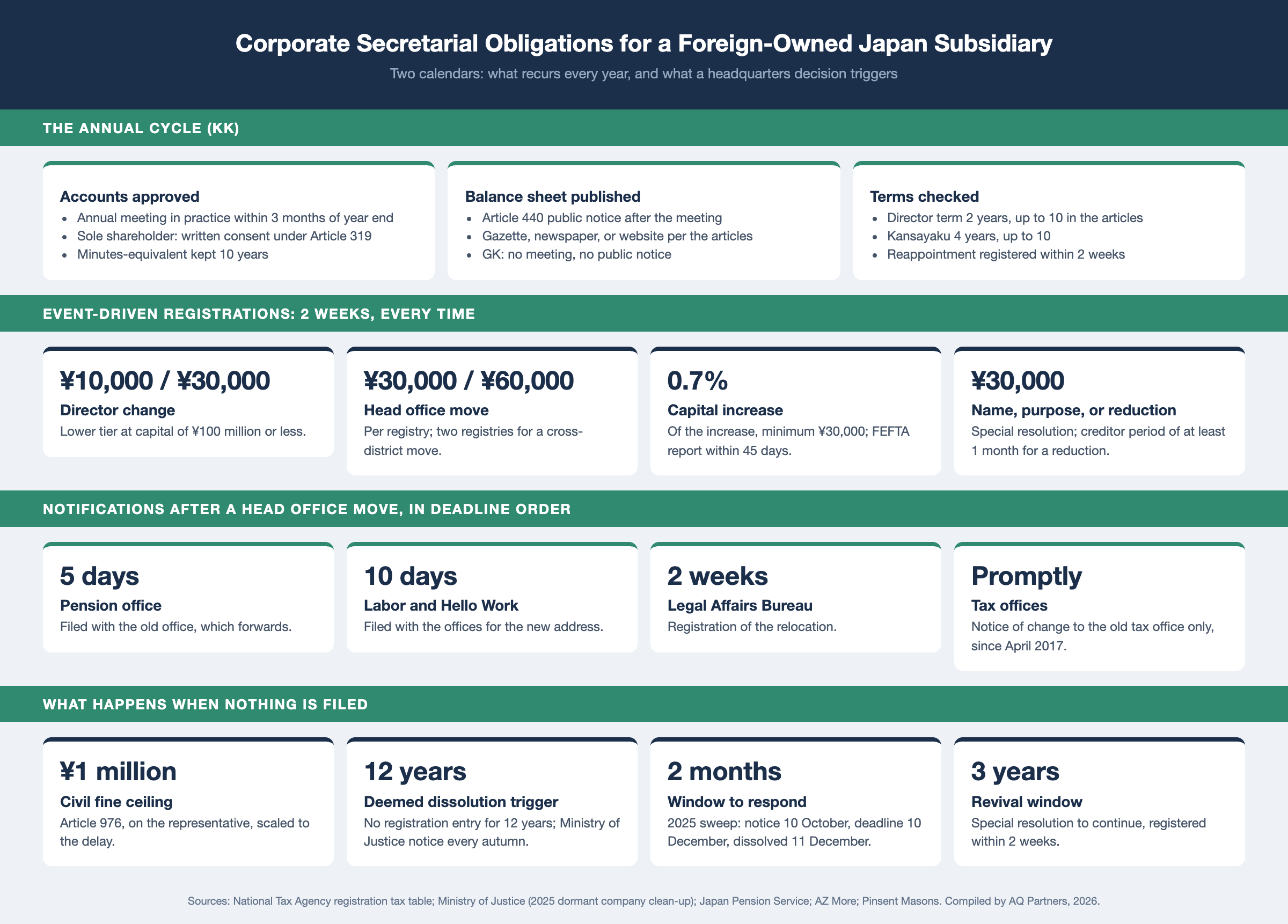
The table below is the event calendar: every registrable change a wholly owned subsidiary is likely to make, with the resolution the Companies Act requires, the registration deadline, the registration and licence tax (登録免許税, touroku menkyo zei), and the notifications that follow. Registration taxes are from the National Tax Agency's registration and licence tax table; where the summary table omits a line item, the figure follows RSM Shiodome Partners' 2024 guide to commercial registration taxes.
| Event | Resolution required | Registration deadline | Registration tax | Follow-on notifications |
|---|---|---|---|---|
| Director appointment, resignation, or reappointment (KK) | Ordinary shareholder resolution; acceptance letter from the appointee | 2 weeks from effective date | ¥10,000 if capital is ¥100 million or less; ¥30,000 above | Bank signatory mandate; tax office notice of change if the representative changes |
| Change of representative director (KK) or representative member (GK) | Board or shareholder resolution; new seal registration if the new representative will hold the seal | 2 weeks | Same as director change | Tax office, prefecture, municipality, pension office, labor office, bank, licences |
| Head office move within the same registry district | Board or sole-director decision; articles amendment if the articles name the municipality | 2 weeks | ¥30,000 | Tax office and local tax offices, pension office within 5 days, labor office within 10 days, bank, licences |
| Head office move to another registry district | Special resolution amending the articles | 2 weeks | ¥60,000 (¥30,000 at each registry) | Same, filed with the old tax office and the old pension office, which forward to the new |
| Capital increase by the parent | Shareholder resolution; subscription and payment evidence | 2 weeks from the payment date | 0.7% of the increase, minimum ¥30,000 | FEFTA post-investment report within 45 days; tax office notice if capital crosses ¥10 million or ¥100 million |
| Capital reduction | Special resolution (ordinary if reducing to cover losses at the annual meeting); creditor objection period of at least one month | 2 weeks from the effective date | ¥30,000 | Tax office notice; withholding on any deemed dividend paid to the parent |
| Change of trade name | Special resolution amending the articles | 2 weeks | ¥30,000 | Tax offices, pension and labor offices, bank, licences, contracts, seal re-registration |
| Change of business purpose | Special resolution amending the articles | 2 weeks | ¥30,000 (¥30,000 total if filed with a name change) | Licence applications where the new purpose is regulated; FEFTA review if the new purpose is a designated sector |
| Change of fiscal year | Special resolution amending the articles | Not a registered matter | None | Tax office, prefecture, and municipality notice of change; stub-period return |
| Appointment or removal of a statutory auditor (kansayaku) | Ordinary resolution; articles amendment to add or drop the office | 2 weeks | Same as director change | None beyond the register |
| Establishment of a branch office | Board or sole-director decision | 2 weeks | ¥60,000 per branch | Local tax offices for the branch location |
| Dissolution and liquidation | Special resolution; liquidator appointment | 2 weeks for dissolution and liquidator; 2 weeks after final accounts for completion | ¥30,000 dissolution; ¥9,000 liquidator; ¥2,000 completion | Tax office dissolution notice; final returns; pension and labor deregistration; FEFTA where applicable |
The Annual Cycle: Accounts, Meeting, Minutes, and Public Notice
Every KK must approve its annual accounts after each fiscal year end, and a wholly owned subsidiary can do the whole cycle on paper. The Companies Act requires an ordinary shareholders' meeting after the close of each fiscal year, and because a shareholder record date is valid for only three months, the meeting is in practice held within three months of the year end. For a subsidiary whose only shareholder is the parent, Article 319 allows every resolution to be adopted by the written consent of all shareholders in lieu of a meeting, with a minutes-equivalent document prepared and kept at the head office for ten years.
The annual cycle for a KK without a board of directors, which is the usual form for a wholly owned subsidiary, runs as follows. The directors prepare the financial statements and business report. If the company has a statutory auditor (監査役, kansayaku), the auditor reviews them. The sole shareholder approves the accounts and any dividend by written resolution. The company then publishes its balance sheet, because Article 440 requires a KK to give public notice of the balance sheet after the annual meeting, in the Official Gazette, a daily newspaper, or on its website depending on the notice method in its articles. A large company, meaning capital of ¥500 million or more or liabilities of ¥20 billion or more, publishes the profit and loss statement as well and must appoint an accounting auditor. Group subsidiaries capitalised above ¥500 million are large companies by definition, which is one more reason to keep stated capital modest and fund the rest as capital reserve or debt, as set out in the guide to funding a Japan subsidiary.
A GK has none of this. There is no shareholders' meeting, no public notice of accounts, and no director term. The members approve the financial statements in whatever way the articles provide, and the only annual corporate filing is the tax return. That difference is the governance argument for a GK covered in the guide to KK vs GK for a wholly owned subsidiary of a multinational.
The table below is the annual calendar for a subsidiary with a March fiscal year end, which is the convention in Japan, with the equivalent timing for any other year end expressed relative to the close.
| Item | Timing | KK | GK | Headquarters owner |
|---|---|---|---|---|
| Financial statements and business report prepared | Within about 6 weeks of year end | Required | Required (financial statements only) | Group controller reviews the reporting package |
| Kansayaku or accounting auditor review | Before the meeting | Only if the office exists or the company is large | Not applicable | Group audit liaison |
| Annual shareholders' meeting or written resolution | Within 3 months of year end | Required; written consent under Article 319 for a sole shareholder | Not applicable; member approval per the articles | Company secretary signs the written resolution |
| Dividend resolution | At the annual meeting or by separate resolution | Within the distributable amount | Per the articles | Group treasury and tax, with the treaty form filed before payment |
| Public notice of the balance sheet | Promptly after the annual meeting | Required under Article 440 | Not required | Provider files; company secretary confirms |
| Director and kansayaku term check | At the annual meeting | Reappoint and register within 2 weeks if a term ends | No terms | Company secretary tracks term expiry dates |
| Corporate tax and local tax returns | Within 2 months of year end, extendable by 1 month on application | Required | Required | Group tax signs |
| Minutes and register update | After the meeting; retain 10 years | Required | Member resolutions retained per the articles | Company secretary files in the group entity tracker |
Director Terms, Appointments, and the Two-Week Rule
Director terms are the item foreign-owned KKs miss most often, because nothing happens on the day a term expires and the register looks unchanged. Under Companies Act Article 332 a director's term of office is two years by default, and a non-public company, meaning one whose shares are all transfer-restricted, may extend it to ten years in its articles. A statutory auditor's term is four years under Article 336, also extendable to ten. When a term ends, the shareholder must resolve to reappoint, the director must accept, and the reappointment must be registered within two weeks, exactly as if a new person had been appointed, as explained in AZ More's summary of the rules on directors in Japan. The same source records the consequence of missing the deadline: the court may impose a civil fine of up to ¥1 million.
Three practical points follow for a group company secretary. First, write the ten-year term into the articles at incorporation; a two-year term means a reappointment resolution and a registration every second year for every director, for a subsidiary whose board never changes. Second, put the term expiry dates in the group entity tracker with the same weight as a filing deadline, because the Legal Affairs Bureau does not send reminders. Third, when the parent replaces a group executive who sits on the Japan board, treat the Chicago or London resolution as the start of the Japanese clock and have the Japan-side documents, the resignation letter, the acceptance letter, and the seal or signature certificate, ready before the parent's meeting rather than after it.
The choice of who serves, including the question of a Japan-resident director or a nominee, is covered in the guide to representative director residency and nominee directors. The mechanics of the filing itself, including the identification certificate and translation each officer must supply, are in the guide to director change registration in Japan, and the term rules in more depth in the guide to director terms of office and re-election.
Address, Name, Purpose, and Fiscal Year: Changes That Ripple Beyond the Register
A head office, name, or purpose change is one registration but a dozen notifications, and the notifications carry the shortest deadlines. The registration itself is routine: a resolution, an articles amendment where the changed item appears in the articles, and a filing within two weeks with a tax of ¥30,000 per item, or ¥60,000 for a head office move that crosses into another registry district because both the old and new bureau register it.
The follow-on notifications are where the real calendar lives. For a head office move, the pension office must receive the change of applicable establishment notification within five days of the move, filed with the pension office for the old address, which forwards it, according to the Japan Pension Service's procedure for a change of establishment address across jurisdictions. The labor insurance change notification goes to the labor standards inspection office for the new address within ten days, and the employment insurance office within the same period. The tax office receives a notice of change (異動届出書, idou todokedesho), filed with the old office promptly after the move; since April 2017 a separate filing with the new office is no longer required. The prefecture and municipality each receive their own notice. Then come the private-sector items: the bank, the lease, every licence that records an address, and every customer contract with a notice clause. The full sequence, including the cross-district trap where the old registry must be filed first, is in the guide to head office relocation in Japan.
A trade name change usually adds a new seal and its registration, and a sweep of every document that carries the name. A business purpose change adds two checks a foreign-owned subsidiary can overlook: whether the new activity needs a licence, and whether it is a designated sector under FEFTA, which would move the parent's future capital contributions from the post-report regime into prior notification. A fiscal year change is the odd one out: it is not a registered matter, so there is no Legal Affairs Bureau filing, but it requires a special resolution amending the articles, a notice of change to the tax office, prefecture, and municipality, and a stub-period return. The reasons a multinational changes the year, and the costs, are in the guide to aligning the subsidiary's fiscal year with the parent; name, purpose, and fiscal year changes are covered together in the guide to changing a company's name, purpose, or fiscal year end.
The table below lists the notifications that follow a head office move, in deadline order.
| Authority or counterparty | Filing | Deadline after the move | Where filed |
|---|---|---|---|
| Japan Pension Service | Change of applicable establishment name or address | 5 days | Pension office for the old address, which forwards |
| Labor Standards Inspection Office | Labor insurance change of name or address | 10 days | Office for the new address |
| Hello Work (employment insurance) | Employer establishment change notification | 10 days | Office for the new address |
| Legal Affairs Bureau | Head office relocation registration | 2 weeks | Old registry (which also files the new for cross-district moves) |
| Tax office | Notice of change (異動届出書) | Promptly; no fixed statutory day | Old tax office only, since April 2017 |
| Prefecture and municipality | Notice of change for local taxes | Promptly; local rules vary | Each local tax office |
| Bank | Registered address and seal certificate update | Per the bank's terms, usually promptly | Branch, with the new registry certificate |
| Licensing bodies and landlords | Licence amendment; lease and contract notices | Per each licence and contract | Each body |
Capital Changes and FEFTA: Where the Parent's Decision Is Also a Filing
A capital change is both a Companies Act procedure and, because the shareholder is foreign, an inward direct investment event under FEFTA. The two run on different clocks and are filed with different bodies, and a group treasury that funds the subsidiary by capital increase has to see both.
A capital increase by the parent needs a shareholder resolution, payment into the company's account, and registration within two weeks of the payment date at 0.7% of the increase with a minimum of ¥30,000. Crossing ¥10 million or ¥100 million of stated capital changes the company's consumption tax and corporate tax status, so the amount should be checked against those thresholds before the resolution. The parent's subscription is then an acquisition of shares by a foreign investor, which under FEFTA requires a post-investment report through the Bank of Japan within 45 days, or a prior notification with a 30-day waiting period where the subsidiary operates in a designated sector, as set out in Pinsent Masons' guide to foreign direct investment in Japan. A parent loan can be inward direct investment too, when its term exceeds one year, its balance exceeds ¥100 million, and it exceeds half of the subsidiary's liabilities.
A capital reduction is the heavier procedure. It requires a special resolution under Article 447, or an ordinary resolution where the reduction at the annual meeting does not exceed the accumulated loss, followed by a creditor protection procedure: public notice in the Official Gazette and individual notice to known creditors, with an objection period of at least one month, which in practice makes the whole procedure about two months, according to Monolith Law Office's commentary on capital reduction under Japanese corporate law. The reduction takes effect on the date set in the resolution once the creditor period has closed, and is registered within two weeks at a tax of ¥30,000. Where the reduction is paid out to the parent, part of the distribution is a deemed dividend subject to withholding. The tax side is covered in the guide to repatriating profits from Japan, and both procedures in the guide to capital increase and capital reduction in Japan. The FEFTA filings in their own right are in the guide to FEFTA inward direct investment notification.
What Happens When Nothing Is Filed: Fines and Deemed Dissolution
A subsidiary that stops filing faces a civil fine for each missed registration and, after twelve years of silence, deletion from the register. Both are automatic in the sense that no creditor or counterparty needs to complain; the Legal Affairs Bureau and the Ministry of Justice act on the register alone.
The fine comes first. Companies Act Article 976 allows the court to impose a non-criminal fine of up to ¥1 million on the representative for a registration filed late or not at all, and the Legal Affairs Bureau refers late filings to the court as a matter of course when it processes them. The amount is scaled to the delay, and a reappointment registered a year late is a common trigger for a foreign-owned company whose parent did not know the term had ended.
Deemed dissolution (みなし解散, minashi kaisan) comes after twelve years. Every autumn the Minister of Justice publishes a notice in the Official Gazette addressed to every KK with no registration entry for twelve years or more, and each registry sends a letter to the company's registered address the same day. The company then has two months to file either a pending registration, such as a director reappointment, or a statement that it has not discontinued business. If it does neither, the registrar registers the dissolution. In the 2025 sweep described on the Ministry of Justice's page on the year's dormant company clean-up, the notice was published on 10 October 2025, the response deadline was 10 December 2025, and companies that did not respond were deemed dissolved on 11 December 2025. A deemed-dissolved company can be revived by a special resolution to continue within three years, registered within two weeks, but it remains liable for the fine on the registration it missed.
The twelve-year clock is the reason a two-year director term is dangerous for a wholly owned subsidiary whose board never changes: with a ten-year term and no other events, a company can go a decade without a registration, and a single missed reappointment then carries it past the threshold. The full procedure and the revival steps are in the guide to deemed dissolution of a dormant Japan subsidiary.
Running the Register from Headquarters
The subsidiary's register belongs in the group entity tracker with the same fields as every other jurisdiction, plus three Japan-specific ones. Those are director term expiry dates, the seal custodian, and the FEFTA sector status. With those in place the two calendars above become routine, and the annual cycle can be run by a provider against a standing instruction.
Four controls cover most of the risk. First, route every parent decision that touches the Japan entity, whether an appointment, a funding tranche, an office move, or a purpose change, through one named person who checks it against the event table before it is minuted. Second, keep the articles lean: a ten-year director term, the head office stated at the municipality level so an in-city move needs no amendment, and a notice method that permits website publication of the balance sheet. Third, keep the seal and its certificate under a documented custody procedure, since almost every filing above needs it; the guide to delegation of authority and the corporate seal sets that out. Fourth, decide whether the resident director and registered address are held by an employee or by a provider, and document the handover when the country manager arrives, as covered in the guide to nominee director and registered address services.
The first-year version of this calendar, from registration day through the first annual meeting, is in the guide to the first-year headquarters calendar for a new Japan subsidiary, and the general governance framework a KK or GK operates under is in the guide to corporate governance requirements for Japan entities.
Frequently Asked Questions
Does a wholly owned Japan KK have to hold a physical annual shareholders' meeting?
No. A KK must adopt the annual resolutions after each fiscal year end, in practice within three months, but Article 319 of the Companies Act lets a sole shareholder adopt them by written consent without a meeting. The company must prepare a document equivalent to minutes and keep it at the head office for ten years, and a KK must still publish its balance sheet afterwards. A GK has no shareholders' meeting requirement at all.
What is the deadline to register a director change in Japan, and what happens if it is missed?
Two weeks from the effective date, under Companies Act Article 915. The registration tax is ¥10,000 for a company with capital of ¥100 million or less and ¥30,000 above that. A late filing can draw a civil fine of up to ¥1 million on the representative under Article 976, scaled to the delay, and a company that lets registrations lapse for twelve years is deemed dissolved.
How long can a director's term be in a foreign-owned KK?
Two years by default under Article 332. A non-public KK, which a wholly owned subsidiary always is, can extend the term to ten years in its articles of incorporation. A statutory auditor's term is four years, also extendable to ten. Every expiry requires a reappointment resolution and a registration within two weeks even when the same person continues.
Does a capital increase by the foreign parent need a FEFTA filing?
Yes. The parent's subscription for new shares is an inward direct investment. Outside designated sectors it is reported to the Bank of Japan within 45 days of the acquisition; in a designated sector it needs a prior notification and a 30-day waiting period before the shares can be issued. The Companies Act registration of the increase is a separate filing due within two weeks of payment, taxed at 0.7% of the increase with a ¥30,000 minimum.
Working with AQ Partners. Our Tokyo team provides back office operations for foreign companies operating in Japan, covering the requirements described above end to end, from annual shareholder resolutions to director change registrations and the public notice. Book a consultation to review your Japan entity's compliance calendar.

Yuga Koda is a founding Director at AQ Partners, supporting foreign companies, funds, and families operating in Japan. His experience operating companies in both Japan and international markets gives him a practical understanding of back office operations from both sides.