
Representative Director Residency and Nominee Directors: What HQ Counsel Needs to Know About Liability and Signing Authority


The representative director (代表取締役, daihyou torishimariyaku) of a Japanese kabushiki kaisha (株式会社, KK) is the officer registered at the Legal Affairs Bureau as the person who binds the company; a goudou kaisha (合同会社, GK) uses a representative member (代表社員, daihyou shain) in the same role. For a multinational's headquarters counsel the question is who should hold that role, whether the person must live in Japan, what personal liability the role carries, and whether a nominee director service is a safe bridge until a country manager is hired. This guide answers those four questions, using the 2015 residency change, the Companies Act liability articles, and a 2022 court decision on name-only directors.
Key Takeaways
- No director has to live in Japan. Since 16 March 2015 the Legal Affairs Bureaus register KKs with no Japan-resident representative director. A branch of a foreign company still needs a resident representative.
- A resident is still needed for seals and banks. Non-residents cannot register a personal seal or obtain a seal certificate, and banks, landlords, and licensing bodies expect one. This practical gap, not the law, is why groups appoint a resident director or nominee.
- A director's duties do not shrink with the role. Directors owe the company a duty of care and are liable to third parties for bad faith or gross negligence under Article 429. A Tokyo High Court decision in 2022 held a name-only director liable for a workplace death he knew nothing about.
- Indemnities and D&O cover are now statutory tools. The 2019 Companies Act amendment, in force since March 2021, lets a company sign indemnification agreements and pay D&O premiums with shareholder or board approval.
- Replacing a nominee is a two-week registration. A director change must be registered within 2 weeks, with registration tax of ¥10,000 where capital is ¥100 million or less and ¥30,000 above.
The 2015 Change and What It Did Not Change
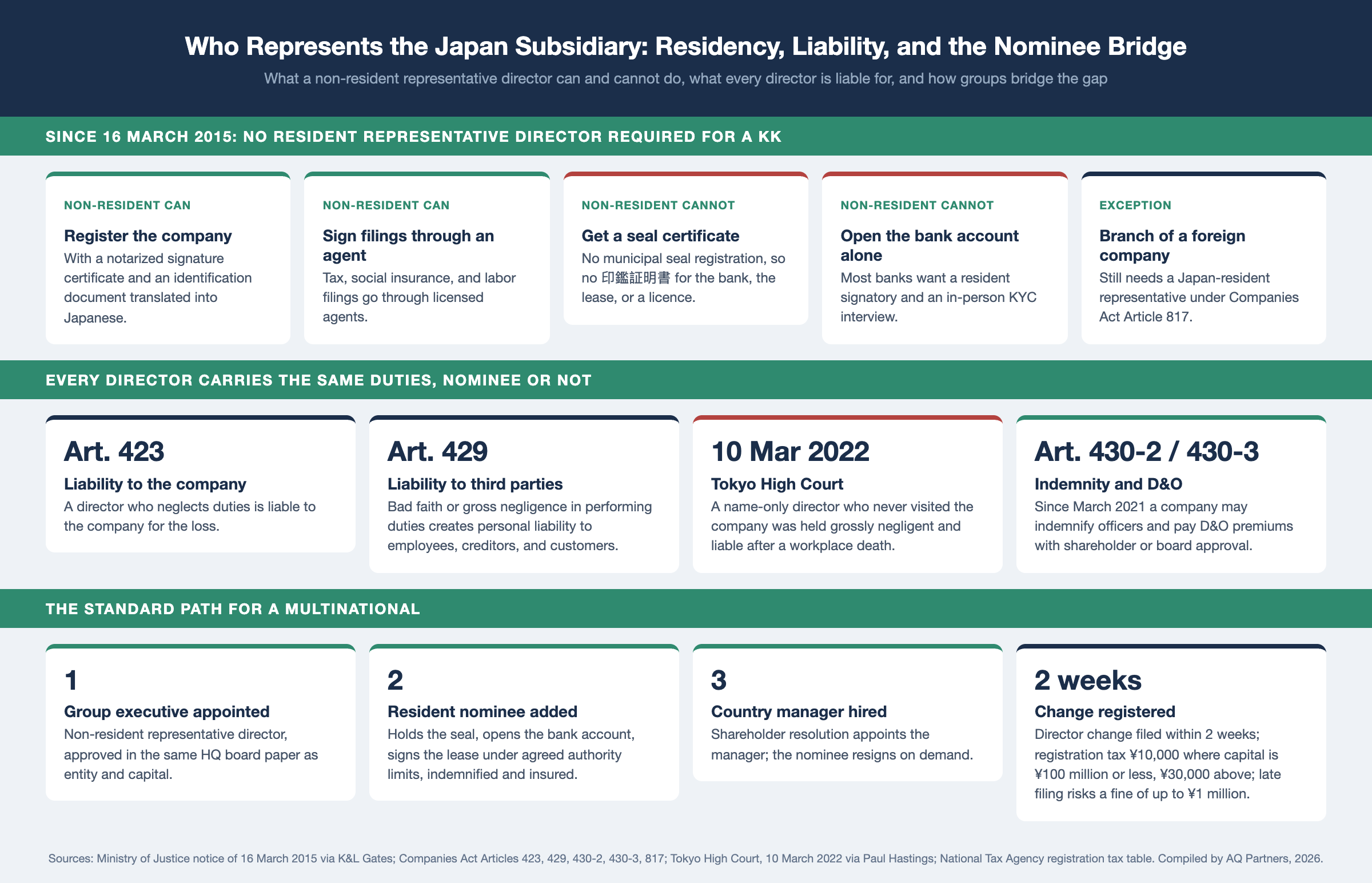
A KK can be incorporated with every director living abroad, but a Japan-resident person is still needed for the seal, the bank, and most licences. The legal requirement went; the operational one stayed.
Until 2015 the Ministry of Justice required at least one representative director of a KK to be ordinarily resident in Japan. On 16 March 2015 the Ministry issued a notice that Legal Affairs Bureaus would accept incorporation applications without a resident representative director, as recorded in K&L Gates' client alert on the change. Two consequences remain. First, the change was a policy notice, not a statute, and it never extended to branches: under Article 817 of the Companies Act a foreign company doing business through a branch must have at least one representative resident in Japan, a point JETRO repeats in its overview of forms of business presence in Japan. Second, the Bureaus began requiring an identification certificate, with a Japanese translation, for every officer, resident or not.
What a non-resident representative director cannot do is register a personal seal at a municipal office or obtain a seal certificate (印鑑証明書, inkan shoumeisho). Banks ask for that certificate at account opening, often with an in-person appearance; landlords ask for it on a lease; licensing bodies ask for it on an application. Groups solve this with a second, resident director or, before the country manager exists, a nominee.
| Action | Non-resident representative director alone | With a Japan-resident director or nominee |
|---|---|---|
| Incorporation registration | Yes, using a notarized signature certificate | Yes |
| Corporate seal registration | Yes, the company seal can be registered with the incorporation filing | Yes |
| Personal seal certificate | No | Yes |
| Corporate bank account | Difficult; most banks require a resident signatory and KYC interview | Yes, 2 to 8 weeks |
| Office lease | Usually refused without a resident signatory | Yes |
| Business licence applications | Varies; many require a resident representative | Yes |
| Signing tax and social insurance filings | Yes, through a licensed agent | Yes |
| Receiving court and tax notices | At the registered office only | In person |
| Sponsoring work visas for staff | Yes, the company sponsors, not the director | Yes |
What the Role Carries: Duties and Personal Liability
Every director owes a duty of care, is liable to the company for neglect, and is liable to third parties for bad faith or gross negligence. Title, residence, and pay do not change this.
Under Article 423 of the Companies Act a director who neglects duties is liable to the company for the resulting loss. Under Article 429 a director who acts in bad faith or with gross negligence in performing duties is liable to third parties for their loss. The second rule reaches employees, creditors, and customers. Company tax and social insurance debts do not fall on the representative director automatically, although secondary liability rules can reach officers in specific circumstances.
The 2022 decision that changed how advisers describe nominee arrangements is summarised in Paul Hastings' alert on nominal directors and personal liability. The Tokyo High Court, on 10 March 2022, held liable a director who had never visited the company, had supplied only his seal certificate for registration, and received no pay, after an employee died from work-related stress. The court held that once appointed, a director owes the full duty of a director, and that being unavailable to exercise basic care was itself gross negligence. The conclusion for any prospective appointee: agreeing to serve without a genuine intention to perform the duties is a route to personal liability, not a shield from it.
Two statutory tools reduce the exposure. Since the 2019 amendment to the Companies Act, in force from March 2021, a company may enter into an indemnification agreement with its officers under Article 430-2 and may take out and pay for directors' and officers' liability insurance under Article 430-3, each with a resolution of the shareholders' meeting or, where there is a board, of the board, as explained in Monolith Law Office's note on D&O insurance contracts after the amendment. An indemnification agreement can cover defence costs in advance; it cannot cover a director who acted to gain an improper benefit or to harm the company. The sole shareholder passes the resolution in writing, and the group's global D&O programme should confirm that the subsidiary's directors, including a nominee, are insured persons.
Nominee Director Services: What They Are and What They Are Not
A nominee director is a Japan resident appointed as a real director to hold the seal, open the bank, and sign until a permanent hire exists. The word nominee describes the commercial arrangement, not a lesser legal status.
The arrangement rests on a service agreement between the group and the provider. The terms that matter are authority, indemnity, and exit. Authority is limited by the agreement and by an internal delegation of authority, for example no borrowing, no hiring, no contracts above a stated amount without headquarters approval; the limits bind the nominee to the group but do not bind third parties, who may rely on the register. The indemnity runs from the group to the nominee and should be backed by D&O cover. The exit is a resignation letter, often signed and held at appointment, and a director change registration filed within 2 weeks. Costs are a monthly fee plus registration fees on entry and exit.
For a GK the roles differ in name. Business is executed by a managing member (業務執行社員, gyoumu shikkou shain), one of whom is the representative member. Where the managing member is a corporation, as it is for a wholly owned subsidiary, the corporation designates an individual executor of duties (職務執行者, shokumu shikkousha), who is registered and carries the same practical role as a representative director. A nominee arrangement for a GK appoints the individual as executor of duties.
| Option | Cost | Group control | Liability holder | Speed to bank and lease | Exit |
|---|---|---|---|---|---|
| Group executive as sole representative, non-resident | None beyond registration | Full | The executive personally | Slow; banks and landlords may refuse | Not applicable |
| Group executive plus a resident group employee as director | Employee's time; visa if not already resident | Full | Both directors | Fast once the employee is in Japan | Director change registration when the employee moves |
| Group executive plus a nominee director | Monthly fee, indemnity, D&O | Full, subject to the nominee's own duty of care | Both; nominee indemnified by the group | Fast, from incorporation | Resignation on demand, registration within 2 weeks |
| Resident country manager as representative director | Salary and possibly a Business Manager visa | Depends on the manager's contract | The manager personally | Fast, but only after hiring | Contractual; removal needs a shareholder resolution |
| Nominee replaced by country manager after hire | Monthly fee for the bridge period, then salary | Full throughout | Shifts to the manager on registration | Fast, no gap | Two registrations, ¥10,000 each where capital is ¥100 million or less |
| Provider-supplied executor of duties for a GK | Monthly fee | Full | The individual, indemnified | Fast | Change of executor registration |
The Standard Path for a Multinational
Most groups appoint a group executive as representative director, add a resident nominee as a bridge, and swap in the country manager once hired. One registration completes the swap.
First, headquarters approves the appointments in the same board paper as the entity and capital decisions, with the indemnification agreement and D&O confirmation attached. Second, every officer supplies a notarized signature certificate and an identification document with a Japanese translation, ordered on approval day because they gate the filing. Third, the nominee registers the company seal, opens the bank account, and signs the lease under the limits in the service agreement. Fourth, when the country manager arrives, a shareholder resolution appoints the manager and accepts the nominee's resignation, filed within 2 weeks. The registration tax is ¥10,000 per application where capital is ¥100 million or less and ¥30,000 above, according to the National Tax Agency's registration and licence tax table. A late filing exposes the representative director to a non-penal fine of up to ¥1 million.
The group approval matrix should be adopted by the subsidiary as internal policy and mirrored in the nominee's service agreement, as covered in the guide to delegation of authority in a Japan subsidiary. Entity form changes the titles and annual formalities, as set out in the guide to KK vs GK for a wholly owned subsidiary of a multinational, and the governance minimums, including when a statutory auditor is required, are in the guides to corporate governance requirements for Japan entities and the kansayaku. The bank step is covered in the guide to opening a corporate bank account in Japan, and the full setup sequence in the headquarters playbook for setting up a Japan subsidiary.
Frequently Asked Questions
Can the group's regional CFO, living in Singapore, be the sole representative director of the Japan KK?
Yes. Since March 2015 the Legal Affairs Bureaus register a KK with no resident representative director; the CFO needs a notarized signature certificate and a translated identification document. The company will still need a resident director or nominee for the seal certificate, the bank account, and the lease.
Is a nominee director really liable for what the company does?
Yes. A nominee is a director with the full duty of care, and the Tokyo High Court held in March 2022 that a name-only director who never engaged with the company was grossly negligent and liable to a third party. Providers require a group indemnity, D&O cover, authority limits, and a resignation mechanism.
Does the country manager need a special visa to become representative director?
A foreign national living in Japan needs a status of residence that permits the activity. A seconded executive typically holds intra-company transferee status; a manager hired to run the company may need Business Manager status, which since October 2025 requires capital of at least ¥30 million and one full-time employee. The company is the sponsor.
Working with AQ Partners. Our Tokyo team provides back office operations for foreign companies operating in Japan, covering the requirements described above end to end, including nominee director and registered address services, director change registrations, and bank account coordination. Book a consultation to review your Japan setup plan.

Yuga Koda is a founding Director at AQ Partners, supporting foreign companies, funds, and families operating in Japan. His experience operating companies in both Japan and international markets gives him a practical understanding of back office operations from both sides.