
Delegation of Authority in a Japan Subsidiary: Mapping the Group Approval Matrix onto Japanese Company Law and the Corporate Seal


Delegation of authority in a Japan subsidiary is the set of rules that decides who may commit the company to a contract, a payment, a hire, or a filing, and how that decision is evidenced. In most multinational groups those rules live in a delegation-of-authority matrix that is internal policy. In Japan they meet a Companies Act that gives the registered representative director statutory power to bind the company, and a commercial practice that treats the registered corporate seal (会社実印, kaisha jitsuin) and its certificate as the proof of that power. This guide is for the HQ counsel and controller who own the group matrix and need it to work in a small Tokyo office.
Key Takeaways
- The group matrix binds insiders, not outsiders. A representative director's authority covers all judicial and extra-judicial acts of the business, and internal limits on it cannot be asserted against a third party who did not know of them. It is enforced by controlling who is registered and who holds the seal.
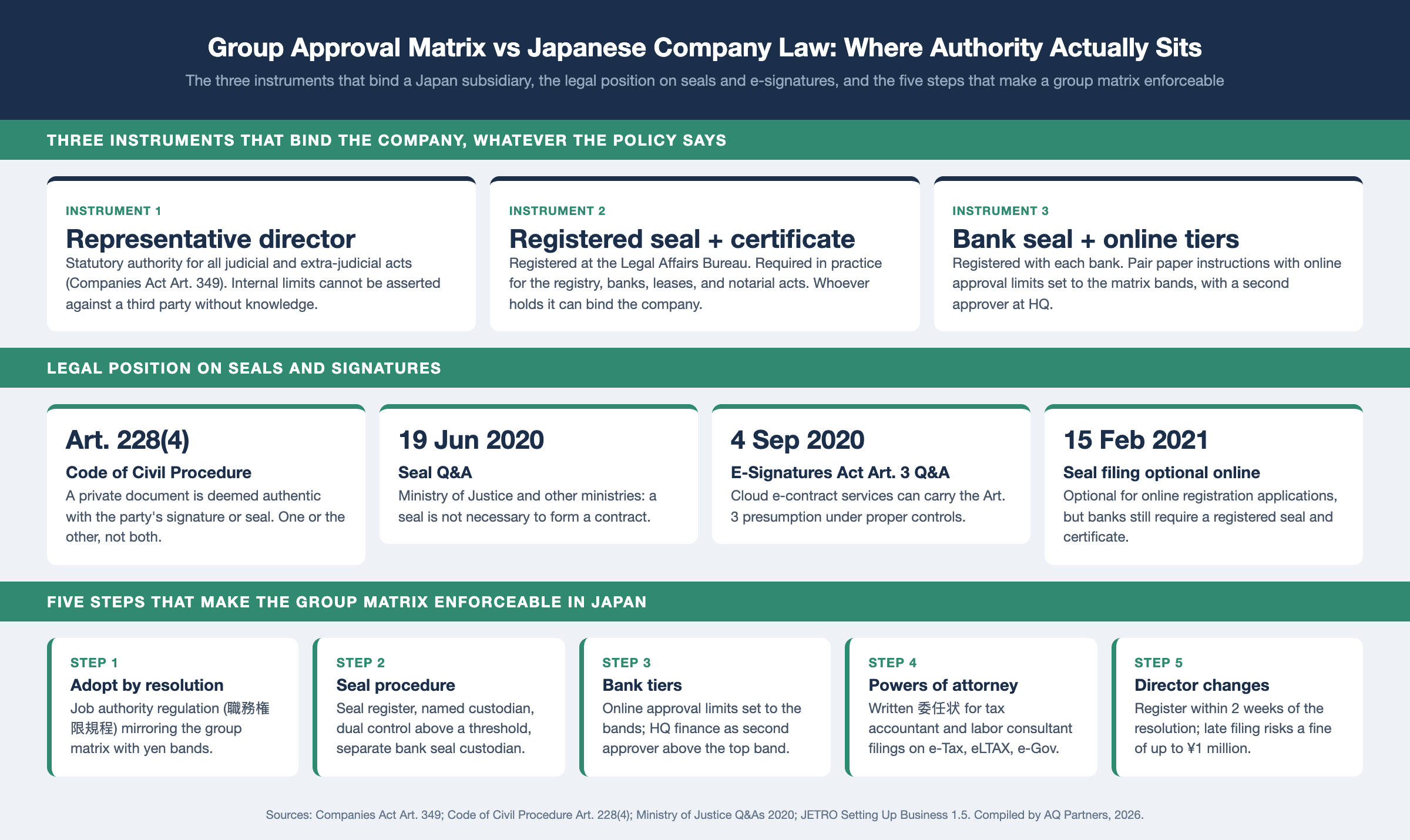
- Japan runs on three instruments. The registered representative director, the registered seal with its certificate (印鑑証明書, inkan shoumeisho), and the bank seal (銀行印, ginkouin). Whoever controls those three controls the company, whatever the policy says.
- A seal is not legally required for a contract, but it is still expected. Government Q&As in 2020 confirmed that contracts do not need a seal and that compliant e-signatures carry the same presumption. Banks, registries, leases, and many Japanese counterparties still ask for the physical seal.
- Adopt the matrix as an internal regulation of the subsidiary. A resolution adopting a job authority regulation (職務権限規程, shokumu kengen kitei) that mirrors the group matrix, plus a seal register with dual control, is what auditors ask to see.
- Registration is part of the control. Any change of director must be registered within 2 weeks, and the representative director faces a fine of up to ¥1 million for late filing, so the matrix must include who initiates that registration.
Why the Group Matrix Does Not Bind Japanese Counterparties
Japanese law makes the registered representative director's authority statutory and, toward outsiders acting in good faith, unrestricted. The matrix can limit what that person is allowed to do, but not what they are able to do.
Article 349 of the Companies Act gives the representative director authority to perform all judicial and extra-judicial acts connected with the company's business, and provides that restrictions on that authority may not be asserted against a third party who did not know of them, as explained in Law Japan's note on limiting a representative director's authority. A vendor holding a sealed contract with a current seal certificate has no duty to check the group matrix; if the director signed above their limit, the contract stands and the remedy is against the individual.
The Legal Affairs Bureau registers the representative director and the company seal together, and JETRO's guide to the certificate of registered company information and seal impression certificate notes that both certificates must ordinarily be presented for bank accounts, administrative filings, registrable assets, and important agreements. Control of the seal and its certificate is therefore the real delegation of authority. The wider seal system, including the four seal types and their registration, is covered in the guide to Japan's inkan system.
Mapping Matrix Line Items onto Japanese Instruments
Each line in a group matrix maps to a Japanese instrument that actually executes the decision, and the map is where most groups discover gaps.
| Matrix line item | Typical group approver | Japan instrument that executes it | Evidence to retain |
|---|---|---|---|
| Customer or vendor contract above threshold | Regional GM, then group legal above a higher band | Registered seal or e-signature by the representative director; kakuin on quotes and invoices | Approval form referencing the matrix band, seal register entry, executed copy |
| Hiring a permanent employee | Country manager with HR sign-off | Employment contract signed or sealed by the representative director; social insurance filings by the provider under a power of attorney | Approved headcount request, signed contract, filing receipts |
| Salary change or bonus | Country manager, HR, finance above a band | Payroll instruction to the provider; year-end adjustment forms | Approval email or system record, payroll register |
| Bank payment | Dual approval above a yen threshold | Online banking approval tiers; bank seal for paper instructions | Bank approval log, invoice, matrix band reference |
| Intercompany charge or loan | Group treasury and tax | Intercompany agreement sealed or signed by the representative director; FEFTA report where the loan qualifies | Agreement, arm's length support, Bank of Japan filing |
| Office lease | Regional GM, group real estate | Registered seal plus seal certificate; landlords rarely accept e-signature | Lease, seal certificate copy, approval form |
| Capital expenditure | Finance above a band | Purchase order sealed with kakuin or e-signed; fixed asset register entry | Approved capex request, invoice, asset register |
| Litigation or settlement | Group legal | Representative director's seal on the settlement; power of attorney to counsel | Board or sole-director resolution, power of attorney |
| Tax and social insurance filings | Controller | Power of attorney (委任状, ininjou) to the tax accountant and labor consultant; e-Tax and e-Gov credentials | Signed powers of attorney, filing receipts |
| Director appointment or resignation | Group legal, sole shareholder resolution | Shareholder written resolution, acceptance letter, registration within 2 weeks | Resolution, registration certificate showing the change |
The director row is the one HQ most often misses: a change approved in the group system but not registered leaves the registry showing the wrong officer, which affects bank signatories and every filing, as the guide to corporate governance requirements for Japan entities sets out.
Seals, Signatures, and Electronic Signatures Compared
A signature or compliant e-signature is as valid as a seal for a contract, but each carries a different presumption and control risk. The choice is practical, not legal.
According to Paul Hastings' client alert on Japan's move toward e-signatures, Article 228(4) of the Code of Civil Procedure deems a private document validly created where it bears the party's signature or seal impression, one or the other, and the government's 2020 Q&As confirmed that a seal is not necessary to form a contract and that cloud e-contract services can satisfy the Electronic Signatures Act under proper controls. The Ministry of Justice published the seal Q&A on 19 June 2020 and the Article 3 Q&A on 4 September 2020.
| Method | Legal effect | Where it is accepted in practice | Control risk |
|---|---|---|---|
| Registered seal (実印) with certificate | Presumption of authenticity; certificate proves registration | Everything, including registry, banks, leases, notarial acts | Highest: whoever holds it can bind the company |
| Bank seal (銀行印) | Contractual with the bank | Paper bank instructions, account changes | High: pair with online approval tiers |
| Square company seal (角印, kakuin) | Evidentiary only, not registered | Invoices, quotations, purchase orders | Low to medium: limit to documents below the matrix threshold |
| Handwritten signature of the representative director | Same presumption as a seal under Article 228(4) | Contracts with foreign counterparties; some domestic ones | Medium: signature certificate needed for non-residents |
| Cloud e-signature under the Electronic Signatures Act | Presumption under Article 3 where the service meets the 2020 guidance | Commercial contracts, HR documents, internal approvals | Low if user identity and audit trail are managed |
| Personal seal of a staff member (認印, mitomein) | Weak evidentiary value | Internal circulation only | Low, but never on external documents |
The practical rule is to move commercial contracts and HR documents to e-signature, keep the registered seal for the registry, banks, leases, and notarial acts, and retire the mitomein from anything external. Seal registration became optional for online incorporation applications from 15 February 2021, but no bank opens an account without a registered seal and certificate, so the option is theoretical in practice.
Implementing the Matrix Inside the Subsidiary
The matrix becomes enforceable through a resolution, a regulation, and a seal procedure, and visible to auditors through the evidence they generate. Five steps cover a subsidiary of any size.
- Adopt the matrix by resolution. The sole director or board adopts a job authority regulation that reproduces the group matrix with yen thresholds, names roles rather than individuals, and states that the representative director exercises statutory authority only within it. That is what makes an over-limit act a breach of duty rather than a policy lapse.
- Write the seal procedure. A seal register records every impression with date, document, requester, approver, and matrix band. The registered seal sits with a named custodian, typically the resident director or the provider, and use above a threshold requires two people present. The bank seal has a different custodian.
- Set the banking tiers to match. Online approval limits follow the matrix bands, with the resident director as one approver and HQ finance as the second above the top band. Paper bank-seal instructions are reserved for account changes.
- Grant the powers of attorney the provider needs. Tax filings through e-Tax and eLTAX and social insurance filings through e-Gov are made by the tax accountant and labor consultant under written powers of attorney listed in the matrix.
- Tie director changes to registration. The matrix names who initiates the Legal Affairs Bureau filing when a director is appointed or resigns, because the 2-week deadline runs from the resolution and late filing exposes the representative director to a fine of up to ¥1 million.
For internal control over financial reporting, the approval form referencing the matrix band and the seal register entry are the evidence that satisfies a SOX walkthrough. In a three-person office, segregation of duties comes from putting the second approval at HQ rather than pretending it exists locally. The bank account, and the resident signatory's role in opening it, is covered in the guide to opening a corporate bank account in Japan.
Where the Resident Director or Nominee Sits in the Matrix
The resident director or nominee holds what the group cannot hold from abroad, so the matrix gives them execution authority, not approval authority. The distinction keeps the seal usable without making its custodian a decision-maker.
A nominee director signs and seals what the matrix has approved, keeps the seal register, attends the bank, and receives official mail; the nominee does not approve spend, hire, or sign intercompany agreements, and the custody agreement should say so. Once a country manager becomes a director, the same structure applies with wider bands. The residency rules, liability, and the terms a nominee should accept are in the guide to representative director residency and nominee directors, and the recurring approvals and registrations across the first year are in the guide to the first-year headquarters calendar. The overall setup sequence, including where these resolutions fall, is in the guide to setting up a Japan subsidiary as a multinational.
Frequently Asked Questions
Can the group matrix stop the representative director from signing a contract in Japan?
Internally, yes: a contract signed above the director's band breaches the adopted regulation and is grounds for removal or a claim. Externally, no: a counterparty without knowledge of the limit can enforce the contract, because restrictions on the representative director's authority cannot be asserted against a third party without knowledge. Control of the seal and its certificate is the practical safeguard.
Can a Japan subsidiary operate entirely on e-signatures?
Contracts, HR documents, and internal approvals can. Company registration, bank account opening, real estate leases, and notarial acts still require the registered seal and its certificate in practice, so every subsidiary keeps one registered seal under controlled custody.
Who should hold the registered seal when the representative director lives abroad?
A resident director, or a nominee or provider under a written custody agreement, holds the seal and keeps the register. The agreement gives execution authority for approved documents only, requires two people above a threshold, and names the HQ approver whose sign-off must exist before any impression.
Working with AQ Partners. Our Tokyo team provides back office operations for foreign companies operating in Japan, covering the requirements described above end to end, including nominee director and seal custody, powers of attorney for tax and social insurance filings, and director change registrations. Book a consultation to review your Japan setup plan.

Yuga Koda is a founding Director at AQ Partners, supporting foreign companies, funds, and families operating in Japan. His experience operating companies in both Japan and international markets gives him a practical understanding of back office operations from both sides.