
Setting Up a Japan Subsidiary: The Headquarters Playbook for Multinational Companies

Setting up a Japan subsidiary, for a multinational company, means incorporating a wholly owned kabushiki kaisha (株式会社, KK) or goudou kaisha (合同会社, GK) under the Japanese Companies Act, funding it, registering it with the tax, pension, and labor authorities, and reporting the investment under the Foreign Exchange and Foreign Trade Act (外国為替及び外国貿易法, FEFTA). The legal steps are the same ones a founder follows, but the work sits in different places: at headquarters, the decisions are about entity classification, capital, who signs, who serves as director, and how the new company fits the group's reporting and approval framework. This playbook is written for that headquarters team, typically the regional CFO, in-house counsel, and the HR or mobility lead, and it sets out every decision, document, deadline, and owner from the first board paper to the end of the subsidiary's first year.
Key Takeaways
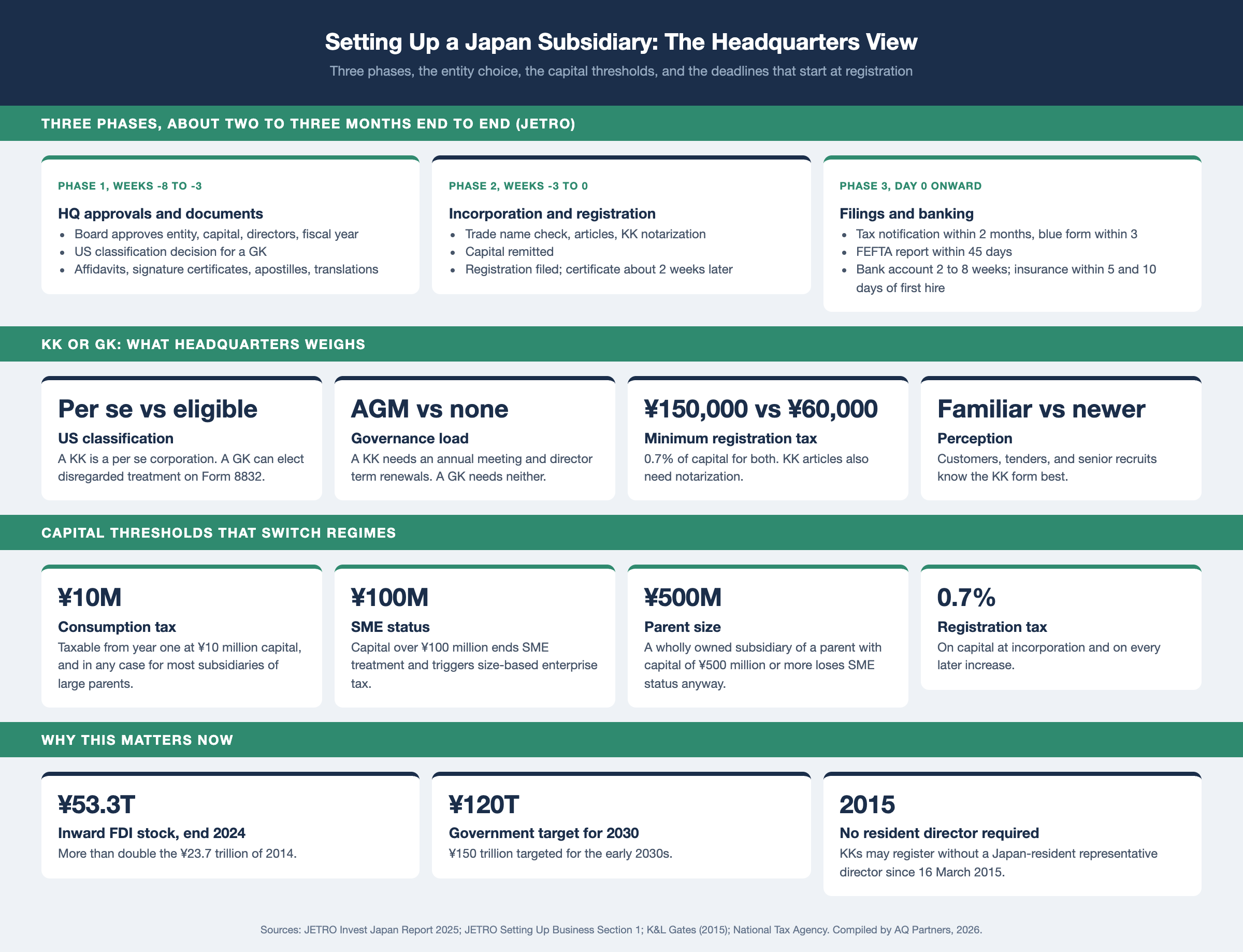
- The entity decision is a US tax decision as much as a Japanese one. A KK is a per se corporation for US federal tax purposes; a GK is an eligible entity that can elect to be disregarded on Form 8832. Groups that want flow-through treatment choose a GK, and many large US groups run Japan that way.
- No director needs to live in Japan, but someone with a registered seal does. The Ministry of Justice dropped the resident representative director requirement for KKs in March 2015. Banks, landlords, and licensing bodies still expect a Japan-resident signatory with a registered seal, which is why nominee director services exist.
- Headquarters produces the slowest documents. Notarized affidavits of the parent's existence and signatory authority, apostilled in the parent's jurisdiction and translated into Japanese, usually gate the timeline. JETRO puts a KK setup at two to three months from deciding the company profile.
- Capital is set by thresholds, not by round numbers. Capital of ¥10 million or more makes the company a consumption tax payer from day one, capital over ¥100 million ends SME corporate tax treatment, and the parent's own size can strip SME status regardless. Excess funding belongs in capital reserve or a parent loan.
- The clock starts at registration, not at the bank. The tax office notification is due within 2 months, the blue form application within 3 months, social insurance enrollment within 5 days of the first payroll office, and the FEFTA post-investment report within 45 days.
What Headquarters Decides Before Anything Is Filed
Six decisions at headquarters fix the shape of the subsidiary, and each is cheaper to make before the articles are drafted than after. They are the entity type, the amount and form of capital, who the directors and representative will be, the fiscal year, the registered address, and the group functions the subsidiary will buy rather than build. The table below gives the default answer for a wholly owned subsidiary of a multinational and the situations in which a group should deviate.
Japan is a large and growing destination for this kind of investment. According to the Japan External Trade Organization's 2025 Invest Japan Report, inward foreign direct investment stock reached ¥53.3 trillion at the end of 2024, more than double the ¥23.7 trillion of a decade earlier, and the government has set targets of ¥120 trillion by 2030 and ¥150 trillion in the early 2030s. The administrative path for a subsidiary has been simplified over that decade, most visibly in the removal of the resident director rule, but the document and threshold traps below are unchanged.
| Decision | Default for a multinational's wholly owned subsidiary | When to deviate |
|---|---|---|
| Entity type | GK where the group wants US flow-through treatment or minimal governance; KK where customers, recruits, licences, or a future listing favour the familiar form | Regulated sectors that expect a KK; joint ventures, where KK share classes and board rules help |
| Stated capital | Between ¥10 million and ¥100 million, with excess funding booked as capital reserve or lent by the parent | Below ¥10 million only if the consumption tax exemption is actually available, which it rarely is for a subsidiary of a large parent |
| Representative director or managing member | A group executive, non-resident, plus a Japan-resident director or nominee for seals and bank dealings | A resident country manager once hired; a nominee only until then |
| Board and auditor | KK with one or more directors and no board of directors; no statutory auditor (kansayaku) unless the group wants one | Add a board and kansayaku if lenders, licences, or a JV partner require them |
| Fiscal year end | Match the parent's year end from incorporation | A March year end where a Japanese lender or partner insists, accepting a stub period in group reporting |
| Registered address | A serviced office or nominee address until a lease is signed | Sign the lease first where a licence requires a physical office at registration |
| Bank | A digital bank for the operating account first, a megabank later for credit and FX | Megabank first where the group treasury policy requires a relationship bank |
| Group functions | Buy accounting, payroll, HR documentation, and corporate secretarial from one provider until headcount justifies hires | Hire a finance lead early where the subsidiary will be a regional hub |
KK or GK: The Classification Question Headquarters Should Settle First
A KK and a GK give the parent the same limited liability but differ in US tax classification, governance load, and market perception. The entity choice therefore belongs to the group tax team as much as to Japan counsel, and it should be settled before the articles are drafted, because converting later means a new registration.
The US point is decisive for US-parented groups. Under the entity classification regulations, a KK is listed as a per se corporation and cannot elect its classification; a GK is not listed and is therefore an eligible entity that can file Form 8832 to be treated as disregarded (with one owner) or as a partnership (with several), as summarised in Japan Business Concierge's note on the check-the-box election for a GK. A disregarded GK lets the parent consolidate Japanese results directly and simplifies foreign tax credit planning, which is why a GK is the common form for US technology and consumer groups. For a UK, German, or Singaporean parent the point does not arise, and the choice turns on the other two factors.
Governance is lighter in a GK. JETRO's overview of forms of business presence in Japan notes that a GK may set its own procedures for preparing and approving financial statements in its articles and need not publish results, whereas a KK is subject to stricter statutory rules. A GK has no shareholders' meeting, no director terms of office, and no public notice of accounts. A KK without a board of directors still needs an annual shareholders' meeting, which a sole shareholder can pass by written resolution, and director terms that must be renewed and re-registered.
Perception is the counterweight. Japanese customers, banks, and senior recruits know the KK form; the GK is newer and, outside technology and consumer sectors, still reads as small. Groups that sell to Japanese corporates, bid on public tenders, or plan to hire senior Japanese executives often accept the KK's governance load for that reason. The detailed comparison, including share transfer rules and conversion, is in the guide to KK vs GK for a wholly owned subsidiary of a multinational.
Capital, Directors, and Address: Three Choices with Threshold Effects
Three choices that look administrative carry tax and practical consequences that headquarters should model rather than default. Capital drives tax status, the director choice drives what the subsidiary can sign, and the address drives which tax office and which licences apply.
Capital. Capital of ¥10 million or more makes the new company a consumption tax payer from its first fiscal year, and a subsidiary more than 50% controlled by a shareholder whose own taxable sales exceed ¥500 million is a taxpayer from day one regardless, so the start-up exemption is rarely available to a multinational. Capital over ¥100 million ends small and medium-sized enterprise treatment: the reduced 15% national rate on the first ¥8 million of income is lost, loss carryforwards can offset only part of income rather than all of it, and size-based enterprise tax applies even in loss years. A subsidiary wholly owned by a parent with capital of ¥500 million or more loses SME treatment anyway, which is the position for most multinationals. Registration and licence tax is 0.7% of capital, minimum ¥150,000 for a KK and ¥60,000 for a GK, and every later capital increase is taxed at 0.7% again. Groups that need a larger equity base can book up to half of the amount paid in as capital reserve, which does not count toward the ¥100 million test for corporate tax. The full analysis of capital versus parent loan is in the guide to funding a Japan subsidiary.
Directors. Since 16 March 2015 the Legal Affairs Bureaus accept KK incorporations without a representative director resident in Japan, as described in K&L Gates' client alert on the change. The same alert records the practical limit: non-residents cannot register a personal seal or obtain a seal certificate, which banks, landlords, and licensing bodies ask for, and every officer must now supply an identification certificate with a Japanese translation. Branches are different; the Companies Act still requires a branch of a foreign company to have at least one representative resident in Japan. In practice most groups appoint a group executive as representative director and add a Japan-resident director, or a nominee director for the first months, to hold the seal and deal with the bank. Liability, signing authority, and the nominee arrangement are covered in the guide to representative director residency and nominee directors.
Address. The registered address fixes the Legal Affairs Bureau, the tax office, and the prefecture and municipality that levy local taxes. A serviced office or a provider's nominee address is enough to incorporate, and moving later is a registration with its own fee. Some licences require a physical office at the time of application, in which case the lease comes first.
The Parent-Company Document Pack
The parent-side documents are the same for every subsidiary, but their lead time depends on the parent's jurisdiction and usually sets the pace. They are the usual reason a Japan incorporation slips. Japan is a party to the Hague Apostille Convention, so a document notarized in a member country and apostilled there is accepted; documents from non-member countries need consular legalisation instead.
JETRO's procedural guide to establishing a subsidiary in Japan lists the parent-side items: registration certificates for the parent, an affidavit on the parent's profile attested by a public notary in the parent's own country, an affidavit on the signatures of the parent's representatives, and a certificate of signature for each appointed director. Everything is filed with a Japanese translation. The table below expands that list into what the group actually assembles.
| Document | Who produces it at HQ | Notarized and apostilled? | Japanese translation? | Typical lead time |
|---|---|---|---|---|
| Certificate of incorporation or registry extract of the parent | Company secretary | Yes, in the parent's jurisdiction | Yes | 1 to 3 weeks depending on registry |
| Affidavit of the parent's existence and corporate details | Company secretary, sworn by an authorised officer | Yes | Yes | 1 to 2 weeks |
| Affidavit of signatory authority and specimen signature | The officer who will sign the subscription documents | Yes | Yes | 1 to 2 weeks, in parallel |
| Board or shareholder resolution approving the subsidiary, capital, and appointments | Board, drafted by counsel | Usually notarized; apostille if the Bureau or bank asks | Yes | Tied to the board calendar |
| Signature certificate for each director and the representative director | Each individual, before a notary in their country of residence | Yes | Yes | 1 week each, in parallel |
| Identification document for each officer (passport copy) | Each individual | Certified copy | Yes | Days |
| Beneficial owner statement | Counsel | No | Prepared in Japanese | Days |
| Letter of acceptance of office for each director | Each individual | No, signature certificate covers it | Prepared in Japanese | Days |
| Capital remittance evidence | Group treasury | No | Bank statement in Japanese or with translation | After the account or custody arrangement exists |
Two points shorten the critical path. First, order the signature certificates and the two affidavits on the same day the board approves the project, because they run in parallel and none depends on the articles. Second, sign the articles electronically through Japanese counsel; a KK's articles must be notarized in Japan, and paper articles attract a ¥40,000 revenue stamp that electronic articles avoid. Jurisdiction-by-jurisdiction detail, including the countries that still require consular legalisation, is in the guide to the parent-company document pack.
The Setup Sequence and Who Owns Each Step
The setup runs in three phases: headquarters approvals and documents, incorporation and registration, and post-registration filings and banking. JETRO's guide estimates two to three months from deciding the company profile to a working subsidiary, and the registration certificate itself is available roughly two weeks after the application is filed. What determines whether a group lands at two months or four is how quickly the headquarters items are cleared.
The table below is the assignment of responsibility that headquarters teams most often ask for and rarely find written down: which step sits with the group, which with the Japan-side provider or counsel, and when it is due relative to registration day.
| Step | HQ owner | Japan-side owner | Timing relative to registration |
|---|---|---|---|
| Board approval of entity, capital, directors, fiscal year | CFO and general counsel | Advises on thresholds | Week -8 to -6 |
| US entity classification decision (Form 8832 timing for a GK) | Group tax | None | Week -8; the election is filed after registration |
| Parent affidavits, signature certificates, apostilles, translations | Company secretary and each officer | Translation and review | Week -6 to -3 |
| Trade name check, articles of incorporation, notarization (KK) | Approves | Counsel or judicial scrivener | Week -3 to -2 |
| Capital remittance to the incorporator's or custody account | Group treasury | Confirms receipt evidence | Week -1 |
| Registration application at the Legal Affairs Bureau | None | Counsel or judicial scrivener | Day 0; certificate about 2 weeks later |
| Corporate seal registration and seal certificate | None | Resident director or nominee | Day 0 with the application |
| Tax office notification of establishment; prefectural and municipal notifications | Signs | Provider prepares and files | Within 2 months |
| Blue form tax return application | Signs | Provider prepares and files | Within 3 months, or before the first year end if earlier |
| FEFTA post-investment report to the Bank of Japan | Group treasury signs | Provider prepares | Within 45 days of the share acquisition |
| Corporate bank account | Treasury supplies KYC on the parent and beneficial owners | Resident director attends; provider coordinates | 2 to 8 weeks after the certificate |
| Social insurance and labor insurance enrollment | HR confirms first hire date | Provider files | Within 5 days and 10 days of the first payroll office or hire |
Groups operating in a sector designated under FEFTA, such as defence, energy, telecommunications infrastructure, or semiconductors, file a prior notification instead of a post-investment report and wait out a review period of 30 days, often shortened to two weeks, before the shares can be subscribed. That check belongs in the week -8 board paper, because it can move the whole timeline. The Japan-side mechanics of each step are in the existing guides to company incorporation in Japan and post-incorporation filings; the bank step, which is the one most often underestimated, is covered in the guide to opening a corporate bank account in Japan.
Fitting the Subsidiary into the Group Framework
A legally complete subsidiary is still stranded if it is not wired into the group's approval matrix, reporting calendar, and treasury from month one. Four connections matter, and each is easier to build into the articles and the first board resolutions than to retrofit.
Delegation of authority. The group's approval matrix decides who may commit the subsidiary, but Japanese counterparties look for the registered representative's seal or signature and the Legal Affairs Bureau's certificate. The reconciliation is a board resolution of the subsidiary that adopts the group matrix as internal policy, plus a controlled process for the seal. The guide to delegation of authority in a Japan subsidiary sets out the mechanics.
Fiscal year. The articles fix the fiscal year, and matching the parent's year end from the start avoids a permanent stub-period reconciliation in group reporting. Changing later requires an amendment to the articles and a tax office notification, and it creates a short first period with its own return; the trade-offs are in the guide to aligning the subsidiary's fiscal year with the parent.
Pre-existing presence. Most multinationals already have people in Japan before the subsidiary exists, through an employer of record, a distributor, or remote employees. Those arrangements can create a permanent establishment of the parent, with Japanese tax exposure on the parent's own income, and they need a clean transfer to the new entity. The guide to permanent establishment risk before the entity exists covers the exposure, and the guide to converting a branch or representative office into a subsidiary covers the case where the group already registered a branch.
Funding and cash. Capital, parent loans, and intercompany charges each trigger different filings and deduction limits. The board paper should state the intended mix and the FEFTA consequence of each tranche, because a parent loan with a term over one year and a balance above ¥100 million is itself an inward direct investment where it exceeds half of the subsidiary's liabilities.
The First Year at a Glance
The first year holds about a dozen dated obligations headquarters must sign or approve, and most fall in the first quarter after registration. The recurring items then settle into a calendar the group can absorb.
In the first three months: tax office and local notifications, the blue form application, social and labor insurance enrollment as soon as anyone is paid, the FEFTA report, the bank account, and for a GK owned by a US parent, the Form 8832 election if flow-through treatment is wanted. In the first six months: the intercompany agreements for services the parent provides, the transfer pricing position on any parent loan, the first monthly reporting package on the group calendar, and work rules if headcount reaches ten. At year end: the annual accounts, the corporate tax and local tax returns within 2 months of year end, the annual shareholders' meeting or GK equivalent, and any director term renewals for a KK. The month-by-month version, with an owner for each item, is in the guide to the first-year headquarters calendar for a new Japan subsidiary.
Frequently Asked Questions
Does a multinational need a Japan-resident director to incorporate a KK?
No. Since March 2015 the Legal Affairs Bureaus accept KK incorporations with no representative director resident in Japan. A resident is still needed in practice to register a seal, obtain a seal certificate, open the bank account, and sign a lease, which is why groups appoint a resident director or use a nominee director until the country manager arrives. A branch of a foreign company, by contrast, must still have a representative resident in Japan.
How long does it take to set up a Japan subsidiary?
JETRO estimates two to three months from deciding the company profile to a working subsidiary, with the registration certificate available about two weeks after filing. The parent's notarized and apostilled documents are the usual critical path, and the bank account takes 2 to 8 weeks after the certificate. Groups that order signature certificates and affidavits at board approval usually land at the short end.
Should a US parent choose a GK for check-the-box treatment?
A GK is an eligible entity that can elect on Form 8832 to be disregarded, while a KK is a per se corporation that cannot. Groups that want Japanese results consolidated directly into the US return generally choose a GK, accepting that the form is less familiar to Japanese customers and senior recruits. The decision belongs with group tax before the articles are drafted.
How much capital should the subsidiary have?
Most multinationals set stated capital between ¥10 million and ¥100 million. The consumption tax exemption below ¥10 million is usually unavailable to a subsidiary of a large parent, and capital over ¥100 million ends SME corporate tax treatment, which a subsidiary of a parent with capital of ¥500 million or more loses anyway. Extra funding is better placed in capital reserve or a parent loan, each with its own filings and limits.
Working with AQ Partners. Our Tokyo team provides back office operations for foreign companies operating in Japan, covering the requirements described above end to end, from incorporation and nominee director services to monthly accounting, payroll, and corporate secretarial filings. Book a consultation to review your Japan setup plan.

Yuga Koda is a founding Director at AQ Partners, supporting foreign companies, funds, and families operating in Japan. His experience operating companies in both Japan and international markets gives him a practical understanding of back office operations from both sides.