
Permanent Establishment Risk Before the Entity Exists: Remote Employees, EORs, and Sales Reps in Japan
A permanent establishment (恒久的施設, koukyuuteki shisetsu, PE) is the threshold at which a foreign company becomes taxable in Japan on its own business profits without having incorporated anything there. For a multinational planning a Japan subsidiary, the risk rarely sits in the future entity; it sits in what already exists. A sales lead working from a Tokyo apartment, a country manager employed through an employer of record (EOR), a distributor that does more than distribute, or a representative office that began taking orders can each make the parent a Japanese taxpayer. This guide sets out what creates a PE under Japanese law, which pre-entity arrangements carry the exposure, what a PE costs, and how to move people and contracts into the new subsidiary so the exposed period is short and clean.
Key Takeaways
- A PE is created by people and premises, not by registration. Japan recognises a fixed-place PE, a construction PE lasting more than one year, and an agent PE, and a treaty definition overrides the domestic one where a treaty applies.
- An EOR does not shield the parent. The EOR is the legal employer for payroll and labor law, but an employee who habitually concludes contracts, or plays the principal role leading to them, can still be a dependent agent of the parent.
- The cost is full Japanese corporate tax on attributable income. A foreign company with a PE files a Japanese return at the 23.2% national rate plus local taxes, and loses the withholding-only position that applies without a PE.
- The exception is narrow. Preparatory or auxiliary activity does not create a PE, but the protection ends once the activity is part of selling, and closely related parties cannot split one operation into exempt pieces.
- The subsidiary is the cure, and timing matters. Incorporate before the sales function grows, novate contracts, transfer employees with social insurance enrollment within 5 days, and paper the interim with intercompany agreements.
What Counts as a Permanent Establishment in Japan
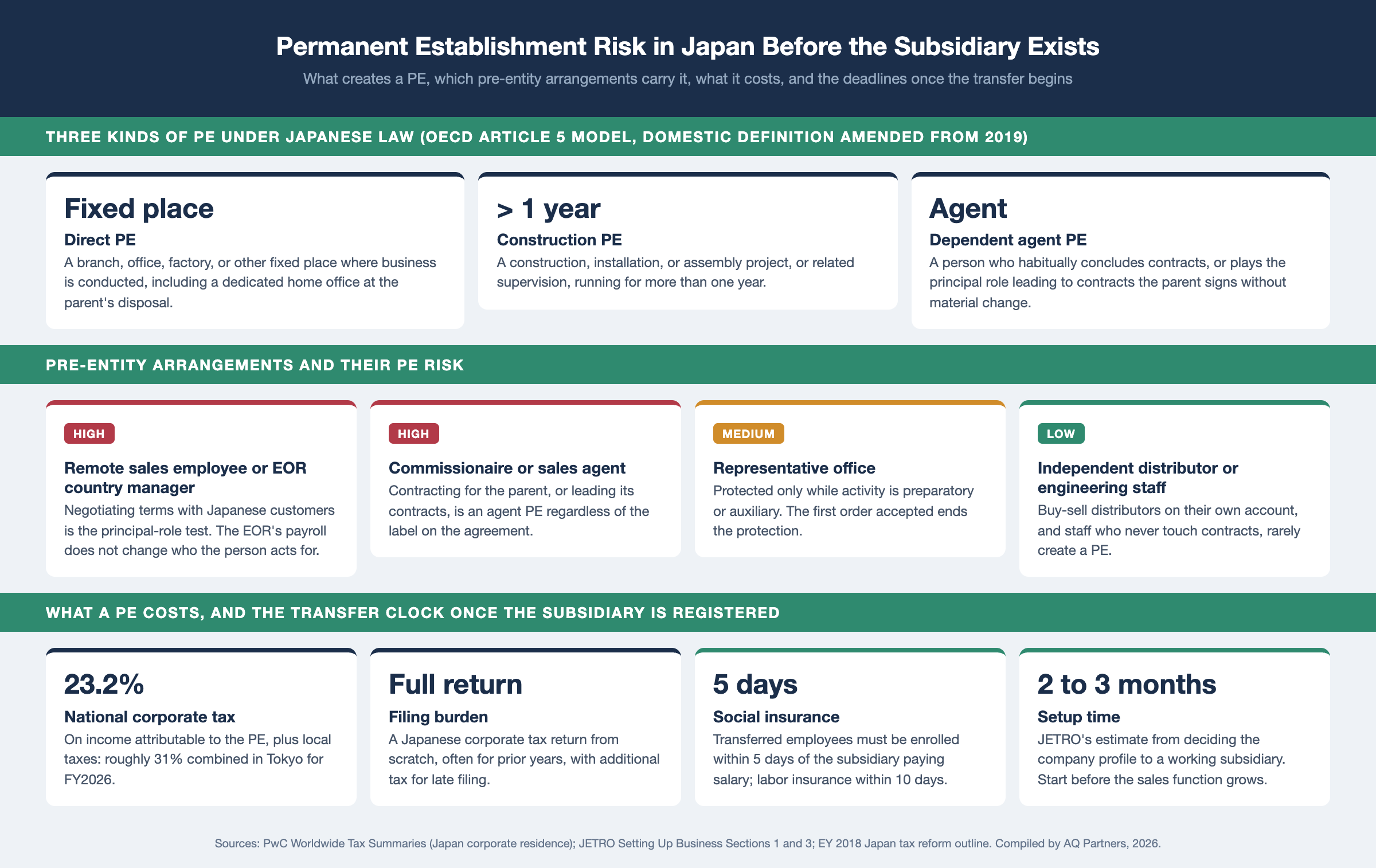
Japanese law recognises three kinds of PE: a fixed place, a construction project over one year, and a dependent agent who leads contracts. According to PwC's summary of corporate residence and PE rules in Japan, the domestic definition follows Article 5 of the OECD Model Tax Convention. A direct PE is a branch, factory, or other fixed place where business is conducted. A construction PE arises from a construction, installation, or assembly project running for more than one year. An agent PE arises where a person other than an independent agent habitually concludes contracts, or habitually plays the principal role leading to contracts that the enterprise concludes without material modification.
The definition is recent. According to EY's 2018 Japan tax reform outline, Japan amended the domestic PE definition along the lines of BEPS Action 7 and the OECD Model, effective for corporate income tax for fiscal years beginning on or after 1 January 2019. Two features matter for multinationals. The agent test no longer turns on who signs: an employee in Japan who negotiates the terms and hands a finished deal to headquarters for signature is playing the principal role. And under the anti-fragmentation rule, a person acting almost exclusively for one enterprise or its closely related enterprises is not independent, and related parties cannot divide one business into separate preparatory pieces. Treaties take precedence over the domestic scope, so the analysis should be run under both.
Three Pre-Entity Arrangements That Create Exposure
Three arrangements most often create a PE: remote staff who sell, a dependent distributor or commissionaire, and a representative office that sells.
Remote employees and the EOR. An EOR is a third-party legal employer that hires the individual, runs payroll, enrolls them in social insurance, and files with the authorities, typically putting a worker on payroll in one to four weeks, as explained in the guide to EOR versus direct hire versus contractor in Japan. The contract sits with the EOR, but the individual works for the parent and is paid to advance its sales. An engineer or support specialist rarely creates a PE. A sales director or country manager who negotiates pricing and terms with Japanese customers is the textbook dependent agent.
Distributors and commissionaires. An independent distributor buying and reselling on its own account creates no PE. The risk appears when the arrangement is dependent in substance: the distributor works almost exclusively for the parent, the parent controls pricing and customers, or the intermediary contracts in its own name on the parent's behalf as a commissionaire. An intermediary that habitually leads the parent's contracts is a PE.
Representative offices. A representative office may research the market, gather information, and advertise, and it cannot sell. Once staff accept orders, negotiate terms, or manage local sales people, the preparatory or auxiliary exception is gone and the office is a fixed-place PE that has also breached its own status, as the comparison of foreign company registration versus a Japan subsidiary notes.
| Pre-entity arrangement | PE risk | What triggers it | Mitigation until the subsidiary exists |
|---|---|---|---|
| Remote employee in sales, foreign payroll or EOR | High | Habitually negotiating or leading contracts; dedicated home office | Lead generation only; contracts concluded abroad; incorporate early |
| Remote employee in engineering or support | Low | Only if the role shifts into customer contracting or a fixed place is maintained | Role description without commercial authority |
| EOR-employed country manager | High | Principal role in deals, hiring local sales staff, running a local office | Trigger to incorporate; written authority limits meanwhile |
| Independent distributor buying and reselling | Low | Exclusivity plus parent control of pricing and customers | Keep the distributor genuinely independent; arm's length terms |
| Commissionaire or sales agent contracting for the parent | High | Habitually concluding or leading the parent's contracts | Convert to a buy-sell distributor or move sales into the subsidiary |
| Representative office | Medium | Any selling, order acceptance, or management of sales staff | Keep to preparatory activity; convert when it cannot |
| Stock held in a Japanese warehouse | Medium | Delivery from stock combined with local selling; treaty-dependent | Use an independent logistics provider; keep selling outside Japan |
| Individual contractor | Medium | Economic dependence and contract-leading activity, whatever the contract says | Genuine independence, or hire through the subsidiary |
What a PE Costs: Tax, Filings, and Transfer Friction
A foreign company with a PE pays Japanese corporate tax on attributable income and files a full return, losing the withholding-only position. JETRO's overview of corporate income taxes in Japan states that a foreign corporation with a PE is taxed on income attributable to the PE and on other Japan-source income, while one without a PE is outside corporate inhabitant tax, enterprise tax, and special corporate enterprise tax and faces only withholding on items such as interest, dividends, and fees.
The rate is the one a subsidiary pays: 23.2% national corporate tax outside the SME regime, and with local taxes a combined effective rate in Tokyo of roughly 31.5% for FY2026. Three things make a PE dearer than the rate suggests. Attribution: the authorities apply substance over form and may attribute more income to the PE than the parent's contracts assign. Filing: the return is prepared from scratch, often for prior years, by a company with no Japanese books or blue form status, and late filing carries additional and delinquent tax. Unwinding: after a year, contracts, revenue, and staff are legally attached to the parent, and moving them becomes a transfer with its own tax questions rather than a fresh start. See the guide to Japan tax compliance by company stage.
Treaty Protection and the Preparatory or Auxiliary Exception
A treaty can narrow the PE definition and the preparatory or auxiliary exception can keep a small presence outside it, but neither protects selling. The US-Japan income tax treaty and its protocols, for example, define PE and the agent test in Article 5 and take precedence over domestic law where the two differ.
The exception covers storage, display, purchasing, and information gathering where the overall activity is preparatory or auxiliary. The activity is assessed as a whole, so an office that gathers market information and also handles negotiations is not auxiliary, and the anti-fragmentation rule stops a group splitting one commercial operation between a representative office, a related contractor, and a remote employee. Document the activities performed, review them quarterly, and treat the first negotiated deal as the signal to incorporate.
The Transfer Plan: Moving People and Contracts into the Subsidiary
The PE window closes only when the people, contracts, and revenue that created it have moved into the subsidiary, each with an owner and a deadline.
Employment moves first. The employee resigns from the EOR or foreign payroll and signs a Japanese contract with the subsidiary, which enrolls them in social insurance within 5 days of becoming a salary-paying office and registers with the labor standards office and Hello Work within 10 days of the first hire. Customer contracts move by novation with the customer's consent or by replacement, and the parent stops invoicing Japanese customers once the subsidiary can. During the gap, an arm's length intercompany services agreement records what each entity does and supports the allocation of income.
| Step | Owner | Timing | Notes |
|---|---|---|---|
| Inventory of Japan activities: people, roles, contracts, stock, offices | Group tax with HQ counsel | Before the board paper | This is the PE assessment; keep it on file |
| Written authority limits for Japan-based staff until transfer | HQ counsel | Immediately | Does not cure an existing PE but stops it growing |
| Incorporate the subsidiary | HQ counsel with Japan provider | Two to three months from decision | Order parent documents at board approval |
| Offer letters and Japanese employment contracts from the subsidiary | HR with Japan provider | At registration | Carry over service and leave; settle EOR exit terms |
| Social insurance enrollment of transferred staff | Japan provider | Within 5 days of the first payroll | Pension and health; labor insurance within 10 days |
| Customer contract novation or replacement | Sales leadership with counsel | First 60 days | Customer consent required for novation |
| Intercompany services agreement for the transition | Group tax | Before the first subsidiary invoice | Arm's length; supports income allocation |
| Stop parent invoicing of Japanese customers | Group finance | Once the subsidiary can invoice | Consider the subsidiary's consumption tax registration |
| Decide the parent's PE-period filing position | Group tax adviser | Before the parent's next return | Shorter, documented periods are easier to defend |
| Close or convert the representative office, if any | HQ counsel | After transfers complete | Do not run both with overlapping staff |
Where the group already registered a branch, the transfer is a conversion covered in the guide to converting a Japan branch or representative office into a subsidiary. The first-year obligations after the transfer are in the guide to the first-year headquarters calendar, and the setup decisions are in the headquarters playbook for setting up a Japan subsidiary.
Frequently Asked Questions
Does hiring through an EOR eliminate permanent establishment risk in Japan?
No. An EOR is the legal employer for payroll, social insurance, and labor law, but the PE test looks at what the individual does for the foreign company. An EOR-employed employee who habitually negotiates or leads customer contracts for the parent can be a dependent agent PE of the parent.
Can a representative office in Japan sell?
No. A representative office is limited to market research, information gathering, and advertising. Selling from it removes the preparatory or auxiliary exception, so the office becomes a fixed-place PE and may be treated as an unregistered branch.
What tax does a foreign company pay if it has a PE in Japan?
Japanese corporate tax on the income attributable to the PE and on other Japan-source income, at the 23.2% national rate plus local inhabitant and enterprise taxes, with a full Japanese return. Without a PE, a foreign company faces only withholding on specified Japan-source payments.
Working with AQ Partners. Our Tokyo team provides back office operations for foreign companies operating in Japan, covering the requirements described above end to end, from incorporation and employee transfer to monthly accounting and tax filings. Book a consultation to review your Japan setup plan.


Yuga Koda is a founding Director at AQ Partners, supporting foreign companies, funds, and families operating in Japan. His experience operating companies in both Japan and international markets gives him a practical understanding of back office operations from both sides.