
Converting a Japan Branch or Representative Office into a Subsidiary

Converting a Japan branch or representative office into a subsidiary means incorporating a new kabushiki kaisha (株式会社, KK) or goudou kaisha (合同会社, GK), moving the business into it, and then closing the branch (支店, shiten) or winding down the representative office (駐在員事務所, chuuzaiin jimusho). Japanese company law has no conversion procedure: a branch is part of the foreign parent, a subsidiary is a separate Japanese company, and the only route between them is a transfer of assets, contracts, employees, and licences followed by a closure. This guide is for the HQ counsel and regional CFO of a group that already has a presence in Japan, and it sets out the tax mechanics, the transfer steps, the closure procedure, and who owns each item.
Key Takeaways
- There is no conversion registration. The group incorporates the subsidiary, transfers the business, and closes the branch, in parallel over the two to three months JETRO estimates for a subsidiary setup.
- Asset transfers between branch and subsidiary are related-party transactions. They are priced at arm's length, can crystallise gains in the branch's final return, and goods transferred carry 10% consumption tax.
- Contribution in kind needs a valuation, cash purchase does not. Property contributed as capital needs a court-appointed inspector unless the total is ¥5 million or less, is listed securities, or is professionally certified. Most groups capitalise in cash and have the subsidiary buy the assets.
- Employees do not move automatically. Each employee must consent, the subsidiary enrolls them in social insurance within 5 days, and seniority and leave balances carry over only by agreement.
- Closing the branch has its own clock. Creditors get at least one month to object, the certificate arrives about two weeks after the closure registration, and the final tax return is due within 2 months of closure.
Why There Is No Conversion Procedure
A branch is part of the foreign parent and a subsidiary is a separate Japanese company, so the law offers a transfer and a closure, not a conversion. JETRO's guide to forms of business presence in Japan draws the lines: a representative office may survey the market, gather information, purchase, and advertise but cannot sell; a branch may trade, open accounts, and lease property in its own name but has no independent legal status, so the parent bears all liability; a subsidiary is a separate corporation whose parent's liability is limited to its equity stake. A branch also needs a representative resident in Japan. JETRO's procedural guide to establishing a subsidiary estimates two to three months from deciding the company profile, which sets the pace for the whole conversion.
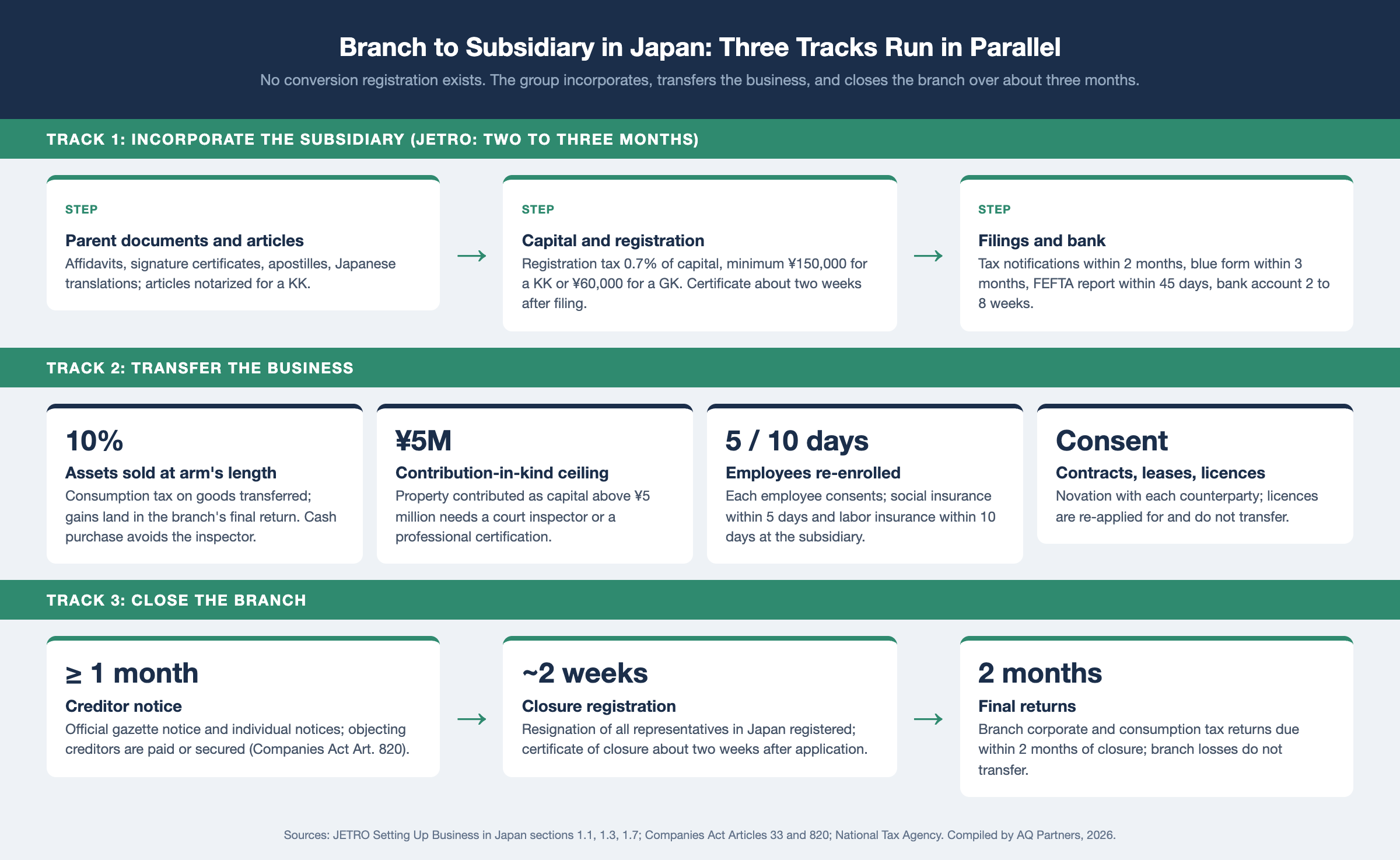
Every asset, contract, employee, licence, account, and lease held by the branch therefore moves by its own mechanism, each with a tax or consent step. The table below shows what changes.
| Attribute | Representative office | Branch office | Subsidiary (KK or GK) |
|---|---|---|---|
| Legal status | None; part of the parent | Registered, but part of the parent | Separate Japanese company |
| Can sell and invoice | No | Yes | Yes |
| Parent liability | Unlimited | Unlimited | Limited to capital contributed |
| Resident representative required | Not registered | Yes, at least one | No, since March 2015 for a KK |
| Registration and licence tax | None | ¥90,000 | 0.7% of capital, minimum ¥150,000 (KK) or ¥60,000 (GK) |
| Japanese corporate tax | None if activity stays preparatory | On income attributable to the Japan permanent establishment | On worldwide income of the company |
| Bank account and lease in own name | Not ordinarily | Yes | Yes |
| Employer of Japanese staff | The parent | The parent, through the branch | The subsidiary |
| Closure procedure | Notify authorities, end lease | Creditor notice, closure registration, final return | Dissolution and liquidation |
Why Groups Convert
Groups convert to ring-fence liability, contract and hire locally, and stop defending which profits belong to the branch. Branch exposure runs straight to the parent's balance sheet once the Japan business signs supplier contracts, leases, or employment agreements of any size.
Tax attribution is the second driver. A branch pays Japanese corporate tax only on income attributable to its permanent establishment, so audits start with attribution arguments; a subsidiary's profits and losses are its own, and advance pricing agreements become available. The comparison of the two tax positions is in the guide to foreign company registration versus a Japan subsidiary. The third driver is commercial: customers, banks, senior recruits, licences, and tenders treat a KK or GK as a committed local presence. The four-way comparison including the representative office is in the guide to KK vs GK vs branch vs representative office.
The Tax Mechanics of Moving Assets
Moving assets from the branch to the subsidiary is a related-party sale: arm's length pricing, with any gain taxed in the branch's final return. Fixed assets, inventory, receivables, prepaid rent, and deposits transfer at fair value, and the parent's home-country return picks up the same transaction.
Consumption tax applies to transferred goods and most services at the standard 10% rate. The subsidiary recovers it as input tax once it is a consumption tax payer, so the cost is timing rather than leakage.
Contributing the branch's assets in kind (現物出資, genbutsu shusshi) as capital is possible but slow. Article 33 of the Companies Act requires a court-appointed inspector to verify the value, with three exemptions summarised in Crear's commentary on Companies Act Article 33: a total contributed value of ¥5 million or less, listed securities recorded at or below market price, or a value certified by a lawyer, certified public accountant, or tax accountant. Most groups capitalise in cash, book any excess as capital reserve, and have the subsidiary buy the assets for cash once its bank account opens. The capital thresholds behind that decision are in the guide to setting up a Japan subsidiary as a multinational.
One item does not travel. Blue-return loss carryforwards in the branch belong to the foreign company's Japanese tax position and are not inherited by the subsidiary, so a branch with unused losses should time the transfer so that asset gains absorb them, after confirming the position with its tax adviser.
Moving Employees, Contracts, Licences, and Accounts
Employees, contracts, licences, and bank relationships each move by consent or re-application, and none moves by operation of law. The HQ calendar and the Japan-side provider have to work from one list.
Employees. A transfer of employment needs each employee's individual consent. The standard approach is a tripartite agreement in which the branch employment ends, the subsidiary hires on the same terms, and seniority, paid-leave balances, and any retirement allowance accrual carry over by written commitment. The branch files loss-of-coverage notices, and the subsidiary enrolls the same people within 5 days for social insurance and within 10 days for labor insurance.
Contracts and licences. Customer, supplier, and lease contracts are novated with each counterparty's consent; landlords usually require a new guarantee. Customers are told the new invoicing entity and its qualified invoice issuer number. Licences issued to the foreign company do not transfer, so the subsidiary applies afresh and the branch stays open until the new licence is issued.
Bank and treasury. The subsidiary's account takes 2 to 8 weeks after the registration certificate, and the branch account stays open until the final return is filed. The parent's subscription of the subsidiary's shares is inward direct investment under the Foreign Exchange and Foreign Trade Act, reported to the Bank of Japan within 45 days unless the sector requires prior notification. Where the group also has remote staff or sales representatives outside the branch, their position is covered in the guide to permanent establishment risk before the entity exists.
Closing the Branch
Closing the branch takes a creditor notice of at least one month, a closure registration, and a final tax return, all once the subsidiary trades. JETRO's guide to closure of branch offices or subsidiary companies sets the sequence: the foreign company resolves to close the branch and have all its representatives in Japan resign, calls on creditors individually and through the official gazette, waits no less than one month, registers the resignation at the Legal Affairs Bureau, receives the certificate of registered closure about two weeks later, then notifies the authorities.
The creditor step is required by Article 820 of the Companies Act, explained in Nagatacho Legal Advisor's note on foreign company closure registrations: an objecting creditor must be paid, secured, or provided for through a trust before the registration can proceed. Objections are rare, but the month cannot be shortened.
The branch's final corporate and consumption tax returns are due within 2 months of the closure date. A representative office has no registration to close: the group notifies the tax office if it filed an establishment notification, ends the lease, and confirms the office never conducted taxable activity. The incorporation track itself is described step by step in the guide to company incorporation in Japan, and the subsidiary's obligations after registration are in the guide to the first-year headquarters calendar.
| Step | HQ owner | Japan-side owner | Timing |
|---|---|---|---|
| Board decision: subsidiary form, capital, directors, transfer date, branch closure | CFO and general counsel | Advises on thresholds and sequencing | Month 0 |
| Parent documents, articles, capital remittance, registration of the subsidiary | Company secretary, treasury | Counsel or judicial scrivener | Months 0 to 2; certificate about 2 weeks after filing |
| Subsidiary tax notifications, blue form, qualified invoice registration, bank account | Signs | Provider | Weeks 1 to 8 after registration |
| Asset valuation and intercompany sale agreement, transfer pricing memo | Group tax | Provider and tax adviser | Before the transfer date |
| Employee consent letters and tripartite transfer agreements | HR | Provider drafts, sharoushi files | 2 to 4 weeks before the transfer date |
| Social and labor insurance: branch loss notices, subsidiary enrollment | HR confirms date | Provider and sharoushi | Within 5 and 10 days of the transfer date |
| Contract novations, lease assignment, customer notices, licence re-applications | Legal and sales | Provider coordinates | Transfer date, licences as issued |
| FEFTA post-investment report on the share subscription | Treasury signs | Provider prepares | Within 45 days of subscription |
| Branch creditor notice in the official gazette and individual notices | General counsel | Judicial scrivener | After the transfer; at least 1 month runs |
| Closure registration, certificate, tax office and authority notifications | Signs | Judicial scrivener and provider | After the notice period; certificate about 2 weeks later |
| Branch final corporate and consumption tax returns | Group tax reviews | Provider and tax accountant | Within 2 months of closure |
Frequently Asked Questions
Can a branch simply be re-registered as a KK?
No. Japanese law has no procedure to convert a branch of a foreign company into a Japanese company. The group incorporates a new KK or GK, transfers the business by sale or contribution, and closes the branch through the creditor notice and closure registration, in parallel so the subsidiary trades before the branch stops.
Do the branch's employees keep their seniority?
Only if the transfer agreement says so. Each employee consents to ending employment with the branch and joining the subsidiary, and seniority, paid-leave balances, and retirement allowance accruals carry over by written commitment. Social insurance is re-enrolled at the subsidiary within 5 days.
How long does closing the branch take once the subsidiary is running?
The creditor notice runs at least one month, the closure registration follows, and the certificate is available about two weeks after the application, so roughly six to eight weeks in total. The branch's final tax returns are due within 2 months of the closure date.
Is a representative office easier to convert?
Yes, because there is nothing to close at the Legal Affairs Bureau. The group incorporates the subsidiary, moves the staff and lease, and notifies the tax office if it filed an establishment notification. The main risk is discovering the office had been selling, which creates a permanent establishment issue for the parent.
Working with AQ Partners. Our Tokyo team provides back office operations for foreign companies operating in Japan, covering the requirements described above end to end, from incorporating the subsidiary and re-enrolling employees to the branch's closure filings and final returns. Book a consultation to review your Japan setup plan.

Yuga Koda is a founding Director at AQ Partners, supporting foreign companies, funds, and families operating in Japan. His experience operating companies in both Japan and international markets gives him a practical understanding of back office operations from both sides.