
The First-Year HQ Calendar for a New Japan Subsidiary: Every Filing, Approval, and Board Action with an Owner


The first-year calendar for a new Japan subsidiary is the set of dated filings, approvals, and board actions that fall between the registration of a kabushiki kaisha (株式会社, KK) or goudou kaisha (合同会社, GK) and the close of its first fiscal year. Most of the deadlines are counted from registration day, a few from the first hire, and the rest follow the Japanese statutory calendar regardless of when the company was formed. For a multinational, the useful version names an owner at headquarters and an owner in Japan for each item, because the filings are signed in Japan but the decisions behind them, on tax elections, intercompany terms, and delegated authority, are made at headquarters.
Key Takeaways
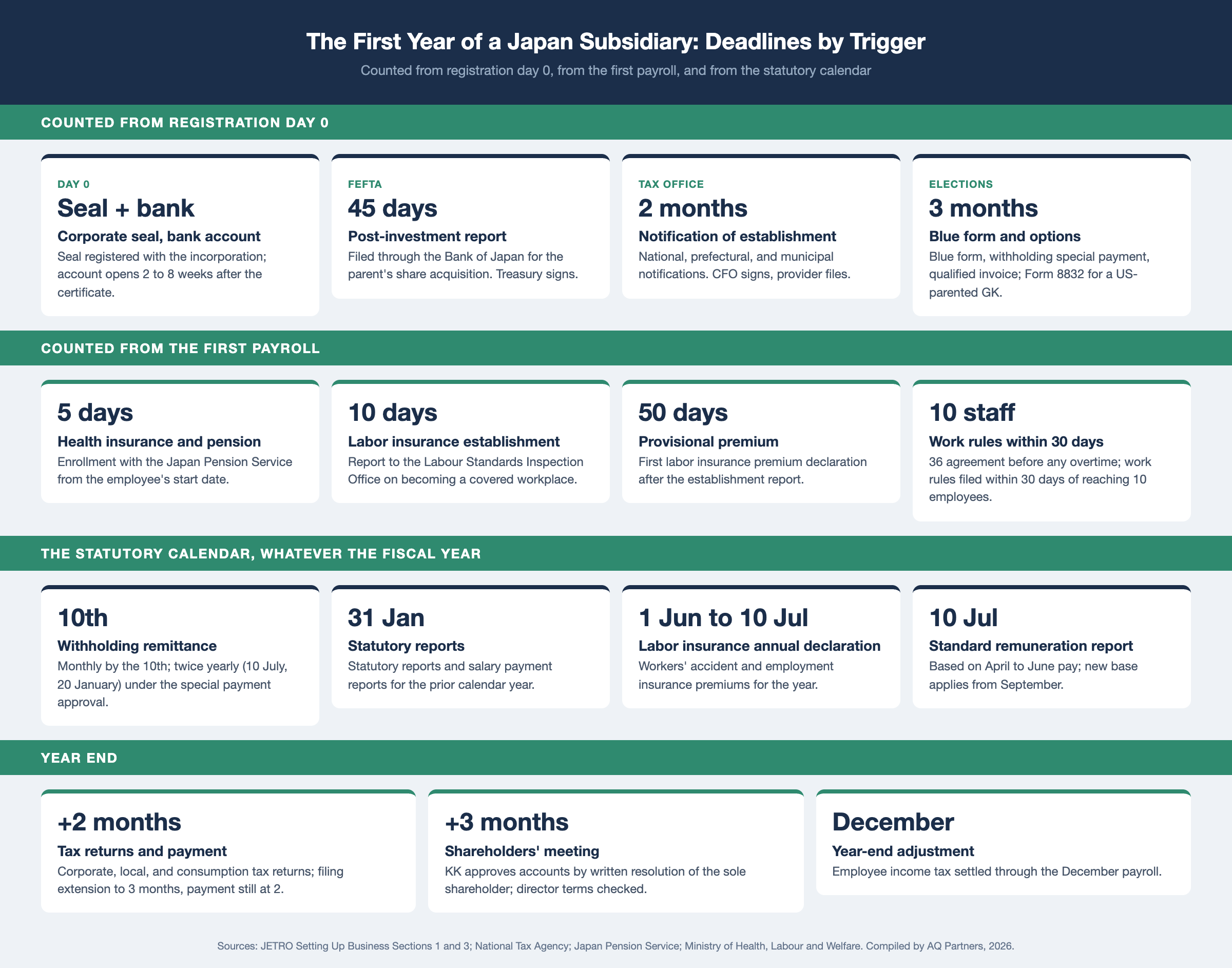
- Four clocks start on registration day. The FEFTA post-investment report is due within 45 days, the tax office notification of establishment within 2 months, the blue form application within 3 months or before the first year end if earlier, and the corporate seal is registered with the incorporation itself.
- Two more start with the first payroll. Health insurance and pension enrollment is due within 5 days of the first hire, and the labor insurance establishment report within 10 days of becoming a covered workplace, with a provisional premium declaration within 50 days.
- Headquarters owns the elections, not the forms. The blue form, the withholding special payment option, qualified invoice registration, and for a US-parented GK the Form 8832 election are decisions the group makes; the Japan-side provider files them.
- The statutory calendar overrides the fiscal year. Statutory reports are due by 31 January, the labor insurance annual declaration runs 1 June to 10 July, and the standard remuneration report is due by 10 July, whatever year end the parent chose.
- Year end brings a two-month sprint. Corporate, local, and consumption tax returns are due within 2 months of year end, extendable by one month for filing but not for payment, and a KK must also hold its annual shareholders' meeting and re-check director terms.
The First 45 Days: Registration Starts Every Clock
Registration day starts the clocks for the FEFTA report, the tax notifications, and the seal, so the first six weeks are the densest of the year. JETRO's guide to establishing a subsidiary in Japan lists the report of the share acquisition to the Bank of Japan as the final step of incorporation; under the Foreign Exchange and Foreign Trade Act (外国為替及び外国貿易法, FEFTA) that post-investment report is due within 45 days for a company outside the designated sectors, and group treasury signs it.
In the same window the subsidiary registers its corporate seal (会社実印, kaisha jitsuin), opens the bank account, and passes its first resolutions: adoption of the group delegation-of-authority matrix as internal policy and appointment of the seal custodian. Those resolutions are covered in the guide to delegation of authority in a Japan subsidiary. The tax office notification of establishment (法人設立届出書, houjin setsuritsu todokedesho) is due within 2 months, with parallel notifications to the prefecture and municipality, as set out in the guide to post-incorporation filings in Japan.
If anyone is paid from day one, including a director drawing a salary, the payroll clocks also start. Health insurance and employees' pension enrollment with the Japan Pension Service is due within 5 days of the start date, the labor insurance establishment report within 10 days of the company first becoming a covered workplace, and the provisional premium declaration within 50 days; the per-agency detail is in the guide to enrolling employees in shakai hoken.
Months 2 to 3: The Tax Elections Headquarters Must Decide
By the end of month 3 the subsidiary must have made four tax elections, and each is a group decision that the Japan-side provider merely files. The blue form tax return application (青色申告承認申請書, aoiro shinkoku shounin shinseisho) is due within 3 months of incorporation or before the first fiscal year end, whichever comes first, and it unlocks the 10-year loss carryforward for the start-up losses most subsidiaries run.
The second election is the withholding special payment approval (源泉所得税の納期の特例, gensen shotokuzei no nouki no tokurei), which lets an employer with fewer than 10 employees remit withheld income tax twice a year, by 10 July and 20 January, instead of monthly. The third is qualified invoice issuer registration, which a subsidiary selling to Japanese businesses needs from its first invoice. The fourth, for a GK owned by a US parent that wants flow-through treatment, is the Form 8832 entity classification election, which group tax files with the IRS on the timetable in the form's instructions. The entity choice and the reasons for that election are in the guide to setting up a Japan subsidiary as a multinational.
Months 4 to 6: Intercompany Terms, Reporting, and the First Ten Hires
The second quarter wires the subsidiary into the group: intercompany agreements, transfer pricing, the reporting package, and HR documents. None has a deadline counted from registration, which is why they slip, and each creates a tax or labor exposure if still missing at year end.
Intercompany service, licence, and loan agreements should be signed before the first charge is booked, with the arm's length basis documented at the same time. The first monthly reporting package should reach the group on its close calendar from the first full month, so the Japanese bookkeeping is built to feed it. On the employment side, a 36 agreement (三六協定, saburoku kyoutei) must be filed with the Labour Standards Inspection Office before any employee works overtime, and work rules (就業規則, shuugyou kisoku) must be filed within 30 days of reaching 10 employees. Headquarters approves the intercompany terms and the first budget in this quarter.
The Statutory Calendar That Ignores Your Fiscal Year
Several employer obligations follow the calendar year or the government's April year, so they fall on fixed dates whatever year end the parent chose. Four recur every year and belong on the group calendar from the start.
Withheld income tax is remitted by the 10th of the month after payment, or twice a year under the special payment approval. In December the employer runs the year-end adjustment (年末調整, nenmatsu chousei) that settles each employee's income tax through payroll. By 31 January the employer files its statutory reports (法定調書, houtei chousho) for the previous calendar year with the tax office, according to the National Tax Agency's guidance on statutory reports, and sends the salary payment reports to each employee's municipality on the same date. From 1 June to 10 July the employer files the labor insurance annual declaration (年度更新, nendo koushin) covering workers' accident and employment insurance premiums, the period the Ministry of Health, Labour and Welfare sets each year. By 10 July the employer also files the standard remuneration report (算定基礎届, santei kiso todoke) based on April to June pay, which the Japan Pension Service uses to reset each employee's social insurance base from September. The table below places every item on a twelve-month timeline.
| Month | Item | Japanese term | Deadline | HQ owner | Japan-side owner |
|---|---|---|---|---|---|
| 1 | Corporate seal registration and bank account opening | 会社実印, 法人口座 | With registration; bank 2 to 8 weeks after | Treasury supplies KYC | Resident director, provider |
| 1 | Delegation-of-authority policy and seal custodian resolution | 職務権限規程 | Before first contract | General counsel | Representative director signs |
| 1 to 2 | FEFTA post-investment report | 事後報告 | Within 45 days of share acquisition | Treasury signs | Provider prepares |
| 1 to 2 | Health insurance, pension, labor insurance enrollment | 新規適用届, 保険関係成立届 | 5 days after first hire; 10 days after covered workplace; premium within 50 days | HR confirms hire dates | Provider files |
| 2 | Notification of establishment, national and local | 法人設立届出書 | Within 2 months | CFO signs | Provider files |
| 3 | Blue form application; withholding special payment approval; qualified invoice registration | 青色申告, 納期の特例, 適格請求書発行事業者 | Within 3 months or before first year end | Group tax decides | Provider files |
| 3 | Form 8832 election for a US-parented GK | None | Per IRS instructions | Group tax files | None |
| 4 to 6 | Intercompany agreements and transfer pricing position | 関連者間契約 | Before first charge | Group tax and counsel approve | Provider books |
| 4 to 6 | First monthly reporting package; budget approval | 月次報告 | Group close calendar | Controller | Provider prepares |
| On hiring | 36 agreement; work rules at 10 employees | 三六協定, 就業規則 | Before overtime; within 30 days of 10 employees | HR approves | Provider drafts and files |
| December | Year-end adjustment | 年末調整 | December payroll | None | Provider runs |
| January | Statutory reports and salary payment reports | 法定調書, 給与支払報告書 | 31 January | None | Provider files |
| June to July | Labor insurance annual declaration; standard remuneration report | 年度更新, 算定基礎届 | 1 June to 10 July; 10 July | None | Provider files |
| Year end + 2 | Corporate, local, and consumption tax returns; payment | 確定申告 | Within 2 months; filing extension to 3 | CFO approves | Provider and tax accountant file |
| Year end + 3 | Annual shareholders' meeting or GK approval; director term check | 定時株主総会 | After accounts are final | Company secretary | Provider drafts minutes |
Year End: Returns, Accounts, and the Shareholders' Meeting
The first year end packs accounts, three tax returns, and corporate approvals into two months, and the filing extension never moves the payment date. According to JETRO's overview of corporate income taxes in Japan, the corporate tax return is due within 2 months of the fiscal year end; the local inhabitant and enterprise tax returns and the consumption tax return share that deadline. A one-month filing extension is available on application before the original deadline, but the estimated tax is still paid at 2 months.
A KK then holds its annual shareholders' meeting to approve the accounts, which a wholly owned subsidiary passes by written resolution of the sole shareholder, and checks whether any director's term expires and needs re-registration. A GK approves its accounts under the procedure its articles set. The first year is usually a short period if the fiscal year was aligned to the parent, a decision covered in the guide to aligning the subsidiary's fiscal year with the parent. Recurring items are summarised below; the shorter founder-oriented version is the guide to the Japan market entry checklist.
| Recurring item | Frequency | Deadline | Owner |
|---|---|---|---|
| Withholding tax remittance | Monthly, or twice yearly under the special payment approval | 10th of the following month; 10 July and 20 January | Provider |
| Payroll and social insurance premiums | Monthly | Premiums due end of the following month | Provider |
| Bookkeeping and group reporting package | Monthly | Group close calendar | Provider, controller reviews |
| Intercompany charges and settlement | Monthly or quarterly | Per agreement | Controller |
| Employee changes: hires, leavers, salary changes | Per event | 5 days for pension and health; 10 days for employment insurance | HR notifies, provider files |
| Director, address, or capital changes | Per event | Registration within 2 weeks of the change | Company secretary, provider files |
Frequently Asked Questions
Which first-year deadlines are counted from registration and which from the first hire?
From registration: the FEFTA post-investment report within 45 days, the notification of establishment within 2 months, and the blue form application within 3 months. From the first payroll: pension and health enrollment within 5 days, the labor insurance establishment report within 10 days, and the provisional premium within 50 days.
What happens if the blue form application is late?
The company files its first return as a white form taxpayer and loses the blue form benefits for that year, including the carryforward of the first-year loss. The application must be filed within 3 months of incorporation or before the end of the first fiscal year, whichever is earlier, so a subsidiary registered late in the parent's fiscal year can have only weeks.
Does the calendar change if the subsidiary is a GK?
The tax, payroll, and FEFTA items are identical. A GK has no annual shareholders' meeting and no director terms to re-register, so year-end approvals reduce to what the articles specify; a US-parented GK adds the Form 8832 election.
Working with AQ Partners. Our Tokyo team provides back office operations for foreign companies operating in Japan, covering the requirements described above end to end, from post-incorporation filings and payroll enrollment to monthly reporting and the year-end returns. Book a consultation to review your Japan setup plan.

Yuga Koda is a founding Director at AQ Partners, supporting foreign companies, funds, and families operating in Japan. His experience operating companies in both Japan and international markets gives him a practical understanding of back office operations from both sides.