
Post Incorporation: What Needs To Get Filed After Incorporation


Introduction
Congratulations on incorporating your business in Japan. While getting your company officially registered is a major milestone, the work doesn't stop there. Once you've chosen your entity structure, Japan's regulatory environment requires newly incorporated companies to file several tax and employment documents to ensure proper compliance and set your business up for long-term success.
Missing these filings can result in penalties, lost tax benefits, or complications down the road when you try to hire employees or claim deductions. According to the National Tax Agency (NTA), all newly established corporations must complete a series of mandatory notifications within strict deadlines following incorporation. The good news is that most of these filings follow a predictable timeline, and understanding what's required helps you stay organized from day one.
This post covers the essential tax and employment filings that apply to all newly incorporated businesses in Japan, regardless of industry or business type. These filings are just one piece of the broader back office infrastructure you'll need when entering the Japanese market. We'll walk through each requirement, explain why it matters, and highlight the key deadlines you need to know.
Key Takeaways
- The Notification of Establishment must be filed within 2 months of incorporation, and the Blue Form Tax Return Application within 3 months. Missing the Blue Form deadline forfeits preferential tax treatment, including 10-year loss carryforwards, for your entire first fiscal year.
- Social insurance enrollment is mandatory within 5 days of establishing a salary-paying office. This applies even if your company has only one director on payroll, and failure to enroll triggers retroactive premium assessments and penalties.
- Seven separate tax filings are required across the NTA (e-Tax), local tax offices (eL-Tax), and multiple labor agencies. Missing any critical filing can delay corporate bank account opening, payroll processing, and tax benefit eligibility.
- The Qualified Invoice System registration is mandatory for companies with initial capital exceeding 10 million JPY or annual taxable sales above 10 million JPY. Without registration, your B2B clients cannot claim consumption tax input credits on your invoices.
- Engaging a specialist during the initial filing period can prevent costly mistakes. Filing errors or missed deadlines can result in lost tax benefits worth hundreds of thousands of yen and administrative complications that compound over time.
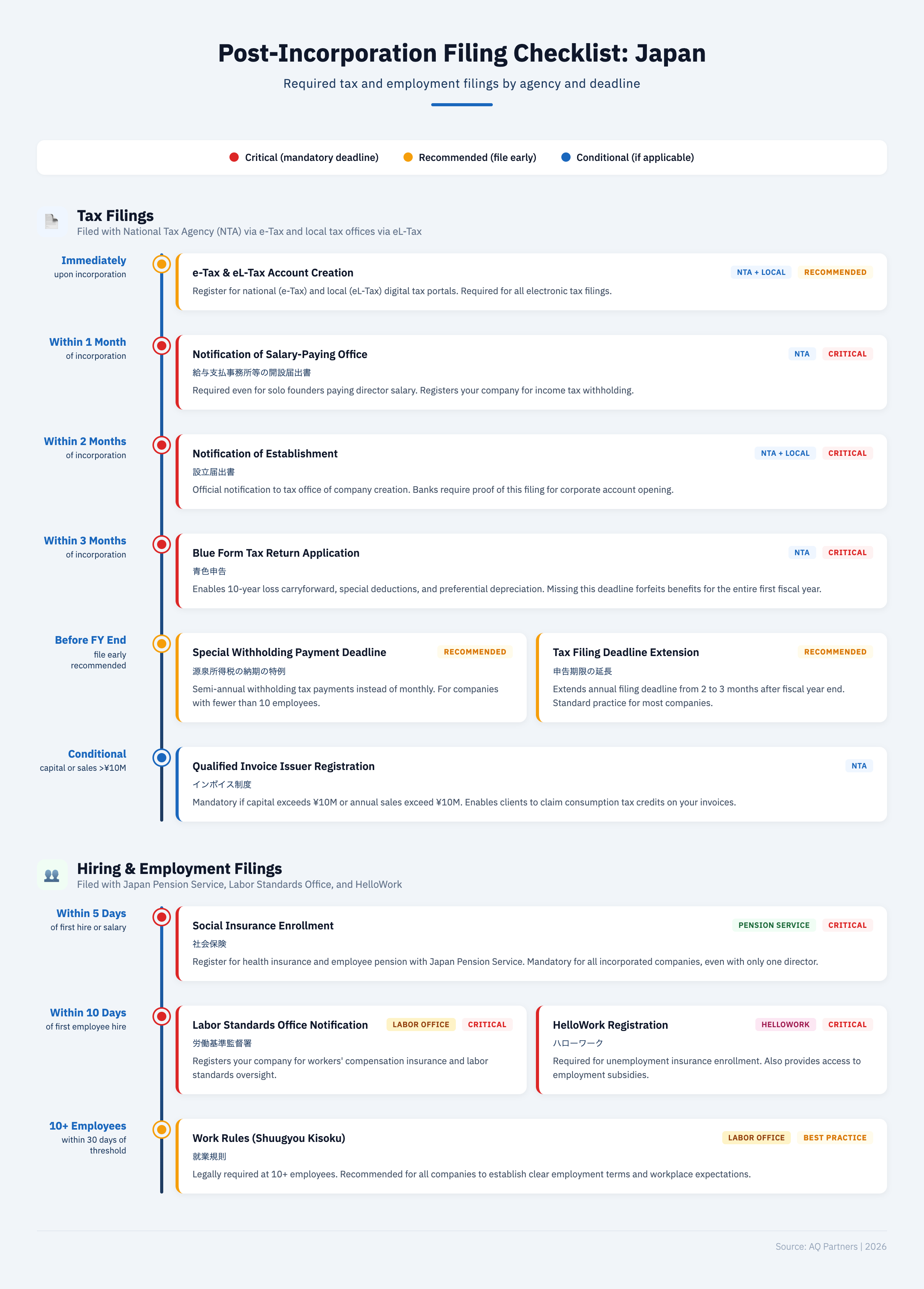
| Filing Name | Deadline | Priority | Summary |
|---|---|---|---|
| Tax Filings | |||
| e-Tax & eL-Tax Account Creation | Setup early | Recommended | Register for Japan's national (e-Tax) and local (eL-Tax) digital tax portals to manage all corporate tax filings electronically. |
| Notification of Establishment (設立届出書) |
Within 2 months | Critical | Official notification to the tax office of your company's creation, including business address, representative director, and fiscal year end. |
| Blue Form Tax Return Application (青色申告) |
Within 3 months | Critical | Enables preferential tax treatment including 10-year loss carryforwards and additional deductions—essential for startups. |
| Notification of Establishment of Salary-Paying Office | Within 1 month | Critical | Registers your company for income tax withholding procedures when paying salaries to employees or directors. |
| Special Payment Deadline for Withholding Tax | No strict deadline | Recommended | Allows companies with fewer than 10 employees to pay withheld income taxes semi-annually instead of monthly. |
| Tax Filing Deadline Extension | Before fiscal year end | Recommended | Extends annual corporate tax filing deadline from 2 months to 3 months after fiscal year end. |
| Qualified Invoice Issuer Registration (インボイス制度) |
Conditional | If applicable | Mandatory if capital >¥10M or sales >¥10M. Enables clients to claim consumption tax credits on your invoices. |
| Hiring & Employment Filings | |||
| Social Insurance Enrollment (社会保険) |
Within 5 days | Critical | Register with Japan Pension Service, Labor Standards Office, and HelloWork for health insurance, pension, and unemployment coverage. |
| Work Rules (就業規則) |
Within 30 days of 10+ employees | Best practice | Formal employment terms document required at 10+ employees but recommended for all companies to establish clear workplace expectations. |
| Labor Standards Inspection Office Notification | Within 10 days of first hire | Critical | Registers your company as an employer and subjects you to labor standards authority oversight. |
| HelloWork Registration | Within 10 days of first hire | Critical | Required for unemployment insurance enrollment and access to job placement services and employment subsidies. |
Tax Filings
Newly incorporated companies in Japan must complete at least seven tax-related filings with the National Tax Agency and local tax offices within the first three months, with deadlines as tight as one month from incorporation.
e-Tax and eL-Tax Account Creation
Japan uses two primary digital tax portals for corporate tax filings: e-Tax for national taxes and eL-Tax for local taxes.
e-Tax is Japan's national digital tax portal, used to file corporate income taxes, consumption tax, and other national tax obligations online. It's managed by the National Tax Agency and serves as your primary interface with the federal tax system. Since 2020, corporations with capital of 100 million JPY or more are required to file returns electronically via e-Tax.
eL-Tax is the local government equivalent, used for filing local corporate taxes with prefectural and municipal tax offices. Since Japanese companies pay taxes at both the national and local levels, you'll need to interact with both systems.
Setting up accounts for both platforms early allows you to manage all tax filings electronically, which streamlines compliance and creates a digital paper trail for your records. As Japan transitions toward digital systems, understanding document and seal requirements becomes increasingly important. Most tax accountants and corporate services providers will help you establish these accounts as part of their onboarding process.
Notification of Establishment
The Notification of Establishment (設立届出書, Setsuritsu Todokede-sho) is a filing to your local tax office (税務署, Zeimusho) that officially notifies the tax authorities of your company's creation.
Deadline: Within 2 months of your incorporation date.
This filing provides the tax office with essential information about your company, including your business address, representative director, fiscal year end, and the nature of your business activities. The filing must also be submitted separately to your prefectural and municipal tax offices, each of which may have slightly different deadlines.
Failing to file this notification on time can delay your ability to file other important tax forms and may result in administrative complications when you need to prove your company's tax registration status. Banks will often request proof of this notification when you open your corporate bank account, making timely filing essential for getting your business operations up and running.
Blue Form Tax Return Application
The Blue Form Tax Return (青色申告, Aoiro Shinkoku) is one of the most valuable tax filings you can make as a newly incorporated company. This application allows your company to use Japan's preferential "Blue Form" tax system, which offers significant benefits compared to the standard "White Form" system.
Deadline: Within 3 months of incorporation or before the end of your first fiscal year, whichever comes first.
Benefits of Blue Form status include the ability to carry forward losses for up to 10 years, claim additional deductions for certain expenses, and take advantage of special depreciation rules. For startups and growing companies that may not be profitable in their early years, the loss carryforward provision alone can save substantial amounts in future tax liability. Under the Blue Form system, companies can also deduct the full amount of net operating losses against future income, compared to limited relief under the White Form system.
Once approved, your Blue Form status continues indefinitely as long as you maintain proper accounting records and file accurate tax returns. However, the NTA can revoke Blue Form status if a company fails to file returns on time for two consecutive years or submits fraudulent records.
Notification of Establishment of Salary-Paying Office
The Notification of Establishment of a Salary-Paying Office (給与支払事務所等の開設届出書, Kyuuyo Shiharai Jimusho-tou no Kaisetsu Todokede-sho) informs the tax office that your company has established an office that will pay salaries to employees or directors.
Deadline: Within 1 month of opening the salary-paying office (typically within 1 month of incorporation if paying director salaries).
This filing is required even if you're a solo founder paying yourself a director's salary. It ensures that your company is registered for proper income tax withholding procedures, which are mandatory in Japan for anyone receiving employment or director compensation. The withholding tax rate varies by salary level but typically ranges from 5% to 45% of gross pay for national income tax.
It's highly recommended to submit this notification even if you don't plan to put anyone on payroll immediately. Having it in place from the beginning prevents delays when you eventually do need to pay salaries and demonstrates to the tax office that you're proactively managing your tax obligations.
Application for Approval of Special Payment Deadline for Withholding Income Tax
When your company pays salaries, you're required to withhold income tax from employee paychecks and remit it to the tax office. By default, these withholding tax payments must be made monthly by the 10th of the following month, which creates a significant administrative burden for small companies.
The Application for Approval of Special Payment Deadline (源泉所得税の納期の特例の承認に関する申請書, Gensen Shotokuzei no Nouki no Tokurei no Shounin ni Kansuru Shinsei-sho) allows eligible companies to pay withheld income taxes on a semi-annual basis instead of monthly.
Deadline: No strict deadline, but best filed early. The special payment schedule applies starting the month after approval is granted.
To qualify, your company must have fewer than 10 employees receiving salaries. Under this special arrangement, withholding taxes for January through June are due by July 10, and taxes for July through December are due by January 20. This filing dramatically reduces your administrative workload and is standard practice for most small and medium-sized businesses in Japan. Even if you're just starting out with one or two people, filing this application early saves you from unnecessary monthly filing requirements.
Submission of Application Form to Extend Tax Filing Deadline
Japanese companies are normally required to file their annual corporate tax returns within two months of their fiscal year end. For many businesses, this timeline is tight, especially when waiting for financial data from banks, vendors, or international subsidiaries. For a comprehensive overview of all annual deadlines, see the corporate tax compliance guide.
The Application to Extend Tax Filing Deadline (申告期限の延長の特例の申請書, Shinkoku Kigen no Enchou no Tokurei no Shinsei-sho) allows you to extend this deadline to three months after fiscal year end. This extra month provides breathing room for your accounting team to close the books properly and ensures your tax filings are accurate and complete.
Deadline: Before the end of the fiscal year for which you want the extension to apply. Best filed early, ideally during your initial post-incorporation filings.
Most Japanese companies file this extension application as a matter of course. While you'll still need to estimate and pay your tax liability by the original two-month deadline to avoid penalties, having the extra month for the actual filing is invaluable for maintaining accuracy and reducing stress during tax season. Interest of approximately 1.0% per year (as set by the NTA for recent fiscal years) accrues on unpaid tax from the original due date to the extended filing date.
Application for Qualified Invoice Issuer
Japan's Qualified Invoice System (適格請求書等保存方式, commonly known as インボイス制度 or "Invoice System") was introduced in October 2023 to enhance the accuracy and transparency of consumption tax collection.
Registering as a qualified invoice issuer allows your company to issue invoices that enable your clients to claim input consumption tax credits when they purchase goods or services from you. If you're not registered, your clients may not be able to claim these credits, which could make your company less competitive, particularly in B2B transactions. During the transitional period through September 2029, buyers can still claim 50% of input tax credits on invoices from non-registered sellers.
Deadline: No strict post-incorporation deadline, but registration is mandatory if your initial capital is over 10 million JPY or if your annual sales exceed 10 million JPY. File before you need to issue tax-inclusive invoices.
Even smaller companies may want to register voluntarily if most of their clients are other businesses that need to claim consumption tax credits.
The application is filed with the National Tax Agency via e-Tax or paper submission. Processing typically takes several weeks, so it's worth filing early if you anticipate needing qualified invoice status.
Hiring & Employment Filings
Employment filings span three separate agencies—the Japan Pension Service, the Labor Standards Inspection Office, and HelloWork—with deadlines as short as 5 days from the first hire or establishment of a salary-paying office.
Social Insurance System Enrollment (Shakai Hoken)
Japan's social insurance system (社会保険, Shakai Hoken) is a comprehensive framework that covers health insurance, employee pension, unemployment insurance, and workers' compensation. According to JETRO's guide on labor regulations, enrollment in this system is mandatory for all incorporated companies, even if you only have one director on the payroll.
Deadline: Within 5 days of hiring your first employee or establishing a salary-paying office. In practice, companies typically complete this within the first month of incorporation.
If you're considering alternative payroll and hiring structures before committing to full social insurance enrollment, it's worth understanding the tradeoffs between establishing your own entity versus using an Employer of Record.
When you establish your company and begin paying salaries, you must register with the appropriate social insurance authorities. This typically involves submitting applications to:
- The Japan Pension Service (年金事務所, Nenkin Jimusho) for health insurance and employee pension
- The Labor Standards Inspection Office (労働基準監督署, Roudou Kijun Kantoku-sho) for workers' accident compensation insurance
- HelloWork (ハローワーク, Public Employment Security Office) for employment insurance
The enrollment process requires documentation proving your company's incorporation, office location, and employee information. Premiums are calculated based on employee salaries and are split between the employer and employee (except for workers' compensation insurance, which is paid entirely by the employer). For health insurance and pension, the combined employer-employee contribution rate is approximately 30% of the employee's standard monthly remuneration.
Failure to enroll in social insurance can result in retroactive premium assessments covering up to two years of unpaid contributions, penalties, and legal complications. It also prevents your employees from accessing critical benefits like national health insurance and pension contributions.
Employment-Related Filings (When Hiring Employees)
Once you begin hiring employees beyond just company directors, several additional filings become necessary to ensure compliance with Japanese labor law. Understanding these requirements early helps you avoid common labor compliance risks that catch many foreign businesses off guard.
Work Rules (就業規則, Shuugyou Kisoku) are required under the Labor Standards Act for any company with 10 or more employees. Even if your company has fewer than 10 employees, creating work rules early is highly recommended as it establishes clear expectations and protects both the company and employees in case of disputes.
Deadline: Within 30 days of reaching 10 employees. Recommended to create early regardless of employee count.
Work rules must be submitted to the Labor Standards Inspection Office and made available to all employees. They serve as the foundation for your employment relationships and are often requested during labor inspections or when resolving workplace issues.
Labor Standards Inspection Office Notification must be filed when you hire your first employee (beyond company officers). This notification registers your company as an employer and ensures you're subject to oversight by the labor standards authorities.
Deadline: Within 10 days of hiring your first employee.
You'll need to provide information about your business activities, number of employees, and workplace safety measures.
HelloWork Registration for unemployment insurance is also required when hiring employees. This registration allows your employees to receive unemployment benefits if they leave the company and ensures you're contributing properly to Japan's unemployment insurance fund.
Deadline: Within 10 days of hiring your first employee.
HelloWork also provides job placement services and various employment subsidies that your company may be eligible for as you grow.
These three filings work together to integrate your company into Japan's labor regulatory framework. While they add administrative overhead, they also provide important protections and benefits for both your company and your employees. For a deeper dive into HR compliance requirements for global teams in Japan, including ongoing obligations beyond these initial filings, see our comprehensive HR compliance guide.
Why and When It Might Make Sense to Engage a Specialist
The complexity of coordinating filings across multiple government agencies, combined with Japanese-language documentation requirements, makes professional support a high-ROI investment for most foreign-owned companies during the initial post-incorporation period.
Navigating Japan's post-incorporation filing requirements can be complex, particularly if you're unfamiliar with the Japanese tax and labor systems or don't have Japanese language fluency. The administrative burden of tracking deadlines, preparing documents in the correct format, and interfacing with multiple government agencies can quickly become overwhelming, especially when you're trying to focus on actually building and running your business.
The consequences of errors or missed deadlines can be significant. Late filings may result in penalties, lost tax benefits (such as Blue Form status or loss carryforwards), or complications when you need to prove your compliance status to banks, investors, or business partners. Incorrect filings can trigger audits or require time-consuming corrections. Under the Corporation Tax Act, the NTA can impose a delinquent tax penalty of up to 14.6% per annum on late tax payments.
This is where engaging a corporate services specialist or tax accountant can provide substantial value. Professional firms that specialize in supporting foreign-owned and domestic businesses in Japan can handle the entire post-incorporation filing process on your behalf.
For example, AQ Partners assists newly incorporated companies with:
- Setting up e-Tax and eL-Tax accounts
- Preparing and submitting all required tax notifications and applications
- Managing social insurance enrollment and ongoing compliance
- Creating and filing employment-related documents
- Providing ongoing tax and accounting support throughout the year
The decision to engage a specialist versus handling these filings yourself depends on several factors: your comfort level with Japanese bureaucracy and language, the complexity of your business structure, your available time and internal resources, and the risk tolerance you have for potential compliance issues.
For many foreign entrepreneurs and startups, the peace of mind and time savings that come from working with experienced professionals far outweigh the cost. This is particularly true during the critical early months when your focus should be on product development, customer acquisition, and business growth rather than navigating government paperwork.
Even if you plan to bring some of these functions in-house eventually, working with a specialist during the initial setup phase ensures you start on solid footing and can learn the systems gradually without the pressure of immediate deadlines.
Conclusion
Post-incorporation filings are a critical but often overlooked aspect of starting a business in Japan. While the list of requirements can seem daunting, most follow a predictable timeline based on your incorporation date and when you begin hiring employees.
The most time-sensitive filings are the Notification of Establishment (within 2 months) and the Blue Form Tax Return Application (within 3 months). Missing these deadlines can create complications or cost you valuable tax benefits, so prioritize them first.
As you move forward, staying organized and maintaining good records will make ongoing compliance much more manageable. Consider creating a calendar with all relevant deadlines, keeping digital and physical copies of all filed documents, and establishing relationships with reliable tax and legal advisors who understand your business.
Completing these filings properly sets the foundation for a compliant, well-structured business that can grow confidently in the Japanese market. Take the time to get them right, and you'll save yourself significant headaches down the road.

Yuga Koda is a founding Director at AQ Partners, supporting foreign companies, funds, and families operating in Japan. His experience operating companies in both Japan and international markets gives him a practical understanding of back office operations from both sides.