
Aligning the Japan Subsidiary's Fiscal Year with the Parent: Options, Filings, and the Cost of Changing Later

The fiscal year (事業年度, jigyou nendo) of a Japan subsidiary is the accounting period written into its articles of incorporation, and Japanese law lets the company choose any period of up to twelve months ending on any month end. There is no rule that a Japanese company must close in March. For a multinational parent, the choice made at incorporation decides whether the subsidiary reports on the group calendar or produces a permanent stub-period reconciliation, and it fixes the deadlines for the first tax return, the blue form application, and the first consumption tax period. This guide explains why the default for a wholly owned subsidiary is to match the parent's year end from day one, what a short first period does to tax thresholds, and what it costs to change the fiscal year later.
Key Takeaways
- March is a convention, not a requirement. A Japanese company may choose any month end, and 68% of Tokyo Stock Exchange Prime companies close in March by custom, not by law. A foreign-owned subsidiary can and usually should match its parent.
- The first period is short if you incorporate mid-year. The first fiscal period runs from the incorporation date to the chosen year end and cannot exceed twelve months, so a December year end with a July incorporation gives a five-and-a-half-month first period with its own full return.
- Short periods prorate tax thresholds. The SME reduced-rate band of ¥8 million is scaled by months over twelve, and the per-capita inhabitant tax levy is charged by month, so a stub period is not a free ride and not a penalty either.
- The blue form deadline moves with the year end. The application is due by the day before the earlier of three months after incorporation and the first year end, so a first period shorter than three months brings the deadline forward.
- Changing later needs no registration but does need a stub return. A fiscal year change is a special shareholder resolution amending the articles, a notification of change to the tax office, prefecture, and municipality, and a short-period tax return within two months of the new year end.
Why a Multinational Should Match the Parent's Year End from Incorporation
Matching the parent's year end at incorporation removes a permanent reconciliation from group reporting and costs nothing extra in Japan. A subsidiary on a different year end is re-cut to the group calendar every quarter, budgets out of step with the parent, and closes when the group team is closing something else.
Japanese practice does not stand in the way. According to the Tokyo Stock Exchange's explainer on fiscal year ends, 68% of Prime Market companies close in March, 13% in December, and 5% in February, which shows a December close is common enough to raise no eyebrows with banks, customers, or auditors. Subsidiaries of US and European groups routinely run December year ends in Japan.
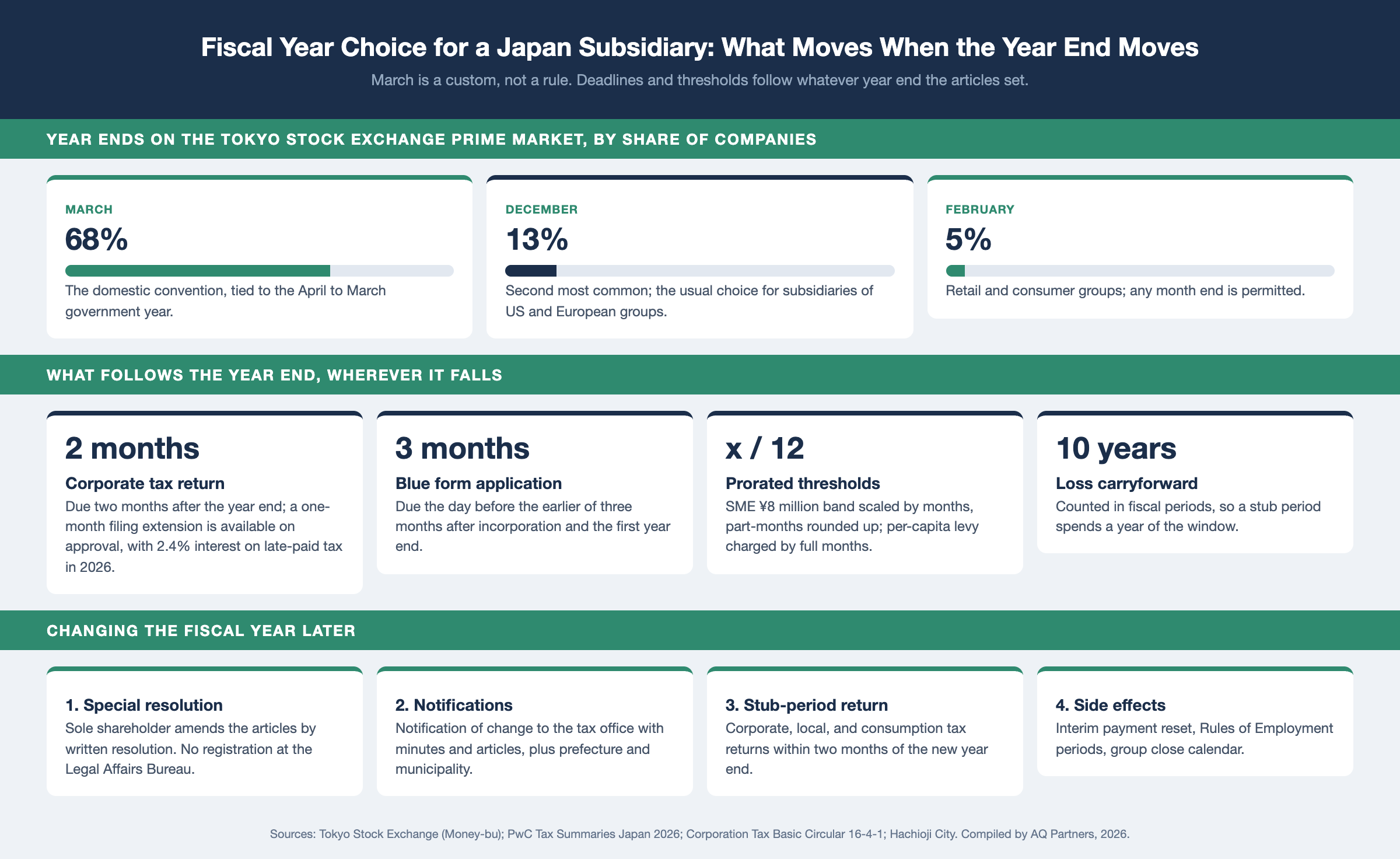
The corporate tax calendar follows the year end wherever it falls. PwC's summary of Japanese tax administration states that the tax year is the accounting period specified in the articles, that the final corporate income and consumption tax returns are due within two months after the end of that period, and that the filing deadline can be extended by one month with approval, while tax paid after the original deadline carries interest at 2.4% per annum for 2026. A December subsidiary files by the end of February, or the end of March on extension.
| Consideration | Year end matched to parent | March year end by Japanese custom |
|---|---|---|
| Group consolidation | Direct, no stub-period cut-off | Quarterly re-cut and a permanent reconciling schedule |
| Budget and forecast cycle | Same cycle as the group | Subsidiary budget spans two group budget years |
| Close and audit calendar | One calendar for the group team | Japan close lands in the group's Q1 reporting window |
| Japanese counterparties | Accepted without comment; December is the second most common year end | Familiar to Japanese lenders and partners |
| Tax return timing | Two months after the group year end, one-month extension available | Return due end of May, extendable to end of June |
| Loss carryforward counting | Follows the group's own year count | Ten-year window counts Japanese fiscal years, misaligned with group loss tracking |
| Payroll year-end adjustment | Calendar year regardless, so no effect | Calendar year regardless, so no effect |
What a Short First Period Does to Deadlines and Thresholds
A mid-year incorporation gives a first fiscal period shorter than twelve months, and Japanese tax law scales several thresholds to it by month. Three of these rules surprise headquarters teams.
The SME reduced-rate band shrinks. A company with capital of ¥100 million or less pays the reduced 15% national rate on the first ¥8 million of income. Where the fiscal period is shorter than a year, the ¥8 million is multiplied by the number of months in the period and divided by twelve, with a partial month counted as a full month, as set out in Corporation Tax Basic Circular 16-4-1. A six-month first period gets a ¥4 million band. This is academic for a subsidiary wholly owned by a parent with capital of ¥500 million or more, which loses SME treatment anyway.
The per-capita levy is charged by the month. The corporate inhabitant tax per-capita levy (均等割, kintouwari) is an annual amount, from ¥70,000 at the smallest band in Tokyo, prorated for a short period by months of existence over twelve, with any part-month shorter than a full month dropped, as Hachioji City's corporate inhabitant tax guidance illustrates. A five-and-a-half-month first period pays five twelfths.
The blue form deadline can arrive before the first quarter ends. The application for blue form status is due by the day before the earlier of two dates: three months after incorporation, and the end of the first fiscal period. The consequences of missing it, including the loss of the loss carryforward for the first period, are covered in the guide to post-incorporation filings in Japan. With a first period of under three months the year end comes first, so the application must be filed before the period closes.
Consumption tax status is also judged per period. Capital of ¥10 million or more makes the company a taxpayer from the first period, and a subsidiary more than 50% controlled by a shareholder whose taxable sales exceed ¥500 million is taxable regardless, under National Tax Agency tax answer 6531.
First-Period Deadlines by Parent Year End
The first return and the blue form deadline follow the year end, so one incorporation date gives different first-year calendars by parent year end. The table uses two incorporation dates for four common year ends.
| Parent year end | Incorporation date | First fiscal period | Months for the ¥8 million band | First return due (before extension) | Blue form deadline |
|---|---|---|---|---|---|
| December | 15 July 2026 | 15 Jul to 31 Dec 2026 | 6 of 12 | 28 Feb 2027 | 14 Oct 2026 |
| December | 10 November 2026 | 10 Nov to 31 Dec 2026 | 2 of 12 | 28 Feb 2027 | 30 Dec 2026 |
| March | 15 July 2026 | 15 Jul 2026 to 31 Mar 2027 | 9 of 12 | 31 May 2027 | 14 Oct 2026 |
| June | 15 July 2026 | 15 Jul 2026 to 30 Jun 2027 | 12 of 12 | 31 Aug 2027 | 14 Oct 2026 |
| September | 15 July 2026 | 15 Jul to 30 Sep 2026 | 3 of 12 | 30 Nov 2026 | 29 Sep 2026 |
| September | 10 October 2026 | 10 Oct 2026 to 30 Sep 2027 | 12 of 12 | 30 Nov 2027 | 9 Jan 2027 |
A very short first period, such as the November incorporation in the table, cannot be avoided by choosing a later first year end, because a period may not exceed twelve months. Groups that control the incorporation date often place it just after the year end so the first period is a full year. The full first-year sequence with owners is in the guide to the first-year headquarters calendar for a new Japan subsidiary.
Changing the Fiscal Year Later: Procedure and Filings
A subsidiary can change its fiscal year at any time by amending its articles, and no registration is needed since the fiscal year is not registered. The work is a resolution, a set of notifications, and a stub-period return; the trap is the stub period.
The amendment is a special resolution of the shareholders' meeting, which a sole corporate shareholder passes by written resolution. A notification of change (異動届出書, idou todokedesho) goes to the tax office with a copy of the minutes and the amended articles, and equivalent notices go to the prefectural tax office and the municipality. According to RSM Shiodome Partners' guide to changing a stock company's fiscal year, no statutory deadline applies to the notification, but it should precede the return for the shortened period. That stub period ends on the new year end, with corporate, local, and consumption tax returns due within two months.
Three side effects belong in the board paper. The ten-year loss carryforward window counts fiscal periods, so a stub period spends a year of it, as explained in the guide to tax loss carryforward rules in Japan. Interim tax payments are based on the previous period, so a short one distorts the next instalment. And any Rules of Employment or bonus provision defined by the fiscal year needs a matching amendment.
| Step | Owner | Timing |
|---|---|---|
| Board paper: new year end, stub period length, effect on group reporting and loss carryforwards | Group controller | At least one quarter before the intended new year end |
| Special resolution of the sole shareholder amending the articles | HQ counsel drafts; parent signs | Before the stub period ends |
| Updated articles with a supplementary provision describing the transitional period | Japan counsel or provider | Same day as the resolution |
| Notification of change to the tax office with minutes and articles | Provider prepares; representative director signs | Promptly after the resolution, before the stub-period return |
| Notifications to the prefectural tax office and municipality | Provider | Same time as the tax office notice |
| Stub-period accounts and corporate, local, and consumption tax returns | Provider prepares; HQ approves | Within two months of the new year end, or three with extension |
| Reset of interim payment schedule and tax provision in the group package | Group tax | With the stub-period return |
| Amendment of Rules of Employment and bonus plan periods | HR, with the labor consultant | Before the new fiscal year begins |
| Update of the group close calendar and audit instructions | Group controller | Before the first close on the new calendar |
A KK and a GK both fix the fiscal year in their articles and change it the same way; the governance points that do differ are in the guide to KK vs GK for a wholly owned subsidiary of a multinational, and the place of this decision in the whole sequence is in the guide to setting up a Japan subsidiary as a multinational.
Frequently Asked Questions
Can a Japan subsidiary have a December year end?
Yes. Any period of up to twelve months set in the articles is allowed, and 13% of Tokyo Stock Exchange Prime companies close in December. The corporate tax return is then due at the end of February, or the end of March with a one-month extension.
Does changing the fiscal year require registration at the Legal Affairs Bureau?
No. The fiscal year is not a registered matter, so the change is made by a special shareholder resolution amending the articles and by notifications to the tax office, the prefecture, and the municipality.
Is a short first fiscal period a problem?
It is manageable. It brings forward the first return and the blue form deadline, prorates the SME reduced-rate band and the per-capita levy by month, and uses a year of the loss carryforward window.
Working with AQ Partners. Our Tokyo team provides back office operations for foreign companies operating in Japan, covering the requirements described above end to end, from the articles and first-period filings to the stub-period return when a fiscal year changes. Book a consultation to review your Japan setup plan.

Yuga Koda is a founding Director at AQ Partners, supporting foreign companies, funds, and families operating in Japan. His experience operating companies in both Japan and international markets gives him a practical understanding of back office operations from both sides.