
KK vs GK for a Wholly Owned Subsidiary of a Multinational: Check-the-Box, Perception, and Governance

For a multinational choosing between a kabushiki kaisha (株式会社, KK) and a goudou kaisha (合同会社, GK) for its wholly owned Japan subsidiary, the decision turns on three things a founder never has to weigh: how the entity is classified for the parent's home-country tax, how much governance the group is prepared to run for a single-shareholder company, and how Japanese customers, banks, and recruits will read the name on the door. Both forms give the parent limited liability and both pay Japanese corporate tax the same way. The differences sit in US entity classification, in the annual mechanics the Companies Act imposes, and in perception. This guide sets out those differences for the group tax, legal, and finance team, and gives a default answer by group profile.
Key Takeaways
- A KK is a per se corporation for US tax; a GK can check the box. The US entity classification regulations list "Japan, Kabushiki Kaisha" as a corporation that cannot elect otherwise. A GK is an eligible entity that can file Form 8832 to be treated as disregarded, which lets a US parent consolidate Japanese results directly.
- The GK election must be filed; the default is corporate treatment. A foreign eligible entity whose owner has limited liability defaults to an association taxable as a corporation. The election can be made effective up to 75 days before filing, so the group tax team should calendar it against the registration date.
- A KK carries an annual governance cycle; a GK does not. A KK must hold a shareholders' meeting every year, which a sole shareholder passes by written resolution, and its directors serve fixed terms that must be renewed and re-registered. A GK has no meeting, no terms, and no public notice of accounts.
- Perception still favours the KK outside technology and consumer sectors. More than 90% of existing Japanese corporations are KKs. Enterprise customers, public tenders, banks, and senior Japanese executives know the form; the GK is accepted but reads as smaller.
- Formation cost is not the deciding factor. A KK costs roughly ¥180,000 to ¥250,000 in statutory fees against ¥60,000 to ¥100,000 for a GK. Converting a GK to a KK later costs ¥500,000 to ¥1,500,000 and 4 to 8 weeks, so the choice should be made once, at headquarters.
The US Classification Rule That Decides Most Cases
For a US-parented group the entity choice is settled by the check-the-box regulations, because only a GK can be treated as a disregarded entity. The regulations at 26 CFR 301.7701-2 list the foreign entities that are always corporations for federal tax purposes, and the Japan entry reads "Japan, Kabushiki Kaisha". A KK therefore files as a foreign corporation from the parent's perspective, and its profits reach the US return only through the controlled foreign corporation rules. A GK is not on the list, so it is an eligible entity that can elect its classification on Form 8832.
Two mechanics matter to the group tax calendar. First, the election is not automatic. Under 26 CFR 301.7701-3, a foreign eligible entity whose members all have limited liability defaults to an association taxable as a corporation, so a GK that never files Form 8832 is treated like a KK. Second, the effective date on the form cannot be more than 75 days before the date the election is filed, nor more than 12 months after, and once an entity changes its classification by election it cannot change again for 60 months. The practical sequence is to register the GK, obtain its registration certificate, and file Form 8832 within 75 days so the election takes effect from incorporation day.
The benefits of disregarded treatment are the ones US groups expect from any foreign LLC: Japanese income and losses flow directly into the parent's return, Japanese corporate tax is available as a direct foreign tax credit rather than through the indirect rules, and intercompany transactions between parent and subsidiary disappear for US purposes. That combination is why so many US technology and consumer groups run their Japanese operations as GKs.
For a UK, German, or Singaporean parent the point does not arise: those systems treat a GK and a KK alike, and the decision turns on governance and perception.
Governance Load for a Single-Shareholder Company
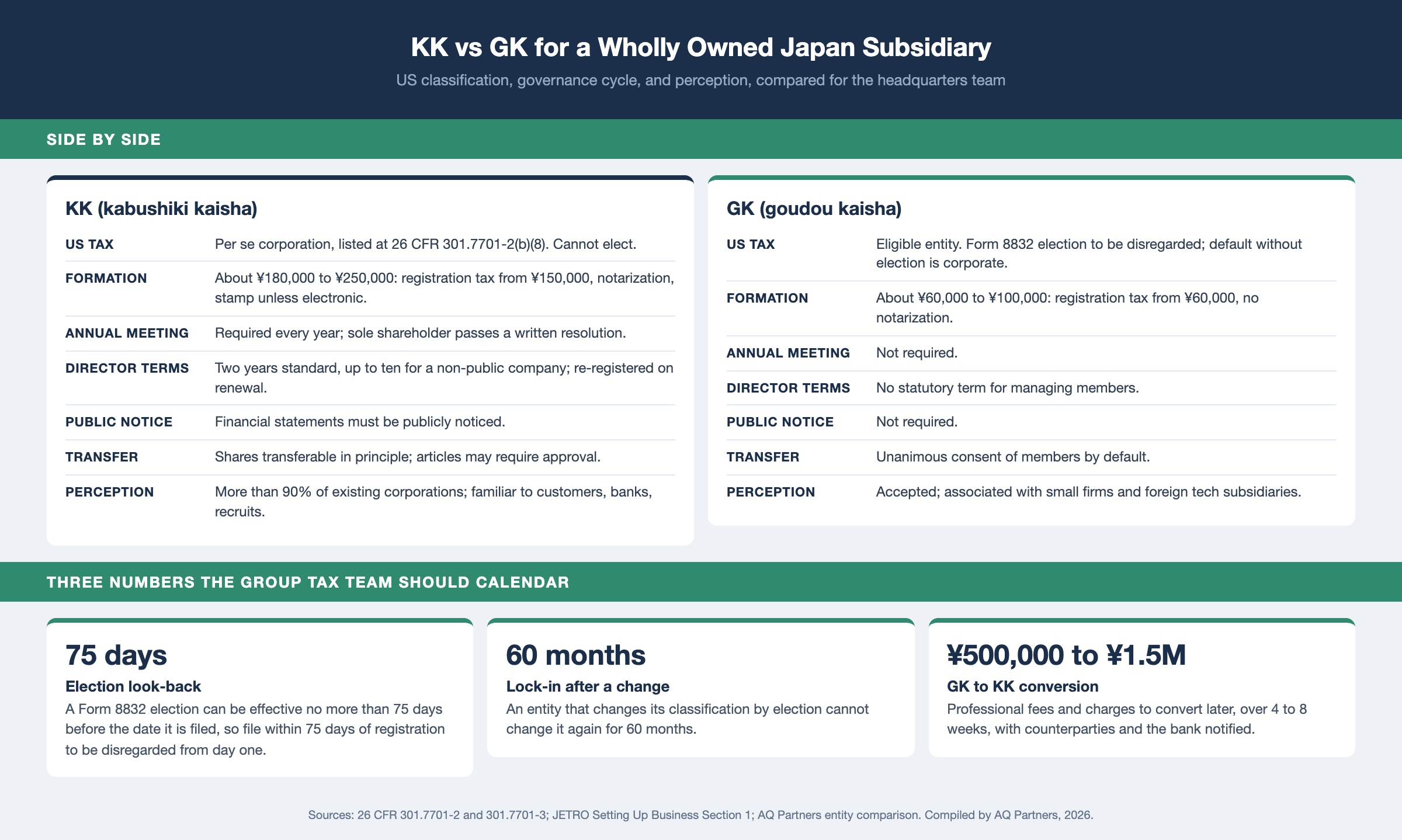
A KK imposes an annual cycle of meetings, terms, and registrations even with one shareholder and one director; a GK imposes almost none. JETRO's comparison of the KK and GK forms records the core differences: a KK's regular shareholders' meeting "in principle, must be held every year", while for a GK it is "not required"; KK director terms run from 1 to 10 years and are extendable up to 10 for non-public companies, while a GK has "no legally stipulated term".
In a KK owned by one shareholder the annual meeting is a formality passed by written resolution, but it still has to be minuted, and the approved financial statements still have to be filed and, under the Companies Act, publicly noticed. The standard director term is two years, extendable to ten by the articles for a non-public company, and every expiry or reappointment is a registration at the Legal Affairs Bureau with a fee and a two-week deadline. A KK that adopts a board of directors needs three or more directors and must appoint a statutory auditor (監査役, kansayaku), as explained in the guide to kansayaku requirements in Japan; most subsidiaries avoid this by having one or two directors and no board.
A GK is run by its members (社員, shain), with management delegated to one or more managing members (業務執行社員, gyoumu shikkou shain) and a representative member (代表社員, daihyou shain). There is no shareholders' meeting, no term of office, and no public notice of accounts, and JETRO's overview of business forms in Japan notes that a GK may set its own procedures for preparing and approving financial statements in its articles. For a parent that will hold 100% and appoint its own executives, the GK removes an entire compliance workstream.
One rule applies to both. Since March 2015 the Legal Affairs Bureaus accept incorporations without a representative resident in Japan, as recorded in K&L Gates' alert on the change, but a resident with a registered seal is still needed for the bank, the lease, and any licence. The guide to representative director residency and nominee directors covers that arrangement for either form.
Share Transfers, Conversion, and Perception
KK shares transfer more easily than a GK interest, and the KK is the form Japanese counterparties expect, so groups planning a listing lean KK. JETRO records that KK shares "may be transferred freely in principle", with the articles able to require board or company approval, whereas a GK interest transfer requires "unanimous approval of equity participants". For a wholly owned subsidiary that consent is a formality, but it becomes a real constraint the moment a second shareholder is contemplated.
Perception is the factor headquarters most often underweights. More than 90% of existing Japanese corporations are KKs, and while GKs made up roughly 29% of new incorporations in 2025, they remain associated with small businesses and foreign technology subsidiaries. Enterprise procurement teams, public-sector tenders, megabanks extending credit, and senior Japanese executives being recruited all recognise the KK immediately. In sectors that sell to large Japanese corporates, a GK can prompt questions about permanence that a KK never does.
Conversion in either direction is possible but is an organisational change, not a form. Converting a GK into a KK requires a member resolution, new articles, and a fresh registration, and realistically costs ¥500,000 to ¥1,500,000 in professional fees and charges over 4 to 8 weeks. The founder-focused analysis of that process, along with the branch and representative office options, is in the full four-way comparison.
The table below puts the two forms side by side for a wholly owned subsidiary of a multinational.
| Point of comparison | KK (kabushiki kaisha) | GK (goudou kaisha) |
|---|---|---|
| US entity classification | Per se corporation; cannot elect | Eligible entity; Form 8832 election to be disregarded or a partnership |
| Default US treatment without an election | Corporation | Corporation (owner has limited liability); election needed |
| Statutory formation cost | About ¥180,000 to ¥250,000: registration tax from ¥150,000, notarization ¥30,000 to ¥50,000, ¥40,000 stamp unless electronic articles | About ¥60,000 to ¥100,000: registration tax from ¥60,000, no notarization |
| Annual shareholders' or members' meeting | Required every year; sole shareholder may pass a written resolution | Not required |
| Director or manager terms | Two years standard, extendable to ten for a non-public company; re-registration on each renewal | No statutory term |
| Statutory auditor (kansayaku) | Required if a board of directors is set up (three or more directors) | Not applicable |
| Public notice of financial statements | Required | Not required |
| Transfer of shares or interest | Free in principle; articles may require approval | Unanimous consent of members by default |
| Perception with customers, banks, recruits | Familiar; more than 90% of existing corporations | Accepted; associated with small firms and foreign tech subsidiaries |
| Japanese corporate tax | Same | Same |
| Later conversion | KK to GK possible but rare | GK to KK: ¥500,000 to ¥1,500,000 and 4 to 8 weeks |
Which Form by Group Profile
The right form follows from the parent's jurisdiction, the subsidiary's customers, and whether a second shareholder or listing is plausible. The table gives the default that most groups in each profile reach, and the reason.
| Group profile | Default form | Reason |
|---|---|---|
| US software or internet group selling to businesses | GK | Check-the-box consolidation; customers already used to GK subsidiaries in the sector |
| US consumer brand with retail or distribution partners | GK, KK where department stores or trading houses insist | Flow-through treatment; perception risk is real with traditional retail partners |
| European industrial or engineering group selling to Japanese manufacturers | KK | No US tax point; enterprise procurement and long supply contracts favour the familiar form |
| Regulated financial or insurance business | KK | Licensing bodies and counterparties expect a KK; board and kansayaku often required anyway |
| Planned joint venture with a Japanese partner | KK | Share classes, board seats, and transfer approval clauses are KK tools; GK unanimity blocks flexibility |
| Subsidiary that may raise outside capital or list in Japan | KK | Only a KK can list; converting later costs time and money during a process that cannot afford it |
Whichever form the group picks, capital is set by the same thresholds and the funding mix carries the same filings; the guide to funding a Japan subsidiary covers that decision, and the guide to delegation of authority in a Japan subsidiary covers the approval matrix for either form. The full sequence of headquarters decisions is in the headquarters playbook for setting up a Japan subsidiary.
Frequently Asked Questions
Can a US parent make a KK a disregarded entity?
No. A KK appears in the per se corporation list at 26 CFR 301.7701-2(b)(8) and cannot elect its classification. Only a GK, which is not listed, can file Form 8832 to be disregarded. A US group that wants flow-through treatment must choose a GK from the outset or accept a conversion later.
Is a GK automatically disregarded once the US parent owns it?
No. A foreign eligible entity whose owner has limited liability defaults to corporate treatment, so the GK must file Form 8832. The election can be effective up to 75 days before the filing date, and after an election to change classification the entity cannot change again for 60 months.
Does a wholly owned KK really need an annual shareholders' meeting?
Yes, every year, although a sole shareholder satisfies it by a written resolution approving the financial statements and any appointments. Minutes must be kept, and director reappointments on expiry of the two-year standard term must be registered. A GK has no equivalent.
Working with AQ Partners. Our Tokyo team provides back office operations for foreign companies operating in Japan, covering the requirements described above end to end, from KK and GK incorporation to the annual corporate secretarial cycle. Book a consultation to review your Japan setup plan.

Yuga Koda is a founding Director at AQ Partners, supporting foreign companies, funds, and families operating in Japan. His experience operating companies in both Japan and international markets gives him a practical understanding of back office operations from both sides.