
Funding a Japan Subsidiary: Capital vs Parent Loan vs Intercompany Services, and How to Repatriate Profits
Funding a Japan subsidiary means choosing how the foreign parent puts money into its Japanese kabushiki kaisha (株式会社, KK) or goudou kaisha (合同会社, GK), and how it later takes that money back out. There are three routes in: paid-in capital, a loan from the parent, and intercompany charges for services or intellectual property. There are five routes out: dividends, interest, royalties, service fees, and a return of capital. Each route carries a different registration cost, a different tax deduction, a different withholding rate, and a different filing under the Foreign Exchange and Foreign Trade Act (外国為替及び外国貿易法, FEFTA). This guide is written for the parent-company finance team that has to decide the mix before the subsidiary's first bank transfer, and it gives the thresholds, rates, and deadlines you need to model each route.
Key Takeaways
- Capital is the simplest route in and the hardest route out. Paid-in capital costs a 0.7% registration and licence tax on any increase (minimum ¥30,000), creates no deduction, and can only be returned through a capital reduction that may be partly taxed as a deemed dividend.
- Parent loans are deductible up to two ceilings. Interest on related-party debt above three times the parent's equity stake is non-deductible under thin capitalization rules, and net interest paid to lenders outside Japan above 20% of adjusted taxable income is non-deductible under earnings stripping rules, unless net interest is ¥20 million or less.
- Intercompany fees and royalties are deductible only at arm's length. Management fees and royalties paid to the parent reduce Japanese taxable income, but the National Tax Agency (国税庁, NTA) tests them under transfer pricing rules and the subsidiary must be able to show what it received.
- Every route out starts at 20.42% withholding. Dividends, interest, and royalties paid to a foreign parent are withheld at 20.42% under domestic law, reduced only if the treaty form is filed before payment. The US treaty takes qualifying parent-subsidiary dividends to 5% or 0%.
- FEFTA filings apply to money, not just shares. A parent loan with a term over one year is inward direct investment once the balance exceeds ¥100 million and, together with any bonds the parent holds, exceeds half of the subsidiary's liabilities. It needs a prior notification in designated sectors or a post-investment report within 45 days, filed through the Bank of Japan.
The Three Ways Money Goes Into a Japan Subsidiary
A foreign parent can fund a Japan subsidiary with paid-in capital, a parent loan, or intercompany charges, and each changes tax and filings. The choice is rarely all-or-nothing. Most foreign-owned subsidiaries in Japan run on a mix: enough capital to satisfy banks, landlords, and immigration, a parent loan to cover the loss-making years, and a services or licence agreement once the subsidiary is generating revenue.
The mix is visible in the national statistics. According to the Japan External Trade Organization's 2025 Invest Japan Report, Japan's inward foreign direct investment stock reached ¥53.3 trillion at the end of 2024, or 8.7% of GDP. Of that stock, equity capital was ¥25.0 trillion, reinvested earnings ¥9.5 trillion, and debt instruments ¥18.8 trillion. The debt share has risen from 13.4% of the stock in 2014 to 35.3% in 2024, while the equity share fell from 64.8% to 47.0%. Foreign parents are funding Japanese affiliates with proportionally more debt than a decade ago, which is exactly why the interest deduction limits described in this guide matter more than they used to.
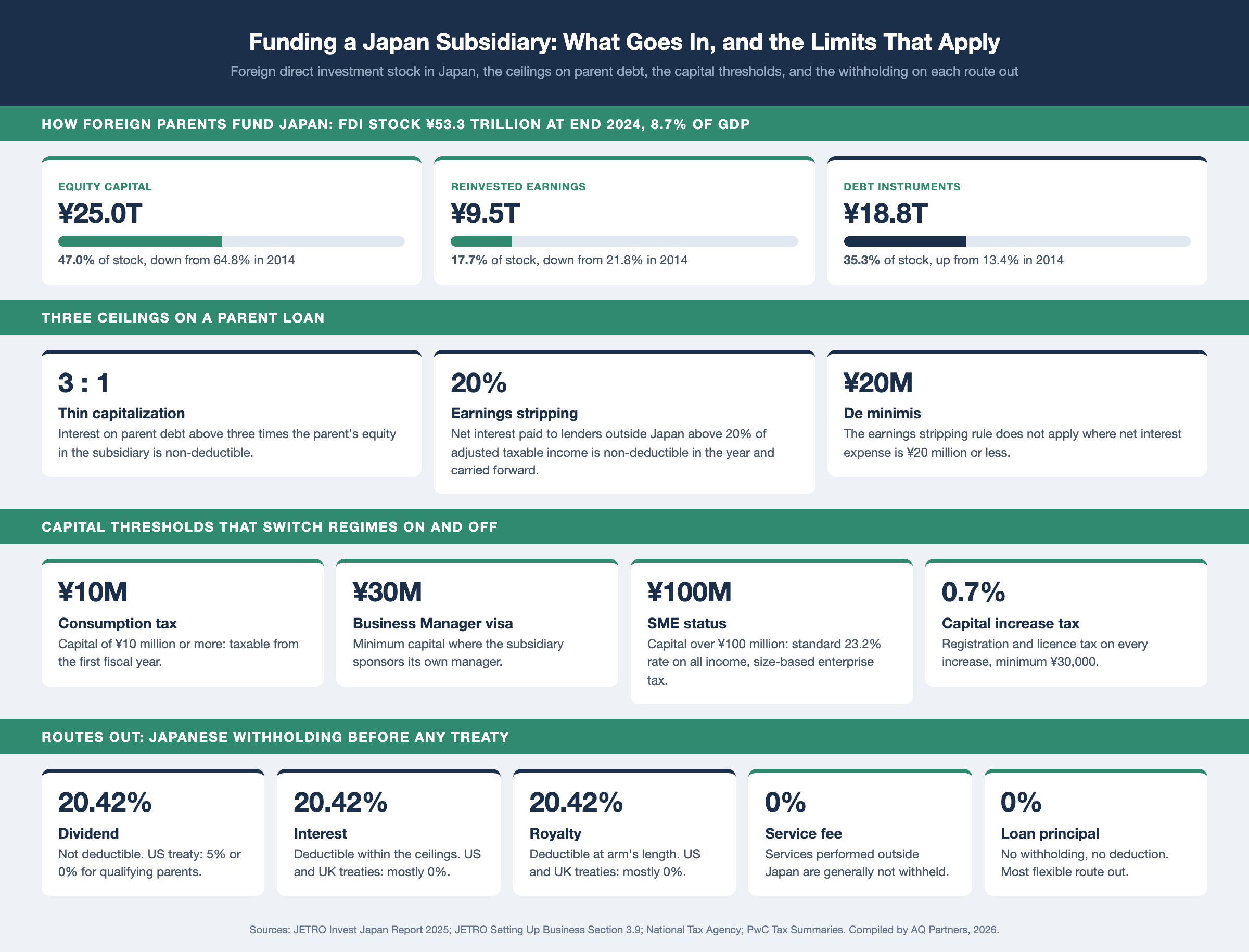
The table below compares the three routes on the criteria that decide the choice: cost at funding, tax treatment, withholding on the return flow, the filings triggered, and how each route interacts with the capital thresholds that Japanese tax and immigration law key off.
| Criterion | Paid-in capital | Parent loan | Intercompany services or royalties |
|---|---|---|---|
| Cost at funding | Registration and licence tax of 0.7% of the increase, minimum ¥30,000 per application | None at registration; loan agreement and arm's length interest rate required | None; intercompany agreement and transfer pricing support required |
| Deduction for the subsidiary | None | Interest is deductible within thin capitalization and earnings stripping limits | Fees and royalties are deductible if at arm's length and substantiated |
| Withholding on the return flow | Dividends withheld at 20.42%, treaty rate if the form is filed first | Interest withheld at 20.42%, treaty rate if the form is filed first | Royalties withheld at 20.42%, treaty rate if filed; fees for services performed outside Japan are generally not withheld |
| Thin capitalization exposure | Raises the equity base, which increases allowable related-party debt | Counts toward the 3:1 debt-to-equity ceiling | Not applicable |
| Earnings stripping exposure | Not applicable | Net interest paid to lenders outside Japan above 20% of adjusted taxable income is non-deductible, unless net interest is ¥20 million or less | Not applicable |
| Transfer pricing documentation | Not applicable | Interest rate must be arm's length | Fee and royalty rates must be arm's length; documentation thresholds apply |
| Effect on capital thresholds | Capital of ¥10 million or more removes the start-up consumption tax exemption; capital over ¥100 million ends SME treatment | No effect on capital thresholds | No effect on capital thresholds |
| FEFTA treatment | Share subscription is inward direct investment: prior notification or post-investment report | Term over one year, balance above ¥100 million, and loan plus parent-held bonds above half of the subsidiary's liabilities: inward direct investment, prior notification or post-investment report | Not inward direct investment; payments may still be reported through the Bank of Japan |
| Flexibility to return funds | Low: capital reduction requires shareholder resolution, creditor protection procedure, and registration | High: principal repaid on schedule without withholding | High: paid as invoiced, subject to arm's length pricing |
| Typical use | Initial funding, immigration and bank requirements, credibility with customers | Loss-making years, working capital, bridging to profitability | Ongoing group services, brand and technology licences, shared platforms |
Paid-In Capital: Registration Tax and the ¥10 Million and ¥100 Million Thresholds
Paid-in capital is the cheapest route to set up and the most consequential for tax, because Japanese law switches regimes at fixed capital levels. The amount of capital a foreign parent chooses is therefore a tax decision as much as a funding decision, and it should be set deliberately rather than rounded to a convenient figure.
The direct cost is the registration and licence tax (登録免許税, touroku menkyo zei). At incorporation the tax on a KK is 0.7% of capital with a minimum of ¥150,000, and every later capital increase is taxed at 0.7% of the increase with a minimum of ¥30,000 per application, according to the National Tax Agency's registration and licence tax table. A parent that funds ¥50 million of capital at incorporation and adds ¥100 million two years later pays ¥350,000 at incorporation and ¥700,000 on the increase. The same ¥150 million lent instead of subscribed costs nothing to register.
The indirect costs come from three thresholds:
- ¥10 million. A newly formed company with capital of ¥10 million or more is a consumption tax payer from its first fiscal year. A company below that level is generally exempt for its first two fiscal years, but the exemption is lost for the second year if taxable sales in the first six months of the first year exceed ¥10 million, and a foreign-owned subsidiary rarely qualifies at all: a new company more than 50% controlled by a shareholder whose own taxable sales exceed ¥500 million is a taxpayer from day one regardless of its capital. Many subsidiaries also register voluntarily to issue qualified invoices. The mechanics are covered in the guide to consumption tax registration in Japan.
- ¥30 million. A founder or manager who needs a Business Manager visa (経営・管理, keiei kanri) must show capital of at least ¥30 million and at least one full-time employee under the standards in force since 16 October 2025. Where the subsidiary will sponsor its own representative director's residence status, this sets a floor on capital regardless of the tax analysis.
- ¥100 million. A company with paid-in capital over ¥100 million loses small and medium-sized enterprise (SME) treatment. It pays the standard 23.2% national corporate tax rate on all income rather than the reduced 15% rate on the first ¥8 million, it can offset only part of its taxable income with loss carryforwards rather than all of it, and it becomes subject to size-based enterprise tax (外形標準課税, gaikei hyoujun kazei) on capital and payroll even in loss years. A subsidiary is also excluded from SME treatment if it is wholly owned by a parent with capital of ¥500 million or more. The rate mechanics are set out in the guide to corporate income tax in Japan.
The practical consequence is that many foreign parents capitalize the Japanese subsidiary at a level between ¥10 million and ¥100 million, then fund growth with debt or retained earnings. A parent that needs a large equity base for bank covenants or customer credibility can put the excess into capital reserve (資本準備金, shihon junbikin) rather than stated capital. Up to half of any amount paid in for shares may be booked as capital reserve under the Companies Act, and capital reserve does not count toward the ¥100 million stated-capital test for SME status. One qualification applies to subsidiaries of large groups. According to EY Japan's 2026 Japan Tax Reform highlights for inbound businesses, for fiscal years beginning on or after 1 April 2026 a wholly owned subsidiary of a parent whose capital and capital surplus together exceed ¥5 billion becomes subject to size-based enterprise tax where its own capital and capital surplus together exceed ¥200 million, even if its stated capital is ¥100 million or less.
Parent Loans: Thin Capitalization, Earnings Stripping, and Withholding on Interest
A parent loan gives the subsidiary a deductible interest expense, but Japan caps the deduction through two overlapping rules. It also gives the parent a route to take principal back without withholding. Both rules are described in JETRO's guide to corporate taxation on international transactions, and both apply regardless of how the loan is documented.
Thin capitalization: the 3:1 test
Under the thin capitalization rule (過少資本税制, kashou shihon zeisei), where a Japanese company's average debt owed to its foreign controlling shareholder exceeds three times that shareholder's equity in the company, the interest attributable to the excess is non-deductible. The rule counts debt from the controlling foreign shareholder and debt from third parties that the shareholder guarantees; unguaranteed bank debt is outside it. Two further mechanics matter in practice. First, the disallowance applies only where the subsidiary's total debt also exceeds three times its total equity, so a subsidiary with substantial unrelated equity or low overall leverage can pass the test even with heavy parent debt. Second, equity is measured as net assets, but never below the company's capital-related amount (資本金等の額, shihonkin tou no gaku), which includes capital reserve. A loss-making subsidiary therefore keeps a floor under its 3:1 ceiling equal to what the parent paid in, and money booked as capital reserve raises that floor exactly as stated capital does. A subsidiary with ¥30 million of capital and retained earnings of zero can carry ¥90 million of parent debt with full interest deductibility; a ¥200 million parent loan on the same equity base leaves interest on ¥110 million of it non-deductible.
Earnings stripping: the 20% test
Under the earnings stripping rule (過大支払利子税制, kadai shiharai rishi zeisei), net interest paid to lenders outside Japan, including unrelated third parties such as foreign banks, is deductible only up to 20% of the subsidiary's adjusted taxable income, which is broadly taxable income before the interest itself, depreciation, and certain other items. Interest disallowed in one year can be carried forward and deducted in a later year within the same 20% limit. The rule does not apply where net interest expense for the year is ¥20 million or less, or where the combined net interest of the Japanese group is 20% or less of its combined adjusted income. For a loss-making subsidiary the practical effect is severe: adjusted taxable income near zero means almost all interest paid to the parent above ¥20 million is deferred, so the deduction the loan was meant to create does not arrive until the subsidiary turns profitable.
Where both rules produce a disallowance, the larger disallowance applies. Modelling both before setting the loan amount and rate is the single most useful piece of planning a parent can do, because the fix, converting part of the loan to capital or capital reserve, is cheap before the loan is drawn and expensive after.
Arm's length interest and withholding
The interest rate itself must be arm's length. The NTA tests intercompany loan rates under the transfer pricing rules, so a parent should document the rate against comparable third-party borrowing or a recognized benchmark, as described in the guide to transfer pricing documentation in Japan. Interest paid to the foreign parent is then withheld at 20.42% under domestic law, the 20% income tax plus the 2.1% reconstruction surtax. Many treaties reduce this substantially: the Japan-US treaty exempts most interest paid to a US parent, and the Japan-UK treaty does the same for a UK parent, according to PwC's summary of Japanese withholding taxes and treaty rates. The reduction applies only if the treaty application form is filed with the NTA through the subsidiary before the first payment.
Principal repayments carry no withholding and no deduction. That makes a parent loan the most flexible route for returning funds, provided the subsidiary has the cash and the repayment does not breach any bank covenant.
Intercompany Management Fees and Royalties: Deductibility, Transfer Pricing, and Consumption Tax
Group service fees and royalties move profit to the parent as a deductible expense, but only at an arm's length price backed by a real service. Every yen must be supported by a written agreement, a service actually received, and documentation of the price. This route is the one the NTA examines most closely in audits of foreign-owned subsidiaries, because it is the route most easily used to strip Japanese profit.
Three conditions have to hold for a management fee (経営指導料, keiei shidou ryou) or service fee to be deductible in Japan:
- A written intercompany agreement that defines the services, the pricing basis, and the payment terms, signed before the services start.
- Evidence that the subsidiary received a benefit it would otherwise have paid a third party for. Shareholder activities, such as the parent's own board reporting or group consolidation, are not chargeable.
- An arm's length price, typically cost plus a mark-up for routine services, with the allocation key documented.
Royalties for trademarks, software, or technology follow the same logic with one addition: the subsidiary must be able to show that it uses the intangible in earning its income. Royalties paid to a foreign parent are withheld at 20.42% unless a treaty applies; the US and UK treaties reduce the rate on most royalties to zero, again subject to advance filing. Fees for services the parent performs entirely outside Japan are generally outside the withholding net, as explained in the guide to withholding tax on dividends and royalties in Japan.
Consumption tax adds a second layer. Services a foreign parent performs outside Japan are outside the scope of Japanese consumption tax, but cross-border digital services supplied business-to-business are subject to a reverse charge on the Japanese recipient, and the classification decides whether the subsidiary must self-assess 10% on the fee. The rules are covered in the guide to consumption tax on cross-border transactions.
The trade-off against a parent loan is clear. Fees and royalties are deductible without the 3:1 and 20% ceilings, but they require substance and documentation the loan does not, and they are the first item an examiner asks about. A subsidiary that pays a management fee equal to most of its operating profit, year after year, should expect the NTA to ask what it received.
FEFTA Filings Every Foreign Parent Should Expect
FEFTA treats a foreign parent's share subscription and its longer-term loans as inward direct investment, each filed through the Bank of Japan. These filings are separate from tax and company registration, and missing them is a compliance failure in its own right.
According to Pinsent Masons' guide to foreign direct investment in Japan, inward direct investment includes the acquisition of any shares in an unlisted Japanese company, the acquisition of 1% or more of a listed company, and a loan by a foreign investor to a Japanese company with a term exceeding one year and an amount above ¥100 million. The Cabinet Order adds a second condition for loans: the balance of the loan plus any bonds of the company that the investor holds must exceed 50% of the company's total liabilities after the loan. That definition catches the parent's initial subscription, every later capital increase, and any large parent loan to a subsidiary whose other borrowings are modest, which describes most foreign-owned subsidiaries in their early years.
The filing route depends on the subsidiary's business:
- Designated sectors. Where the Japanese company operates in a sector designated for national security or supply-chain reasons, such as defence, energy, telecommunications infrastructure, or semiconductors, the parent files a prior notification and waits out a review period of 30 days, often shortened to two weeks for routine cases and extendable to as long as five months where national security concerns are raised. The transaction cannot close during the waiting period.
- All other sectors. The parent files a post-investment report within 45 days of completing the investment.
Two further points catch foreign parents out. First, the definition is applied per transaction, so a capital increase or a new loan tranche restarts the analysis. Second, a subsidiary that later adds a designated activity, such as offering a telecommunications service alongside its software, can move from the post-report regime into the prior-notification regime for its next funding round. The sector rules and their interaction with licensing are covered in the guide to regulatory barriers to Japan market entry.
The table below collects the thresholds that drive the funding decision in one place.
| Threshold | What it triggers | Route affected | Source of the rule |
|---|---|---|---|
| Capital of ¥10 million or more | Consumption tax payer status from the first fiscal year; also triggered below ¥10 million where the controlling parent's taxable sales exceed ¥500 million | Capital | Consumption Tax Act |
| Capital of ¥30 million or more | Minimum capital for a Business Manager visa applicant | Capital | Immigration Services Agency |
| Capital over ¥100 million | Loss of SME corporate tax treatment; size-based enterprise tax applies | Capital | Corporation Tax Act, Local Tax Act |
| Parent capital of ¥500 million or more | Wholly owned subsidiary excluded from SME treatment regardless of its own capital | Capital | Corporation Tax Act |
| Subsidiary capital plus capital surplus over ¥200 million, parent over ¥5 billion | Size-based enterprise tax from fiscal years beginning 1 April 2026, even with stated capital of ¥100 million or less | Capital | Local Tax Act, 2024 reform |
| Related-party debt over 3 times equity | Interest on the excess non-deductible (thin capitalization) | Parent loan | Special Taxation Measures Act |
| Net related-party interest over 20% of adjusted taxable income | Excess interest non-deductible in the year, carried forward (earnings stripping) | Parent loan | Special Taxation Measures Act |
| Net interest expense of ¥20 million or less | Earnings stripping rule does not apply for the year | Parent loan | Special Taxation Measures Act |
| Loan over ¥100 million with a term over one year, exceeding half of the borrower's liabilities | Inward direct investment: prior notification or post-investment report | Parent loan | FEFTA and Cabinet Order on Inward Direct Investment |
| Post-investment report within 45 days | Filing deadline for investments outside designated sectors | Capital and parent loan | FEFTA |
| Capital increase registration at 0.7%, minimum ¥30,000 | Registration and licence tax on every increase | Capital | Registration and Licence Tax Act |
Getting Cash Out: Dividends, Interest, Royalties, Fees, and Capital Reductions
A Japan subsidiary can return cash to its parent through five routes, and the withholding and deductibility of each differ enough to change the result. The choice can move the group's after-tax outcome by several percentage points. The starting point for every route except loan principal and service fees is 20.42% withholding, reduced by treaty only where the correct form has been filed before payment.
Dividends are the default. A KK may distribute retained earnings as a dividend of surplus (剰余金の配当, jouyokin no haitou) subject to the distributable amount test under the Companies Act, and a GK distributes profit under its articles. The dividend is not deductible for the subsidiary and is withheld at 20.42% under domestic law. The Japan-US treaty reduces the rate to 5% where the US parent holds at least 10% of the voting shares, and to 0% where it has held at least 50% for the six months ending on the dividend entitlement date, a threshold the 2019 protocol lowered from more than 50% held for twelve months. The UK treaty reduces qualifying parent-subsidiary dividends to 0%; other treaties commonly land at 5% or 10% for substantial holdings. The full treaty mechanics, including the forms and the holding-period tests, are set out in the guide to withholding tax on dividends and royalties in Japan.
A capital reduction with distribution (資本の払戻し, shihon no haraimodoshi) is the route for returning funds a parent put in as capital. It requires a shareholder resolution, a creditor protection procedure with a public notice period, and a registration at the Legal Affairs Bureau (法務局, houmukyoku). For tax purposes the distribution is split between a return of capital and a deemed dividend (みなし配当, minashi haitou) in proportion to the company's capital-related amount and its retained earnings, and the deemed-dividend portion is withheld like any other dividend. A subsidiary with large retained earnings therefore cannot return capital tax-free simply by labelling the distribution a capital reduction.
The table below compares the routes.
| Route out | Deductible for the subsidiary? | Japanese withholding before treaty | Main condition or limit | Companies Act procedure |
|---|---|---|---|---|
| Dividend of surplus | No | 20.42% | Distributable amount test; treaty form filed in advance | Shareholder resolution |
| Interest on parent loan | Yes, within thin capitalization and earnings stripping limits | 20.42% | Arm's length rate; disallowed interest carried forward | None |
| Loan principal repayment | Not applicable | None | Cash availability and bank covenants | None |
| Royalty | Yes, if arm's length | 20.42% | Licence agreement; subsidiary must use the intangible | None |
| Management or service fee | Yes, if arm's length and substantiated | Generally none for services performed outside Japan | Written agreement; benefit test; possible consumption tax reverse charge | None |
| Capital reduction with distribution | No | 20.42% on the deemed-dividend portion | Split between return of capital and deemed dividend | Resolution, creditor protection, registration |
| Share buyback by the subsidiary | No | 20.42% on the deemed-dividend portion | Distributable amount test; deemed dividend arises on the excess over capital | Resolution |
| Liquidation distribution | No | 20.42% on the deemed-dividend portion | Only on dissolution; final tax return required | Dissolution and liquidation procedure |
Timing matters as much as route. Withholding on dividends, interest, and royalties must be paid to the tax office by the 10th of the month after payment, and the treaty application form must be filed through the subsidiary by the day before the payment. A parent whose subsidiary pays a dividend in March and files the treaty form in April has withheld at 20.42% and must claim a refund rather than apply the treaty rate. The operational side of withholding is covered in the guide to withholding tax in Japan.
Choosing the Mix by Stage
The right funding mix changes as the subsidiary moves from set-up through losses to profit, and the common mistake is never revisiting it. Structures fixed at incorporation tend to stay fixed. Three stages cover most foreign-owned subsidiaries.
Stage 1, set-up and first year. Capital does the work. Set stated capital at the level immigration, banks, and customers require, typically between ¥10 million and ¥100 million, and put any excess into capital reserve. Keep parent debt minimal until the subsidiary has revenue, because interest on a loss-making subsidiary is largely deferred under earnings stripping and generates withholding with no offsetting deduction. File the FEFTA post-investment report within 45 days of the subscription. The set-up steps are in the guide to company incorporation in Japan.
Stage 2, growth and losses. Fund the losses with a parent loan sized against the 3:1 thin capitalization ceiling, with an arm's length rate and a term over one year documented and reported under FEFTA. Avoid charging management fees that push the subsidiary deeper into loss; the deduction is worthless in a loss year and the fee still attracts scrutiny. Track loss carryforwards, which are usable in full by an SME and in part by a larger company, as set out in the guide to tax loss carryforward rules in Japan.
Stage 3, profitability. Introduce arm's length service and licence agreements for what the parent actually provides, with transfer pricing documentation in place before the first invoice. Repay the parent loan from operating cash to reduce interest disallowance and withholding. Once loss carryforwards are used, model dividends at the treaty rate against retaining earnings in Japan, remembering that reinvested earnings made up 17.7% of Japan's inward FDI stock in 2024 and are the route with no withholding at all.
At each stage, the parent should test the structure against the group's overall position, because a deduction in Japan is only worth having if the corresponding income is taxed at a lower rate at the parent. That comparison is the subject of the guide to Japan tax compliance versus international tax planning.
Frequently Asked Questions
Can a foreign parent lend to its Japan subsidiary interest-free?
A foreign parent can make an interest-free loan, but the NTA can impute arm's length interest under transfer pricing rules and tax the subsidiary as if it had paid it, while the parent receives nothing. Interest-free loans also give the subsidiary no deduction. Most advisers recommend an arm's length rate, documented, with withholding and treaty forms handled from the first payment.
Does a parent loan need FEFTA prior notification?
A loan from a foreign parent to a Japanese company is inward direct investment under FEFTA when its term exceeds one year, its balance exceeds ¥100 million, and the loan plus any bonds the parent holds exceed half of the company's total liabilities. It then requires prior notification only if the Japanese company operates in a designated sector; otherwise a post-investment report within 45 days of the loan is sufficient. Shorter or smaller loans fall outside the definition but may still be reported as cross-border payments.
Is management fee income from a Japan subsidiary taxed in Japan?
A management fee paid to a foreign parent for services performed entirely outside Japan is generally not subject to Japanese withholding tax and is not Japan-source income for the parent. The fee is deductible for the subsidiary only if it is arm's length, covered by a written agreement, and supported by evidence that the subsidiary received a service it would otherwise have paid for. Digital services may trigger a consumption tax reverse charge on the subsidiary.
How much capital should a foreign-owned KK have?
Most foreign-owned KKs set stated capital between ¥10 million and ¥100 million. Below ¥10 million the company can be exempt from consumption tax for its first two fiscal years, although a subsidiary of a parent with taxable sales above ¥500 million is taxable regardless; at ¥30 million or more it satisfies the Business Manager visa capital requirement; above ¥100 million it loses SME corporate tax treatment and becomes subject to size-based enterprise tax. Amounts beyond the target can be booked as capital reserve, which does not count toward the ¥100 million corporate tax test, although a wholly owned subsidiary of a large group faces a separate ¥200 million capital-plus-surplus test for size-based enterprise tax from fiscal years beginning 1 April 2026.
Working with AQ Partners. Our Tokyo team provides bank payment support, monthly bookkeeping and annual tax filings for foreign companies operating in Japan, so the books and filings your zeirishi works from are right. Book a consultation to discuss your situation.


Yuga Koda is a founding Director at AQ Partners, supporting foreign companies, funds, and families operating in Japan. His experience operating companies in both Japan and international markets gives him a practical understanding of back office operations from both sides.