
Consumption Tax Registration in Japan: When and How to Register

Consumption tax registration in Japan determines whether a company must charge, collect, and remit the 10% consumption tax (消費税, shōhizei) on its sales. The registration threshold is ¥10 million in taxable sales during the base period—the fiscal year two years prior—but multiple exceptions exist for newly incorporated companies, high-capital entities, and businesses that elect voluntary registration. Understanding when registration is required, when it is optional, and which calculation method to elect are among the most important tax planning decisions for foreign companies entering the Japanese market.
Key Takeaways
- The ¥10 million base period threshold determines mandatory registration—companies whose taxable sales exceeded ¥10 million in the fiscal year two years prior (the “base period”) are automatically classified as taxable enterprises and must register, file returns, and remit consumption tax.
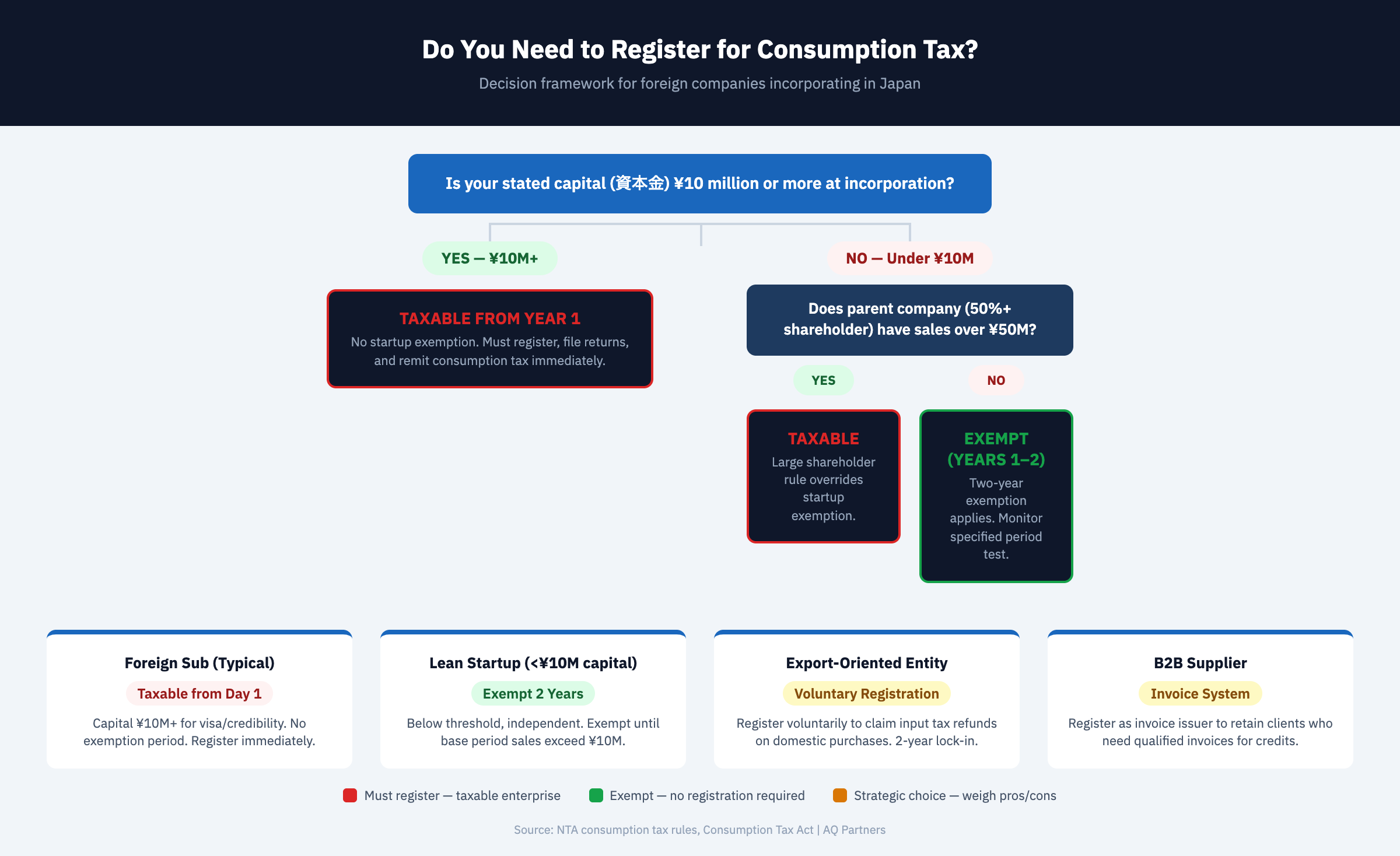
- Newly incorporated companies are generally exempt for two fiscal years—with a critical exception—if the company's stated capital at incorporation is ¥10 million or more, consumption tax obligations begin from the first fiscal year, eliminating the startup exemption.
- A six-month “specified period” test can override the base period exemption—if taxable sales or taxable payroll in the first six months of the preceding fiscal year exceed ¥10 million, the company becomes a taxable enterprise in the current year regardless of base period sales.
- Voluntary registration enables input tax credit recovery but creates a two-year lock-in—companies below the ¥10 million threshold can elect to register voluntarily to claim consumption tax refunds on purchases, but the election cannot be revoked for at least two fiscal years.
- The Simplified Tax System offers administrative relief for companies with sales under ¥50 million—this method calculates input tax credits as a fixed percentage of output tax (40–90% depending on industry), eliminating the need to track actual input tax on every purchase.
The ¥10 Million Base Period Threshold
Companies whose taxable sales in the base period exceed ¥10 million are classified as taxable enterprises and must register for consumption tax. The base period is the fiscal year that ended two full fiscal years before the current one.
For a company with a March 31 fiscal year end, the base period for fiscal year 2026 (April 2025 – March 2026) is fiscal year 2024 (April 2023 – March 2024). If the company's taxable sales in that base period exceeded ¥10 million, it must register as a consumption tax taxpayer for fiscal year 2026. Taxable sales include all sales subject to the standard 10% or reduced 8% consumption tax rate, but exclude exempt transactions such as residential rent and financial services.
According to PwC's Japan tax summary, approximately 60% of Japanese corporations are classified as tax-exempt enterprises—primarily small businesses with sales below the ¥10 million threshold. For foreign companies establishing Japanese subsidiaries, this proportion is less relevant because most foreign subsidiaries exceed the threshold quickly or trigger the capital-based exception described below.
Special Rules for Newly Incorporated Companies
Newly incorporated companies with no base period are generally treated as tax-exempt enterprises for their first two fiscal years. However, three important exceptions can override this exemption.
Capital-Based Exception
If a company's stated capital (資本金) is ¥10 million or more at the time of incorporation, consumption tax obligations begin immediately from the first fiscal year. This exception is particularly relevant for foreign companies because most foreign subsidiaries are capitalized well above ¥10 million. Companies established as a Kabushiki Kaisha (KK) for visa eligibility purposes often set capital at ¥5 million to ¥30 million, with the October 2025 Business Manager Visa reform now requiring ¥30 million for new visa applicants.
Specified Period Test
Even if the base period exemption applies, a company becomes a taxable enterprise if its taxable sales in the first six months of the immediately preceding fiscal year (the “specified period”) exceed ¥10 million. Alternatively, if the taxable payroll paid during that six-month period exceeds ¥10 million, the same result applies. The company can choose to use either the sales test or the payroll test—whichever is more favorable.
Large Shareholder Rule
A newly incorporated company is not eligible for the startup exemption if more than 50% of its shares are held by an entity (or group of related entities) whose taxable sales in the base period exceeded ¥50 million. This rule targets subsidiaries of large groups that would otherwise exploit the startup exemption by creating new entities.
| Scenario | Capital at Incorporation | Parent Company Sales | Year 1 Status | Year 2 Status |
|---|---|---|---|---|
| Small independent company | Under ¥10M | N/A | Exempt | Exempt (unless specified period test triggered) |
| Foreign subsidiary (typical) | ¥10M or more | Any | Taxable | Taxable |
| Low-capital subsidiary of large group | Under ¥10M | Over ¥50M | Taxable (large shareholder rule) | Taxable |
| Small company, fast growth | Under ¥10M | Under ¥50M | Exempt | Taxable if specified period test triggered |
| Voluntary registrant | Under ¥10M | N/A | Taxable (by election) | Taxable (locked in for 2 years minimum) |
| Invoice system registrant | Under ¥10M | N/A | Taxable (registration as invoice issuer creates taxable status) | Taxable |
Voluntary Registration: Pros and Cons
Companies below the ¥10 million threshold can elect to become taxable enterprises by filing a Consumption Tax Taxable Enterprise Election Form (消費税課税事業者選届出書) with the tax office before the start of the fiscal year in which they wish to become taxable.
Voluntary registration is beneficial in three main scenarios. First, companies making significant capital investments (equipment, office buildout, inventory) can recover the consumption tax paid on those purchases through input tax credits. Second, export-oriented companies benefit from zero-rated export sales combined with full input tax credit recovery—creating net refund positions. Third, under the Qualified Invoice System, B2B suppliers may need to register to retain clients who require qualified invoices for their own input tax credit claims.
The primary downside is a two-year lock-in: once elected, the company cannot revoke its taxable enterprise status for at least two fiscal years. During this period, the company must charge consumption tax on all sales, file returns, and remit the net tax to the NTA—even if it would otherwise qualify for exemption. Companies should model the financial impact before electing, comparing the input tax credit benefit against the administrative cost and cash flow impact of remitting consumption tax.
The Simplified Tax System Election
Companies with base period taxable sales of ¥50 million or less may elect the Simplified Tax System (簡易課税制度), which replaces actual input tax tracking with deemed purchase rates ranging from 40% to 90% based on industry classification.
The election must be filed by the day before the fiscal year starts and is binding for at least two years. Companies should compare their actual input tax ratio against the deemed rate for their industry classification before electing. Service companies (Type 5, 50% deemed rate) and real estate companies (Type 6, 40% deemed rate) with low actual purchase ratios may find the Simplified Tax System increases their effective tax burden. Conversely, wholesale companies (Type 1, 90% deemed rate) almost always benefit. The full rate schedule and industry classifications are detailed in the consumption tax pillar guide.
Registration Procedures and Filing Requirements
Once a company becomes a taxable enterprise—whether by exceeding the threshold, incorporation with ¥10 million+ capital, or voluntary election—specific filing and notification requirements apply.
- Taxable Enterprise Notification: Companies exceeding the ¥10 million threshold must file a Consumption Tax Taxable Enterprise Notification (消費税課税事業者届出書) with the tax office by the end of the fiscal year in which the threshold was exceeded.
- Qualified Invoice Issuer Registration: Separate from the taxable enterprise notification, companies should file the Qualified Invoice Issuer Registration Application to receive a T-number and issue credit-eligible invoices.
- Simplified Tax System Election: If electing the Simplified Tax System, file the Simplified Tax System Election Form (消費税簡易課税制度選択届出書) by the day before the target fiscal year begins.
- Annual Return Filing: Consumption tax returns are due within two months after the fiscal year end. The filing deadlines guide covers interim payment schedules and penalty provisions.
All forms can be filed electronically through the NTA's e-Tax system or in paper at the competent tax office. Foreign companies typically coordinate these filings through their Japanese tax accountant (税理士, zeirishi), who handles both the technical calculations and the Japanese-language documentation requirements.
Strategic Considerations for Foreign Companies
Foreign companies should make consumption tax registration decisions as part of their broader Japan market entry planning, considering capital structure, supplier relationships, and business model.
The capital structure decision directly affects consumption tax timing. Setting stated capital below ¥10 million preserves the two-year startup exemption but may affect bank account opening, visa eligibility, and business credibility. Companies can set a portion of investment as capital reserve (資本準備金) rather than stated capital to keep the stated capital figure below ¥10 million while still demonstrating financial strength.
For companies expecting net refund positions—common during the setup phase when investment spending exceeds revenue—voluntary registration from day one ensures immediate recovery of consumption tax on setup costs including office leasing, equipment, professional fees, and initial inventory. The NTA processes refund claims within approximately one to two months of filing, providing a meaningful cash flow benefit during the high-spending startup phase.
Navigating consumption tax registration alongside entity formation, post-incorporation filing requirements, and Qualified Invoice System compliance requires coordinated planning. AQ Partners handles consumption tax registration, method elections, and ongoing compliance as part of our comprehensive back office services for foreign companies in Japan. Contact us at hello@aqpartners.jp.

Yuga Koda is a founding Director at AQ Partners, supporting foreign companies, funds, and families operating in Japan. His experience operating companies in both Japan and international markets gives him a practical understanding of back office operations from both sides.