
Japan Qualified Invoice System (Invoice Seido): What Foreign Companies Must Know

Japan's Qualified Invoice System (適格請求書等保存方式, tekikaku seikyūsho-tō hozon hōshiki), commonly called the invoice seido (インボイス制度), is the mandatory invoicing framework that took effect on October 1, 2023, requiring businesses to issue and retain qualified invoices as a prerequisite for claiming consumption tax input credits. For foreign companies operating in Japan, the system fundamentally changes supplier management, accounts payable processes, and consumption tax recovery—purchases from suppliers who have not registered as qualified invoice issuers will gradually lose all input tax credit eligibility by October 2029.
Key Takeaways
- Only invoices from registered issuers qualify for input tax credits—businesses must register with the NTA to receive a T-number (T + 13-digit corporate number) that must appear on every invoice to make it credit-eligible for the buyer.
- Qualified invoices must contain seven mandatory items—issuer name and registration number, transaction date, description of goods or services, amount by tax rate category, consumption tax amount by rate, recipient name, and the applicable tax rate (8% or 10%).
- Transitional rules phase out credits for unregistered supplier purchases over six years—buyers can claim 80% of input tax through September 2026, then 50% through September 2029, then 0% from October 2029, creating increasing financial pressure to source from registered suppliers.
- Digital invoices and electronic storage are fully accepted—the Electronic Books Preservation Act (電子帳簿保存法) allows qualified invoices to be issued and stored electronically, with digital records carrying the same legal weight as paper invoices when proper storage requirements are met.
- Small businesses with sales under ¥10 million face a strategic registration decision—registering means charging and remitting consumption tax on all sales, but not registering risks losing business clients who need qualified invoices for their own input tax credit claims.
How the Qualified Invoice System Works
The Qualified Invoice System requires sellers to register with the NTA and issue invoices containing prescribed information, and requires buyers to retain these invoices to claim input tax credits on their consumption tax returns.
Before October 2023, Japan used an account-based invoicing method where any invoice could support an input tax credit claim. The Qualified Invoice System shifted to an invoice-based method aligned with European VAT invoice standards, where only invoices from registered issuers meeting format requirements are valid for credit purposes. According to the NTA's invoice system portal, approximately 4.3 million businesses had registered by the end of fiscal year 2024—roughly 56% of the estimated 8 million businesses filing consumption tax returns or potentially eligible to register.
The system is integral to Japan's consumption tax framework, which applies a 10% standard rate and 8% reduced rate. The dual-rate structure is precisely why the Qualified Invoice System was introduced—to ensure accurate tracking of tax amounts at each rate when credits flow through the supply chain.
Registration Process and Requirements
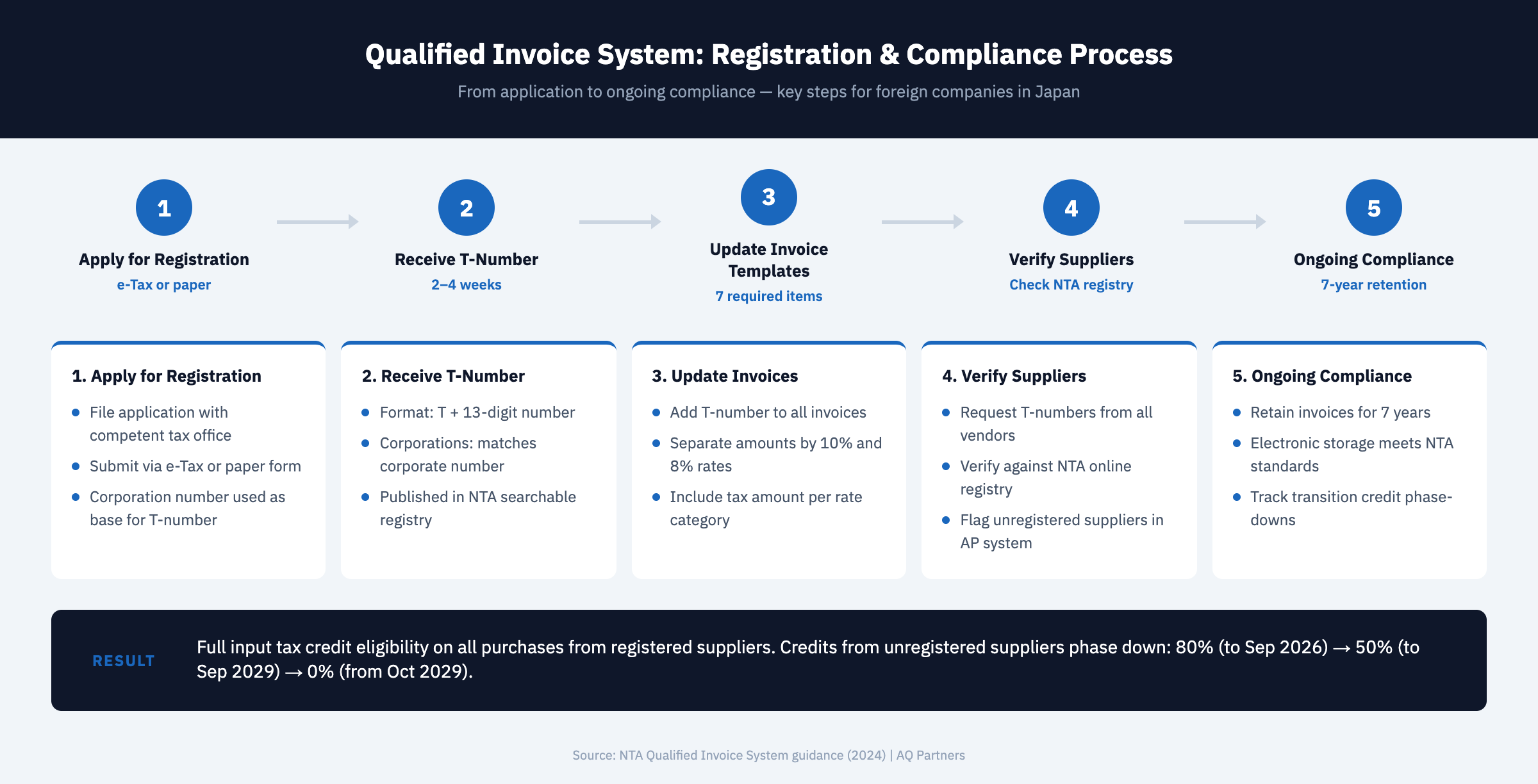
Businesses register as qualified invoice issuers by filing an application (適格請求書発行事業者の登録申請書) with the competent tax office. Registration is processed within approximately two to four weeks.
The registration application can be submitted in paper or electronically via the NTA's e-Tax system. Upon approval, the NTA assigns a registration number in the format T + 13 digits—for corporations, this matches the corporate number (法人番号) already assigned at incorporation. Sole proprietors receive a separately assigned 13-digit number. All registered issuers are listed in the NTA's publicly searchable National Tax Agency registry, allowing buyers to verify a supplier's registration status.
Foreign companies with a Japan-based subsidiary (KK or GK) register through that entity's tax office. Foreign businesses without a Japanese entity but with consumption tax obligations—such as B2C digital service providers—register through the NTA's designated foreign business registration process. The registration is effective from the date specified on the registration notice and remains valid until the business files for cancellation.
Invoice Format Requirements
A qualified invoice must contain seven mandatory data elements. Missing any required element means the invoice does not qualify for the buyer's input tax credit, regardless of the supplier's registration status.
| Required Element | Description | Common Errors |
|---|---|---|
| 1. Issuer name & registration number | Legal name of the seller plus T-number (e.g., T1234567890123) | Using trade name instead of registered legal name; omitting T-prefix |
| 2. Transaction date | Date the goods were delivered or services were provided | Using invoice issue date instead of supply date |
| 3. Description of goods/services | Sufficient detail to identify the transaction; must note if reduced-rate items | Generic descriptions like “miscellaneous” or “various services” |
| 4. Amount by tax rate category | Subtotal amounts separated by 10% and 8% rate categories | Combining 10% and 8% items into a single line total |
| 5. Consumption tax amount by rate | Tax amount calculated and shown separately for each rate category | Showing only total tax without rate-level breakdown |
| 6. Applicable tax rate | Clear indication of which rate (10% or 8%) applies to each line item | Failing to mark reduced-rate items with the “*” or “(軽)” indicator |
| 7. Recipient name | Name of the buyer (may be omitted for simplified invoices in retail) | Issuing to “cash customer” for B2B transactions |
Retail businesses, restaurants, taxis, and other businesses transacting primarily with consumers may issue simplified qualified invoices (適格簡易請求書), which omit the recipient's name and may show either the tax rate or the tax amount (rather than both). This applies to industries specified in Article 57-4(1) of the Consumption Tax Act.
Transitional Rules for Purchases from Unregistered Suppliers
The NTA established a six-year transition period during which businesses can claim partial input tax credits on purchases from suppliers who have not registered as qualified invoice issuers. The credit percentage decreases in three phases.
This transitional schedule creates escalating financial consequences for maintaining relationships with unregistered suppliers:
- Phase 1 (October 1, 2023 – September 30, 2026): 80% of the consumption tax on purchases from unregistered suppliers can be claimed as input tax credits. The effective additional cost of purchasing from an unregistered supplier is 2% of the purchase price (20% of the 10% tax rate).
- Phase 2 (October 1, 2026 – September 30, 2029): Credit drops to 50%. The effective additional cost rises to 5% of the purchase price.
- Phase 3 (October 1, 2029 onward): No credit available. Purchasing from an unregistered supplier costs the full 10% consumption tax with no recovery.
For foreign companies managing Japanese supplier relationships, this transition requires proactive vendor management. Companies should request registration numbers from all suppliers, update procurement systems to flag unregistered vendors, and factor the declining credit into total cost of ownership calculations when evaluating supplier alternatives. The consumption tax registration guide explains the threshold rules that determine when suppliers must register.
Digital Invoicing and Electronic Storage
Qualified invoices may be issued and stored in electronic format under the Electronic Books Preservation Act (電子帳簿保存法, denshi chōbo hozon hō), which was significantly amended effective January 2024 to mandate electronic storage of electronically received transaction documents.
Electronic qualified invoices must meet the same seven content requirements as paper invoices. For storage, companies must ensure one of the following: a timestamp system that prevents alteration, version management systems that record all modifications, or storage in a system meeting the NTA's technical standards for search functionality and display. The retention period is seven years from the filing deadline of the relevant tax year—matching the standard document retention period for tax purposes.
Companies using accounting software that supports the Qualified Invoice System can automate much of the compliance burden. Major Japanese accounting platforms including freee, MoneyForward, and Yayoi have built qualified invoice templates, registration number validation, and compliant electronic storage directly into their systems. Foreign companies should ensure their accounting software can generate invoices meeting all seven format requirements and store received invoices in compliance with the Electronic Books Preservation Act.
Impact on Small Businesses and Freelancers
Tax-exempt small businesses (those with base period taxable sales under ¥10 million) face a strategic choice: register as qualified invoice issuers and begin charging consumption tax, or remain unregistered and risk losing business clients who need qualified invoices.
Before October 2023, tax-exempt businesses had no incentive to register voluntarily because their clients could claim input credits regardless. The Qualified Invoice System changed this dynamic completely. B2B clients now face a direct financial penalty for purchasing from unregistered suppliers, creating market pressure for even small businesses to register.
To mitigate the burden on small businesses that newly register, the NTA introduced a two-thirds reduction measure (2割特例, ni-wari tokurei) effective through fiscal years ending on or before September 30, 2026. Under this measure, newly registered small businesses can calculate their consumption tax liability as 20% of their output tax (effectively reducing the tax to 2% of sales), regardless of actual input tax. This provision is simpler than both the standard method and the Simplified Tax System, requiring no prior election filing.
Foreign companies hiring Japanese freelancers, independent contractors, or small service providers should verify whether those suppliers have registered. The shift toward registered suppliers is already significant—according to NTA data, approximately 1.8 million previously tax-exempt businesses voluntarily registered as qualified invoice issuers in the system's first year.
Compliance Checklist for Foreign Companies
Foreign companies operating in Japan should address several operational areas to ensure full compliance with the Qualified Invoice System and maximize input tax credit recovery.
- Register your entity: File the qualified invoice issuer registration application through your competent tax office. Confirm your T-number matches your corporate number.
- Update invoice templates: Ensure all outgoing invoices contain all seven mandatory elements. Include T-number, rate-separated subtotals, and tax amounts broken down by rate.
- Verify supplier registration: Request T-numbers from all Japanese suppliers and verify them against the NTA's online registry. Flag unregistered suppliers in your procurement system.
- Configure accounting software: Ensure your system can process dual-rate invoices, validate registration numbers, and store electronic invoices in compliance with the Electronic Books Preservation Act.
- Retain invoices for seven years: Both issued and received qualified invoices must be retained for seven years from the tax filing deadline. Electronic storage must meet NTA technical standards.
- Train accounts payable staff: Personnel processing invoices must understand the format requirements and be able to identify non-compliant invoices before payment.
- Plan for transition phases: Model the financial impact of the declining credit percentages (80% → 50% → 0%) on purchases from unregistered suppliers and adjust procurement strategy accordingly.
The Qualified Invoice System represents one of the most significant changes to Japan's consumption tax framework since the dual-rate introduction in 2019. Foreign companies that proactively address registration, invoice format compliance, and supplier management will avoid unnecessary tax costs and maintain smooth operations with Japanese business partners. For end-to-end support with invoice system compliance, consumption tax filings, and back office operations, contact AQ Partners at hello@aqpartners.jp.

Yuga Koda is a founding Director at AQ Partners, supporting foreign companies, funds, and families operating in Japan. His experience operating companies in both Japan and international markets gives him a practical understanding of back office operations from both sides.