
Japan's Qualified Invoice System: What It Means for Your Accounting Software

Key Takeaways
- Mandatory since October 2023 — Japan's Qualified Invoice System requires consumption tax-registered suppliers to issue invoices with a government-assigned registration number or buyers lose their input tax credit.
- Your accounting software must be compliant — Software that cannot auto-populate T-numbers, separate 8% and 10% tax rates, and store invoices for 7 years creates legal and financial exposure.
- Domestic tools are ready out of the box — freee, MoneyForward Cloud, and Yayoi all added QI support before the October 2023 deadline; global platforms like SAP and NetSuite require Japan-specific localization modules.
- Input tax credit is at stake — If your vendor is not registered under the QI system, you cannot claim consumption tax credit on purchases from them — a direct hit to your cash flow.
- Foreign companies face a steeper configuration burden — Multi-currency, multi-entity setups common among foreign firms require careful QI configuration to avoid compliance gaps in Japanese subsidiaries.
What Is Japan's Qualified Invoice System?
Japan's Qualified Invoice System (適格請求書等保存方式, commonly called the "Invoice System" or インボイス制度) became mandatory on October 1, 2023, and restructured how consumption tax credits are claimed across every business-to-business transaction in Japan.
Before the system took effect, businesses could claim input consumption tax credits based on simplified bookkeeping records. Under the new framework, that credit is only available if the buyer holds a valid "qualified invoice" (適格請求書) issued by a supplier who has formally registered with the National Tax Agency (NTA). Registration produces a unique T-number — the letter "T" followed by a 13-digit identifier — which must appear on every qualifying invoice the supplier issues.
The system affects any company that is itself registered for consumption tax in Japan. For foreign companies operating Japanese subsidiaries or branches, the Invoice System is not optional: if your Japanese entity collects or pays consumption tax, it must both issue and receive compliant invoices. According to the NTA, approximately 4.8 million businesses had registered under the QI system by the end of 2024, reflecting near-universal adoption among consumption tax-liable entities.
Suppliers with annual revenue at or below ¥10 million are exempt from consumption tax registration and therefore cannot issue qualified invoices. Buyers who purchase from these small, unregistered suppliers are unable to claim input tax credits on those transactions — a fact that has pushed many foreign companies to audit their vendor lists carefully.
For a broader overview of how the Invoice System fits into Japan's corporate tax landscape, see our guide to tax filing and corporate compliance in Japan.
Why Your Accounting Software Must Support Qualified Invoices
Software that cannot generate or ingest qualified invoices will directly cost your company money — specifically, the input consumption tax credit you are legally entitled to claim on eligible purchases.
Japan's consumption tax operates at two rates: the standard rate of 10% and the reduced rate of 8% that applies to food, beverages, and certain other goods. A qualified invoice must display consumption tax amounts separated by these two rates. Accounting software that lumps tax into a single line or does not distinguish between rates cannot produce a legally compliant invoice, meaning your customers cannot claim their input credit — and you risk the same problem when receiving non-compliant invoices from your own vendors.
The compliance burden extends beyond invoice generation. Under Japan's document retention rules, qualified invoices must be stored for seven years. Electronic invoices stored digitally must meet additional requirements under the Electronic Books Preservation Act, including searchability and tamper-evidence controls. PwC's Japan tax summary provides a useful reference for the consumption tax and invoice requirements that underpin these obligations.
For foreign companies, the stakes are compounded by audit risk. Japan's National Tax Agency has made QI compliance an active audit focus. Errors in registration number display, missing tax-rate breakdowns, or gaps in electronic storage can result in denied input credits, back-tax assessments, and penalties.
Our full guide to accounting software in Japan covers how to evaluate platforms across the full range of compliance requirements.
What "Compliant" Looks Like in Your Software
A compliant accounting platform must handle qualified invoices end-to-end: generation, receipt, storage, and reporting — each with specific technical requirements set by the NTA.
The table below summarizes the required fields on a qualified invoice and the corresponding software capability needed to produce and process them correctly.
| Invoice Requirement | Legal Basis | Required Software Capability |
|---|---|---|
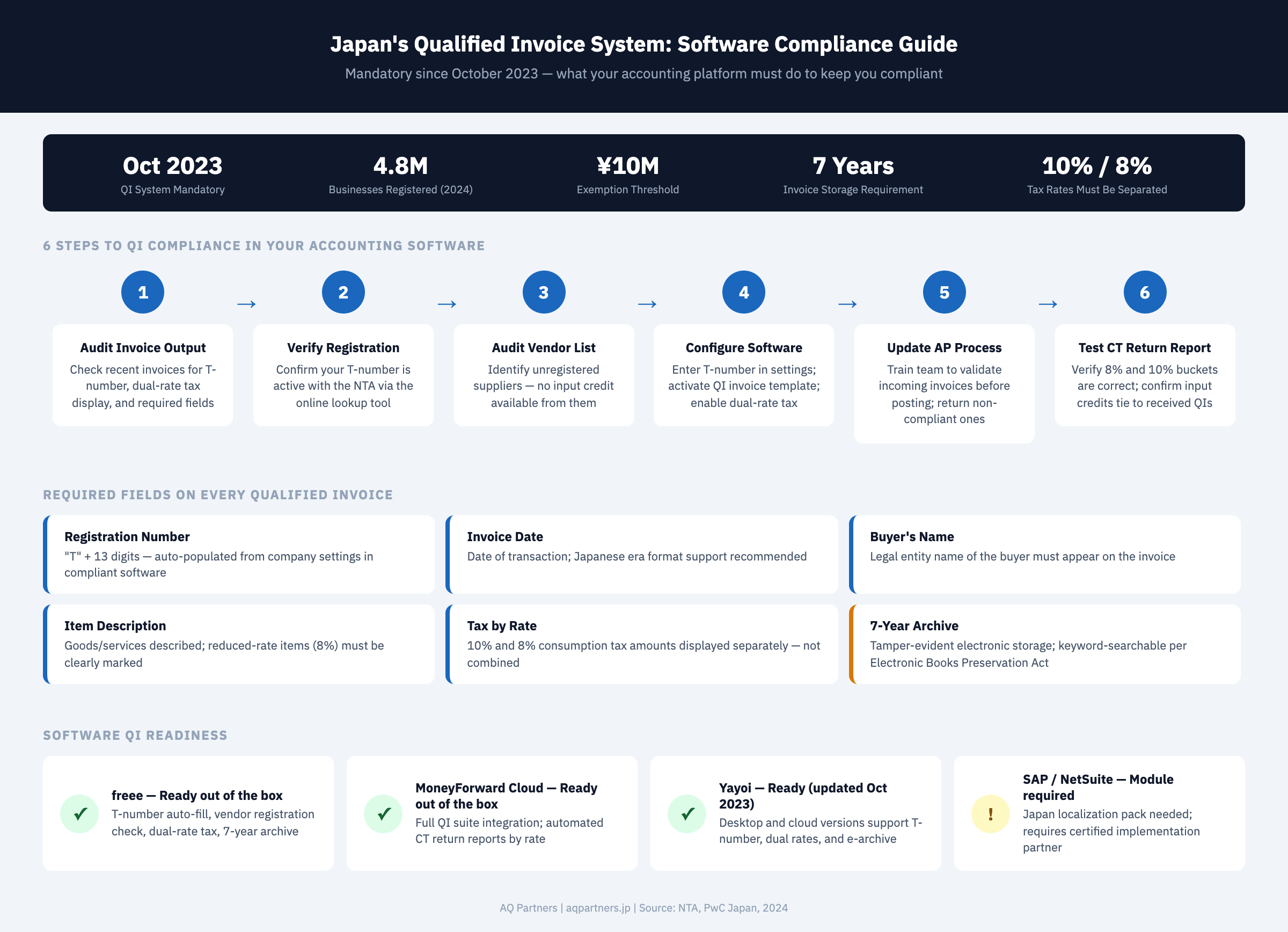
| Supplier's QI registration number (T + 13 digits) | Consumption Tax Act, Article 57-4 | Auto-populate T-number from company settings; validate format on output |
| Invoice date | Consumption Tax Act, Article 57-4 | Date field linked to transaction date; Japanese era date format support recommended |
| Buyer's name or trade name | Consumption Tax Act, Article 57-4 | Customer master with legal entity name; addressee field on invoice template |
| Description of goods or services | Consumption Tax Act, Article 57-4 | Line-item description field; reduced-rate items must be clearly marked as such |
| Consumption tax amount separated by rate (8% and 10%) | Consumption Tax Act, Article 57-4; dual-rate system | Dual tax-rate engine; subtotals and tax displayed separately per rate on all output |
| Total amount per tax rate | Consumption Tax Act, Article 57-4 | Automated subtotal grouping by tax rate; yen rounding per NTA guidance |
| 7-year invoice storage | Electronic Books Preservation Act; Denpyo hoyogimu | Tamper-evident electronic archive; keyword searchability; timestamping for e-invoices |
| QI-compliant reporting for tax filing | Consumption Tax Act; annual and interim return requirements | Consumption tax return reports segmented by rate; purchase credit summary tied to received QIs |
Freee, MoneyForward, and Yayoi: Built-In QI Support
Japan's three leading domestic accounting platforms all delivered full QI compliance before the October 2023 deadline, making them the lowest-friction choice for companies that need to get up and running quickly.
freee updated its invoicing module to automatically insert the user's T-number on all outgoing invoices, split tax calculations by the 8% and 10% rates at the line-item level, and archive received invoices in a searchable, tamper-evident format. freee also added a vendor registration check — you can enter a supplier's T-number during vendor setup and the system flags unregistered suppliers so your team knows in advance that no input credit will be available from that vendor.
MoneyForward Cloud Accounting integrated QI support across its suite, including the invoicing, expense, and payables modules. MoneyForward also introduced automated consumption tax return report generation that reconciles input credits against received qualified invoices.
Yayoi updated its desktop and cloud products to support QI registration number management, dual-rate tax display, and the 7-year electronic archive requirement. Yayoi's strong penetration among Japanese accountants makes it a pragmatic choice if your Japanese subsidiary works closely with local accounting firms already using the platform.
For a detailed side-by-side comparison of these three platforms — including pricing, language support, and suitability for foreign-owned entities — see our post on the best accounting software in Japan: freee, MoneyForward, and Yayoi compared.
Global Software and Qualified Invoice Compliance
Global ERP and accounting platforms can be made QI-compliant, but none support Japan's invoice requirements out of the box — localization is required, and it adds both cost and implementation time.
SAP S/4HANA supports Japan's Qualified Invoice System through its Japan localization layer. The localization handles T-number field mapping, dual consumption tax rate logic, and the electronic bookkeeping requirements under Japan's Electronic Books Preservation Act. However, activating and configuring the Japan localization on an existing global SAP instance is a material implementation project — typically requiring a certified SAP partner familiar with both the technical configuration and Japan tax law.
Oracle NetSuite provides Japan tax localization through its SuiteApp ecosystem. The Japan Localization SuiteApp adds QI-specific invoice fields, tax code separation by rate, and NTA-compliant reporting. As with SAP, the localization module must be implemented deliberately — a standard NetSuite instance used for a Japanese entity without localization will not produce compliant invoices.
Xero does not currently offer a dedicated Japan QI localization. Companies using Xero for a Japanese entity typically need to manage QI compliance through manual workarounds or third-party add-ons, which introduces audit risk.
The general principle: the further a global platform's default configuration is from Japan's specific requirements, the greater the localization investment. Our analysis of global versus domestic accounting software for Japan walks through this decision in detail.
The JETRO guide to setting up business in Japan also provides useful context on the regulatory environment that shapes software requirements for foreign-owned entities.
Steps to Upgrade or Migrate Your Accounting Software for QI Compliance
If your current accounting setup is not yet fully QI-compliant, the remediation path depends on whether you are updating an existing platform or migrating to a new one — but the core steps are the same.
Step 1 — Audit your current invoice output. Pull a sample of invoices issued by your Japanese entity in the last 90 days and check each against the eight required fields listed in the compliance table above. Pay particular attention to T-number display and tax-rate separation — these are the two most commonly missing elements.
Step 2 — Verify your registration number is active. Confirm that your Japanese entity's T-number is registered and active with the NTA. If your entity became liable for consumption tax recently, the registration may still be pending.
Step 3 — Audit your vendor list for unregistered suppliers. Identify vendors from whom you cannot claim input tax credit because they are either unregistered or below the ¥10 million exemption threshold. Quantify the tax impact and decide whether to renegotiate pricing with those vendors or shift purchases to registered alternatives.
Step 4 — Configure or activate QI features in your platform. For domestic platforms (freee, MoneyForward, Yayoi), this typically means entering your T-number in company settings and enabling the QI invoice template. For global platforms, engage your implementation partner to activate and configure the Japan localization module — allow 4 to 12 weeks depending on complexity.
Step 5 — Update your accounts payable intake process. Train your AP team to validate incoming invoices against QI requirements before posting. Invoices missing required fields should be returned to vendors for correction rather than processed and filed.
Step 6 — Test your consumption tax return report. Before your next consumption tax filing period, run a test report and confirm that input credits are correctly tied to received qualified invoices and that the 8% and 10% tax buckets are correctly separated.
How AQ Partners Can Help
AQ Partners provides back-office services for foreign companies operating in Japan, including accounting software setup, consumption tax registration, and ongoing compliance management. If your Japanese entity's accounting software is not yet fully configured for the Qualified Invoice System — or if you are evaluating platforms as part of a Japan market entry — our team can help you assess your current setup, close compliance gaps, and build the operational infrastructure to stay compliant.
We work with the full range of platforms used by foreign-owned entities in Japan, from freee and MoneyForward to SAP and NetSuite localization projects, and we maintain direct relationships with Japanese tax accountants (税理士) who can validate your QI configuration against current NTA requirements.
To discuss your accounting software compliance needs, contact us at aqpartners.jp/contact. We offer an initial compliance review for new inquiries.

Yuga Koda is a founding Director at AQ Partners, supporting foreign companies, funds, and families operating in Japan. His experience operating companies in both Japan and international markets gives him a practical understanding of back office operations from both sides.