
Consumption Tax on Cross-Border Transactions: Exports, Imports & Digital Services

Consumption tax on cross-border transactions in Japan follows distinct rules depending on whether goods or services are exported, imported, or delivered digitally across borders. Exports from Japan are zero-rated at 0%, allowing full recovery of input tax paid on domestic purchases. Imports are subject to consumption tax at the border, assessed on the CIF value plus customs duties. Cross-border digital services—including cloud computing, SaaS, advertising, and streaming—are taxed under a separate framework with reverse-charge mechanisms for B2B transactions and direct registration requirements for B2C providers. For foreign companies operating in Japan, understanding these rules directly affects cash flow, pricing strategy, and compliance obligations.
Key Takeaways
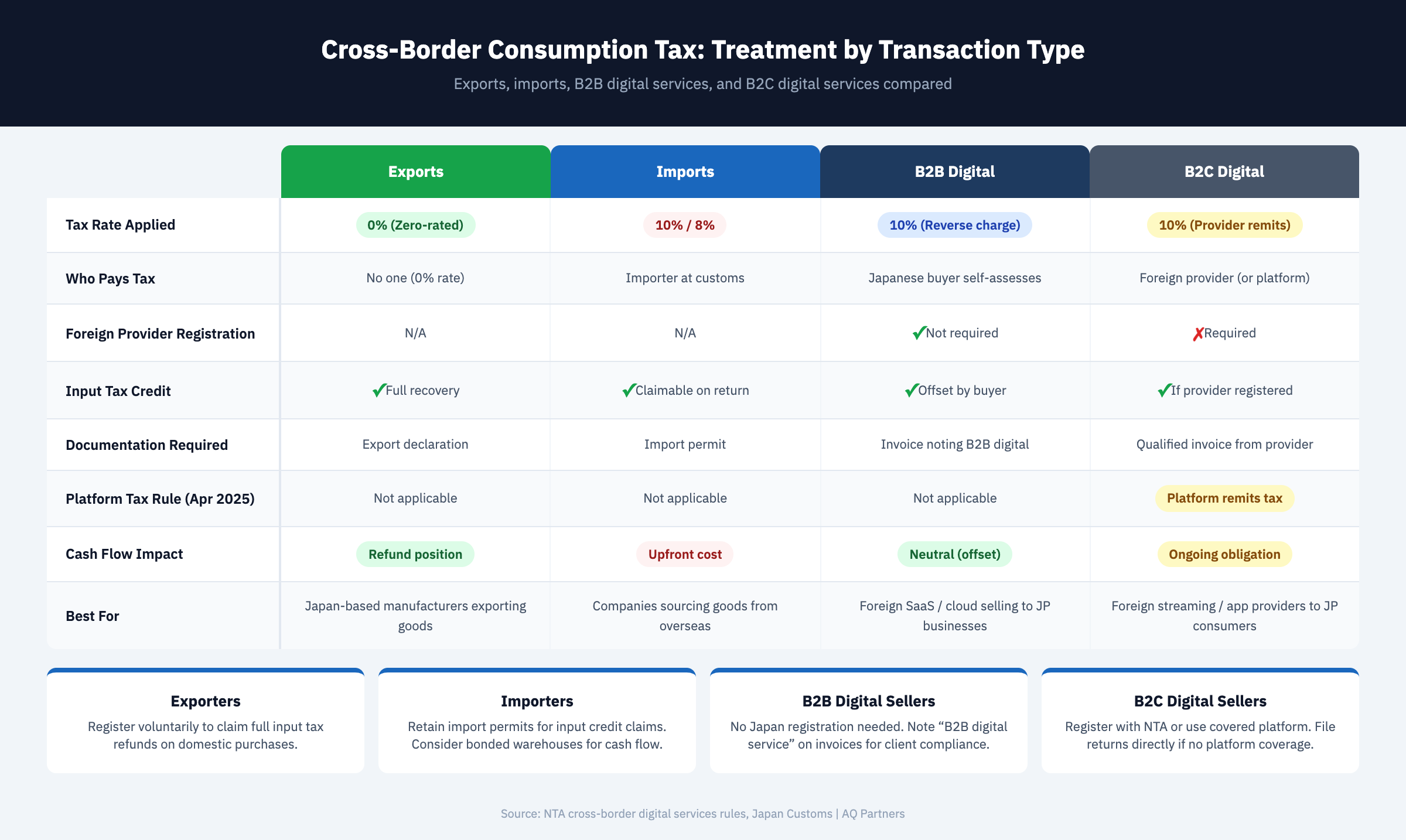
- Exports are zero-rated, enabling full input tax credit recovery—Japan-based companies exporting goods pay 0% consumption tax on export sales while recovering all consumption tax paid on domestic purchases, frequently creating net refund positions with the NTA.
- Import consumption tax is assessed at customs on CIF value plus duties—the standard 10% rate (or 8% for reduced-rate food items) applies to the landed cost of imported goods, and this amount is claimable as an input tax credit on the importer's consumption tax return.
- B2B cross-border digital services use a reverse-charge mechanism—the Japanese business recipient self-assesses and reports consumption tax, eliminating the need for the foreign provider to register with the NTA for B2B transactions.
- B2C digital service providers must register directly with the NTA—foreign companies providing digital services to Japanese consumers must register as “registered foreign business operators” and file consumption tax returns in Japan.
- Platform taxation rules effective April 2025 shift liability to digital platforms—platform operators facilitating B2C digital service sales from foreign providers to Japanese consumers now bear consumption tax collection and remittance obligations.
Zero-Rated Exports from Japan
Goods and services exported from Japan are taxed at 0% consumption tax, meaning the transaction is taxable but at a zero rate—critically different from being exempt. Zero-rating preserves the exporter's right to claim full input tax credits on all domestic purchases related to the export activity.
Zero-rating applies to the following categories of export transactions:
- Physical goods shipped outside Japan—supported by export declarations filed with Japan Customs
- International transportation services—air, sea, and overland transport of goods or passengers crossing Japan's borders
- Services provided to non-residents for consumption outside Japan—including consulting, design, and engineering services where the benefit is received outside Japan
- International telecommunications services—calls and data services between Japan and overseas destinations
- Transfer of intellectual property for use outside Japan—patent licensing, trademark assignments, and technology transfers
To qualify for zero-rating, the exporter must maintain proof of export. For physical goods, this means retaining the customs export declaration (輸出許可通知書). For services, the exporter must document that the service was provided to a non-resident for use outside Japan. Without proper export documentation, the NTA may reclassify the transaction as a standard 10% taxable sale during an audit.
The cash flow advantage of zero-rating is significant. A manufacturer purchasing ¥100 million in domestic raw materials pays ¥10 million in consumption tax on those inputs. If all finished goods are exported, the manufacturer owes ¥0 in output tax and claims a full ¥10 million refund. The NTA processes these refund claims within approximately one to two months of filing. Export-heavy companies with high domestic procurement should consider filing actual interim returns to accelerate refund recovery, as detailed in the consumption tax filing guide.
Import Consumption Tax
Goods imported into Japan are subject to consumption tax at the point of customs clearance, assessed on the CIF (cost, insurance, freight) value of the goods plus any applicable customs duties and excise taxes.
The tax base for import consumption tax is calculated as: (CIF value + customs duty + excise tax) × consumption tax rate. The standard 10% rate applies to most imports, while the reduced 8% rate applies to qualifying food and non-alcoholic beverages. The importer pays this tax to Japan Customs at the time of import clearance, either directly or through a licensed customs broker.
Import consumption tax paid at customs is fully claimable as an input tax credit on the importer's consumption tax return, provided the company is a registered taxable enterprise and retains the customs import permit (輸入許可通知書) as supporting documentation. This credit mechanism ensures import consumption tax does not become a permanent cost for businesses that resell or use imported goods in taxable activities.
Bonded Warehouses and Free Trade Zones
Goods stored in bonded warehouses (保税地域) are not subject to import consumption tax until they are released from the bonded area into domestic circulation. Companies using bonded warehouses for logistics can defer consumption tax payment until goods are actually needed, improving cash flow for inventory-heavy businesses. Goods re-exported from bonded warehouses without entering domestic circulation are never subject to import consumption tax.
Cross-Border Digital Services: The 2015 Framework
Since October 2015, Japan has applied consumption tax to cross-border digital services—electronic services provided from overseas to recipients in Japan. The rules distinguish between B2B and B2C transactions, applying fundamentally different compliance mechanisms to each.
Digital services subject to these rules include cloud computing, SaaS and PaaS platforms, streaming media (music, video, e-books), online advertising, digital content distribution, and electronic data processing services. The NTA classifies these as “services provided via telecommunications lines” (電気通信利用役務の提供). According to PwC's Japan tax summary, the digital services rules apply regardless of whether the foreign provider has a physical presence in Japan.
| Aspect | B2B Digital Services | B2C Digital Services |
|---|---|---|
| Tax mechanism | Reverse charge—Japanese buyer self-assesses | Foreign provider registers and files returns |
| Who remits tax | Japanese business recipient | Foreign provider (or platform from April 2025) |
| Registration required by foreign provider | No | Yes—must register as foreign business operator |
| Input tax credit for buyer | Available (offset against reverse charge) | Available if foreign provider is registered |
| Filing requirement | Buyer includes in regular consumption tax return | Foreign provider files separate consumption tax return |
| Examples | SaaS for corporate use, cloud infrastructure, B2B advertising | Consumer streaming, app store purchases, online games |
| Qualified Invoice System applicability | Reverse-charge transactions exempt from invoice requirement | Provider must issue qualified invoices if registered |
| Platform taxation (from April 2025) | Not applicable—B2B continues under reverse charge | Platform assumes tax obligation for foreign provider sales |
B2B Reverse-Charge Mechanism
When a foreign company provides digital services to a Japanese business customer, the Japanese buyer is responsible for self-assessing and reporting the consumption tax under the reverse-charge mechanism (リバースチャージ方式). The foreign seller does not charge consumption tax.
The Japanese buyer reports the reverse-charge consumption tax as both output tax (liability) and input tax (credit) on the same return. For most businesses with a taxable sales ratio of 95% or higher, the output and input amounts offset completely, creating no net tax liability. The NTA requires the Japanese buyer to report reverse-charge transactions only when their taxable sales ratio is below 95%—otherwise, the reporting obligation is waived.
Foreign companies selling B2B digital services to Japanese businesses do not need to register with the NTA for consumption tax purposes. The buyer handles all compliance. However, the foreign provider should clearly designate the transaction as a “business-to-business digital service” on invoices to help Japanese clients identify the correct tax treatment.
B2C Digital Service Registration
Foreign companies providing digital services directly to Japanese consumers (B2C) must register with the NTA as “registered foreign business operators” (登録国外事業者) and file consumption tax returns in Japan.
The registration process requires filing an application with the NTA's Foreign Business Office. Registered foreign operators must file annual consumption tax returns, charge consumption tax on sales to Japanese consumers, and issue qualified invoices under the Qualified Invoice System. The NTA maintains a public list of registered foreign business operators, and Japanese business customers can only claim input tax credits on purchases from providers appearing on this list.
Major global digital service providers including Google, Apple, Amazon, Microsoft, Netflix, and Spotify are registered with the NTA and charge Japanese consumption tax on B2C digital sales. Smaller foreign digital service providers with significant Japanese consumer revenue should assess whether their obligation to register has been triggered.
Platform Taxation Rules (April 2025)
Effective April 1, 2025, digital platform operators facilitating B2C digital service sales from foreign providers to Japanese consumers are deemed the supplier for consumption tax purposes. The platform—not the individual foreign seller—is responsible for collecting and remitting consumption tax.
This rule applies to platforms that meet specific revenue and transaction thresholds set by the NTA. The platform taxation rule was introduced to address compliance challenges with individual foreign sellers who may lack the resources or incentive to register directly with the NTA. Platforms covered by this rule must register as taxable enterprises in Japan, charge consumption tax on relevant transactions, and file returns. Foreign providers selling through covered platforms are relieved of direct consumption tax obligations on those platform-facilitated sales.
The platform taxation rule does not affect B2B digital service transactions, which continue to operate under the reverse-charge mechanism. It also does not apply to physical goods sold through platforms—those are subject to import consumption tax at customs when shipped from overseas.
Special Considerations for Foreign Companies
Foreign companies with cross-border operations involving Japan should evaluate several strategic factors related to consumption tax on international transactions.
Tax Refund Optimization for Exporters
Japan-based subsidiaries that primarily export goods or services should structure their operations to maximize consumption tax refund recovery. This includes registering as taxable enterprises from day one (even if below the ¥10 million threshold), filing actual interim returns to accelerate quarterly refunds, and maintaining meticulous export documentation for NTA audit defense. The registration guide covers voluntary registration strategies for export-oriented companies.
Transfer Pricing Implications
Consumption tax applies to intercompany transactions between a Japanese subsidiary and its foreign parent at arm's-length prices. If transfer pricing adjustments increase the value of imported services, the consumption tax liability on those services increases proportionally. Companies should coordinate transfer pricing documentation with consumption tax reporting to ensure consistency.
Tourist Tax-Free Shopping
Foreign visitors to Japan can purchase goods tax-free at licensed tax-free shops when total purchases exceed ¥5,000 (general goods) or ¥5,000 (consumables) at a single retailer. The retailer processes the tax exemption at the point of sale and reports the transaction through the NTA's tax-free purchase records system. Effective April 2025, new measures require tax-free purchased goods to be verified at departure, with consumption tax charged retroactively if goods are not exported.
Cross-border consumption tax rules create both obligations and opportunities for foreign companies in Japan. Proper structuring of export documentation, import tax credit claims, and digital service compliance can significantly affect a company's effective tax position. AQ Partners provides end-to-end support for cross-border consumption tax compliance, from import documentation to export refund optimization. Contact us at hello@aqpartners.jp.

Yuga Koda is a founding Director at AQ Partners, supporting foreign companies, funds, and families operating in Japan. His experience operating companies in both Japan and international markets gives him a practical understanding of back office operations from both sides.