
The Parent-Company Document Pack for a Japan Incorporation: Affidavits, Apostilles, and Signatory Rules by Country


The parent-company document pack is the set of certificates, affidavits, and signature proofs that a foreign parent must produce, notarize, apostille, and translate before its Japanese subsidiary can be registered at the Legal Affairs Bureau (法務局, houmukyoku). For a multinational these documents are the critical path: the Japanese registration takes about two weeks once filed, while assembling notarized and apostilled proof at headquarters takes two to six weeks depending on the jurisdiction. This guide is the execution checklist for the company secretary or counsel who owns the pack: the documents, the sequence, the competent authority by jurisdiction, and the errors that send a package back.
Key Takeaways
- Four documents come from the parent, and all four are notarized. JETRO lists the parent's registration certificate, an affidavit on the parent's profile, an affidavit on its representatives' signatures, and a signature certificate for each director, each attested by a notary in the parent's own country.
- Notarize first, apostille second, translate last. Japan has been a party to the Hague Apostille Convention since 1970, so an apostille from the parent's competent authority replaces consular legalisation. The apostille goes on the original; the Japanese translation accompanies it and is never apostilled.
- Every officer needs identification with a Japanese translation. Since the 2015 change that removed the resident director requirement, the Legal Affairs Bureaus ask for an identification certificate for every officer, which for non-residents means a certified passport copy and a notarized signature certificate in place of a seal certificate.
- Freshness is enforced in practice. Registry practice expects supporting certificates to be issued within about three months of filing. Order the parent's certificate late enough to stay fresh and the signature certificates early enough to run in parallel.
- Electronic articles save ¥40,000. A KK's articles must be notarized in Japan at a graduated fee of ¥30,000 to ¥50,000 by capital; filing them electronically avoids the ¥40,000 revenue stamp that paper articles attract.
What the Legal Affairs Bureau Expects from the Parent
The registrar needs proof that the parent exists, that its signatory may sign, and that each officer is who they claim, in a form it can verify. JETRO's guide to establishing a subsidiary in Japan lists the parent-side items as registration certificates for the parent, an affidavit regarding the parent's profile attested by a public notary in the parent's own country, an affidavit regarding the signatures of the parent's representatives, and a certificate of signature for each appointed director. Around those four sit the subsidiary's own documents that the parent's officers sign: the subscription and board resolution, letters of acceptance of office, and the beneficial owner statement introduced for new KKs.
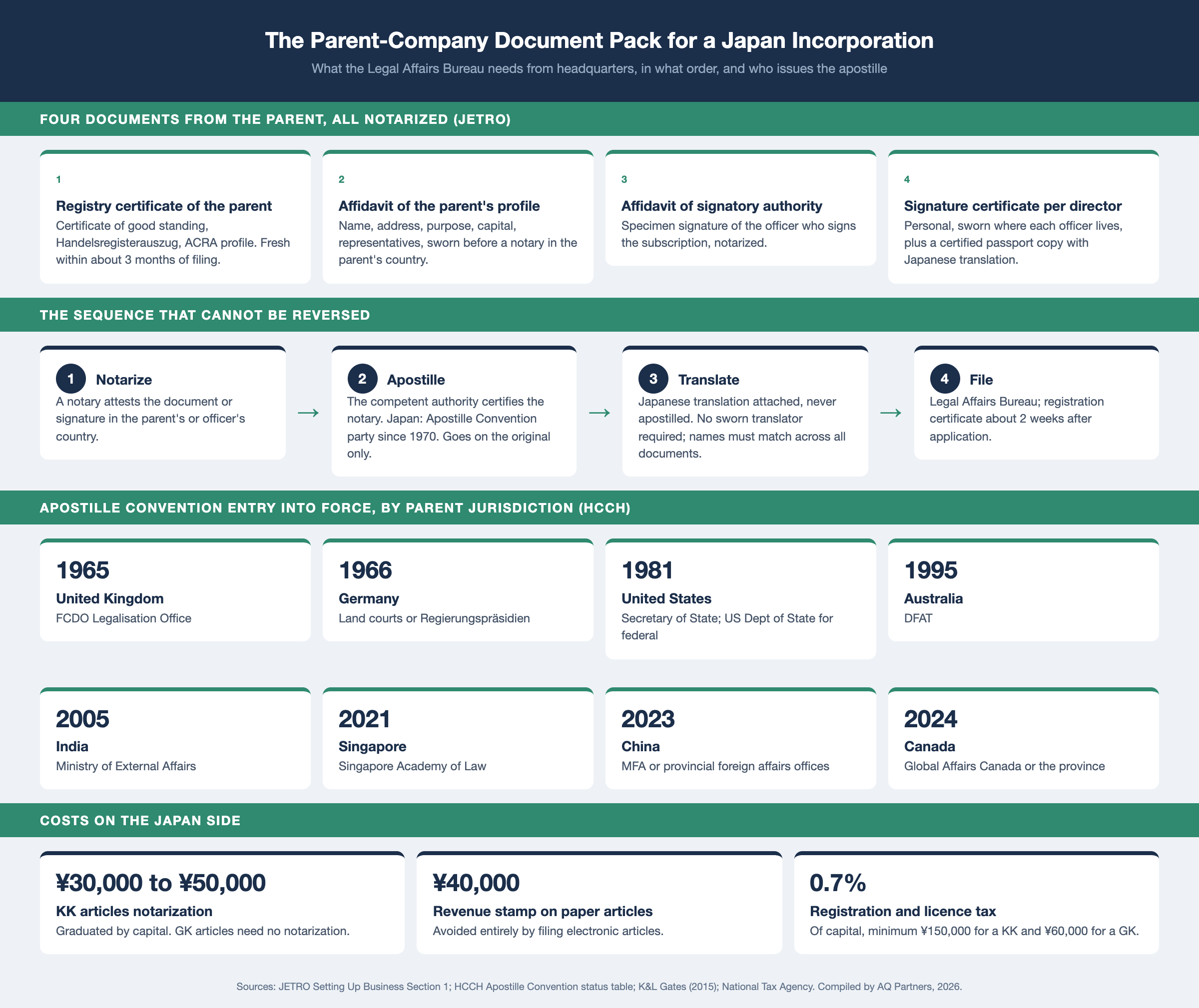
The table below is the assembly list, with who produces each item and how it is authenticated.
| Document | Produced by | Notarize and apostille | Japanese translation | Typical lead time |
|---|---|---|---|---|
| Registration certificate or registry extract of the parent (certificate of good standing, Handelsregisterauszug, ACRA profile) | Company secretary, from the home registry | Yes, apostille on the certified original | Yes | 1 to 3 weeks, registry dependent |
| Affidavit of the parent's profile (name, address, purpose, capital, representatives) | Authorised officer, sworn before a notary | Yes | Yes | 1 to 2 weeks |
| Affidavit of signatory authority with specimen signature of the signing officer | The officer who signs the subscription | Yes | Yes | 1 to 2 weeks, in parallel |
| Signature certificate for each director and the representative director | Each individual, before a notary where they live | Yes | Yes | About 1 week each, in parallel |
| Identification certificate for each officer (certified passport copy) | Each individual | Certified copy; apostille where the Bureau requests | Yes | Days |
| Board or shareholder resolution approving the subsidiary, capital, and appointments | Parent board, drafted by counsel | Notarized; apostille if requested by the Bureau or bank | Yes | Tied to the board calendar |
| Letter of acceptance of office for each director | Each individual | No; the signature certificate authenticates it | Prepared in Japanese | Days |
| Beneficial owner statement (実質的支配者となるべき者の申告書) | Japanese counsel with parent input | No | Prepared in Japanese | Days |
| Capital remittance evidence | Group treasury | No | Statement with translation | After remittance |
Notarize, Then Apostille: The Sequence That Cannot Be Reversed
A foreign document reaches the Bureau in three steps: notary attestation, an apostille on the notary's signature, then a Japanese translation. Japan has been a party to the Hague Convention Abolishing the Requirement of Legalisation for Foreign Public Documents since 27 July 1970, according to the HCCH status table for the Apostille Convention, so a single apostille certificate from the parent's designated authority is accepted in place of embassy legalisation. Documents from a country that is not a party still need consular legalisation at the Japanese embassy or consulate there, which typically adds weeks.
The order matters because the apostille authenticates the notary, not the content. An affidavit sworn after the apostille, or a translation apostilled instead of the original, is rejected. The Bureau checks the translation against the apostilled original, so the two travel together but only the original carries the certificate.
Competent Authorities by Parent Jurisdiction
Every major parent jurisdiction is now an Apostille Convention party; the practical difference is who issues the apostille and how long it takes. Canada and China joined only recently, which matters for groups whose last Japan filing predates 2024. The table gives the entry-into-force date from the HCCH status table and the issuing authority; turnaround figures are commonly observed ranges to re-check at filing.
| Parent jurisdiction | Apostille Convention in force since | Competent authority for apostilles | Registry document commonly used | Turnaround, notes |
|---|---|---|---|---|
| United States | 15 October 1981 | Secretary of State of the issuing state; US Department of State for federal documents | Certificate of good standing | 5 to 10 days standard, 1 to 3 days expedited; state formats vary |
| United Kingdom | 24 January 1965 | Foreign, Commonwealth and Development Office Legalisation Office | Certificate of incorporation with current appointments from Companies House | Days by post or premium service; documents are English, translation is short |
| Singapore | 16 September 2021 | Singapore Academy of Law | ACRA business profile | Fast; before 2021 Singapore documents needed consular legalisation |
| Germany | 13 February 1966 | Varies by Land: court presidents, Regierungspräsidien, or the Bundesverwaltungsamt for federal documents | Handelsregisterauszug from the local Amtsgericht | About 5 to 10 days; German extracts are long and add translation time |
| Australia | 16 March 1995 | Department of Foreign Affairs and Trade | ASIC current company extract | Days; English documents |
| Canada | 11 January 2024 | Global Affairs Canada, or the provincial authority for provincially issued documents | Certificate of compliance or good standing, federal or provincial | About 1 to 2 weeks; specify federal versus provincial incorporation |
| China | 7 November 2023 | Ministry of Foreign Affairs or authorised provincial foreign affairs offices | Business licence and registry extract | Weeks; Chinese documents need full Japanese translation |
| India | 14 July 2005 | Ministry of External Affairs, through its outsourced collection centres | Certificate of incorporation and master data from the Registrar of Companies | Weeks; documents must first be attested at state level |
Signature Certificates for Officers Who Live Outside Japan
Japanese registration runs on registered seals, and a non-resident officer who cannot register one substitutes a notarized signature certificate. Since the Ministry of Justice accepted KK incorporations without a Japan-resident representative director in March 2015, every officer must also supply an identification certificate with a Japanese translation, as recorded in K&L Gates' alert on the change. For a non-resident that means a certified passport copy plus the signature certificate, sworn before a notary in the country where the officer lives and apostilled there, not at the parent's head office. A group with directors in three countries therefore runs three parallel notarizations, and the slowest one sets the date.
The certificates are personal, so they cannot be signed under a power of attorney, and the officer's name and address must match the articles and acceptance letters. A Japan-resident director or nominee files a municipal seal certificate instead, dated within three months. The practical reasons a resident signatory is still useful, from bank opening to leases, are covered in the guide to representative director residency and nominee directors.
Translation, Freshness, and the Articles
Every foreign-language document is filed with a Japanese translation, no sworn translator is required, and supporting certificates must be recent. Japan has no sworn-translator system, so the Bureau accepts a translation prepared by counsel or the provider, but company and personal names in katakana and romaji must match across the package; inconsistencies are a routine cause of requisitions.
Registry practice treats supporting certificates as stale after roughly three months from issue, which is the same standard applied to Japanese seal certificates. The parent's registry certificate should therefore be ordered so that it is fresh on the filing date, while the officers' signature certificates, which do not carry a registry date, can be prepared as soon as the board approves the project.
The subsidiary's articles of incorporation (定款, teikan) sit alongside the pack. For a KK they must be notarized by a Japanese notary at a fee graduated by capital of ¥30,000, ¥40,000, or ¥50,000, and paper articles carry a ¥40,000 revenue stamp that electronic articles avoid; a GK's articles need no notarization. What the articles must contain is in the guide to articles of incorporation in Japan, and the Japan-side sequence from trade name check to registration is in the guide to company incorporation in Japan. The headquarters decisions the pack has to reflect, from entity type to capital, are in the headquarters playbook for setting up a Japan subsidiary, and the entity choice itself in the guide to KK vs GK for a multinational's subsidiary.
Why Packs Get Sent Back
Most rejections come from sequencing and consistency errors, not missing documents, and each costs two to four weeks because the fix happens abroad. The recurring ones are:
- Apostille on the translation. The apostille must authenticate the original; a translation is attached, never apostilled.
- Affidavit content that does not match the registry. The parent's address or representative in the affidavit differs from the certificate, often because one was issued after a change.
- Signatory not shown as authorised. The person who signed the subscription is not the representative named in the parent's certificate and no board resolution bridges the gap.
- Name rendering drift. Katakana or romaji spellings differ between the articles, the acceptance letters, and the signature certificates.
- Stale certificates. A registry certificate issued more than three months before filing.
- Officer identification missing. A passport copy without certification or without a Japanese translation.
The general checklist for any foreign incorporator, including branches and representative offices, is in the guide to documents needed to incorporate a foreign company in Japan; this page covers the corporate parent's pack specifically.
Frequently Asked Questions
Can the parent's documents be signed under a power of attorney?
The parent's affidavits can be sworn by any officer whose authority appears in the registry certificate or a board resolution. Signature certificates cannot: each director signs personally before a notary where they live. A power of attorney to Japanese counsel covers the filing, not the officers' proofs.
Does a Singapore or Canadian parent still need consular legalisation?
No. Singapore has been an Apostille Convention party since 16 September 2021 and Canada since 11 January 2024, so an apostille from the Singapore Academy of Law or from Global Affairs Canada or the relevant province is sufficient. Groups whose last Japan filing predates those dates should update their internal checklists.
How long is the parent's registry certificate valid for a Japan filing?
Registry practice expects supporting certificates to be issued within about three months of the application. There is no statutory expiry, but a Bureau will usually requisition an older certificate, so order it to land inside the window.
Working with AQ Partners. Our Tokyo team provides back office operations for foreign companies operating in Japan, covering the requirements described above end to end, from the document pack and translations through registration, seals, and the bank account. Book a consultation to review your Japan setup plan.

Yuga Koda is a founding Director at AQ Partners, supporting foreign companies, funds, and families operating in Japan. His experience operating companies in both Japan and international markets gives him a practical understanding of back office operations from both sides.