
Deemed Dissolution (みなし解散): How a Dormant Japan Subsidiary Gets Struck Off After 12 Years


Deemed dissolution (みなし解散, minashi kaisan) is the procedure under Article 472 of the Companies Act by which a kabushiki kaisha (株式会社, KK) with no entry in the commercial register for twelve years is treated as a dormant company (休眠会社, kyuumin gaisha), notified by the Minister of Justice, and, if it does not respond within two months, dissolved by the registrar without any application from the company. It catches foreign-owned subsidiaries more often than domestic ones, because the triggering events are decided abroad while the registry's letter goes to an address nobody at headquarters reads. This guide covers the trigger, the annual sweep, the two-month response, the consequences, the three-year revival window, and the controls that keep a subsidiary off the list.
Key Takeaways
- Twelve years of silence is the trigger. A KK with no registration entry for twelve years is a dormant company under Article 472. The Minister of Justice publishes a notice in the Official Gazette every autumn, the registry writes to the registered address the same day, and the company has two months to respond.
- Two responses stop the clock, and only one fixes the problem. Filing the overdue registration, usually a director reappointment, stops dissolution and cures the lapse. A statement that business continues stops dissolution but leaves the missed registration outstanding, with the fine of up to ¥1 million still available.
- The 2025 sweep ran from 10 October to 10 December. Companies that did not respond by 10 December 2025 were deemed dissolved at the end of that day, and the dissolution was registered from 11 December 2025.
- Revival is possible for three years. A deemed-dissolved company can resolve to continue by special resolution within three years and register the continuation within two weeks, with directors reappointed. After three years it can only be liquidated.
- A ten-year director term makes exposure worse. A ten-year term with no other events means a decade without touching the register; one missed reappointment carries it past twelve years.
The Trigger: Twelve Years Without a Registration Entry
A KK becomes a dormant company under Article 472 when twelve years pass without an entry in the commercial register, whether or not it is trading. A subsidiary that files tax returns and pays staff every month is still dormant here if its registered matters have not changed.
The rule presumes a register untouched for twelve years describes a company that no longer exists. For a foreign-owned subsidiary that is often wrong: long director terms, the same representative, and the same address produce a silent register. The Ministry of Justice's description of the dormant company clean-up applies the same procedure to general incorporated associations and foundations after five years without an entry.
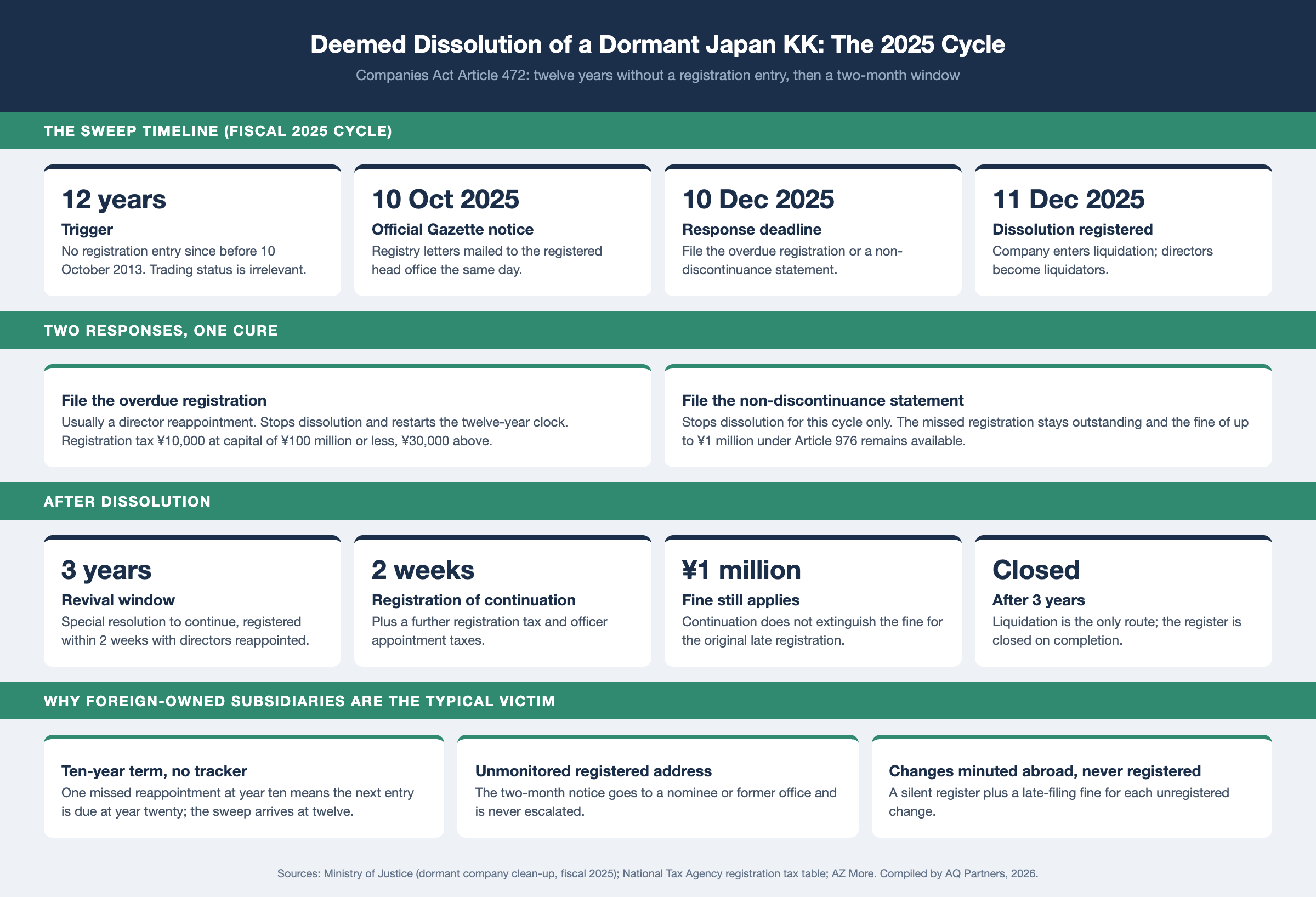
Twelve years is reached more easily than it sounds. A director's term is two years by default and up to ten years in the articles of a non-public company, and every expiry is a registrable reappointment. One with a ten-year term touches it every ten, and a single reappointment missed at the ten-year mark pushes the next entry to twenty years while the sweep arrives at twelve. The term rules are in the guide to director terms of office and re-election.
The Annual Sweep: Notice, Letter, and the Two-Month Window
Every autumn the Minister of Justice publishes one Official Gazette notice for every dormant company, and registries mail them the same day. The two months run from the public notice, not from receipt of the letter, so unread mail does not extend the period.
The 2025 cycle is the working example. According to the Ministry of Justice's page on the fiscal 2025 clean-up, the notice was published on 10 October 2025, the response deadline was 10 December 2025, and companies that had not responded were deemed dissolved at the end of that day, with the registrar entering the dissolution from 11 December 2025.
The letter goes to the registered head office. For a subsidiary using a nominee address or an office it left without registering the move, the letter may reach nobody who recognises it. This is the most common way a foreign-owned company misses the window, and it is why the registered address, covered in the guide to nominee director and registered address services, should forward official mail to a named person at headquarters.
| Step | 2025 cycle date | What the company must do | Consequence of inaction |
|---|---|---|---|
| Twelve years pass with no registration entry | Last entry before 10 October 2013 | Nothing yet; the company is now dormant | Listed in the coming sweep |
| Minister of Justice publishes the Official Gazette notice | 10 October 2025 | Check whether the company is covered | Two-month clock starts |
| Registry mails a notice to the registered head office | 10 October 2025 | Route the letter to headquarters | Unread mail does not extend the period |
| Company files the overdue registration or the non-discontinuance statement | By 10 December 2025 | Reappointment resolution and application, or the statement form | Deemed dissolved if neither is filed |
| Deemed dissolution takes effect | End of 10 December 2025 | None; the company is in liquidation | Directors become liquidators unless others are appointed |
| Registrar enters the dissolution | From 11 December 2025 | None | Register shows the company as dissolved |
| Continuation window | Until 10 December 2028 | Special resolution to continue, registered within two weeks, directors reappointed | After three years, liquidation is the only route |
| Fine for the missed registration | Any time after the lapse | Nothing prevents it once the registration is late | Civil fine of up to ¥1 million, whether or not the company continues |
The Two Responses, and Why Only One Cures the Lapse
A listed company avoids dissolution by filing the overdue registration or a non-discontinuance statement. Only the registration restores compliance. The statement is a stopgap, and the fine for the missed filing remains available.
The registration route is right in almost every case. The missing entry is nearly always a director or representative director reappointment, sometimes with an unregistered head office move. The application goes to the registry with the registration tax, which is ¥10,000 for a company with capital of ¥100 million or less and ¥30,000 above that for an officer change, per the National Tax Agency's registration and licence tax table. The procedure is the ordinary one in the guide to director change registration in Japan, and once entered, the twelve-year clock restarts.
The statement route (事業を廃止していない旨の届出, jigyou wo haishi shiteinai mune no todokede) declares to the registry that the company is still in business. It stops the deemed dissolution for that cycle only. It registers nothing, so the directors remain unregistered past their terms, the next sweep can list the company again, and the Ministry of Justice's guidance states that the fine for the earlier failure to register can still be imposed. Under Article 976 the court may fine the representative up to ¥1 million for a late registration, as summarised in AZ More's summary of the rules on directors in Japan. The statement is worth filing only when the registration cannot be completed within two months, and the registration should follow immediately.
What Deemed Dissolution Does to the Company
A deemed-dissolved company is not deleted; it enters liquidation, exists only to wind up its affairs, and cannot carry on business. For a subsidiary that is in fact trading, that status contradicts its operations, and every counterparty that checks the register will see it.
On dissolution the directors become liquidators unless the articles or a shareholder resolution appoint someone else. Many contracts carry dissolution clauses, and a bank that sees the entry on a certificate of registered matters will restrict the account. Tax obligations continue: a return is due for the period to the dissolution date and for each liquidation period, with the usual deadline of two months after the period end.
The remedy is continuation (会社継続, kaisha keizoku). A deemed-dissolved company may resolve to continue by special resolution within three years of the dissolution. Continuation is registrable and must be registered within two weeks of the resolution, together with the appointment of directors and a representative director. The continuation carries a further registration tax and each officer appointment is taxed at ¥10,000 or ¥30,000. The Ministry of Justice guidance is explicit that continuation does not extinguish the fine for the registration originally missed. After three years the company must complete its liquidation, and the register is then closed.
For comparison, the voluntary route costs ¥30,000 for the dissolution registration, ¥9,000 for the liquidator appointment, and ¥2,000 for completion of liquidation, according to RSM Shiodome Partners' 2024 guide to commercial registration taxes. A tax-side dormancy filing (休業届, kyuugyou todoke) pauses some tax obligations; it does not touch the commercial register or prevent deemed dissolution.
Why Foreign-Owned Subsidiaries Are the Typical Victim
Foreign-owned subsidiaries go dormant more easily than domestic ones because the decisions are made abroad and the warnings are delivered in Japan. Three patterns account for most cases.
The first is the long term with no tracker: a ten-year term set at incorporation, a group executive as representative director, and nobody at headquarters holding the reappointment date. The governance framework, including the term rules, is in the guide to corporate governance requirements for Japan entities. The second is the unmonitored address: a serviced office, a provider's address, or an office the company left years ago, where the registry's letter is received by someone with no instruction to escalate it. The third is the unregistered change: the parent replaced the representative director or moved the office, and never registered it in Japan, leaving a silent register and a late filing with its own fine. Who should hold the representative role is covered in the guide to representative director residency and nominee directors.
Keeping the Subsidiary Off the List
Four headquarters controls prevent deemed dissolution by replacing the registry's letter with the group's own calendar.
Hold the register in the group entity tracker with the last registration date and every director's term expiry, alerting three months ahead. Use a registered address where official mail is opened and forwarded to a named person at headquarters within days. Pull a certificate of registered matters (履歴事項全部証明書, rireki jikou zenbu shoumeisho) once a year and compare it with the tracker. And include the October sweep in the standing instruction to the Japan provider: check the Official Gazette notice against the last entry date and confirm in writing that the company is not covered.
| Control | Owner | Frequency | What it prevents |
|---|---|---|---|
| Director and kansayaku term expiry dates in the group entity tracker, alerting 3 months ahead | Group company secretary | Continuous; reviewed annually | The missed reappointment that starts the silence |
| Registered address with same-day escalation of registry and Ministry of Justice mail | Japan provider or resident director | Continuous | The unread two-month notice |
| Annual certificate of registered matters compared with the tracker | Group company secretary with the provider | Once a year | Unregistered changes and a silent register |
| Check of the October Official Gazette notice against the last entry date | Japan provider | Every October | Being listed without knowing it |
| Route every parent decision touching a Japan registered matter through one named person | Group company secretary | Per decision | Changes minuted abroad but never registered |
| Register the head office move before the old lease ends | Japan provider | Per move | Letters sent to an address the company has left |
| Consider a shorter director term where the board never changes | HQ counsel | At incorporation or by articles amendment | A decade of silence created by a ten-year term |
The full annual and event-driven checklist these controls support is in the guide to corporate secretarial obligations for a foreign-owned KK or GK in Japan.
Working with AQ Partners. Our Tokyo team provides back office operations for foreign companies operating in Japan, covering the requirements described above end to end, from director term tracking and reappointment registrations to an annual register check. Book a consultation to review your Japan entity's compliance calendar.

Yuga Koda is a founding Director at AQ Partners, supporting foreign companies, funds, and families operating in Japan. His experience operating companies in both Japan and international markets gives him a practical understanding of back office operations from both sides.