
Nominee Director and Registered Address Services in Japan: What They Cover, What They Cost, and the Liability the Nominee Carries


A nominee director service (名義取締役, meigi torishimariyaku) supplies a Japan-resident individual who is appointed as a director, and often as representative director, of a foreign-owned kabushiki kaisha (株式会社, KK) or goudou kaisha (合同会社, GK) so that the company has someone in Japan who can register a seal, open the bank account, sign the lease, and receive official mail. A registered address service (本店所在地の提供, honten shozaichi no teikyou) supplies the address that appears in the articles and on the commercial register until the subsidiary signs its own lease. Both exist because Japanese practice still expects a resident signatory even though the law no longer requires one, and both are interim arrangements to scope, price, and exit deliberately.
Key Takeaways
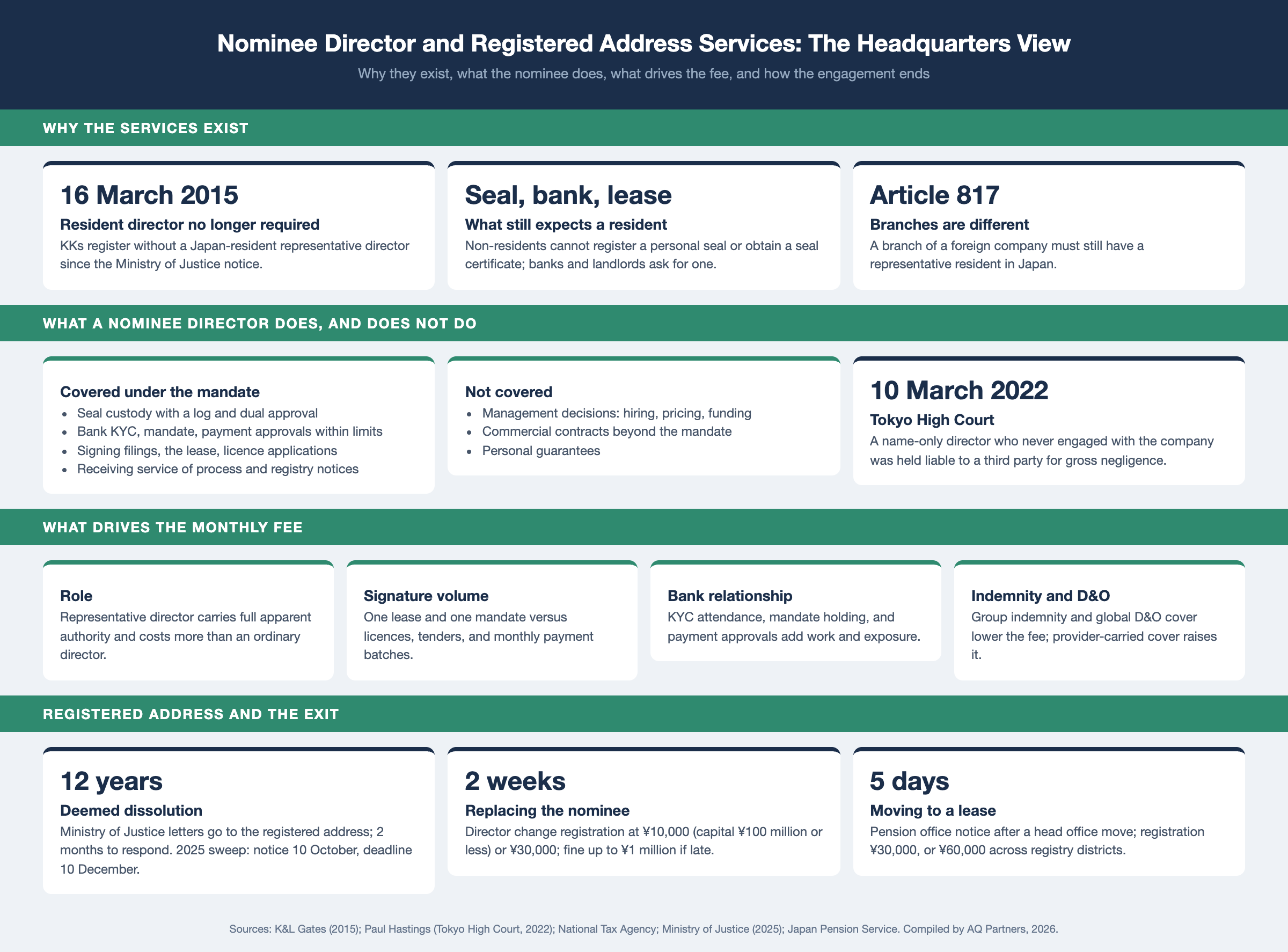
- The law stopped requiring a resident director in 2015; the market did not. Since 16 March 2015 a KK can register with no Japan-resident representative director, but banks, landlords, licensing bodies, and the seal system still expect one.
- A nominee is a real director with real liability. The Companies Act makes no distinction. The Tokyo High Court held a name-only director personally liable to a third party in March 2022, so the agreement must carry indemnity, insurance, and authority limits.
- The service is priced by exposure, not by hours. A monthly fee reflects whether the nominee is representative or ordinary director, the signature and bank workload, and the liability carried; registration fees apply on entry and exit.
- The registered address is where the Ministry of Justice writes to you. Deemed-dissolution notices go there. An unmonitored address is how a subsidiary with no registration entry for 12 years is struck off without headquarters hearing about it.
- Exit is a two-week registration. Replacing the nominee with the country manager costs ¥10,000 for a company with capital of ¥100 million or less; moving to a leased office is a ¥30,000 relocation registration plus a five-day pension office notice.
Why These Services Exist After the 2015 Rule Change
Japan dropped the resident director requirement for KKs in 2015, but every step after registration still assumes a resident with a seal. K&L Gates' client alert on the Ministry of Justice change records both halves: the Legal Affairs Bureaus accept KK incorporations without a resident representative director, and non-residents cannot register a personal seal or obtain a seal certificate, which banks, landlords, and licensing bodies ask for. Branches of foreign companies still need a resident representative under Article 817.
The result is a sequencing problem. The group wants its own executive as representative director, and that executive lives abroad, while the bank, the landlord, the registry, and the courts each want a resident. Until the country manager is hired, usually months after incorporation, a nominee director working from a provider's address fills those roles. The legal question of whether a group needs a resident director at all, and the liability every director carries, is in the guide to representative director residency and nominee directors; this guide covers the service itself.
What a Nominee Director Does, and Does Not Do
A nominee director is appointed by shareholder resolution like any other, and the Companies Act gives the role no special status. The nominee is liable to the company for neglect under Article 423 and to third parties for bad faith or gross negligence under Article 429. Paul Hastings' client alert on nominal directors reports the decisive case: on 10 March 2022 the Tokyo High Court held liable a director who had never visited the company, had supplied only a seal certificate, and received no pay, after an employee died from work-related stress. A nominee who does nothing is, in the court's view, grossly negligent by definition.
That is why a nominee service is a defined scope of work. It covers seal custody under a written procedure with a log, attending bank account opening and holding the mandate within group limits, executing filings that need the representative's seal, signing the lease, and escalating court documents and registry notices the same day.
It does not cover management. The nominee does not decide hiring, pricing, contracts beyond the mandate, or funding, and gives no personal guarantees. Those limits protect the group as much as the nominee. Keeping the group's approval matrix and the nominee's statutory authority aligned is covered in the guide to delegation of authority and the corporate seal. The table below compares a nominee with the two alternatives a group usually weighs.
| Question | Group executive only, non-resident | Resident employee as director | Nominee director from a provider |
|---|---|---|---|
| Company seal and certificate | Registrable with a signature certificate, but no resident holder | Held by the employee | Held by the provider under a custody procedure |
| Bank account opening | Slow; many banks decline without a resident signatory | Employee attends | Nominee attends and holds the mandate |
| Lease and licences | Landlords and licensing bodies may refuse | Employee signs | Nominee signs within the mandate |
| Liability holder | The executive personally | The employee personally, usually without indemnity | The nominee, indemnified and insured under the agreement |
| Group control | Full | Depends on seniority and reporting line | Full, through the mandate and approval forms |
| Cost | None beyond registration | Salary; often an unplanned promotion to director | Monthly fee plus registration on entry and exit |
| Exit | Not applicable | Resignation, often awkward if the employee is junior | Resignation on demand under the agreement; two-week registration |
How the Service Is Priced
A nominee director service is charged as a monthly fee set by the liability and workload the nominee takes on, not by hours spent. Providers do not publish a single rate because the same appointment can mean very different exposure, so a counsel comparing quotes should ask what drives each one.
Four factors move the fee. Role: a representative director carries full apparent authority, so it costs more than an ordinary seat. Signature volume: one lease and one mandate is lighter than licences, tenders, and monthly payment batches. Bank relationship: attending KYC, holding the mandate, and approving payments each add exposure. Insurance: a provider carrying its own cover prices it in, and a group offering indemnity and global D&O can expect less. Registration costs sit on top: the appointment and the eventual replacement are each a director change registration at ¥10,000 for a company with capital of ¥100 million or less and ¥30,000 above, per the National Tax Agency's registration and licence tax table.
A registered address service is a smaller monthly fee covering the address, mail receipt and forwarding, and escalation of official mail. The two are commonly bundled with the annual resolutions and register monitoring into a corporate secretarial retainer, which most wholly owned subsidiaries run until they have an administration hire in Japan.
The Registered Address: Mail, the Registry, and the Twelve-Year Trap
The registered address is the head office (本店, honten) on the register, and every authority writes to the company there. The tax office, the prefecture and municipality, the Japan Pension Service, the labor office, and the courts all use it, and a provider's address is accepted by all of them.
The address matters most for the mail nobody expects. Every autumn the Ministry of Justice publishes a notice to every KK with no registration entry for twelve years and sends a letter to each company's registered address. The company then has two months to file a pending registration or a statement that it has not discontinued business; otherwise it is deemed dissolved. In the 2025 sweep described on the Ministry of Justice's dormant company clean-up page, the notice went out on 10 October 2025, the deadline was 10 December 2025, and non-responding companies were deemed dissolved on 11 December 2025. A subsidiary whose registered address is an unchecked serviced office or a former employee's home is exactly the company that misses that letter. The procedure and the revival route are in the guide to deemed dissolution of a dormant Japan subsidiary.
One distinction is worth stating once: a registered address for a subsidiary is not a virtual office for a Business Manager visa applicant, whose company needs an independent office under the rules in force since October 2025.
When the subsidiary moves into its own lease, the change is a head office relocation registered within two weeks at ¥30,000, or ¥60,000 if it crosses into another registry district. The pension office must receive the change of applicable establishment within five days of the move, filed with the office for the old address, which forwards it, under the Japan Pension Service's procedure for a change of address across jurisdictions. The tax office, labor office, bank, and licences follow, as set out in the guide to head office relocation in Japan.
What Headquarters Counsel Should Require in the Agreement
The nominee agreement turns a personal appointment into a controlled service, and counsel should negotiate it like any outsourcing contract. It cannot remove the nominee's statutory liability, but it can allocate the cost, limit what the nominee is asked to do, and ensure the group hears about problems in time.
Since the 2019 Companies Act amendment, in force from March 2021, a company may enter into an indemnification agreement with its officers under Article 430-2 and may pay for directors' and officers' liability insurance under Article 430-3, which for a wholly owned subsidiary means a written shareholder resolution. The group's global D&O programme should list the nominee as an insured person, and the agreement should say so. The clauses below are the ones to insist on.
| Clause | Why it matters | Typical position |
|---|---|---|
| Scope of authority | Article 429 liability attaches to what the nominee does and fails to do; a narrow written mandate protects both sides | Listed acts only; everything else needs a group approval form |
| Indemnity from the parent | The nominee's liability is personal; the parent, not the subsidiary, is the credible indemnitor | Full indemnity except for the nominee's own wilful misconduct |
| D&O insurance | Article 430-3 allows the company to pay premiums; the group programme is usually cheaper than a standalone policy | Nominee named as an insured person under the group policy |
| Seal custody procedure | The seal is the company's signature; misuse is the largest practical risk | Written log, dual approval, monthly reconciliation shared with the group |
| Reporting cadence | The nominee must show engagement; the group must hear about official mail | Same-day escalation of official correspondence; monthly summary |
| Information rights for the nominee | A director who cannot see the accounts cannot discharge the duty of care | Access to management accounts, payroll status, and tax filings |
| Termination and resignation | The group needs a clean exit; the nominee must be able to resign if cooperation stops | 30 days' notice either way; resignation on demand; both sign the change registration |
| Handover on exit | Seals, bank tokens, certificates, and the custody log must transfer without a gap | Itemised handover schedule; registration filed within two weeks |
| Fee basis and registration costs | Avoids disputes when the scope grows | Monthly fee; registration taxes and scrivener fees at cost |
The exit is routine when the agreement is drafted this way. The sole shareholder resolves to appoint the country manager and accepts the nominee's resignation, the new director supplies an acceptance letter and identification, the new representative registers a seal or supplies a signature certificate, and the change is registered within two weeks. Filing late exposes the representative to a civil fine of up to ¥1 million under Article 976, as AZ More's summary of the rules on directors in Japan records. The document set is in the guide to director change registration in Japan, the bank-side steps in the guide to opening a corporate bank account in Japan, and the full annual and event calendar the nominee helps run in the guide to corporate secretarial obligations for a foreign-owned KK or GK.
Working with AQ Partners. Our Tokyo team provides back office operations for foreign companies operating in Japan, covering the requirements described above end to end. Book a consultation to review your Japan entity's compliance calendar.

Yuga Koda is a founding Director at AQ Partners, supporting foreign companies, funds, and families operating in Japan. His experience operating companies in both Japan and international markets gives him a practical understanding of back office operations from both sides.