
Head Office Relocation in Japan (本店移転): Registration, Tax Office Notifications, and the Cross-Jurisdiction Trap

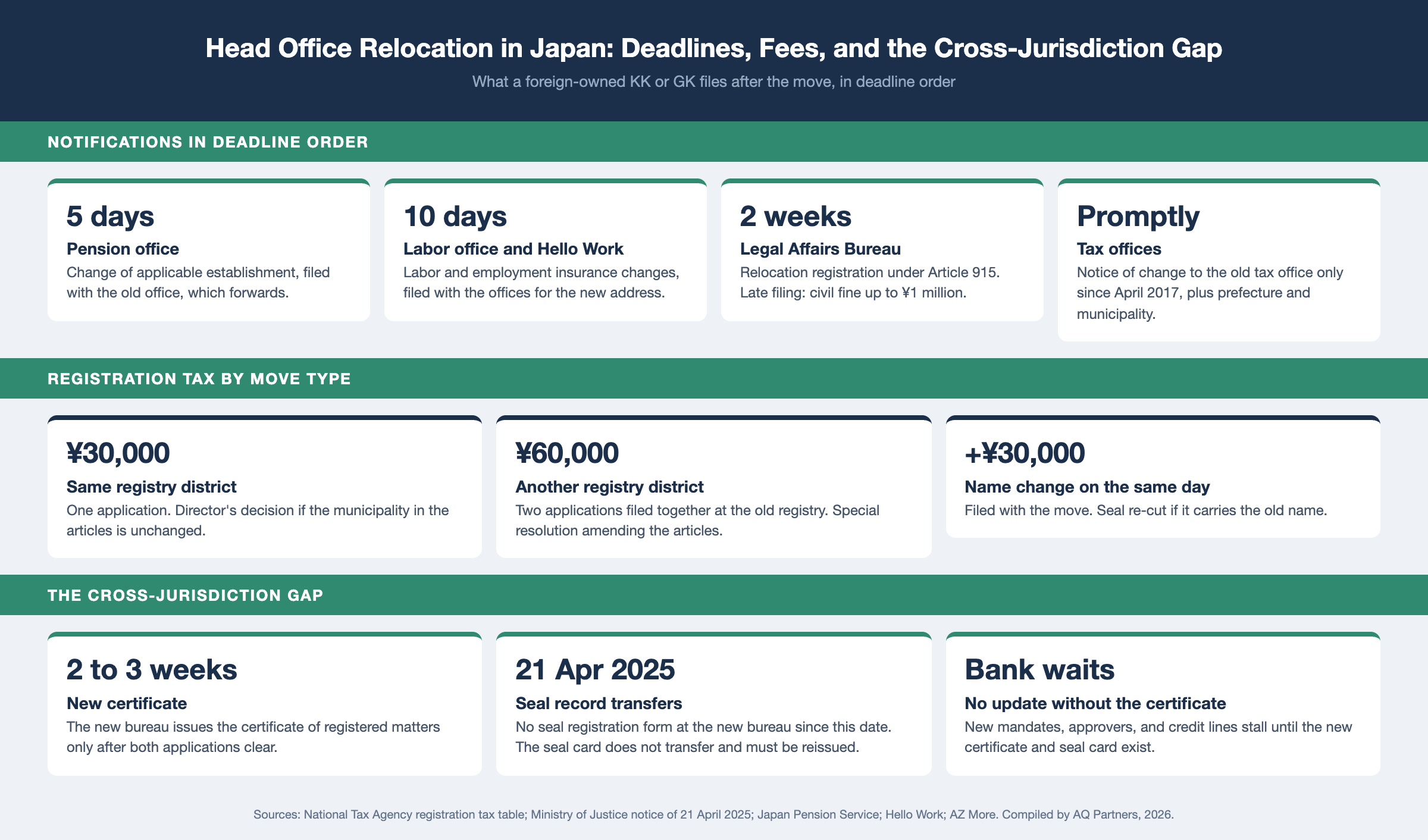
A head office relocation (本店移転, honten iten) is the change of a Japanese company's registered principal office. For a foreign-owned kabushiki kaisha (株式会社, KK) or goudou kaisha (合同会社, GK) it is one registration at the Legal Affairs Bureau (法務局, houmukyoku) followed by notifications to the pension office, the labor offices, the tax offices, the bank, and every licensing body that records an address. The registration is due within two weeks of the move; the first notification is due within five days. A move into the district of a different registry adds a second application, a longer wait for the new certificate, and a window in which the bank will not act on the new address.
Key Takeaways
- The articles decide the resolution. Most articles state the head office at municipality level, so a move within the same city needs only a director's decision, while a move to another municipality needs a special shareholder resolution amending the articles.
- Two weeks and ¥30,000 per registry. Registration is due within two weeks of the move under Companies Act Article 915. A move within the same registry district costs ¥30,000; a move to another district is two applications filed together at the old registry for ¥60,000.
- The seal now follows the company. Since 21 April 2025 the old registry transfers the seal record to the new one, so no fresh seal registration form is needed. The seal card does not transfer and must be reissued at the new bureau.
- The pension office gets five days, the labor offices ten. The change of applicable establishment goes to the old pension office within five days; the labor and employment insurance changes go to the offices for the new address within ten days of the day after the move.
- The bank waits for the new certificate. A cross-district move can take two to three weeks to produce a certificate from the new bureau, and the bank will not update the account until it has one. Time the move so payroll and vendor runs do not fall in that gap.
Which Resolution the Move Needs
The resolution depends on whether the new address is inside the municipality named in the articles, not on the distance moved. Japanese articles almost always state the head office at the level of the smallest administrative unit (最小行政区画, saishou gyousei kukaku), a city, ward, town, or village, rather than a street address. A move within that unit changes nothing in the articles, so a decision of the directors, or of the managing member of a GK, is enough. A move to another municipality amends the articles and needs a special shareholder resolution, which a wholly owned subsidiary passes as a written resolution of the sole shareholder.
The registry district is a separate question. A move within the same Legal Affairs Bureau district is one application. A move into another district is two applications, one removing the company from the old registry and one entering it at the new, filed together at the old bureau, which forwards the second. The registration and licence tax is ¥30,000 per location under the National Tax Agency's registration and licence tax table, so a cross-district move costs ¥60,000. A name change filed on the same day is registered with the move.
| Move type | Resolution | Applications | Registration tax | Seal | New certificate available |
|---|---|---|---|---|---|
| Same municipality and district | Director or managing member decision | One, at the current registry | ¥30,000 | Unchanged | About 1 to 2 weeks |
| Other municipality, same district | Special resolution amending the articles | One, at the current registry | ¥30,000 | Unchanged | About 1 to 2 weeks |
| Other district, same prefecture | Special resolution amending the articles | Two, filed together at the old registry | ¥60,000 | Record transferred; new seal card required | About 2 to 3 weeks |
| Other prefecture | Special resolution amending the articles | Two, filed together at the old registry | ¥60,000 | Record transferred; new seal card required | About 2 to 3 weeks; local tax offices change |
| Move plus trade name change, same day | Special resolution covering both | Filed together | ¥30,000 or ¥60,000, plus ¥30,000 for the name | Seal re-cut if it carries the old name | As above |
| Move to a nominee or serviced address | As for the destination municipality | As above | As above | Custody arrangement documented | As above |
The Registration: Two Weeks, and What Changed in 2025
The relocation must be registered within two weeks of the move, and since April 2025 a cross-district move needs no new seal registration form. The two-week rule is Companies Act Article 915, and a late filing exposes the representative to a civil fine of up to ¥1 million under Article 976, as AZ More's summary of the rules on directors and registration records.
Under the amended Commercial Registration Rules described in the Ministry of Justice's notice on head office moves to another registry district, effective 21 April 2025, the old registry transfers the seal record and the seal is carried over. The seal card (印鑑カード, inkan kaado) is not transferred and must be requested from the new bureau once registration completes. Until then the company cannot pull a fresh seal certificate at the new address, which the bank requires. The corporate number does not change with the address. The seal's role in every filing is set out in the guide to delegation of authority and the corporate seal and the inkan system guide.
The Notification Cascade, in Deadline Order
The registration is the slowest filing but not the first deadline: the pension office wants notice within five days, the labor offices within ten. Under the Japan Pension Service's procedure for a change of establishment address across pension office jurisdictions, the change of applicable establishment is filed within five days with the pension office for the old address, which forwards it. The employment insurance change is due within ten days from the day after the change at Hello Work, according to the Hello Work guidance on the employer establishment change notification, and the labor insurance change goes to the labor standards inspection office for the new address within the same ten days.
The tax filings have no statutory day but should follow at once. The notice of change (異動届出書, idou todokedesho) goes to the tax office for the old address only; the National Tax Agency's simplification of 1 April 2017 removed the duplicate filing with the new office. The prefecture and municipality each receive their own notice, and where the company crosses a municipal boundary the per-capita levy of corporate inhabitants tax is prorated by months between the two jurisdictions, with a partial month dropped, as Kashiwa City's guidance on mid-year relocations explains., and as covered in the guide to corporate resident tax in Japan.
| Authority or counterparty | Filing | Deadline after the move | Where filed | Owner |
|---|---|---|---|---|
| Japan Pension Service | 適用事業所名称/所在地変更届 | 5 days | Pension office for the old address, which forwards | Payroll provider |
| Labor Standards Inspection Office | 労働保険名称、所在地等変更届 | 10 days from the day after the move | Office for the new address | Payroll provider |
| Hello Work | 雇用保険事業主事業所各種変更届 | 10 days from the day after the move | Hello Work for the new address, with the labor insurance copy | Payroll provider |
| Legal Affairs Bureau | 本店移転登記 | 2 weeks | Old registry; two applications for a cross-district move | Judicial scrivener |
| Legal Affairs Bureau (new) | 印鑑カード交付申請 | After registration completes | New registry | Resident director or nominee |
| Tax office | 異動届出書 | Promptly; no fixed day | Old tax office only | Accounting provider |
| Prefectural tax office | 異動届 | Promptly; local rules vary | Old and new prefecture where they differ | Accounting provider |
| Municipality | 異動届 | Promptly; local rules vary | Old and new municipality where they differ | Accounting provider |
| Bank | Registered address and seal certificate update | Per the bank; needs the new certificate | Branch | Resident director with treasury |
| Licensing bodies | Licence amendment or re-application | Per each licence | Each body | Compliance lead |
| Landlord, customers, vendors | Lease and contract notices; invoice address; online-sales legal notice | Per each contract | Counterparties | Country manager |
The Cross-Jurisdiction Trap
A cross-district move opens a two-to-three-week window with a new address, no certificate proving it, and a bank that will not act without one. The old registry must accept both applications before the new registry enters the company, and the new bureau's certificate of registered matters is what the bank, landlords, and licensing bodies require.
The consequence is operational. Payroll runs from the existing account and is unaffected, but a new signatory mandate, a new credit line, a change of online banking approver, or a vendor's request for a current certificate cannot be met until the registration completes. A group that moves at month end and pays salaries on the 25th usually clears the gap; one that moves mid-month with a rent transfer and a payroll run inside the window does not. The bank relationship is described in the guide to opening a corporate bank account in Japan.
The sequence that avoids the trap: fix the move date at least three weeks before any banking change is needed; pull fresh seal certificates and a certificate of registered matters from the old registry before filing, because the old bureau stops issuing them once the company leaves; file the pension, labor, and employment insurance changes and the registration in the first ten days; request the seal card at the new bureau on the day registration completes and take the new certificate to the bank that week. A subsidiary on a provider's registered address follows the same sequence with the provider holding the seal card, as described in the guide to nominee director and registered address services.
Moves That Carry Other Changes
A relocation often coincides with a name, purpose, or director change, and each rides on the same filing but adds its own documents. A name change files with the move for a further ¥30,000 and requires the seal to be re-cut if it carries the old name, which means a fresh seal registration even though the address transfer alone no longer needs one. A purpose change is another ¥30,000 and triggers a licence check. A change of representative director adds the director change registration. The name and purpose procedures are in the guide to changing a company's name, purpose, or fiscal year end, and every registrable event is collected in the pillar guide to corporate secretarial obligations for a foreign-owned KK or GK.
Frequently Asked Questions
Does a Japan subsidiary need a shareholder resolution to move office?
Only if the new address is outside the municipality stated in the articles of incorporation. A move within that municipality needs a decision of the directors or managing member. A move to another city or ward amends the articles and needs a special resolution, which a sole shareholder passes in writing.
How much does a head office relocation cost to register in Japan?
The registration and licence tax is ¥30,000 per registry. A move within the same district is one application at ¥30,000; a move to another district is two applications filed together at the old registry for ¥60,000. A trade name change filed at the same time adds ¥30,000.
Does the company need to re-register its seal after moving to another registry district?
Not since 21 April 2025. The old registry transfers the seal record, so no seal registration form is filed with the move. The seal card is not transferred, so the company must request a new card from the new registry after registration completes before it can obtain seal certificates there.
What is the first deadline after a head office move?
The pension office, within five days of the move, filed with the office for the old address. The labor standards office and Hello Work follow within ten days from the day after the move, and the Legal Affairs Bureau within two weeks.
Working with AQ Partners. Our Tokyo team provides back office operations for foreign companies operating in Japan, covering the requirements described above end to end, from the relocation registration and seal card to the pension, labor, and tax office notifications. Book a consultation to review your Japan entity's compliance calendar.

Yuga Koda is a founding Director at AQ Partners, supporting foreign companies, funds, and families operating in Japan. His experience operating companies in both Japan and international markets gives him a practical understanding of back office operations from both sides.