
Changing Your Company Name, Business Purpose, or Fiscal Year End in Japan


Changing a Japan subsidiary's trade name, business purpose, or fiscal year end means amending its articles of incorporation (定款, teikan) by a special resolution of the shareholders and then working through the filings each change triggers. A name change and a purpose change are registered matters, so each is filed with the Legal Affairs Bureau (法務局, houmukyoku) within two weeks at a registration tax of ¥30,000, and a name change then cascades through seals, banks, tax and insurance offices, licences, and contracts. A fiscal year change is not a registered matter: no Legal Affairs Bureau filing and no registration tax, but a set of tax notifications and a stub-period return. This guide sets out the resolution, filings, deadlines, and follow-on work for each.
Key Takeaways
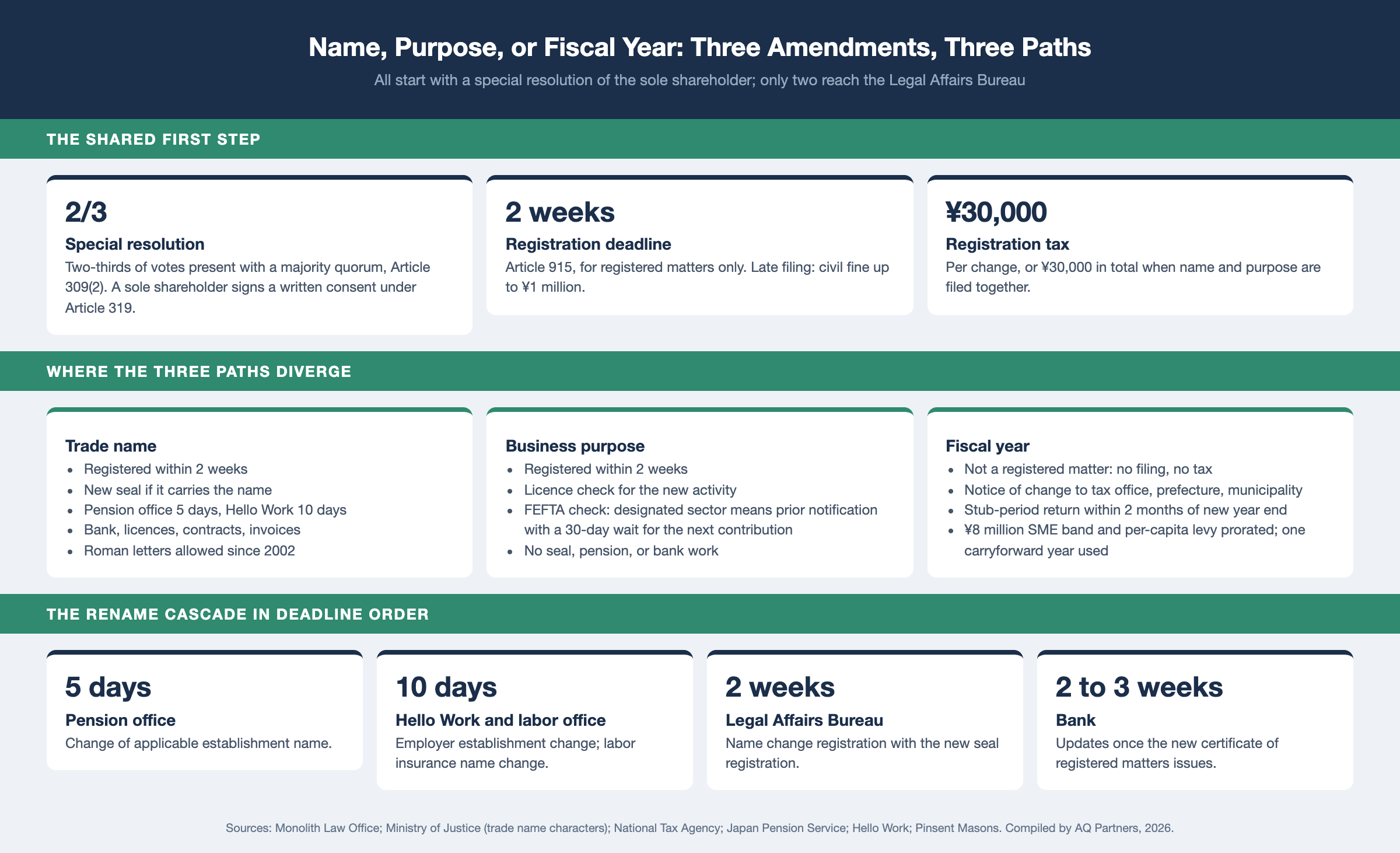
- All three changes start with the same special resolution. Amending the articles needs a shareholders' resolution passed by two-thirds of the votes present with a majority quorum under Companies Act Article 309(2). A sole corporate shareholder passes it by written consent under Article 319, so no meeting is held.
- Name and purpose are registered; the fiscal year is not. A trade name or purpose change must be registered within two weeks under Article 915 at ¥30,000 each, or ¥30,000 in total when filed together. A fiscal year change needs only tax notifications and a stub-period return.
- A rename is a notification cascade, not a filing. The pension office must be told within five days and the employment insurance office within ten, and the corporate seal usually has to be re-cut and re-registered before the bank will accept the new name.
- A purpose change can change the FEFTA regime. Where the new activity is a designated sector under the Foreign Exchange and Foreign Trade Act, the parent's next capital contribution moves from a post-investment report to prior notification with a 30-day waiting period.
- A fiscal year change costs a year of loss carryforward. The stub period is a fiscal year for tax purposes: its return is due within two months of the new year end, the ¥8 million SME band and the per-capita levy are prorated by month, and the ten-year carryforward window spends one of its years.
One Resolution, Three Different Filings
Each change is an amendment to the articles that needs a special resolution, but only the name and purpose changes go on to the register. Any amendment to the articles requires the special resolution described in Monolith Law Office's explanation of articles amendments under Japanese corporate law: a majority of the voting rights present and at least two-thirds of those in favour. For a wholly owned subsidiary the parent is the only shareholder, so the resolution is a one-page written consent under Article 319.
What happens next depends on whether the amended item is a registered matter. Trade name and business purpose both appear on the certificate of registered matters, so the same source records that the company must apply for change registration within two weeks of the change under Article 915(1), with a civil fine of up to ¥1 million for a late filing. The fiscal year does not appear on the register, so its change is complete once the articles are amended and the tax authorities are told.
| Step | Trade name change | Business purpose change | Fiscal year change |
|---|---|---|---|
| Resolution | Special resolution amending the articles; written consent for a sole shareholder | Same | Same |
| Legal Affairs Bureau registration | Yes, within 2 weeks | Yes, within 2 weeks | No; not a registered matter |
| Registration tax | ¥30,000 | ¥30,000; ¥30,000 in total if filed with a name change | None |
| Corporate seal | Re-cut and re-register if the seal carries the name | No change | No change |
| Tax office and local tax offices | Notice of change with the new certificate | Usually a notice of change; some offices do not require it | Notice of change with minutes and amended articles; stub-period return within 2 months of the new year end |
| Pension and labor insurance | Name change notices within 5 and 10 days | No filing | No filing |
| Licences and FEFTA | Licence amendments for the new name | Licence application if the activity is regulated; FEFTA regime check | No filing |
| Bank, contracts, invoices | All updated | Rarely affected | Not affected |
Trade Name: The Rules and the Cascade
A trade name (商号, shougou) change is the simplest registration and the longest follow-on list, because the name is on every account and contract. The rules for the new name come from the Companies Act and the Commercial Registration Act: a KK's name must contain 株式会社 and a GK's 合同会社, a company may not register a name identical to another company's at the same head office address, and words implying a regulated business, such as bank or insurance, may not be used without the licence. Since 1 November 2002 the register accepts Roman letters, Arabic numerals, and a short list of symbols, as set out on the Ministry of Justice's page on using Roman characters in trade names, so a subsidiary can register the group brand in Latin script rather than a katakana transliteration.
The registration is filed within two weeks of the effective date at ¥30,000, and where the name and purpose change together the combined filing is taxed at ¥30,000 in total, according to RSM Shiodome Partners' guide to commercial registration taxes. If the registered corporate seal (会社実印, kaisha jitsuin) shows the old name, a new seal is cut and its registration filed with the same application; the bank will not switch the account name until it sees the new certificate of registered matters and the new seal certificate.
The cascade then runs on statutory clocks. The Japan Pension Service must receive the change of applicable establishment name within five days, per its procedure for a change of establishment name or address. The employment insurance office must receive the employer establishment change notification within ten days counted from the day after the change, per Hello Work's guidance on the form, and the labor insurance name change goes to the labor standards inspection office in the same period. The tax office, prefecture, and municipality each receive a notice of change with the new certificate.
| Counterparty | Action | Deadline | Owner |
|---|---|---|---|
| Legal Affairs Bureau | Trade name change registration; new seal registration if needed | 2 weeks from effective date | Judicial scrivener |
| Japan Pension Service | Change of applicable establishment name | 5 days | Provider or HR |
| Hello Work | Employer establishment change notification | 10 days from the day after the change | Provider or HR |
| Labor Standards Inspection Office | Labor insurance name change notification | 10 days | Provider or HR |
| Tax office, prefecture, municipality | Notice of change with new certificate | Promptly after registration | Provider |
| Bank | Account name, registered seal, online banking mandates | After the new certificate issues, usually 2 to 3 weeks after filing | Resident director and finance |
| Licensing bodies | Licence amendment or notification | Per licence, commonly within 30 days | Counsel |
| Customers, vendors, landlord | Contract notices; invoice and qualified invoice details | Per contract | Operations and finance |
| Public-facing materials | Website legal notice, signatures, letterhead, other seals | At the effective date | Marketing and admin |
Business Purpose: Drafting, Licences, and the FEFTA Check
A business purpose (目的, mokuteki) change is a two-week registration at ¥30,000, and the drafting of the new clause matters more than the filing. The clause defines what the company may lawfully do, and licensing bodies and banks read it. It should name the new activity in terms the regulator recognises, keep the lines the company still uses, and end with the customary catch-all covering all business incidental to the listed purposes.
Two checks belong before the resolution. The first is licensing: if the new purpose is a regulated activity, the licence or notification must be in place before the business starts, and some regulators require the purpose to be registered before they accept the application. The second is FEFTA. Where the new purpose falls within a designated business sector under the Foreign Exchange and Foreign Trade Act, the parent's next capital contribution moves from a post-investment report filed within 45 days into prior notification with a 30-day waiting period, as described in Pinsent Masons' guide to foreign direct investment in Japan. A purpose change into a designated sector may itself require a filing by the existing foreign shareholder; the designated-sector list changes, so check the current list first. The mechanics are in the guide to FEFTA inward direct investment notification.
Fiscal Year: No Registration, but a Stub Period
A fiscal year (事業年度, jigyou nendo) change never reaches the Legal Affairs Bureau; its cost sits entirely in the tax filings the stub period creates. After the special resolution, the company files a notice of change (異動届出書, idou todokedesho) with the tax office, attaching the minutes and the amended articles, and equivalent notices with the prefecture and the municipality. There is no registration tax and no seal work.
The stub period is where the work is. The period from the old year end to the new one is a fiscal year in its own right, with corporate, local, and consumption tax returns due within two months of the new year end. Because it is short, the ¥8 million band taxed at the reduced SME rate is prorated by months over twelve, and the per-capita inhabitant tax levy, from ¥70,000 at the smallest band in Tokyo, is charged by month. The ten-year loss carryforward window counts fiscal years, so a stub period spends one, as explained in the guide to tax loss carryforward rules in Japan. The reasons a multinational aligns the year with its parent, with a worked table of stub periods, are in the guide to aligning the subsidiary's fiscal year with the parent.
Sequencing the Three Changes from Headquarters
When a group rebrands and restructures at once, the filing order decides whether the subsidiary spends weeks with a mismatched bank account name. Three rules keep the sequence clean. Pass one combined special resolution covering every amended article, so a single ¥30,000 registration covers both name and purpose. Cut the new seal before the effective date and file its registration with the change application, so the bank update can start the day the new certificate issues. Set a name change's effective date at least three weeks before any deadline that depends on the new name, because the new certificate takes two to three weeks. The full event calendar is in the guide to corporate secretarial obligations for a foreign-owned KK or GK, the parallel cascade for an office move in the guide to head office relocation in Japan, the articles in the guide to articles of incorporation in Japan, and seal replacement in the guide to Japan's inkan system.
Frequently Asked Questions
Can a Japan subsidiary register its trade name in Roman letters?
Yes. Since 1 November 2002 the register accepts Roman letters, Arabic numerals, and a short list of symbols, so a subsidiary can register the group brand in Latin script followed by 株式会社 or 合同会社.
Does changing the fiscal year require a Legal Affairs Bureau filing?
No. The fiscal year is not a registered matter, so there is no registration and no registration tax. The company amends its articles by special resolution, files a notice of change with the tax office, prefecture, and municipality, and files a stub-period return within two months of the new year end.
What is the registration tax for changing both name and purpose?
¥30,000 in total when the two changes are filed in one application, against ¥30,000 each if filed separately. Both must be registered within two weeks of the effective date, and a late filing exposes the representative to a civil fine of up to ¥1 million.
Working with AQ Partners. Our Tokyo team provides back office operations for foreign companies operating in Japan, covering the requirements described above end to end, from the shareholder resolution and registration to the pension, labor, tax, and bank notifications that follow. Book a consultation to review your Japan entity's compliance calendar.

Yuga Koda is a founding Director at AQ Partners, supporting foreign companies, funds, and families operating in Japan. His experience operating companies in both Japan and international markets gives him a practical understanding of back office operations from both sides.