
FEFTA Inward Direct Investment: Prior Notification vs Post-Investment Report for Foreign Shareholders

Inward direct investment (対内直接投資等, tainai chokusetsu toushi tou) is the category of transaction that the Foreign Exchange and Foreign Trade Act (外国為替及び外国貿易法, FEFTA) requires a foreign investor to notify or report when it puts money into a Japanese company. For a multinational with a wholly owned kabushiki kaisha (株式会社, KK) or goudou kaisha (合同会社, GK), it covers the parent's subscription at incorporation, every later capital increase, and any parent loan that crosses the size and term thresholds. Each transaction falls into one of two regimes: a prior notification (事前届出, jizen todokede) with a waiting period where the subsidiary operates in a designated business sector, or a post-investment report (事後報告, jigo houkoku) within 45 days everywhere else, both filed through the Bank of Japan. This guide sets out which transactions are caught, which regime applies, the deadlines, who signs, and what the 2026 amendment changes.
Key Takeaways
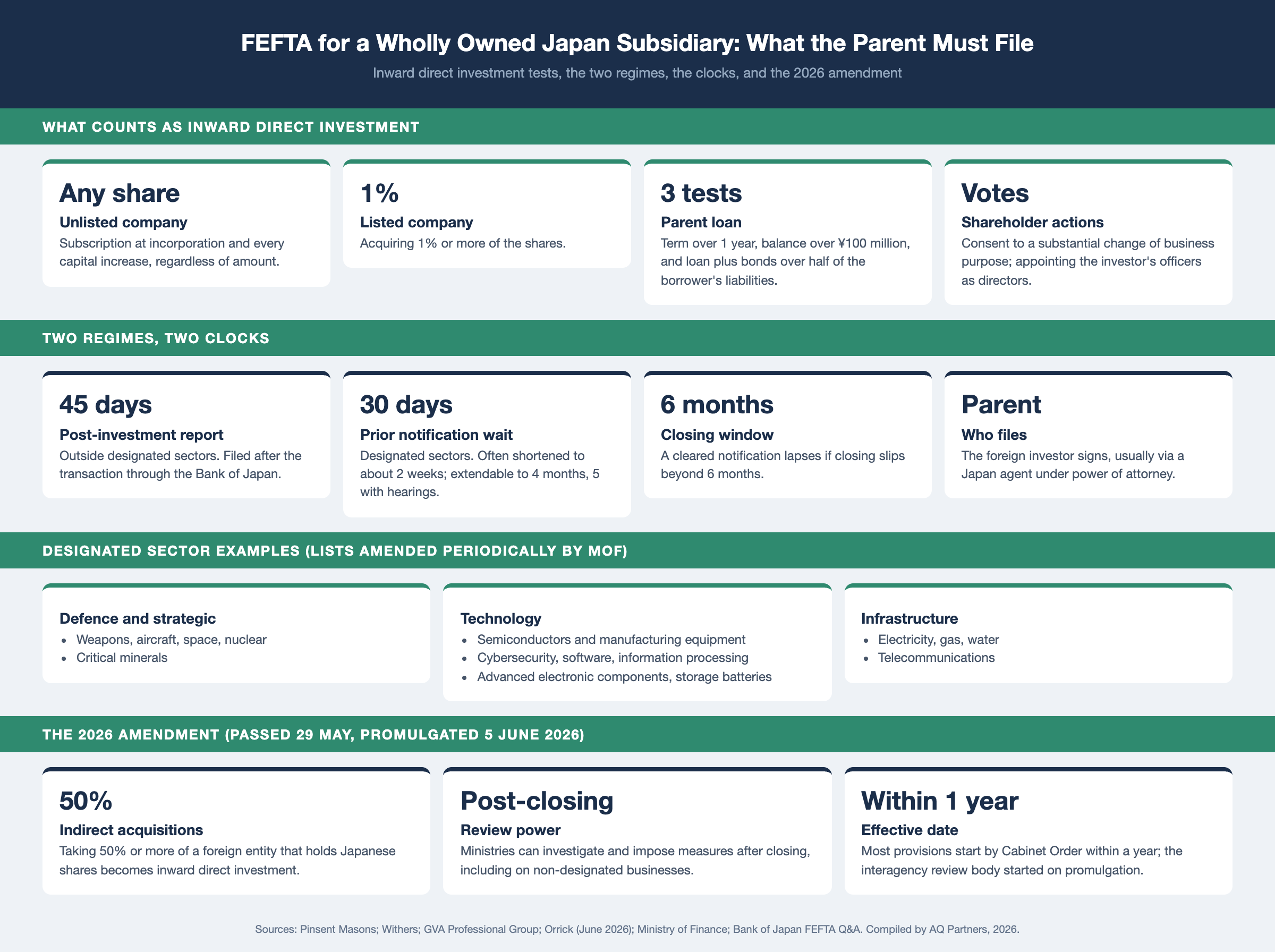
- Every share the parent takes in an unlisted subsidiary is inward direct investment. The initial subscription at incorporation and each capital increase are reportable regardless of amount; for a listed company the threshold is 1% of the shares.
- Parent loans are caught by a three-part test. A loan is inward direct investment when its term exceeds one year, its balance exceeds ¥100 million, and the loan plus any bonds the parent holds exceed half of the subsidiary's liabilities.
- Two regimes, two clocks. Outside designated sectors the parent files a post-investment report within 45 days of the transaction. In a designated sector the parent files a prior notification and waits 30 days, often shortened to two weeks and extendable to five months, before closing.
- The parent signs, not the subsidiary. The foreign investor is the filer, usually through a Japan-based agent under a power of attorney, and the prescribed Bank of Japan forms differ for share acquisitions and for loans.
- The 2026 amendment reaches upstream. Promulgated on 5 June 2026 and taking effect by Cabinet Order within a year, it brings acquisitions of 50% or more of a foreign entity that holds Japanese shares into the screening regime and creates an interagency review body.
What Counts as Inward Direct Investment for a Foreign Parent
A parent's share subscriptions, capital increases, qualifying loans, and certain shareholder votes are all inward direct investment under FEFTA. The test is applied to each transaction, not once at incorporation.
A foreign investor (外国投資家, gaikoku toushika) is a non-resident, a foreign entity, or a Japanese company in which foreign holders have 50% or more of the voting rights, as summarised in Withers' overview of the FEFTA regulation. Every multinational parent qualifies, and so does any Japanese holding company it controls.
For such an investor, the transactions that count include the acquisition of any shares in an unlisted Japanese company, whatever the percentage, and the acquisition of 1% or more of a listed company, according to Pinsent Masons' guide to foreign direct investment in Japan. The same guide adds loans to a Japanese company with a term exceeding one year and an amount above ¥100 million; the Bank of Japan's FEFTA question-and-answer guidance adds the further condition that the loan plus any bonds of the company held by the investor must exceed 50% of the company's total liabilities after the loan. Consenting as shareholder to a substantial change in the company's business purpose, and voting to appoint the investor's officers as directors, are also caught, though these matter most for listed targets. GVA Professional Group's introduction to FEFTA for foreign startups confirms that for an unlisted company any share acquisition, regardless of size, is inward direct investment, which is why the subscription at incorporation is itself reportable.
Prior Notification or Post-Investment Report: The Designated Sector Test
The regime depends on the subsidiary's business rather than the investment size, and a designated-sector activity means notifying before investing. Everything else is reported after.
Designated business sectors (指定業種, shitei gyoushu) are those treated as relevant to national security, public order, public safety, or the smooth running of the economy. The lists are set by public notice and amended periodically; the current lists are published on the Ministry of Finance's foreign direct investment page. Recurring examples are weapons, aircraft, space, and nuclear manufacturing, cybersecurity and certain software and information processing, semiconductors and their manufacturing equipment, advanced electronic components and storage batteries, critical minerals, and utilities such as electricity, gas, telecommunications, and water. A core subset carries a narrower exemption and higher scrutiny.
A subsidiary that develops software or processes data for its group should be checked against the current list before each investment, because those designations are broad and have been extended several times since 2019. A group that changes the subsidiary's business purpose into a designated activity moves its next capital contribution from the report regime into the notification regime, a point covered in the guide to changing a company's name, purpose, or fiscal year end.
An exemption system lets certain investors acquire designated-sector shares without prior notification if they do not become directors, do not propose a transfer of the designated business, and do not access non-public technical information. A parent that seats its executives on the subsidiary's board cannot use it.
Deadlines, Forms, and Who Files
A post-investment report is due within 45 days of the transaction; a prior notification goes in 30 days to six months before closing. Both pass through the Bank of Japan as receiving office for the Ministry of Finance and the sector ministries.
The foreign investor files, not the subsidiary. The parent signs the prescribed form or appoints an agent in Japan by power of attorney, usually the subsidiary's provider or counsel. Separate prescribed forms exist for share acquisitions, for loans, and for the post-investment report, all in Japanese.
The waiting period is 30 days from receipt. Routine cases are often cleared in about two weeks; where national security concerns arise the period can be extended to four months, or five where hearings are held, and closing must wait. A notification lapses if closing slips beyond six months from acceptance and must be refiled.
The table below maps each transaction a wholly owned subsidiary's parent is likely to make onto its regime and deadline.
| Transaction | Inward direct investment? | Regime outside designated sectors | Regime in a designated sector | Deadline | Filed by |
|---|---|---|---|---|---|
| Subscription for shares at incorporation | Yes, any amount (unlisted) | Post-investment report | Prior notification | 45 days after acquisition; or 30-day wait before closing | Parent, via agent in Japan |
| Capital increase subscribed by the parent | Yes, any amount | Post-investment report | Prior notification | Same | Parent |
| Parent loan over one year, over ¥100 million, over half of liabilities | Yes | Post-investment report | Prior notification | Same, from drawdown | Parent |
| Parent loan of one year or less, or below the thresholds | No | None (payment report may apply) | None | Not applicable | Not applicable |
| Capital reserve contribution without new shares | Generally treated with the share issue it accompanies | Report with the subscription | Notify with the subscription | Same | Parent |
| Consent to a substantial change of business purpose | Yes | Post-investment report | Prior notification | Same, from the resolution | Parent |
| Appointment of the parent's officers as directors | Yes, in the listed-company context; check for unlisted | Report if caught | Notify if caught | Same | Parent |
| Transfer of the subsidiary's shares between group companies | Yes, for the acquiring foreign investor | Post-investment report | Prior notification | Same | Acquiring group company |
| Dividend or loan repayment to the parent | No | None (payment report may apply) | None | Not applicable | Not applicable |
Large cross-border payments between subsidiary and parent may separately require a payment report through the Bank of Japan; the bank usually prompts for it.
The Prior Notification Timeline in Practice
A designated-sector notification adds four to eight weeks to a funding round, so it should start before the board resolves the capital increase. The sequence is below.
| Step | Timing | Who |
|---|---|---|
| Check the subsidiary's activities against the current designated and core sector lists | Before the board paper | Group counsel with Japan counsel |
| Prepare the notification form, business description, and investor details in Japanese | 1 to 2 weeks | Agent in Japan |
| Parent signs the form and power of attorney | Day 0 minus 1 week | Parent's authorised officer |
| Bank of Japan receives the notification for the Ministry of Finance | Day 0 | Agent |
| Standard waiting period runs | Day 0 to day 30; often shortened to about day 14 | Ministries |
| Extended review where concerns are raised | Up to four months, five with hearings | Ministries |
| Transaction closes; shares issued or loan drawn | After clearance and within six months of acceptance | Subsidiary and parent |
| Registration of the capital increase at the Legal Affairs Bureau | Within 2 weeks of payment | Subsidiary |
The Companies Act side, including the 0.7% registration tax and the capital thresholds, is in the guide to capital increase and capital reduction in Japan. The loan side, with the interest and withholding rules, is in the guide to intercompany loans to a Japan subsidiary.
Penalties and the 2026 Amendment
Failing to notify or report draws criminal penalties and divestment orders, and the 2026 amendment widens the regime to indirect acquisitions. An investor that enters a designated sector without prior notification can be ordered to divest, and violations carry criminal sanctions including imprisonment of up to three years and fines, according to Withers' overview. A missed post-investment report is a lesser breach but surfaces at the worst moment, when a buyer's due diligence asks for the filings.
The amendment passed the Diet on 29 May 2026 and was promulgated on 5 June 2026, as recorded in Orrick's alert on the reform of Japan's foreign investment screening regime. Most provisions take effect by Cabinet Order within one year of promulgation; the interagency review framework took effect on promulgation. Three changes matter for a group with a Japan subsidiary. Acquiring 50% or more of the voting rights in a foreign entity that holds Japanese shares becomes inward direct investment, so a change of control at the parent or an intermediate holding company can require screening where the subsidiary is in a designated sector. The ministries gain a power to investigate and impose measures after closing, including on non-designated businesses. Mitigation commitments offered with a notification gain a statutory footing. Groups with a designated-sector subsidiary should add Japan to the checklist for any upstream reorganisation.
The corporate secretarial calendar these filings sit within is in the guide to corporate secretarial obligations for a foreign-owned KK or GK, and the funding decision behind most of them is in the guide to funding a Japan subsidiary. Sector licensing that often coincides with designated-sector status is covered in the guide to regulatory barriers to Japan market entry.
Frequently Asked Questions
Does a 100% parent need to file FEFTA paperwork for every capital increase?
Yes. Each subscription for new shares in an unlisted subsidiary is a separate inward direct investment, reported within 45 days of the acquisition, or notified in advance with a 30-day waiting period if the subsidiary operates in a designated sector. Retained earnings and reserve movements without a share issue are not caught.
Who signs the FEFTA filing, the parent or the Japanese subsidiary?
The foreign investor, which is the parent. In practice the parent appoints an agent in Japan by power of attorney, usually the subsidiary's provider or counsel, who prepares the form and submits it to the Bank of Japan.
What changes under the 2026 FEFTA amendment for an existing subsidiary?
Routine filings for capital increases and loans are unchanged. The amendment, promulgated on 5 June 2026 with most provisions effective within a year by Cabinet Order, adds screening of acquisitions of 50% or more of a foreign entity holding Japanese shares, a post-closing review power, and an interagency review body.
Working with AQ Partners. Our Tokyo team provides back office operations for foreign companies operating in Japan, covering the requirements described above end to end, from FEFTA reports and prior notifications to capital registrations and the annual corporate calendar. Book a consultation to review your Japan entity's compliance calendar.

Yuga Koda is a founding Director at AQ Partners, supporting foreign companies, funds, and families operating in Japan. His experience operating companies in both Japan and international markets gives him a practical understanding of back office operations from both sides.