
Intercompany Loans to a Japan Subsidiary: Interest Rates, Withholding, and FEFTA Reporting

An intercompany loan to a Japan subsidiary is a loan from the foreign parent, or another group company, to its Japanese kabushiki kaisha (株式会社, KK) or goudou kaisha (合同会社, GK), documented as debt rather than paid in as capital. It is the most common way foreign parents fund losses and working capital in Japan, and it touches four rulebooks at once: the Companies Act for the agreement, transfer pricing rules for the rate, withholding tax rules for every interest payment, and the Foreign Exchange and Foreign Trade Act (外国為替及び外国貿易法, FEFTA) for reporting the loan. This guide is the operational checklist from term sheet to first interest payment.
Key Takeaways
- Document the loan before the money moves. A signed agreement with term, currency, rate, repayment schedule, and ranking is what the tax office, the bank, and the Bank of Japan will each ask for.
- The rate must be arm's length. The National Tax Agency (国税庁, NTA) tests intercompany loan rates under transfer pricing rules, starting from what the subsidiary would pay an unrelated bank. An interest-free loan invites imputed interest.
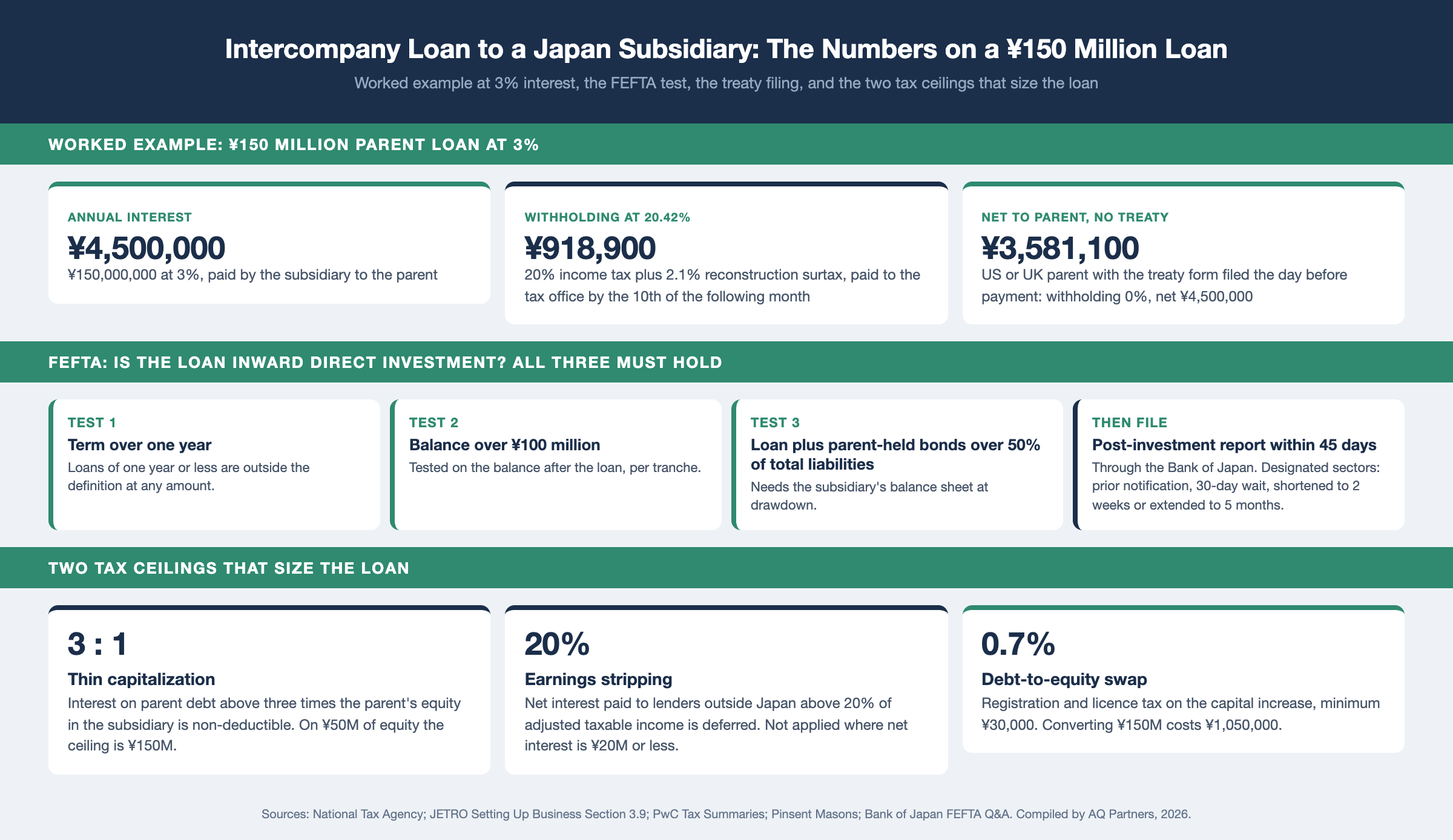
- Every interest payment is withheld at 20.42%. The subsidiary withholds 20% income tax plus the 2.1% reconstruction surtax and pays it by the 10th of the following month, unless a treaty form was filed the day before payment. The US and UK treaties take most interest to 0%.
- A parent loan is FEFTA inward direct investment when its term exceeds one year, its balance exceeds ¥100 million, and the loan plus any parent-held bonds exceed half of the subsidiary's total liabilities. Report within 45 days through the Bank of Japan, or notify in advance in designated sectors.
- Size the loan against two tax ceilings. Interest on parent debt above three times the parent's equity is non-deductible under thin capitalization, and net interest paid abroad above 20% of adjusted taxable income is deferred under earnings stripping, unless net interest is ¥20 million or less.
What an Intercompany Loan Agreement to a Japan Subsidiary Must Contain
A loan agreement for a Japan subsidiary needs five terms fixed before drawdown: term, currency, rate, repayment schedule, and ranking. Japanese law does not prescribe a form, but each term drives a filing or a tax test. The term decides FEFTA treatment, because only loans exceeding one year can be inward direct investment. The currency decides who carries exchange risk. The rate must survive a transfer pricing review. The repayment schedule sets when principal, which carries no withholding, comes back. The ranking clause, usually subordinating the parent loan to bank debt, is what Japanese banks require. A board resolution under the Companies Act (会社法, kaishahou) completes the paperwork.
The lifecycle in order:
| Step | Deadline | Filing or document |
|---|---|---|
| 1. Term sheet: amount, term, currency, rate basis, repayment, subordination | Before drawdown | Internal approval memo |
| 2. Transfer pricing rate support | Before signing | Rate benchmark memo kept with the local file |
| 3. Board approvals and signed loan agreement | Before drawdown | Board minutes, executed agreement |
| 4. FEFTA classification, using the subsidiary's total liabilities | Before drawdown | Prior notification in designated sectors, 30-day wait |
| 5. Drawdown and bank receipt | Per agreement | Bank remittance record; bank may request the agreement |
| 6. Post-investment report, filed by the parent through the Bank of Japan | Within 45 days of drawdown | FEFTA post-investment report |
| 7. Treaty application form, filed by the subsidiary with its tax office | By the day before the first interest payment | 租税条約に関する届出書 with residency certificate where required |
| 8. Interest payment and withholding by the subsidiary | Withholding paid by the 10th of the month after payment | Withholding tax payment slip |
| 9. Year-end: FX translation, thin capitalization and earnings stripping tests | With the corporate tax return, two months after year end | Tax return schedules, transfer pricing local file update |
Setting an Arm's Length Interest Rate
The rate on a parent loan must be one the subsidiary could get from an unrelated lender, because the NTA tests it under transfer pricing rules. Too high a rate is disallowed; too low a rate, or none, is treated as a benefit conferred on the parent.
The NTA's transfer pricing administrative guidelines (移転価格事務運営要領, the NTA's administrative guidelines on transfer pricing) set out an order of methods that is commonly applied in practice: first, the rate the borrower would pay an unrelated bank for a loan of the same currency, term, and amount; failing that, the rate the lender itself would pay a bank to fund the loan; and failing that, a rate built from a risk-free benchmark such as government bonds in the loan currency. The practical evidence is a quote from the subsidiary's own Japanese bank, kept on file with the agreement, as described in the guide to transfer pricing documentation in Japan.
An interest-free loan is not a safe harbour. Where the parent charges nothing, the NTA can impute an arm's length rate and tax the foregone interest, while the subsidiary gains no deduction. A modest documented rate is safer.
Two ceilings shape the amount rather than the rate: thin capitalization disallows interest on parent debt above three times the parent's equity, and earnings stripping defers net interest paid abroad above 20% of adjusted taxable income unless net interest is ¥20 million or less. Both are set out in JETRO's guide to corporate taxation on international transactions and worked through in the companion guide to thin capitalization and earnings stripping rules in Japan.
Withholding Tax on Interest and Treaty Relief
Interest paid by a Japan subsidiary to a non-resident lender is withheld at 20.42% and paid to the tax office by the 10th of the following month. The rate is 20% income tax plus the 2.1% reconstruction surtax, and the subsidiary, not the parent, is liable for any shortfall.
A ¥150 million loan at 3% produces ¥4,500,000 of annual interest. At 20.42% the subsidiary withholds ¥918,900 and remits ¥3,581,100 to the parent. With parent equity of ¥50 million the loan sits exactly at the 3:1 thin capitalization ceiling, and because net interest is below ¥20 million earnings stripping does not apply.
According to PwC's summary of Japanese withholding taxes and treaty rates, the Japan-US and Japan-UK treaties reduce withholding on most interest to 0%, while other treaties commonly land at 5% or 10%. The reduction is not automatic: the parent completes the treaty application form (租税条約に関する届出書, sozei jouyaku ni kansuru todokedesho), the subsidiary files it with its tax office by the day before the first interest payment, and some treaties require a certificate of residence attached. A form filed after payment does not apply retroactively; the subsidiary withholds at 20.42% and the parent claims a refund. Payment mechanics are in the guide to withholding tax in Japan.
FEFTA Reporting for a Parent Loan
A parent loan is FEFTA inward direct investment when it runs over one year, exceeds ¥100 million, and exceeds half of the subsidiary's liabilities. All three must hold, and the third counts the loan plus any bonds of the subsidiary the parent holds, against total liabilities after the loan. A ¥150 million two-year loan to a subsidiary with ¥20 million of other liabilities is inward direct investment; the same loan to one carrying ¥400 million of bank debt is not.
According to Pinsent Masons' guide to foreign direct investment in Japan, the filing route depends on the subsidiary's business. In a designated sector, the parent files a prior notification through the Bank of Japan and waits 30 days before drawdown; the wait is often shortened to two weeks and can be extended to five months. In every other sector the parent files a post-investment report within 45 days of drawdown. The Bank of Japan's FEFTA question-and-answer guidance is the primary reference for the loan definition. Each tranche is tested on its own, the 50% test needs the subsidiary's actual balance sheet at drawdown, and consolidating short-term advances into a term loan can bring the arrangement into scope on the day of conversion.
Currency Choice and Foreign Exchange Tax Treatment
A parent can lend in yen or its own currency, and the choice decides who carries exchange risk and how Japanese taxable income moves with the rate.
For Japanese corporate tax, short-term foreign-currency monetary items are translated at the year-end rate, while long-term items normally stay at the historical rate unless the company elects year-end translation by notifying its tax office. According to RSM Shiodome Partners' 2025 guide to foreign currency transactions for Japanese subsidiaries, a long-term foreign-currency borrowing can also be revalued without an election where the translation difference exceeds roughly 15% of book value. A parent-currency loan therefore produces translation gains or losses in Japan that a yen loan never does. Hedging through the subsidiary's bank is possible if documented and matched to the loan; see the guide to multi-currency accounts and forex management in Japan.
| Criterion | Yen-denominated loan | Parent-currency loan |
|---|---|---|
| Who carries exchange risk | Parent | Subsidiary |
| Year-end translation in Japan | None | Short term: year-end rate; long term: historical rate unless elected or the 15% rule applies |
| Effect on Japanese taxable income | Interest only | Interest plus translation gains or losses |
| Rate benchmark for transfer pricing | Japanese bank lending rates, typically low | Lending rates in the loan currency, typically higher |
| Interest withholding | 20.42% or treaty rate on the yen amount | 20.42% or treaty rate on the yen equivalent at payment |
| Hedging | Not needed in Japan | Forward or swap through the subsidiary's bank, documented |
| Typical use | Subsidiary with yen revenue and yen costs | Parent that manages group exposure centrally |
Converting the Loan to Capital
A parent loan can be converted into share capital by a debt-equity swap, the standard fix when parent debt passes the 3:1 thin capitalization ceiling. The subsidiary issues new shares to the parent for the loan receivable.
Three costs and one risk apply. The capital increase is registered at the Legal Affairs Bureau (法務局, houmukyoku) at a registration and licence tax of 0.7% of the increase, minimum ¥30,000 per application, according to the National Tax Agency's registration and licence tax table; converting the ¥150 million loan in the worked example costs ¥1,050,000. The increase is itself FEFTA inward direct investment and needs its own report. If stated capital passes ¥100 million, the subsidiary loses small and medium-sized enterprise tax treatment, so parents often book part of the conversion as capital reserve. The risk is deemed income: where the loan is contributed at a value below face, typically because the subsidiary is insolvent, the difference can be taxed as debt extinguishment income (債務消滅益, saimu shoumetsu eki). A solvent subsidiary converting at face value avoids this. The wider capital-versus-debt choice is the subject of the guide to funding a Japan subsidiary, and the pooled alternative is covered in the guide to cash pooling and treasury setup for a Japan entity.
Frequently Asked Questions
Can the parent lend short term to stay outside FEFTA?
A loan with a term of one year or less is outside the inward direct investment definition regardless of amount. Rolling short-term advances are harder to defend as arm's length debt, and consolidating them into a term loan triggers the FEFTA test on that date.
Does the subsidiary need a bank's permission to borrow from its parent?
No approval is required, but a Japanese bank that has lent to the subsidiary will usually have a covenant on additional borrowing and expect the parent loan to be subordinated.
What happens if the treaty form is filed late?
The subsidiary must withhold at 20.42% on every payment made before the form is on file. The parent can then claim a refund from the Japanese tax office, a process that takes months.
Working with AQ Partners. Our Tokyo team provides back office operations for foreign companies operating in Japan, covering the requirements described above end to end, from loan documentation and FEFTA reporting to monthly withholding filings and year-end tax schedules. Book a consultation to discuss your situation.


Yuga Koda is a founding Director at AQ Partners, supporting foreign companies, funds, and families operating in Japan. His experience operating companies in both Japan and international markets gives him a practical understanding of back office operations from both sides.