
Cash Pooling and Treasury Setup for a Japan Entity


Treasury setup for a Japan entity means deciding where a Japanese subsidiary keeps its cash, in which currencies, who controls payments, and whether its balances are swept into a group cash pool. Cash pooling (キャッシュプーリング, kyasshu puuringu) concentrates the bank balances of group companies so that surplus cash in one entity funds deficits in another. For a foreign-owned kabushiki kaisha (株式会社, KK) or goudou kaisha (合同会社, GK) the decision is not only operational: every pooled balance is an intercompany loan in Japanese tax law, bringing arm's length interest, withholding tax, thin capitalization, earnings stripping, and Foreign Exchange and Foreign Trade Act (外国為替及び外国貿易法, FEFTA) reporting into what looks like a bank product.
Key Takeaways
- A physical cash pool turns every balance into a loan. Yen swept to a foreign pool leader, or a deficit covered by it, is an intercompany loan needing an arm's length rate and documentation.
- Interest the Japan entity pays abroad is withheld at 20.42%. Treaty relief requires the treaty form to be filed before the first interest payment.
- Net borrowing from the pool hits two deduction ceilings. Interest on parent debt above three times the parent's equity, and net interest paid abroad above 20% of adjusted taxable income, is non-deductible unless net interest is ¥20 million or less.
- FEFTA often does not bite on pool balances, but check. A pool leader's advance is inward direct investment only when its term exceeds one year, it exceeds ¥100 million, and it exceeds half of the entity's liabilities.
- Bank setup takes weeks, so design treasury before incorporation closes. Corporate account opening in Japan takes 2 to 8 weeks, and pooling cannot run before that.
Why Cash Pooling in Japan Is a Tax Question, Not a Banking One
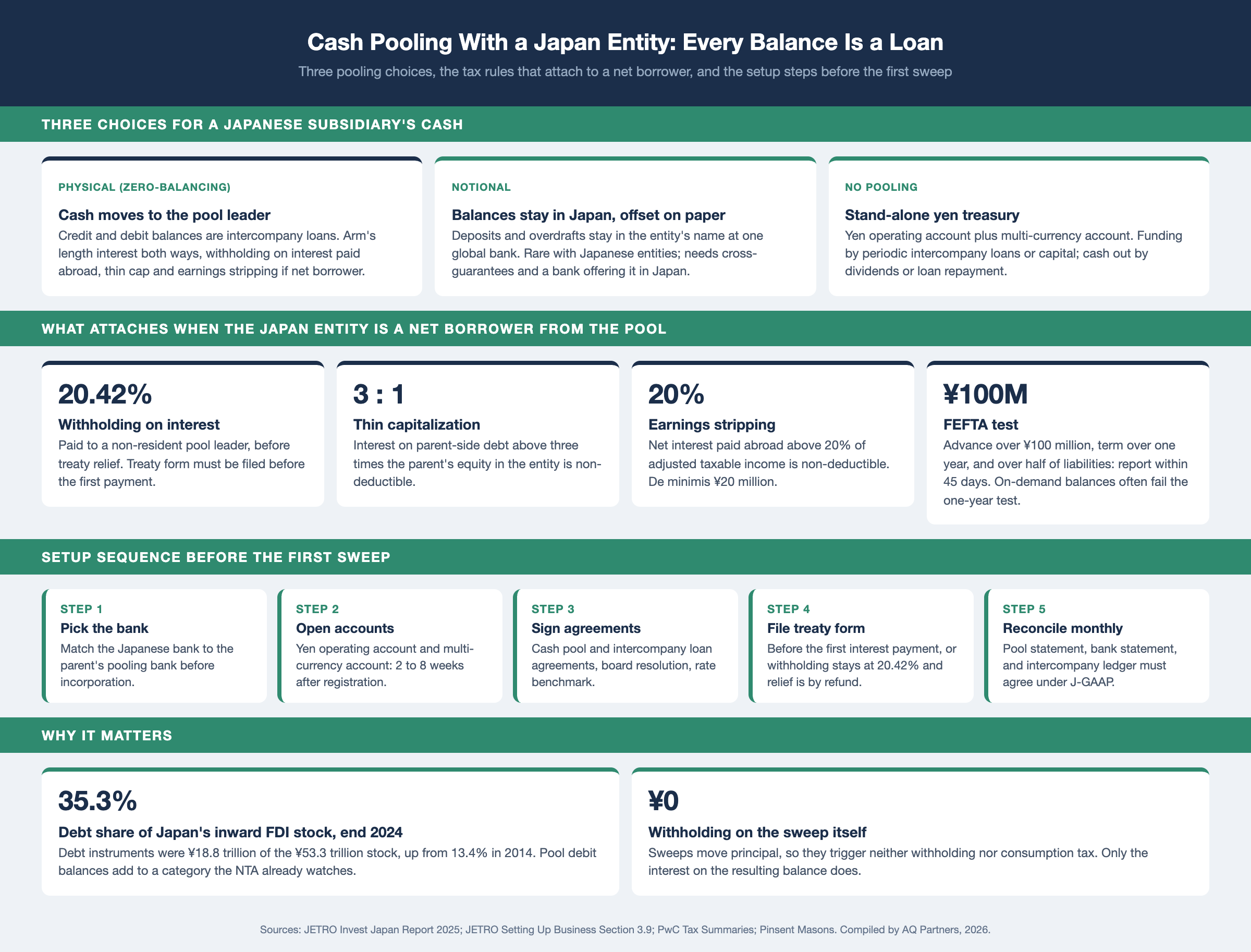
Pooling a Japanese subsidiary's cash creates intercompany loans in both directions, and Japan taxes each direction as a loan rather than a bank sweep. A zero-balancing pool moves yen to the pool leader each night and back when the subsidiary needs to pay; the credit balance is a loan made, the debit balance a loan received. The National Tax Agency (国税庁, NTA) expects each to carry an arm's length rate, and interest paid to a non-resident pool leader is withheld at 20.42% under domestic law, reduced only where a treaty applies and the form was filed in advance, according to PwC's summary of Japanese withholding tax rates.
The direction of the balance also matters. The Japan External Trade Organization's 2025 Invest Japan Report shows that debt instruments made up ¥18.8 trillion, or 35.3%, of Japan's ¥53.3 trillion inward foreign direct investment stock at the end of 2024, up from 13.4% in 2014. A pool in which the Japanese entity is a persistent net borrower adds to that debt for tax purposes; one in which it is a persistent net lender raises the question of whether it earns an arm's length return.
Physical Pooling, Notional Pooling, or No Pooling
Physical pooling sweeps cash and creates loans, notional pooling offsets balances without moving them, and no pooling leaves the entity self-funded. Notional pooling with a Japanese entity is uncommon because it needs one bank offering the product in Japan and abroad plus cross-guarantees, so most foreign groups choose between a physical pool run by the parent's bank and a stand-alone Japan treasury.
| Criterion | Physical (zero-balancing) pool | Notional pool | No pooling, stand-alone treasury |
|---|---|---|---|
| Legal character of balances | Intercompany loans in both directions | Deposits and overdrafts in the entity's own name, offset for interest | Deposits in the entity's own name |
| Arm's length interest | Required on every balance, both directions | Required on the allocation of the netting benefit | Only if a separate intercompany loan exists |
| Withholding tax | 20.42% on interest paid to a non-resident leader before treaty relief | Generally none; interest is paid by and to the bank | None |
| Transfer pricing documentation | Pool agreement, rate benchmark, allocation of synergy benefit | Allocation of the netting benefit among members | Not applicable |
| Thin capitalization and earnings stripping | Exposed when the entity is a net borrower above the 3:1 and 20% ceilings | Exposed only through a bank overdraft guaranteed by the parent | Not applicable |
| FEFTA inward direct investment | Tested when the leader's advance exceeds ¥100 million, runs over one year, and exceeds half of liabilities | Not applicable to bank balances | Not applicable |
| Bank setup in Japan | Bank that can execute sweeps with the leader's bank, plus sweep mandate | Single global bank with a Japan branch offering the product | Any Japanese bank; yen account plus multi-currency account |
| FX exposure | Yen converted at each sweep unless the pool has a yen sub-account | Balances stay in yen | Balances stay in yen; conversion only on dividends or repayments |
Tax Exposures When the Japan Entity Is a Net Borrower
A Japanese entity that draws on the pool more than it contributes is a borrower from its parent, and three rules limit or tax the interest. JETRO's guide to corporate taxation on international transactions sets out the first two.
- Thin capitalization (過少資本税制, kashou shihon zeisei). Where debt owed to the foreign controlling shareholder, including pool advances, exceeds three times that shareholder's equity in the subsidiary, interest on the excess is non-deductible. Total debt must also exceed three times total equity, and equity is never measured below the capital the parent paid in.
- Earnings stripping (過大支払利子税制, kadai shiharai rishi zeisei). Net interest paid to lenders outside Japan is deductible only up to 20% of adjusted taxable income, unless net interest expense for the year is ¥20 million or less. A loss-making subsidiary with a large debit balance can find most of its pool interest deferred.
- FEFTA. According to Pinsent Masons' guide to foreign direct investment in Japan, a loan by a foreign investor with a term exceeding one year and an amount above ¥100 million is inward direct investment, and the Cabinet Order adds that the loan plus any bonds held must exceed half of the borrower's liabilities. Pool balances are usually repayable on demand, so the one-year test is often not met, but a fixed minimum term or a balance rolled for more than a year can meet it, in which case a post-investment report is filed through the Bank of Japan within 45 days.
Withholding on pool interest works like any parent loan: 20.42%, the 20% income tax plus the 2.1% reconstruction surtax, paid by the 10th of the following month. Treaty relief, which takes most interest paid to a US or UK parent to zero, applies only if the form was filed before the first payment. The mechanics are covered in the guides to intercompany loans to a Japan subsidiary and thin capitalization and earnings stripping in Japan.
Transfer Pricing on Pool Benefits
A cash pool creates a synergy benefit, and transfer pricing rules expect members to share it, with only a routine reward kept by the pool leader. The reference point is the OECD's 2020 Transfer Pricing Guidance on Financial Transactions, now Chapter X of the OECD Transfer Pricing Guidelines. According to that guidance, synergy benefits are generally allocated to members, the leader is rewarded for its functions and risks, and balances that persist for long periods are treated as term loans. For the Japanese subsidiary this means a deposit-like rate on credit balances no worse than its own bank would pay, a rate on debit balances that reflects its own credit standing rather than the parent's guarantee, and a description of the pool and its rate-setting in the transfer pricing file, as set out in the guide to transfer pricing documentation in Japan.
Bank Setup and Payment Rails in Japan
A Japanese subsidiary needs a yen account, a multi-currency account, and online banking mandates before pooling starts, and they take weeks to open. Corporate account opening for a foreign-owned company takes 2 to 8 weeks depending on the bank, as described in the guide to opening a corporate bank account in Japan. Registration and seal certificates must be dated within three months of the application.
Domestic yen payments run over the Zengin System, operated by the Japanese Banks' Payment Clearing Network, which delivers customer fund transfers in real time across Japan and extends settlement beyond business hours through its More Time System at participating banks. Cross-border payments to and from the pool leader run over SWIFT through the subsidiary's bank, which applies its own FX spread; megabank spreads are materially wider than fintech platforms', as compared in the guide to multi-currency accounts and forex management in Japan. Sweeps are transfers of principal and trigger neither consumption tax nor withholding; only the interest on the resulting balances does.
| Setup step | Timing | Why it matters for pooling |
|---|---|---|
| Choose the Japanese bank against the parent's pooling bank | Before incorporation | Sweeps need a bank that works with the leader's bank |
| Open yen operating account | Weeks 1 to 8 after registration | No payments, payroll, or sweeps without it |
| Open multi-currency account | With or after the yen account | Holds parent-currency funding |
| Sign the cash pool and intercompany loan agreements | Before the first sweep | Arm's length evidence; board resolution |
| Set the interest benchmark and calculation method | Before the first sweep | Supports deductibility and the transfer pricing file |
| File the treaty application form for interest | Before the first interest payment | Otherwise withholding is 20.42%, relief by refund |
| Test the FEFTA loan definition | At the first advance and annually | Post-investment report within 45 days if the test is met |
| Set month-end reconciliation and reporting | First month-end | Pool balances must tie to the intercompany ledger |
FX, Documentation, and Month-End
A Japanese subsidiary should hold yen for yen obligations, convert only what the group needs, and reconcile pool balances to its ledger monthly. The simplest hedge is natural: match yen revenue against yen payroll, rent, and social insurance, and keep the yen account funded to one payroll cycle before any sweep. Parent-currency funding is best held in the multi-currency account and converted monthly, keeping the FX result in the entity that chose the currency. A pool denominated in the parent's currency converts yen at every sweep and should be avoided unless it offers a yen sub-account.
The documentation set is a cash pool agreement, an intercompany loan agreement, interest calculation records, and a board resolution, since a KK director is accountable for lending company funds. Under J-GAAP each day's pool balance is an intercompany receivable or payable, so the bank statement, the leader's pool statement, and the ledger must agree at month-end. Interest is accrued monthly at the agreed benchmark, withholding is tracked against the 10th-of-the-month remittance, and the year-end balance is tested against the thin capitalization and earnings stripping ceilings before the tax return. Whether the subsidiary should carry that much debt is the subject of the pillar guide to funding a Japan subsidiary and repatriating profits.
Frequently Asked Questions
Does sweeping cash from a Japan subsidiary to the parent trigger withholding tax?
No. A sweep moves principal and carries no withholding or consumption tax. Withholding applies only to interest paid on a debit balance to a non-resident pool leader, 20.42% before treaty relief.
Can a Japanese subsidiary join a cash pool interest-free?
It can, but the NTA can impute arm's length interest under transfer pricing rules, and the subsidiary gets no deduction for interest it did not pay.
Does a cash pool balance count as inward direct investment under FEFTA?
Only where the advance exceeds ¥100 million, runs over one year, and with any bonds held exceeds half of the subsidiary's liabilities. On-demand balances often fail the one-year test; a balance rolled for more than a year should be reviewed and, if caught, reported within 45 days.
Working with AQ Partners. Our Tokyo team provides back office operations for foreign companies operating in Japan, covering the requirements described above end to end, from bank account opening and intercompany bookkeeping to withholding filings. Book a consultation to discuss your situation.

Yuga Koda is a founding Director at AQ Partners, supporting foreign companies, funds, and families operating in Japan. His experience operating companies in both Japan and international markets gives him a practical understanding of back office operations from both sides.