
Thin Capitalization and Earnings Stripping Rules in Japan: Limits on Deducting Interest Paid to a Foreign Parent

Thin capitalization and earnings stripping are the two Japanese tax rules that cap how much interest a Japan subsidiary can deduct when it borrows from its foreign parent or from other lenders outside Japan. The thin capitalization rule (過少資本税制, kashou shihon zeisei) disallows interest on related-party debt above three times the foreign shareholder's equity. The earnings stripping rule (過大支払利子税制, kadai shiharai rishi zeisei) disallows net interest paid abroad above 20% of the subsidiary's adjusted taxable income. Both apply automatically, both are tested every fiscal year, and where both bite, the larger disallowance wins. This guide works each rule through in yen, with three scenarios a foreign-owned kabushiki kaisha (株式会社, KK) is likely to meet, and shows the structural fixes that keep the deduction intact.
Key Takeaways
- Thin capitalization is a double 3:1 test. Interest is disallowed only where debt from the foreign controlling shareholder exceeds three times that shareholder's equity AND the subsidiary's total debt exceeds three times its total equity.
- Equity never falls below paid-in capital. Equity is measured as net assets but floored at the capital-related amount, so a loss-making subsidiary keeps a ceiling equal to three times what the parent paid in, including capital reserve.
- Earnings stripping catches third-party foreign lenders too. Since fiscal years beginning April 2020 the 20% cap applies to net interest paid to any lender outside Japan, down from a 50% cap that covered related parties only.
- Two de minimis exits exist. The earnings stripping rule does not apply where net interest is ¥20 million or less, or where the Japanese group's combined net interest is 20% or less of its combined adjusted income.
- Disallowed interest is deferred, not lost. Interest disallowed under earnings stripping carries forward seven years, extended to ten years for interest arising in fiscal years beginning between 1 April 2022 and 31 March 2025.
Who the Rules Apply To
Thin capitalization covers debt from a foreign shareholder holding half or more; earnings stripping covers net interest paid to any lender abroad. Both catch a parent loan.
A foreign controlling shareholder (国外支配株主等, kokugai shihai kabunushi tou) is a non-resident or foreign corporation that directly or indirectly holds 50% or more of the Japanese company's shares, or that otherwise controls it. Debt from a fund provider (資金供与者等, shikin kyouyosha tou) is pulled in as well: where the parent guarantees a bank loan, or provides the funds that a third party on-lends, that debt counts as related-party debt for the 3:1 test. Unguaranteed bank borrowing sits outside thin capitalization.
Earnings stripping is broader. According to JETRO's guide to corporate taxation on international transactions, the rule disallows interest paid by a corporation to persons located outside Japan, including third parties, to the extent that net interest exceeds 20% of adjusted taxable income. The FY2020 reform lowered the cap from 50% to 20% and widened the scope from related parties to any recipient whose interest is not subject to Japanese corporate tax. A foreign bank loan therefore counts; a loan from a Japanese bank does not.
| Feature | Thin capitalization | Earnings stripping |
|---|---|---|
| Debt in scope | Debt from a 50%-or-more foreign shareholder, plus third-party debt the shareholder guarantees or funds | Net interest paid to any lender outside Japan, related or not, where the interest is not taxed in Japan |
| Test | Related-party debt over 3 times the shareholder's equity, and total debt over 3 times total equity | Net interest over 20% of adjusted taxable income |
| Equity measure | Net assets, floored at the capital-related amount (資本金等の額) | Not equity-based; adjusted taxable income adds back net interest and depreciation |
| De minimis | None | Net interest of ¥20 million or less, or group net interest of 20% or less of group adjusted income |
| Disallowed interest | Permanently non-deductible | Carried forward seven years (ten years for FY2022 to FY2024 interest) |
| Where both apply | The larger of the two disallowances is applied | |
| Governing law | Special Taxation Measures Act, Article 66-5 | Special Taxation Measures Act, Article 66-5-2 |
The Thin Capitalization Test in Numbers
Thin capitalization disallows interest on related-party debt above three times the shareholder's equity, but only if total debt also exceeds 3:1. Both legs must fail before any interest is lost.
The first leg compares the average balance of debt owed to the foreign controlling shareholder and its fund providers against that shareholder's equity stake. The second leg, described by PwC Japan's glossary entry on thin capitalization as a safe harbour, switches the rule off where the company's total average debt is three times its own equity or less.
Equity for both legs is total assets minus total liabilities, but where that figure is smaller than the capital-related amount (資本金等の額, shihonkin tou no gaku), the capital-related amount is used instead. The capital-related amount includes stated capital and capital reserve. This floor matters most in the loss-making years when a subsidiary borrows heavily: the accumulated deficit shrinks net assets, but the 3:1 ceiling never drops below three times what the parent paid in.
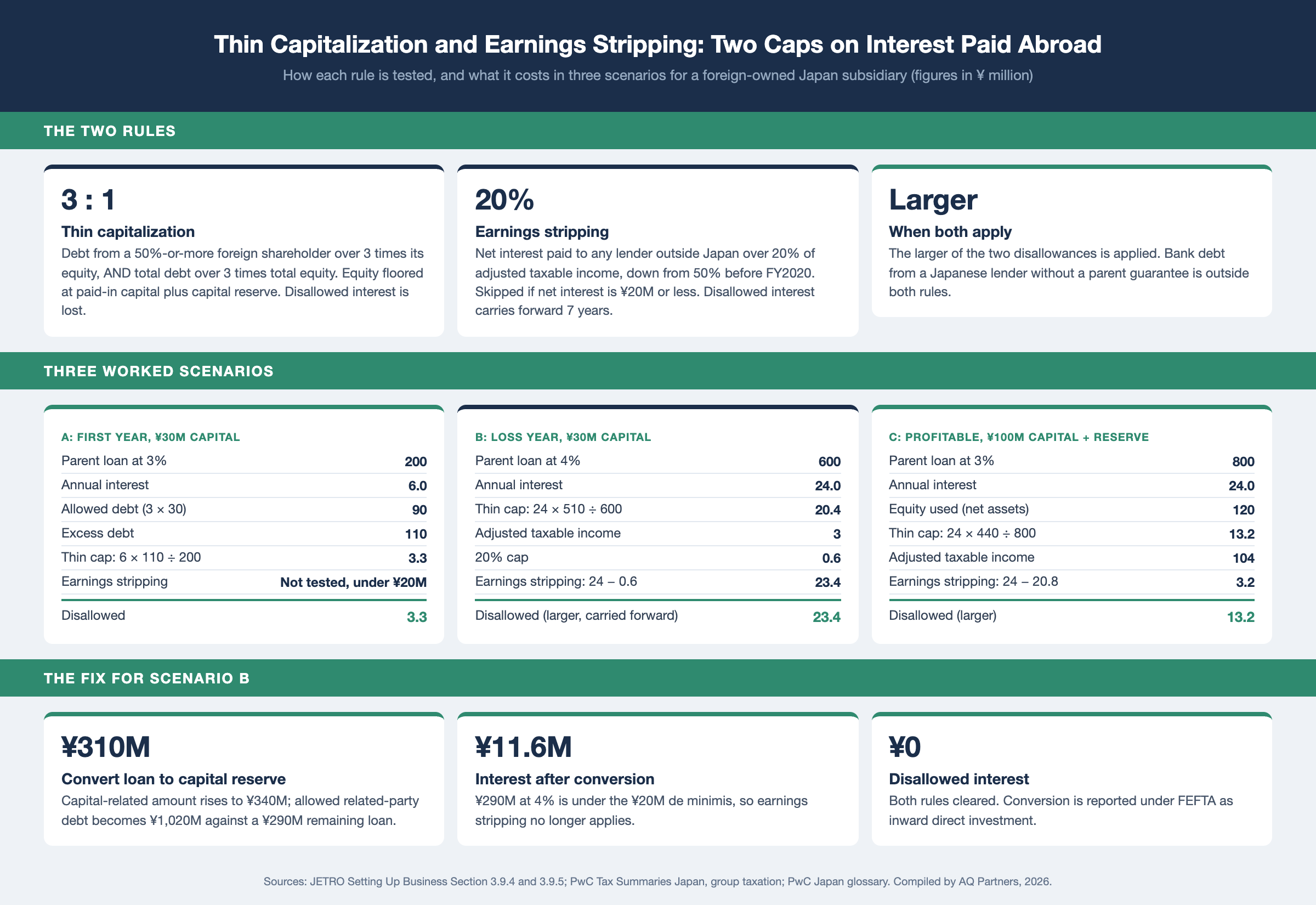
Take a subsidiary with ¥30 million of paid-in capital, no retained earnings, and a ¥200 million parent loan at 3%. Allowable related-party debt is ¥90 million. The excess is ¥110 million, so ¥3.3 million of the ¥6 million interest charge is disallowed: 6 × 110 ÷ 200 = 3.3. Total debt of ¥200 million against ¥30 million of equity fails the safe harbour, so the disallowance stands.
The Earnings Stripping Test in Numbers
Earnings stripping disallows net interest paid abroad above 20% of adjusted taxable income, unless net interest is ¥20 million or less. The disallowed amount carries forward, and the rule does not care who the lender is.
Adjusted taxable income is taxable income before the net interest itself, with depreciation and certain other items added back. A profitable subsidiary with large depreciation has a generous cap. A loss-making subsidiary has a base near zero, so almost all foreign-paid interest above ¥20 million is deferred: the parent loan meant to create a deduction produces one only once the subsidiary turns profitable.
Two exits are available. First, the rule does not apply in any year where net interest expense is ¥20 million or less. Second, it does not apply where the combined net interest of all Japanese corporations in the same more-than-50% capital group is 20% or less of their combined adjusted income. Interest that is disallowed carries forward for seven years and becomes deductible in a later year within that year's 20% cap. According to PwC's summary of Japanese group taxation rules, the 2024 Tax Reform Act extended that period to ten years for interest incurred in fiscal years beginning between 1 April 2022 and 31 March 2025.
Three Worked Scenarios
Three scenarios, a first year, a loss-making year, and a profitable year, show which rule bites and confirm that the larger disallowance applies. Figures are in millions of yen.
| Line | Scenario A: first year | Scenario B: loss-making growth | Scenario C: profitable |
|---|---|---|---|
| Paid-in capital plus capital reserve | 30 | 30 | 100 (50 capital, 50 reserve) |
| Net assets at year end | 30 | 10 (after losses) | 120 |
| Equity used for the 3:1 test | 30 | 30 (floored at capital) | 120 |
| Parent loan, average balance | 200 | 600 | 800 |
| Interest rate and annual interest | 3%, 6.0 | 4%, 24.0 | 3%, 24.0 |
| Allowable related-party debt (3 × equity) | 90 | 90 | 360 |
| Excess debt | 110 | 510 | 440 |
| Thin capitalization disallowance | 3.3 | 20.4 | 13.2 |
| Taxable income after interest; depreciation | Not tested | (29); 8 | 60; 20 |
| Adjusted taxable income | Not tested | 3 | 104 |
| Earnings stripping cap (20%) | Not tested: interest is under ¥20 million | 0.6 | 20.8 |
| Earnings stripping disallowance | 0 | 23.4 | 3.2 |
| Disallowance applied (the larger) | 3.3 (thin capitalization) | 23.4 (earnings stripping, carried forward) | 13.2 (thin capitalization) |
Scenario A never reaches earnings stripping because ¥6 million of interest is under the ¥20 million floor. Scenario B is the expensive one: adjusted taxable income of ¥3 million means the 20% cap allows only ¥0.6 million of the ¥24 million charge, so ¥23.4 million is deferred, more than the ¥20.4 million thin capitalization would take. Scenario C is profitable, so earnings stripping is mild at ¥3.2 million, but thin capitalization still removes ¥13.2 million because the loan is large relative to equity. The corporate tax rates that turn each disallowance into cash are set out in the guide to corporate income tax in Japan.
How to Keep the Deduction
The fixes are structural: resize the loan, convert part of it to capital or capital reserve, or replace it with unguaranteed Japanese bank debt. All three are cheap before the loan is drawn and expensive after.
Converting debt to equity attacks thin capitalization directly, because it raises the equity floor and shrinks the debt at the same time. In Scenario B, converting ¥310 million of the ¥600 million loan into capital reserve lifts the capital-related amount to ¥340 million, so allowable related-party debt becomes ¥1,020 million against a remaining loan of ¥290 million. Interest falls to ¥11.6 million at 4%, which is under the ¥20 million floor, so earnings stripping no longer applies either. The conversion costs a 0.7% registration and licence tax on any amount booked to stated capital, which is one reason to book it to capital reserve where the Companies Act permits, and it is reported under the Foreign Exchange and Foreign Trade Act as inward direct investment. The mechanics of choosing between capital and loan are in the guide to funding a Japan subsidiary.
Three further levers apply:
- Size the loan to the ceiling. Keep parent debt at or under three times the parent's equity in the subsidiary, and keep net foreign-paid interest at or under ¥20 million where the business allows. A loan structured this way is described in the guide to intercompany loans to a Japan subsidiary.
- Use unguaranteed Japanese bank debt. A loan from a Japanese bank without a parent guarantee is outside thin capitalization and, because the bank is taxed in Japan, outside earnings stripping as well.
- Document the rate. Neither rule replaces transfer pricing. The interest rate on a parent loan must be arm's length regardless of whether the amount is deductible, as set out in the guide to transfer pricing documentation in Japan.
Interest that is paid still carries Japanese withholding at 20.42% unless a treaty form is filed in advance. Deductibility and withholding are separate questions, and both feed into the choice of route home, compared in the guide to repatriating profits from Japan.
Frequently Asked Questions
Does thin capitalization apply if the parent owns exactly 50%?
Yes. A foreign controlling shareholder is defined as a non-resident or foreign corporation holding 50% or more of the Japanese company's shares directly or indirectly, so a 50/50 joint venture partner outside Japan is within scope and its loans are tested against three times its equity stake.
Is interest disallowed under thin capitalization ever recovered?
No. Interest disallowed under thin capitalization is permanently non-deductible. Only interest disallowed under earnings stripping carries forward, for seven years in general and ten years for interest arising in fiscal years beginning between 1 April 2022 and 31 March 2025.
Does a loan from a Japanese bank count toward earnings stripping?
No. Earnings stripping applies to net interest paid to recipients whose interest income is not subject to Japanese corporate tax, which in practice means lenders outside Japan. Interest paid to a Japanese bank is taxed in the bank's hands and is excluded from the calculation.
Working with AQ Partners. Our Tokyo team provides monthly bookkeeping, annual tax filings and specialist tax filings for foreign companies operating in Japan, so the books and filings your zeirishi works from are right. Book a consultation to discuss your situation.


Yuga Koda is a founding Director at AQ Partners, supporting foreign companies, funds, and families operating in Japan. His experience operating companies in both Japan and international markets gives him a practical understanding of back office operations from both sides.