
Repatriating Profits from Japan: Dividends vs Royalties vs Capital Reduction
Repatriating profits from Japan means moving cash that a Japanese subsidiary has earned back to its foreign parent, and the route chosen decides how much Japanese tax leaks on the way. A dividend of surplus (剰余金の配当, jouyokin no haitou) is the default route. A royalty or an intercompany fee is deductible for the subsidiary and can cut Japanese corporate tax. A capital reduction with distribution (資本の払戻し, shihon no haraimodoshi) returns money the parent paid in, but part of it is often taxed as a deemed dividend. Loan principal repayment carries no withholding at all. This guide compares the routes and works one example on ¥100 million of profit.
Key Takeaways
- Dividends are simple but never deductible. A dividend needs a shareholder resolution and a distributable-amount test, comes out of taxed profit, and is withheld at 20.42% before any treaty.
- Treaty relief depends on the form, not the treaty. The Japan-US treaty cuts dividend withholding to 5% at 10% ownership and 0% at 50% held for six months; the Japan-UK treaty gives 0% at 10% held for six months. Neither applies unless the treaty application form reaches the tax office through the payer by the day before payment.
- Royalties are the only route that reduces Japanese corporate tax. An arm's length royalty is deductible for the subsidiary and, under the US and UK treaties, withheld at 0%, so ¥30 million of royalty saves a large Tokyo subsidiary roughly ¥9.45 million of Japanese tax against a dividend.
- A capital reduction is not a tax-free return of capital. The distribution is split between a return of capital and a deemed dividend (みなし配当, minashi haitou) in proportion to the company's capital-related amount and its book net assets, and the deemed-dividend portion is withheld like any dividend.
- Loan principal is the zero-withholding route. Repaying a parent loan involves no withholding and no deduction, the cleanest way to return funds the parent lent rather than subscribed.
The Five Routes Out of a Japan Subsidiary
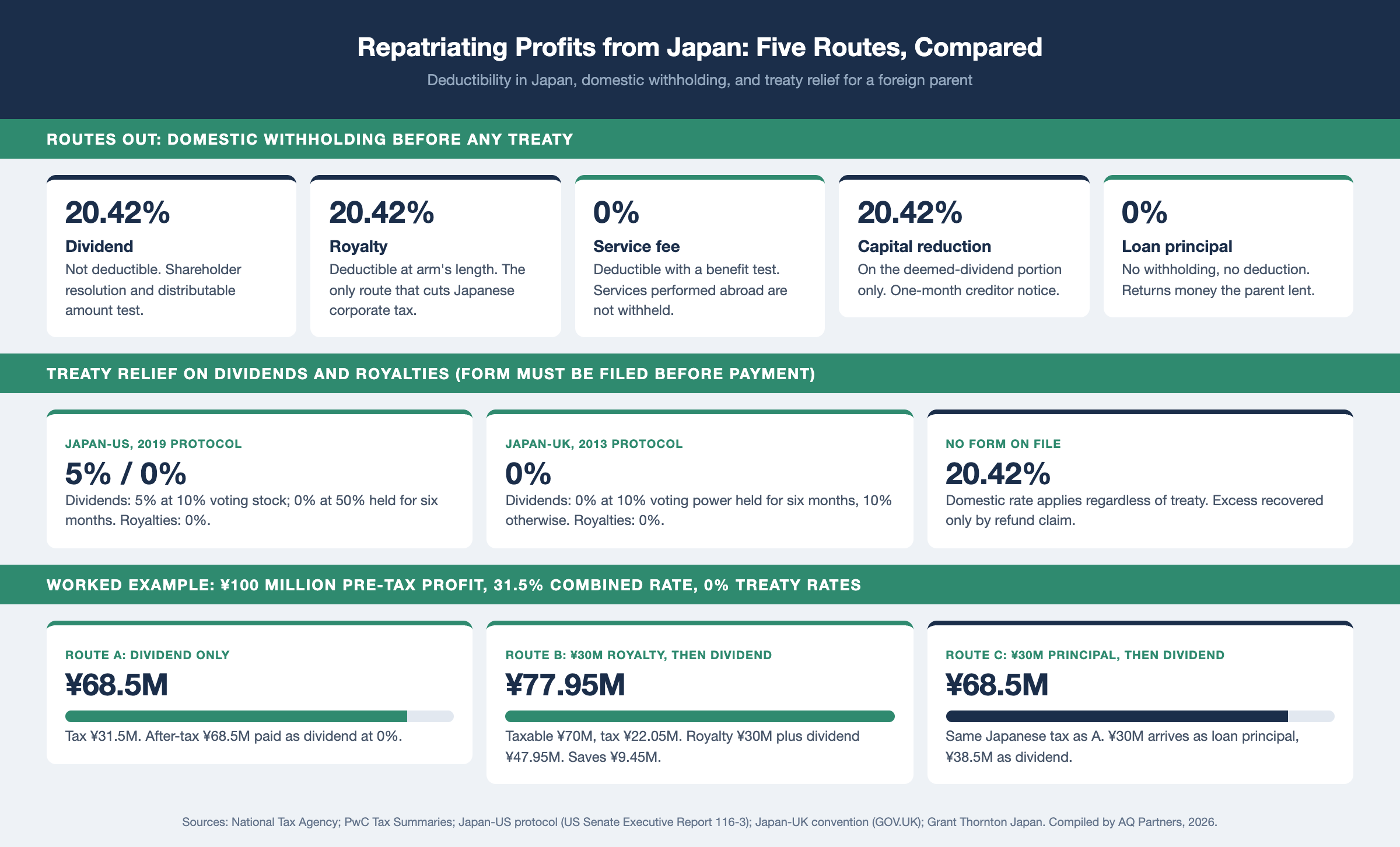
A Japan subsidiary returns cash through dividends, royalties, fees, a capital reduction, or loan repayment, each with its own withholding rate. The right choice depends on whether the cash came in as capital or debt, whether the parent supplies intellectual property or services the subsidiary uses, and which treaty covers the parent. Every rate below is the domestic rate before treaty relief unless stated.
| Route | Deductible in Japan | Domestic withholding | Japan-US treaty rate | Companies Act procedure | Best used when |
|---|---|---|---|---|---|
| Dividend of surplus | No | 20.42% | 5% at 10% voting; 0% at 50% held six months | Shareholder resolution; distributable amount test | Retained earnings exist and the parent qualifies for a low treaty rate |
| Royalty for IP | Yes, at arm's length | 20.42% | 0% | None; licence agreement | The parent owns brand, software, or technology the subsidiary uses |
| Service or management fee | Yes, at arm's length with evidence of benefit | Generally none for services performed outside Japan | Not applicable | None; service agreement | The parent performs real services for the subsidiary |
| Interest on parent loan | Yes, within thin capitalization and earnings stripping limits | 20.42% | 0% on most interest | None; loan agreement | The subsidiary was funded by debt |
| Loan principal repayment | Not applicable | None | Not applicable | None | Returning funds the parent lent |
| Capital reduction with distribution | No | 20.42% on the deemed-dividend portion | Treaty dividend rate on the deemed-dividend portion | Shareholder resolution; one-month creditor notice; registration | Returning capital from a subsidiary with little retained profit |
| Share buyback | No | 20.42% on the deemed-dividend portion | Treaty dividend rate on the deemed-dividend portion | Shareholder resolution; distributable amount test | Partial exit or restructuring of the shareholding |
| Liquidation distribution | No | 20.42% on the deemed-dividend portion | Treaty dividend rate on the deemed-dividend portion | Dissolution and liquidation procedure | Closing the subsidiary |
Which routes are open depends on how the subsidiary was funded, covered in the guide to funding a Japan subsidiary with capital, parent loans, or intercompany services.
Dividends: The Distributable Amount Test and the 20.42% Starting Point
A dividend of surplus is the default route: paid from taxed profit within the distributable amount, withheld at 20.42% unless a treaty form is filed. The Companies Act (会社法, kaishahou) lets a kabushiki kaisha (株式会社, KK) distribute only up to its distributable amount, broadly retained earnings and other surplus less treasury shares and certain reserves, by ordinary shareholder resolution. A wholly owned subsidiary passes this as a written resolution of the sole shareholder.
Under domestic law, dividends paid to a foreign corporation are withheld at 20.42%, the 20% income tax rate plus the 2.1% reconstruction surtax, as set out in the National Tax Agency's withholding tax guidance. Treaties lower this substantially for parent companies. Under the Japan-US treaty as amended by the 2019 protocol, the rate is 5% where the US parent owns at least 10% of the voting stock and 0% where it has owned at least 50% for the six months ending on the date entitlement to the dividend is determined; the protocol lowered the 0% threshold from more than 50% held for twelve months, according to the US Senate Executive Report 116-3 on the protocol. Under the Japan-UK treaty as amended by the 2013 protocol, the rate is 0% where the UK parent has owned at least 10% of the voting power for the six months ending on the entitlement date, and 10% otherwise. Other treaties commonly sit at 5% or 10%, per PwC's table of Japanese treaty rates.
The relief is form-triggered. The treaty application form (租税条約に関する届出書, sozei jouyaku ni kansuru todokedesho) must reach the tax office through the Japanese payer by the day before the dividend is paid. Filed late, the subsidiary withholds at 20.42% and the parent recovers the difference by refund application, which ties up cash for months. The guide to withholding tax on dividends and royalties in Japan covers the forms in detail.
Royalties and Fees: The Only Routes That Reduce Japanese Corporate Tax
An arm's length royalty or fee is deductible for the subsidiary, so it moves profit to the parent before Japanese corporate tax rather than after. For a large Tokyo company the combined statutory effective rate is approximately 31.5% where size-based enterprise tax applies and 35.4% where it does not, per the guide to Japan's three-tier corporate tax system. Every ¥1 million of supportable royalty therefore saves roughly ¥315,000 to ¥354,000 of Japanese tax that a dividend of the same amount would not.
The conditions are strict. The royalty must be for intellectual property the subsidiary genuinely uses, at an arm's length rate under the transfer pricing rules. Royalties to a foreign parent are withheld at 20.42% under domestic law, but the US and UK treaties both reduce most royalties to 0%, again only where the form is filed in advance. A fee for services the parent performs entirely outside Japan is generally not Japan-source income and carries no withholding, but it must pass a benefit test and be documented, as set out in the guide to intercompany management fees and service agreements for Japan subsidiaries.
Capital Reduction and Share Buyback: The Deemed Dividend Trap
A capital reduction returns capital the parent paid in, but part of it is taxed as a deemed dividend wherever retained earnings exist. The Companies Act procedure requires a shareholder resolution to reduce stated capital or capital surplus, a creditor protection procedure with public and individual notices giving creditors at least one month to object, and registration at the Legal Affairs Bureau (法務局, houmukyoku).
For tax, the distribution is split. The return-of-capital portion equals the company's capital-related amount (資本金等の額, shihonkin tou no gaku) multiplied by the reduction in capital surplus divided by book-value net assets at the end of the previous period; the remainder is a deemed dividend. Grant Thornton Japan's note on deemed dividends from capital returns illustrates this: a company with capital and capital surplus of 6,000 against book net assets of 5,500 distributes 1,000 by reducing capital surplus by 500, so the return-of-capital portion is 6,000 multiplied by 500 divided by 5,500, or 545, and the remaining 455 is a deemed dividend withheld at 20.42% or the treaty dividend rate. A share buyback and a liquidation distribution follow the same split.
Loan Principal and Timing: Where the Zero-Withholding Route Sits
Repaying the principal of a parent loan involves no Japanese withholding and no deduction, the cleanest route for returning money the parent lent. Interest on that loan is deductible within the thin capitalization and earnings stripping limits and withheld at 20.42% under domestic law, reduced to 0% on most interest under the US and UK treaties. The loan must carry an arm's length rate and may need reporting under the Foreign Exchange and Foreign Trade Act, as explained in the guide to intercompany loans to a Japan subsidiary.
One timing rule applies to every withheld route. Tax withheld on a dividend, royalty, or interest payment must reach the tax office by the 10th of the month following payment, with the treaty form already on file. The operational side is in the guide to withholding tax in Japan.
Worked Example: ¥100 Million of Profit Under Three Routes
On ¥100 million of pre-tax profit, a dividend delivers ¥68.5 million to a treaty parent; routing ¥30 million as a royalty delivers ¥77.95 million. The example assumes a large Tokyo subsidiary subject to size-based enterprise tax at a combined statutory rate of 31.5%, a parent qualifying for 0% treaty withholding on dividends and royalties (a US parent at 50% or a UK parent at 10%, each held six months), and a ¥30 million royalty defensible at arm's length.
| Line | Route A: dividend only | Route B: ¥30 million royalty, then dividend | Route C: ¥30 million loan principal, then dividend |
|---|---|---|---|
| Pre-tax profit | ¥100,000,000 | ¥100,000,000 | ¥100,000,000 |
| Deductible payment to parent | ¥0 | ¥30,000,000 | ¥0 |
| Taxable income | ¥100,000,000 | ¥70,000,000 | ¥100,000,000 |
| Japanese corporate tax at 31.5% | ¥31,500,000 | ¥22,050,000 | ¥31,500,000 |
| After-tax profit | ¥68,500,000 | ¥47,950,000 | ¥68,500,000 |
| Cash to parent at 0% treaty rates | ¥68,500,000 | ¥77,950,000 | ¥68,500,000 |
| Cash to parent at domestic 20.42% | ¥54,512,300 | ¥62,032,610 | ¥60,638,300 |
| Japanese tax saved against Route A | ¥0 | ¥9,450,000 | ¥0 |
Route B is the only route that lowers Japanese corporate tax, and the saving equals the royalty multiplied by the corporate rate. Route C matches Route A at treaty rates, but ¥30 million arrives as loan principal rather than dividend. Without a treaty form, Route C beats Route A because principal carries no withholding. At the parent, a US corporation typically deducts the foreign-source portion of the dividend under the Section 245A dividends-received deduction, and a UK company typically treats it as exempt under Part 9A of the Corporation Tax Act 2009, so Japanese withholding is usually a final cost rather than a credit. Confirm the parent-side treatment with the parent's own adviser.
Frequently Asked Questions
Can a Japan subsidiary pay a dividend in its first profitable year?
Yes, if the Companies Act distributable amount is positive after the year-end accounts are approved. Accumulated losses reduce it, so a subsidiary that lost money for three years and earned ¥50 million in year four may have little to distribute until the deficit is cleared.
Is a capital reduction better than a dividend for a parent without treaty relief?
Only for the return-of-capital portion, which carries no withholding. The deemed-dividend portion is withheld at 20.42%, and the split follows the ratio of the capital-related amount to book net assets, not the label on the distribution.
What happens if the treaty form is filed after the dividend is paid?
The subsidiary withholds at 20.42% and remits by the 10th of the following month. The parent then claims a refund of the difference, supported by the treaty form and a residence certificate. Refunds are available but slow, so filing before the payment date is standard practice.
Working with AQ Partners. Our Tokyo team provides back office operations for foreign companies operating in Japan, covering the requirements described above end to end, from dividend resolutions and treaty forms to withholding filings and capital reduction registrations. Book a consultation to discuss your situation.


Yuga Koda is a founding Director at AQ Partners, supporting foreign companies, funds, and families operating in Japan. His experience operating companies in both Japan and international markets gives him a practical understanding of back office operations from both sides.