
Intercompany Management Fees and Service Agreements for Japan Subsidiaries: Deductibility and Documentation


An intercompany management fee (経営指導料, keiei shidou ryou) is a charge a foreign parent makes to its Japanese subsidiary for services the parent or another group company provides: finance, HR, IT, legal, marketing support, or general management. For the subsidiary it is deductible only if three conditions hold at once: a written agreement in place before the services start, evidence that the subsidiary received a benefit it would otherwise have paid a third party for, and a price an unrelated party would have accepted. The National Tax Agency (国税庁, NTA) examines these charges closely because a fee that fails the test is not simply disallowed; it is recharacterised as a donation and taxed as if the subsidiary had given the money away. This guide sets out the test, the pricing method, the withholding and consumption tax position, the documentation thresholds, and an audit checklist.
Key Takeaways
The Three Conditions for Deducting a Management Fee in Japan
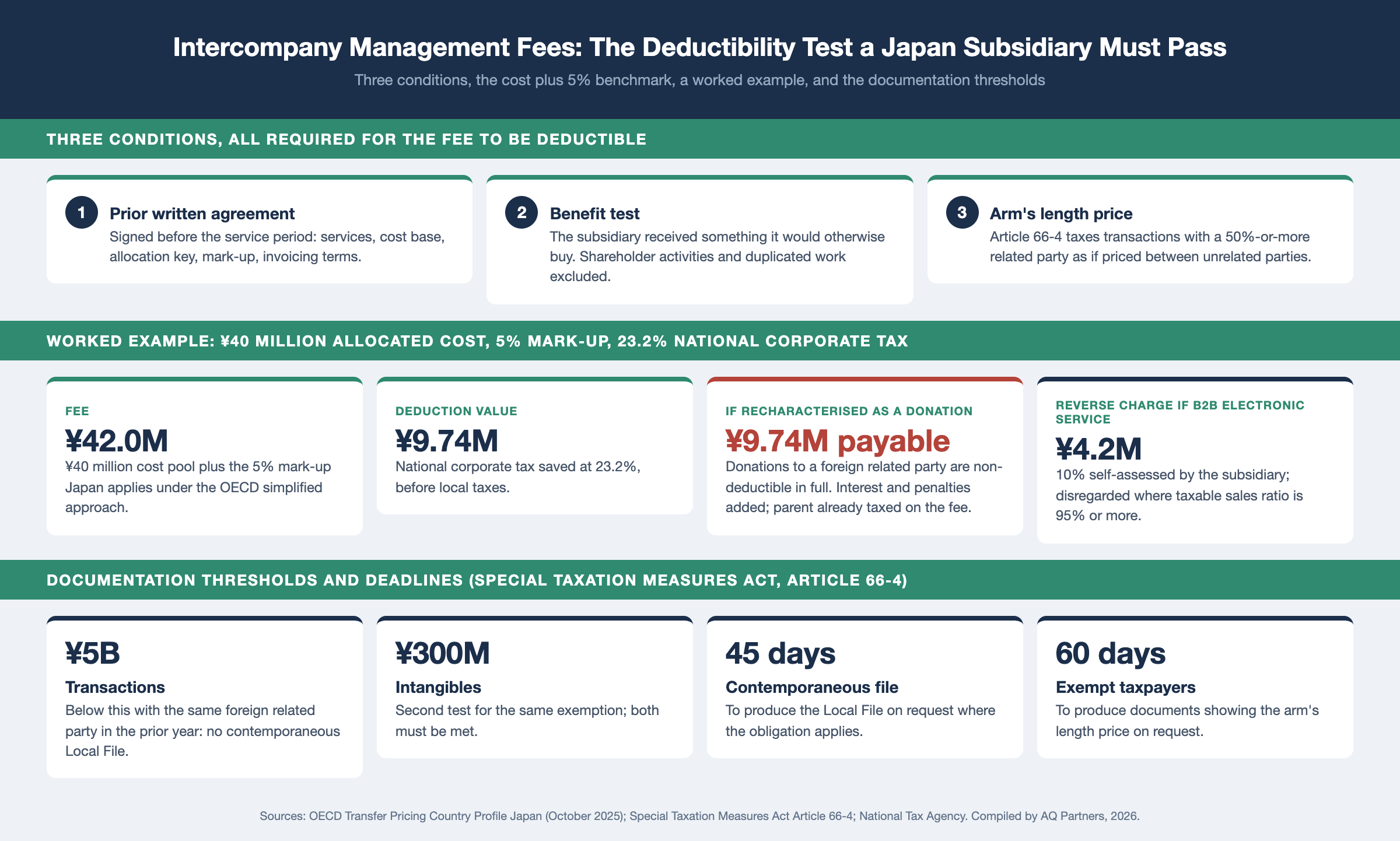
A management fee is deductible only where a prior written agreement, a proven benefit to the subsidiary, and an arm's length price all exist together. Each condition answers a different question an examiner will ask.
The agreement. An intercompany services agreement signed before the service period defines the services, cost base, allocation key, mark-up, and invoicing cycle. A fee invoiced under an agreement signed after year end, or with none at all, fails at the first step regardless of what was delivered.
The benefit. The subsidiary must show it received something of commercial value that it would otherwise have bought from a third party or performed itself. The test excludes shareholder activities, services the subsidiary already performs in-house, and incidental benefits of group membership. Evidence means ticket logs, deliverables, time records, and named staff.
The price. Under Article 66-4 of the Special Taxation Measures Act (租税特別措置法, sozei tokubetsu sochi hou), a transaction with a foreign related party, meaning a company with a direct or indirect shareholding relationship of 50% or more, is taxed as if it took place at the arm's length price. A fee above that price is disallowed to the extent of the excess.
Chargeable Services vs Shareholder Activities
Only services that benefit the subsidiary can be charged; work done in the parent's own interest as a shareholder cannot. The table below sorts the common items.
ActivityChargeable to the subsidiary?ReasonPayroll processing, accounts payable, bookkeeping support run centrallyYesThe subsidiary would otherwise buy or staff this itselfIT infrastructure, helpdesk, licensed group software seatsYesDirect operational benefit, measurable by user countHR policy, recruiting support, training programmes used by Japan staffYesBenefit to the subsidiary's own workforceLegal and tax advice on the subsidiary's own contracts and filingsYesService the subsidiary would source from a Japanese adviserMarketing and sales support producing Japan-market leads or materialsYesCommercial benefit in the subsidiary's marketGroup consolidation, parent audit, parent board and shareholder reportingNoShareholder activity performed for the parent's benefitInvestor relations, group financing at parent level, parent listing complianceNoShareholder activityServices the subsidiary already performs with its own staffNoDuplication fails the benefit testPassive benefit from group reputation or purchasing powerNoIncidental benefit of group membership, not a service
Pricing the Fee: Cost Plus 5% Under the Simplified Approach
Routine support services are priced at allocated cost plus a 5% mark-up, the OECD simplified approach that Japan has adopted. According to the OECD's 2025 Japan transfer pricing country profile, updated October 2025, the NTA applies the simplified approach with a mark-up of 5% to qualifying services. Japan has no separate statutory safe harbour for services, so the cost base and allocation key still have to be defended.
Three elements make up the price:
A worked example shows the stakes. A Japanese subsidiary is allocated ¥40 million of group finance, HR, and IT costs for the year. With the 5% mark-up the fee is ¥42 million. Deducted against profits taxed at the 23.2% national corporate tax rate, the fee saves ¥9,744,000 in national tax before local taxes are counted. If the NTA recharacterises the same ¥42 million as a donation because no agreement or benefit evidence exists, the deduction is lost in full and the ¥9,744,000 becomes payable, plus local taxes, interest, and penalties, while the parent has already been taxed on the fee at home.
Withholding and Consumption Tax on Management Fees, Royalties, and Cost Sharing
Fees for services performed abroad carry no withholding; royalties are withheld at 20.42% and B2B electronic services bear a 10% reverse charge. The classification of the payment decides the cash cost before the deduction is considered.
Withholding follows where the work is done. Fees for services the parent's staff perform entirely outside Japan are not Japan-source income, as explained in the guide to withholding tax on dividends and royalties in Japan. Services performed inside Japan by visiting parent staff can be Japan-source and withheld, and a fee that is in substance a licence of know-how or software is a royalty, withheld at 20.42% unless a treaty form is filed in advance.
Consumption tax follows how the service is delivered. Under the NTA's guidance on cross-border electronic services, a business-to-business electronic service from a foreign provider to a Japanese business is a specified taxable purchase (特定課税仕入れ, tokutei kazei shiire) on which the recipient self-assesses 10% under the reverse charge. A subsidiary whose taxable sales ratio is 95% or more, or which uses simplified taxation, may treat the purchase as not having occurred for the time being. Services performed abroad and delivered in person or by ordinary correspondence are outside the scope, as set out in the guide to consumption tax on cross-border transactions.
CriterionManagement or service feeRoyaltyCost contribution arrangementWhat is paid forServices performed by group staffUse of trademarks, software, know-how, patentsShare of joint development or shared asset costsDeductible for the subsidiaryYes, if agreement, benefit, and arm's length price holdYes, if the subsidiary uses the intangible and the rate is arm's lengthYes, if the subsidiary's share matches its expected benefitJapanese withholdingGenerally none for services performed abroad20.42% domestic, treaty rate if filed in advanceGenerally none; NTA may recharacterise as royalty if an intangible is licensedConsumption taxOut of scope if performed abroad; 10% reverse charge if B2B electronic serviceReverse charge may apply to electronic delivery of software or contentDepends on the nature of each contributionPricing methodCost plus 5% for low value-adding servicesComparable licence rates or profit splitCost allocated by expected benefit, no mark-upCore documentationServices agreement, cost pool, allocation key, benefit evidenceLicence agreement, benchmarking study, usage evidenceCCA agreement, contribution and benefit measurementMain audit riskDonation recharacterisation for missing benefit or agreementRate above arm's length, or fee that is really a royaltyBuy-in and balancing payments mispriced
Transfer Pricing Documentation Thresholds
A Local File is due with the return unless prior-year dealings with the related party were under ¥5 billion, and under ¥300 million for intangibles. The exemption removes the contemporaneous deadline, not the obligation.
Article 66-4 of the Special Taxation Measures Act, in the consolidated text of the Act, sets both thresholds and both deadlines. Where contemporaneous documentation is required, the Local File must be produced within 45 days of an examiner's request; where the exemption applies, documents showing the arm's length price must still be produced within 60 days. Most foreign-owned subsidiaries fall under the thresholds. The file's structure and the Master File and country-by-country layers are covered in the guide to transfer pricing documentation requirements in Japan, and JETRO's overview of taxation of international transactions summarises how Japan applies the arm's length principle.
What Happens on Audit, and the Checklist That Prevents It
A fee that fails the benefit or agreement test becomes a donation to a foreign related party, non-deductible in full under Article 66-4(3). The subsidiary pays corporate tax on the disallowed amount plus interest and penalties.
An ordinary donation in Japan is partly deductible within a formula limit; a donation to a foreign related party is not deductible at all, and the examiner need only show that the subsidiary cannot demonstrate what it received. A well-prepared subsidiary keeps the following on file every year:
A subsidiary that also carries a parent loan should check the combined outbound flow against the interest ceilings in the guide to intercompany loans to a Japan subsidiary, weigh fees against dividends and royalties using the guide to repatriating profits from Japan, and place both within the pillar guide to funding a Japan subsidiary.
Frequently Asked Questions
Can a parent charge a management fee to a loss-making Japan subsidiary?
Yes, if the three conditions are met, but the deduction has no value in a loss year and the fee still attracts scrutiny. Many groups reduce charges during the loss period, document the reason, and resume once the subsidiary is profitable.
Is a management fee subject to Japanese withholding tax?
Not where the services are performed outside Japan, because the fee is not Japan-source income. Withholding can apply where parent staff work inside Japan, and applies at 20.42% where the payment is in substance a royalty.
Does the 5% mark-up apply to every intercompany service?
No. The 5% simplified approach covers low value-adding support services such as accounting, HR, IT support, and administration. Services central to the group's business, such as research or sales, require a benchmarked mark-up.
Working with AQ Partners. Our Tokyo team provides back office operations for foreign companies operating in Japan, covering the requirements described above end to end. Book a consultation to discuss your situation.

Yuga Koda is a founding Director at AQ Partners, supporting foreign companies, funds, and families operating in Japan. His experience operating companies in both Japan and international markets gives him a practical understanding of back office operations from both sides.