
Capital Increase and Capital Reduction in Japan: Procedure, Tax Effects, and the ¥100 Million Threshold
A capital increase (増資, zoushi) or capital reduction (減資, genshi) in a Japan subsidiary is a Companies Act procedure that changes the stated capital (資本金, shihonkin) recorded on the commercial register, and for a foreign-owned kabushiki kaisha (株式会社, KK) or goudou kaisha (合同会社, GK) it is also a tax event and, on the way in, an inward direct investment under the Foreign Exchange and Foreign Trade Act (FEFTA). An increase is quick: a resolution, a payment, and a registration within two weeks. A reduction is slow, because creditors get at least a month to object. Both move the company across the thresholds that decide its consumption tax status, small and medium-sized enterprise (SME) treatment, and local tax tiers. This guide sets out the procedure, cost, and tax effect of each.
Key Takeaways
- An increase is registered within two weeks of the payment date at 0.7% of the increase. The registration and licence tax has a ¥30,000 minimum, and the parent's subscription is reported to the Bank of Japan under FEFTA within 45 days.
- Half of any subscription can go to capital reserve instead of stated capital. Under Companies Act Article 445 an amount not exceeding one half of the payment may be excluded from stated capital and booked as capital reserve, which cuts the registration tax and helps stay under ¥100 million.
- A reduction takes about two months because of the creditor procedure. A special resolution, Gazette and individual creditor notices, and an objection period of at least one month precede the effective date; registration then costs a flat ¥30,000.
- A reduction with a payout is partly a dividend. The distribution is split between a return of capital and a deemed dividend in proportion to the capital-related amount and retained earnings, and the deemed-dividend portion is withheld at 20.42% or the treaty rate.
- Cutting capital to ¥100 million no longer buys SME status for a large group's subsidiary. From fiscal years beginning 1 April 2026 a wholly owned subsidiary of a parent with capital and capital surplus over ¥5 billion stays inside size-based enterprise tax if its own capital and capital surplus exceed ¥200 million.
Capital Increase: Resolution, Payment, Registration, and Report
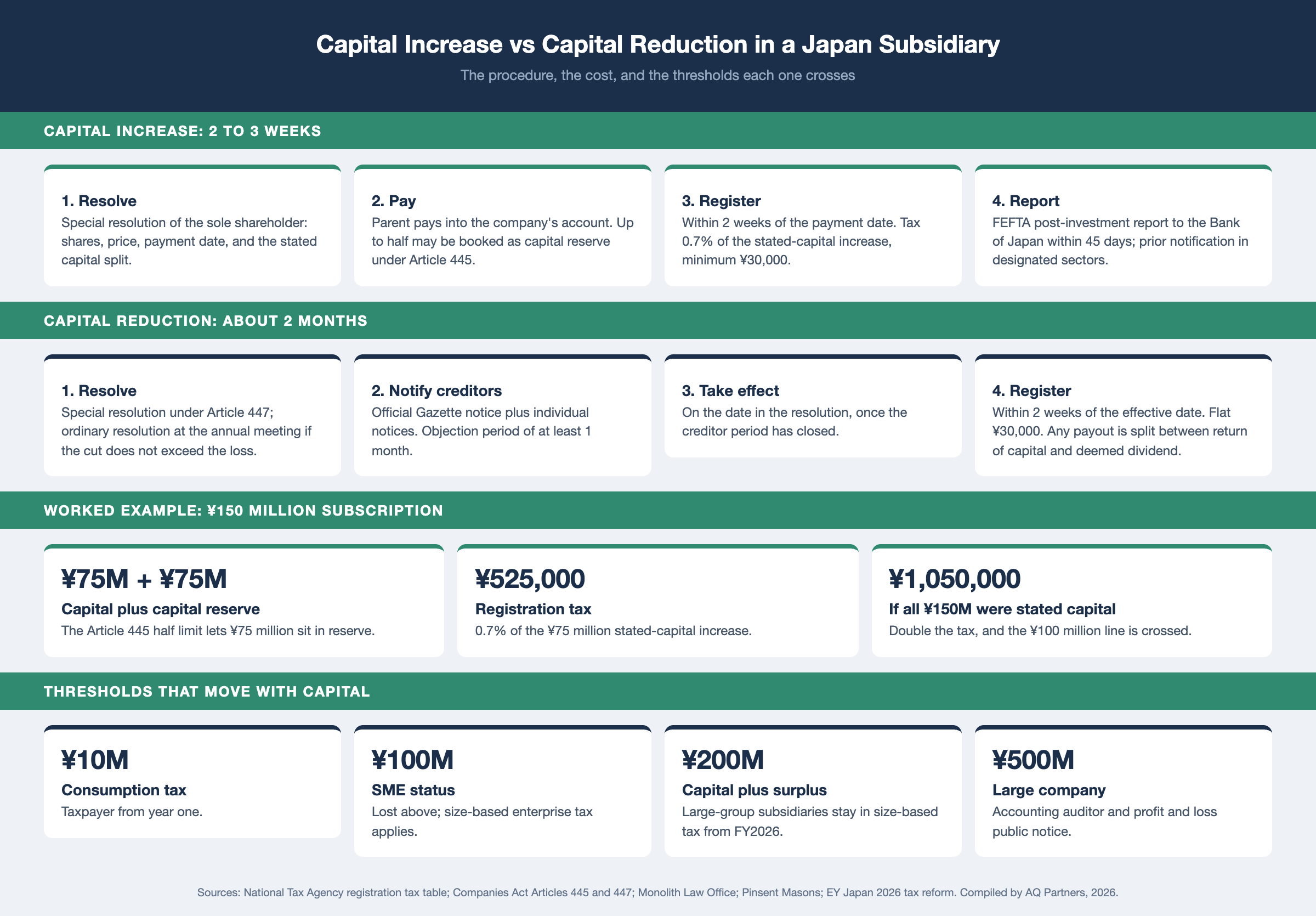
A capital increase by the sole shareholder is a share issue to the parent: a special resolution, a payment, and registration within two weeks. The parent resolves the shares, price, payment date, and stated-capital split, pays into the company's account, and the company registers the new capital at the Legal Affairs Bureau (法務局, houmukyoku) within two weeks of the payment date under Article 915.
The registration and licence tax (登録免許税, touroku menkyo zei) is 0.7% of the increase in stated capital, minimum ¥30,000 per application, according to the National Tax Agency's registration and licence tax table. It is charged on the amount that becomes stated capital, not on the amount paid, which is where Article 445 matters: the company may exclude up to one half of the payment from stated capital and must then book it as capital reserve (資本準備金, shihon junbikin), as the text of Companies Act Article 445 provides. Capital reserve counts toward the capital-related amount for tax and thin capitalization purposes but not toward stated capital for the ¥100 million SME test or the registration tax base.
The FEFTA side runs on its own clock. A foreign parent's subscription for new shares is an inward direct investment, reported to the Bank of Japan within 45 days, or subject to prior notification with a 30-day waiting period where the subsidiary operates in a designated sector, as set out in Pinsent Masons' guide to foreign direct investment in Japan. The report is due even for a 100% parent. If the new stated capital crosses ¥10 million, ¥100 million, or ¥500 million, the tax office and local tax offices also receive a notice of change.
Worked Example: A ¥150 Million Subscription
A parent subscribing ¥150 million can book half as capital reserve and pay ¥525,000 in registration tax instead of ¥1,050,000. The arithmetic: 0.7% of ¥75,000,000 is ¥525,000; 0.7% of the full ¥150,000,000 would be ¥1,050,000. The half limit in Article 445 means no more than ¥75 million of a ¥150 million payment can go to reserve, so a company that already has ¥30 million of stated capital reaches ¥105 million and crosses the ¥100 million line either way. Keeping it below the line then means funding part of the ¥150 million as a parent loan rather than equity, the decision covered in the guide to funding a Japan subsidiary.
Capital Reduction: Special Resolution and the Creditor Procedure
A capital reduction needs a special resolution, a creditor period of at least one month, and registration within two weeks, about two months in all. Under Article 447 the shareholder resolves the amount, whether any of it becomes capital reserve, and the effective date. A special resolution is required, except that an ordinary resolution at the annual shareholders' meeting suffices where the reduction does not exceed the accumulated loss, according to Monolith Law Office's commentary on capital reduction under Japanese corporate law.
The company then publishes the reduction in the Official Gazette (官報, kanpou) and gives individual notice to each known creditor, allowing objections for a period of at least one month. An objecting creditor must be paid, secured, or provided for unless the reduction poses no risk to it, and Gazette scheduling stretches the sequence to about two months. The company registers the reduction within two weeks at a flat ¥30,000, the figure given in RSM Shiodome Partners' guide to commercial registration taxes.
Two uses are common. A nominal reduction absorbs accumulated losses with no cash leaving the company, typically before a recapitalisation. A reduction with distribution (資本の払戻し, shihon no haraimodoshi) returns cash to the parent, and that payout is split for tax between a return of capital and a deemed dividend (みなし配当, minashi haitou) in proportion to the capital-related amount and retained earnings, with the deemed-dividend portion withheld at 20.42% or the treaty rate. The worked example and treaty rates are in the guide to repatriating profits from Japan.
| Step | Capital increase | Capital reduction |
|---|---|---|
| Resolution | Special resolution on shares, price, payment date, and capital split | Special resolution under Article 447; ordinary resolution at the annual meeting where the cut does not exceed the loss |
| Creditor procedure | None | Official Gazette notice plus individual notices; objection period of at least 1 month |
| Cash movement | Parent pays in by the payment date | None for a loss-covering reduction; distribution to the parent for a reduction with payout |
| Effective date | Payment date | Date set in the resolution, after the creditor period closes |
| Registration deadline | 2 weeks from the payment date | 2 weeks from the effective date |
| Registration tax | 0.7% of the increase in stated capital, minimum ¥30,000 | ¥30,000 flat |
| FEFTA | Post-investment report within 45 days; prior notification in designated sectors | None for the reduction itself |
| Tax office notices | Notice of change where capital crosses ¥10 million, ¥100 million, or ¥500 million | Notice of change; withholding return for any deemed dividend |
| Typical duration | 2 to 3 weeks | About 2 months |
The Thresholds That Make Capital a Tax Decision
Stated capital switches tax regimes on and off, so check every change against the ¥10 million, ¥100 million, and ¥500 million lines first. The per-capita levy of corporate inhabitant tax also steps with capital and headcount, from ¥70,000 a year in Tokyo's 23 wards for a company with capital of ¥10 million or less and 50 or fewer employees to ¥3.8 million for the largest corporations, as covered in the guide to Japanese corporate resident tax.
The ¥100 million line is the one groups most often manage by reduction, and the rules have tightened. A company at ¥100 million or less is an SME for corporate tax and sits outside size-based enterprise tax (外形標準課税, gaikei hyoujun kazei). According to EY Japan's summary of the 2026 tax reform for inbound businesses, for fiscal years beginning on or after 1 April 2026 a wholly owned subsidiary of a parent whose capital and capital surplus exceed ¥5 billion stays inside size-based enterprise tax where its own capital and capital surplus exceed ¥200 million, whatever its stated capital. Capital reserve is capital surplus, so a ¥75 million plus ¥75 million split leaves ¥150 million of capital and surplus, under the line, but a second subscription of the same size crosses it. SME corporate tax status also fails where the parent's capital is ¥500 million or more.
| Stated capital line | Crossing upward triggers | Crossing downward restores |
|---|---|---|
| ¥10 million | Consumption tax payer status from the first fiscal year; higher per-capita levy tier | Start-up exemption only for new companies that also pass the parent-sales test |
| ¥100 million | Loss of SME corporate tax treatment; size-based enterprise tax; higher levy tier | SME treatment, unless the parent's capital is ¥500 million or more; size-based tax still applies to large-group subsidiaries over ¥200 million capital plus surplus |
| ¥200 million capital plus capital surplus | Size-based enterprise tax for a wholly owned subsidiary of a parent over ¥5 billion, from FY2026 | Exit from that rule only if both capital and surplus are reduced |
| ¥500 million | Large company under the Companies Act: accounting auditor and profit and loss public notice | Large-company status ends at the next fiscal year end below the line |
| Registration tax | 0.7% of each increase, minimum ¥30,000 | Flat ¥30,000 per reduction |
| FEFTA | Every parent subscription is reported within 45 days | A reduction is not an inward direct investment |
Sequencing a Reduction and Increase Together
A reduction followed by an increase, the usual recapitalisation, costs ¥30,000 plus 0.7% of the new stated capital and takes about three months. The two resolutions can be passed on the same day with the increase taking effect after the reduction, but the increase cannot be registered until the reduction's effective date.
Three timing points follow. A loss-covering reduction can pass by ordinary resolution at the annual shareholders' meeting, so it is cheapest scheduled with the annual accounts, covered in the guide to the annual shareholders' meeting for a foreign-owned KK. The FEFTA report for the new subscription is due 45 days after the shares are issued, not after the reduction; the mechanics are in the guide to FEFTA inward direct investment notification. And an increase that exceeds the authorised share cap needs an amendment to the articles of incorporation first. All three sit inside the event calendar in the guide to corporate secretarial obligations for a foreign-owned KK or GK.
Frequently Asked Questions
How long does a capital reduction take in Japan?
About two months from the shareholder resolution to the effective date, because the creditor objection period must be at least one month and the Official Gazette notice has to be scheduled first. Registration follows within two weeks at a flat ¥30,000.
Can the parent put half of a subscription into capital reserve to stay under ¥100 million?
Yes. Companies Act Article 445 allows an amount not exceeding one half of the payment to be excluded from stated capital and booked as capital reserve. The registration tax of 0.7% applies only to the stated-capital portion, and capital reserve does not count toward the ¥100 million SME test, although it counts toward the ¥200 million capital-plus-surplus test for large-group subsidiaries from April 2026.
Does a capital reduction paid out to the parent attract withholding tax?
Partly. The distribution is split between a return of capital and a deemed dividend in proportion to the company's capital-related amount and retained earnings. The deemed-dividend portion is withheld at 20.42%, or at the treaty rate if the treaty form is filed before payment. A subsidiary with no retained earnings has no deemed dividend.
Working with AQ Partners. Our Tokyo team provides back office operations for foreign companies operating in Japan, covering the requirements described above end to end, from capital increase and reduction registrations and FEFTA reports to the tax office notices that follow. Book a consultation to review your Japan entity's compliance calendar.


Yuga Koda is a founding Director at AQ Partners, supporting foreign companies, funds, and families operating in Japan. His experience operating companies in both Japan and international markets gives him a practical understanding of back office operations from both sides.