
Annual Shareholders' Meeting for a Foreign-Owned KK: What Must Happen, When, and What a Sole-Shareholder Subsidiary Can Skip

The annual shareholders' meeting (定時株主総会, teiji kabunushi soukai) is the yearly general meeting every kabushiki kaisha (株式会社, KK) must hold after the close of each fiscal year to approve the accounts and renew its officers under the Companies Act (会社法, kaishahou). For a foreign-owned KK with a single corporate shareholder, the meeting is a legal event rather than a physical one: the parent adopts every resolution in writing and the cycle runs from headquarters. What cannot be skipped is the paperwork, its retention, the public notice that follows, and the reappointment of any director whose term ends. This guide sets out what the law requires, what a sole shareholder can dispense with, and the timeline and document set the company secretary needs each year.
Key Takeaways
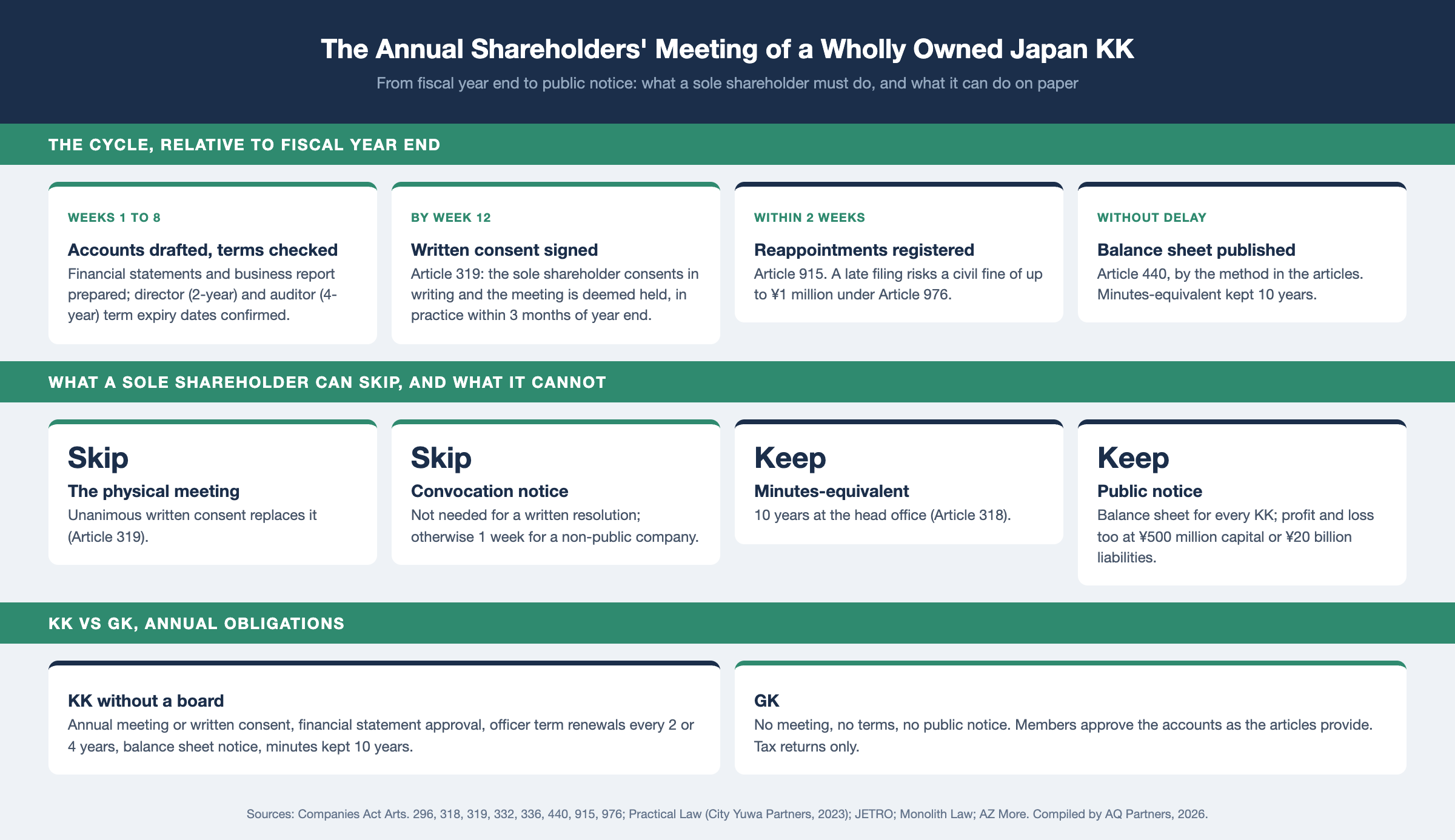
- The meeting is mandatory; the room is not. A KK must hold an ordinary shareholders' meeting after each fiscal year end, in practice within three months. Under Companies Act Article 319 a sole shareholder can adopt every resolution by written consent, and the meeting is deemed held.
- Written resolutions carry the same records duty. The company must prepare a document equivalent to minutes and keep it at the head office for ten years under Article 318.
- Approving the accounts is only part of the agenda. The annual resolutions cover the financial statements, the business report, any dividend within the distributable amount, director and auditor reappointments where a term ends, and the remuneration ceiling.
- Public notice follows the meeting. Article 440 requires a KK to publish its balance sheet after the annual meeting, by the method its articles specify. A large company, with capital of ¥500 million or more or liabilities of ¥20 billion or more, publishes the profit and loss statement as well.
- A GK has none of it. A goudou kaisha (合同会社, GK) holds no shareholders' meeting, has no director terms to renew, and publishes no accounts. Its members approve the financial statements in whatever way the articles provide.
What the Law Requires and When
Every KK must hold an ordinary shareholders' meeting after each fiscal year end, and the three-month window comes from the record-date rule. Article 296 of the Companies Act requires the ordinary meeting to be held within a certain period after the close of each fiscal year. Because a record date fixed under Article 124 is valid for only three months, a company that uses its year end as the record date for voting and dividend rights must hold the meeting within three months of that date. Niizawa Law's summary of Japanese corporate law on shareholders' meetings and annual reporting describes the practice as "typically within three months after the fiscal year end".
Convocation is light. A non-public company sends notice at least one week ahead, against two weeks for a public company, and one without a board or written voting provisions may shorten it in its articles, according to Monolith Law Office's guide to the operation of shareholders' meetings. A written resolution needs no notice at all.
The obligations that survive whatever format is chosen are three: the resolutions must be adopted, the minutes or their equivalent must be prepared and kept, and any director or auditor reappointment must be registered within two weeks. A late registration exposes the representative to a civil fine of up to ¥1 million under Article 976, as AZ More's note on the rules on directors in Japan records.
Adopting the Resolutions on Paper: Article 319
A sole corporate shareholder can replace the meeting with a written consent, which the Companies Act treats as a resolution adopted at a meeting. Article 319 provides that where a director or a shareholder proposes a matter and every shareholder entitled to vote consents in writing or by electronic record, the proposal is deemed resolved at a shareholders' meeting. Article 320 does the same for matters that only need to be reported to shareholders, such as the business report: where all shareholders agree in writing that the report need not be made, it is deemed made.
For a foreign parent the mechanics are a single document: counsel drafts the proposals, the parent's signatory signs a written consent, and the consent is filed as the minutes-equivalent. Companies Act Article 318 requires the minutes of a shareholders' meeting to be kept at the head office for ten years, and Practical Law's note on company records and registers in Japan by City Yuwa Partners confirms the same ten-year, head-office rule for board minutes and accounting books, and five years for the financial statements themselves. The minutes may be held electronically; many articles still require directors' signatures or seals, so check the articles first.
The deemed meeting still has a date, the day the last consent arrives, and that date starts the two-week registration clock for any reappointment.
What Goes on the Agenda
The annual resolutions for a wholly owned KK are a short, repeatable list, and each item has its own article and its own trap.
- Approval of the financial statements. Article 438 requires the balance sheet, profit and loss statement, and related schedules to be approved at the ordinary meeting. Where the company has an accounting auditor and the auditor's opinion is clean, Article 439 replaces approval with a report. A small subsidiary without an accounting auditor approves.
- The business report. Reported, not approved, and dispensable by written agreement under Article 320.
- Dividend of surplus. Resolved under Article 454 and limited by the distributable amount under Article 461. The withholding position on a dividend to a foreign parent is covered in the guide to repatriating profits from Japan.
- Director and auditor reappointments. A director's term is two years under Article 332 and a statutory auditor's four years under Article 336, each extendable to ten in the articles of a non-public company. A term that ends at the annual meeting must be renewed by resolution and registered within two weeks, as explained in the guide to director terms of office and re-election; the filing itself is in the guide to director change registration.
- Remuneration ceiling. Article 361 requires director remuneration to be fixed by the articles or by shareholder resolution. Groups usually resolve a total ceiling once and leave allocation to the directors.
Whether the company needs a statutory auditor at all depends on its structure and size, which the guide to kansayaku requirements in Japan sets out; most wholly owned subsidiaries without a board do not.
Public Notice and the Large-Company Line
After the annual meeting a KK must publish its balance sheet; the method depends on the articles and the content on whether it is a large company. Article 440 requires public notice of the balance sheet without delay after the ordinary meeting, in the Official Gazette, a daily newspaper, or on the company's website, whichever the articles prescribe as the company's public notice method. A subsidiary with capital of ¥500 million or more, or liabilities of ¥20 billion or more, is a large company and must publish the profit and loss statement as well; it must also appoint an accounting auditor, as the guide to corporate governance requirements for Japan entities explains.
Website notice is the cheapest method, but the balance sheet must then stay posted for five years and the articles must name the website method. The only way to avoid publication is a GK. The guide to KK vs GK for a wholly owned subsidiary of a multinational weighs that against the KK's advantages.
The Annual Timeline and the Document Set for Headquarters
The cycle runs from year end to public notice in about three months, and each step has a named owner on the Japan side and at headquarters. The table is the standing calendar for a KK with no board and a sole corporate shareholder.
| Step | Companies Act basis | Timing after year end | Japan-side owner | Headquarters owner |
|---|---|---|---|---|
| Close the books and draft the financial statements and business report | Art. 435 | Weeks 1 to 6 | Provider or finance lead | Group controller reviews the reporting package |
| Statutory auditor review, where one exists | Art. 436 | Weeks 6 to 8 | Kansayaku | Group audit liaison |
| Check director and auditor term expiry dates | Arts. 332, 336 | Week 8 | Provider | Company secretary confirms who continues |
| Draft the written consent covering accounts, dividend, reappointments, remuneration | Arts. 319, 320, 438, 454, 361 | Weeks 8 to 10 | Provider or counsel | Counsel reviews |
| Parent signs the written consent; deemed meeting date fixed | Art. 319 | By week 12, within 3 months | Provider collects | Authorised signatory signs |
| Register any reappointment or change of officers | Art. 915 | Within 2 weeks of the deemed meeting | Judicial scrivener or counsel | Acceptance letters and signature certificates supplied |
| Public notice of the balance sheet | Art. 440 | Without delay after the meeting | Provider | Company secretary confirms posting |
| File the minutes-equivalent and update the group entity tracker | Art. 318 | After the meeting; retain 10 years | Provider | Company secretary |
| Pay any dividend and file the treaty form before payment | Art. 461 | Per the resolution | Provider and bank | Group treasury and tax |
The annual document set for headquarters is short: draft financial statements and business report, the written consent for signature, acceptance letters and signature certificates for renewed officers, then the registered certificate and public notice confirmation.
What a GK Does Instead
A GK owes none of the shareholders' meeting machinery, which is the strongest governance argument for choosing the form over a KK. JETRO's overview of forms of business presence in Japan notes that a GK may stipulate the procedures for preparing and approving its financial statements in its articles of association and need not publish financial results. There is no annual meeting, no director term, no public notice, and no reappointment registration. The table below compares the annual obligations.
| Annual obligation | KK without a board | GK |
|---|---|---|
| Ordinary shareholders' or members' meeting | Required; written consent under Art. 319 for a sole shareholder | None; approval per the articles |
| Approval of financial statements | Shareholder approval under Art. 438 | Member approval as the articles provide |
| Minutes or equivalent | Prepared and kept 10 years at the head office | Member resolution records as the articles provide |
| Officer term renewal | Directors every 2 years, auditors every 4, up to 10 in the articles; registered within 2 weeks | No terms; managing members serve until changed |
| Public notice of accounts | Balance sheet under Art. 440; profit and loss too for a large company | Not required |
| Remuneration resolution | Shareholder resolution or articles under Art. 361 | As the articles provide |
| Corporate and local tax returns | Within 2 months of year end, extendable by 1 month | Same |
The annual cycle sits inside the wider checklist of recurring and event-driven duties in the guide to corporate secretarial obligations for a foreign-owned KK or GK .
Frequently Asked Questions
Can the parent's signatory sign the written consent from abroad?
Yes. Article 319 requires written or electronic consent from all shareholders, with no requirement that it be signed in Japan or notarized. Any reappointment that follows needs the director's acceptance letter and, for a non-resident, a signature certificate, usually collected at the same time.
What if the subsidiary misses the three-month window?
The three months is the record-date rule, so the company must fix a new record date, and the accounts stay unapproved until it does. The real exposure is a director whose term ended: the reappointment is due within two weeks, and a long delay can draw a civil fine of up to ¥1 million.
Does a wholly owned KK have to publish its balance sheet?
Yes. Article 440 applies to every KK; only the profit and loss statement is limited to large companies. The method is whatever the articles specify, including a website notice. A GK has none.
Working with AQ Partners. Our Tokyo team provides back office operations for foreign companies operating in Japan, covering the requirements described above end to end, from the annual written resolution and officer reappointments to the public notice and the ten-year record set. Book a consultation to review your Japan entity's compliance calendar.

Yuga Koda is a founding Director at AQ Partners, supporting foreign companies, funds, and families operating in Japan. His experience operating companies in both Japan and international markets gives him a practical understanding of back office operations from both sides.