
Director Terms of Office in Japan: The 2-Year Default, the 10-Year Extension, and Fines for Late Re-Election

A director's term of office (任期, ninki) in a Japanese kabushiki kaisha (株式会社, KK) is the period after which the appointment lapses unless the shareholder re-elects the director and the company registers the reappointment. Under Article 332 of the Companies Act the default term runs until the close of the ordinary shareholders' meeting for the last fiscal year ending within two years of election, and a non-public company may extend it to ten years in its articles of incorporation. It is the item foreign-owned subsidiaries miss most often, because nothing visible happens on the day it ends. This guide explains how the term is counted, what a reappointment costs, what a lapse does to the director's authority, and how a headquarters company secretary should track the dates.
Key Takeaways
- Terms end at a meeting, not on an anniversary. A director's term runs to the close of the annual shareholders' meeting for the last fiscal year that ends within the term period, so a two-year term elected in May with a March year end actually ends at the meeting held by June two years later.
- Ten years is available to every wholly owned subsidiary. A non-public KK, meaning one whose shares are all transfer-restricted, can set director and statutory auditor terms up to ten years in its articles. Most foreign-owned subsidiaries qualify and should use it.
- Reappointment is a registration like any other. Re-election (重任, chounin) needs a shareholder resolution, the director's acceptance, and a filing within two weeks under Article 915, with a registration tax of ¥10,000 for a company with capital of ¥100 million or less and ¥30,000 above.
- A lapsed director does not simply disappear. Where the lapse would leave the company short of its required number, the director continues with the rights and duties of the office under Article 346 until a successor is registered, but the register is wrong and a late filing can draw a civil fine of up to ¥1 million.
- A long term can create a long silence. With a ten-year term and no other changes, a subsidiary can go a decade without a registration, and the Ministry of Justice deems dissolved any KK with no entry for twelve years.
How a Director's Term Is Counted
A director's term is measured to a shareholders' meeting, not a calendar date, so the expiry rarely falls where a headquarters diary expects it. Article 332 sets the default term as ending at the close of the ordinary shareholders' meeting for the last fiscal year that ends within two years of election. The annual meeting is held in practice within three months of the year end, because a shareholder record date is valid for only three months. The rule and the ten-year extension for companies with transfer-restricted shares are summarised in AZ More's overview of the rules on directors in Japan.
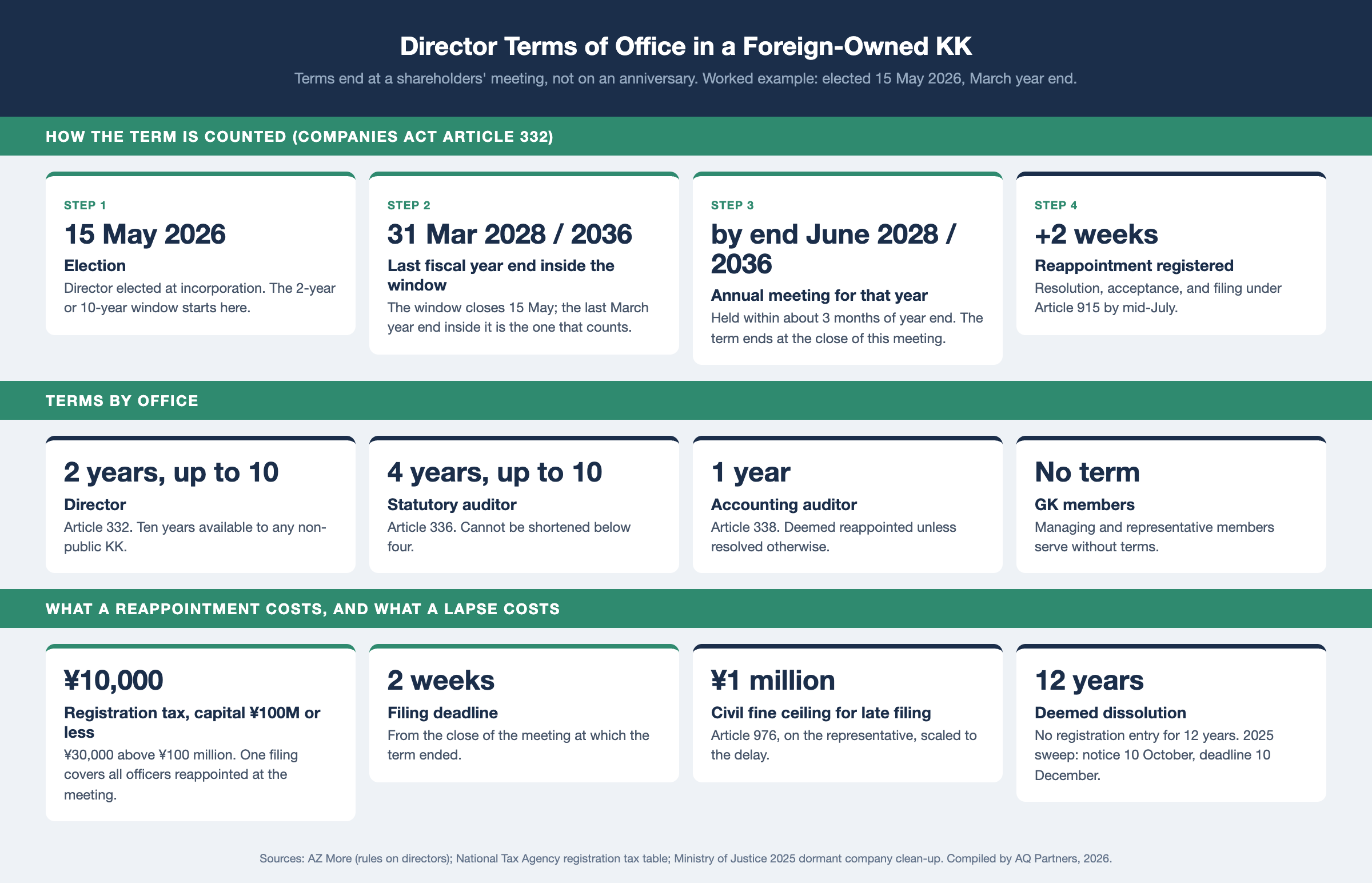
A worked example shows the mechanic. A subsidiary is incorporated on 15 May 2026 with a fiscal year ending 31 March and elects its directors that day. With the two-year default, the window runs to 15 May 2028; the last fiscal year ending inside it closes on 31 March 2028; the annual meeting for that year falls by the end of June 2028; the term ends at the close of that meeting, and the reappointment must be registered within two weeks, by mid-July 2028. With a ten-year term in the articles, the window runs to 15 May 2036, the last fiscal year inside it ends 31 March 2036, the meeting falls by the end of June 2036, and the registration by mid-July 2036. The other offices are counted the same way, as the table shows; members of a goudou kaisha (合同会社, GK) have no terms at all.
| Role | Default term | Maximum in the articles (non-public KK) | Companies Act article | Registration on expiry |
|---|---|---|---|---|
| Director (取締役) | To the annual meeting for the last fiscal year ending within 2 years | 10 years | Article 332 | Reappointment registered within 2 weeks |
| Representative director (代表取締役) | Follows the directorship | Follows the directorship | Article 349 | Re-registered with the director reappointment |
| Statutory auditor (監査役) | 4 years, cannot be shortened | 10 years | Article 336 | Reappointment registered within 2 weeks |
| Accounting auditor (会計監査人) | 1 year, deemed reappointed unless resolved otherwise | 1 year | Article 338 | Deemed reappointment registered within 2 weeks |
| GK managing member (業務執行社員) | No term | Not applicable | Article 591 | None unless the member changes |
| GK representative member (代表社員) | No term | Not applicable | Article 599 | None unless the member changes |
Reappointment: Resolution, Acceptance, Registration, Tax
Re-electing a director whose term has ended is a full appointment to the register: the same resolution, acceptance, deadline, and tax as a new one. The shareholder resolves the reappointment, in a wholly owned subsidiary by the sole shareholder's written consent under Article 319, the director signs an acceptance of office, and the company files with the Legal Affairs Bureau (法務局, houmukyoku) within two weeks of the meeting under Article 915. The registration tax is ¥10,000 for a company with capital of ¥100 million or less and ¥30,000 above, per the National Tax Agency's registration and licence tax table.
The documents are light for a resident director: the written resolution, the acceptance letter, and a seal certificate for a representative director. For a non-resident group executive, the acceptance is signed before a notary abroad and a signature certificate replaces the seal certificate, each with a Japanese translation; those take one to three weeks and should be ordered before the meeting. The operation of the meeting itself, including written resolutions, is set out in Monolith Law Office's guide to shareholders' meetings in Japan; the filing mechanics are in the guide to director change registration in Japan.
What a Lapse Does: Rights-and-Duties Directors, Wrong Registers, and Fines
When a term ends without a reappointment, the law keeps the company functioning but leaves its register wrong, and that is what costs money. Under Article 346, where the expiry of a term or a resignation would leave the company with fewer directors than the law or its articles require, the departing director continues to hold the rights and duties of a director (権利義務取締役, kenri gimu torishimariyaku) until a successor takes office. The same rule means a sole director cannot register a resignation until a replacement is appointed, which catches groups that try to remove a departing country manager before the successor's documents are ready.
The register, however, shows an expired term, and the Legal Affairs Bureau notices when the next filing arrives. Late registrations are referred to the court, which may impose a non-criminal fine of up to ¥1 million on the representative under Article 976, scaled to the delay.
The slower consequence is deemed dissolution. The Ministry of Justice sweeps the register every autumn and treats any KK with no registration entry for twelve years as dormant. In the 2025 sweep described on the Ministry's page on the year's dormant company clean-up, notices went out on 10 October 2025, companies had until 10 December 2025 to file a pending registration or a statement that business continued, and those that did neither were deemed dissolved on 11 December 2025. A ten-year term means a well-run subsidiary can go ten years without a registration; a single missed reappointment then carries it past twelve. The revival procedure is in the guide to deemed dissolution of a dormant Japan subsidiary.
| Trigger | Resolution needed | Filing | Registration tax | Deadline | If missed |
|---|---|---|---|---|---|
| Term expires, same person continues | Shareholder re-election; acceptance | Reappointment (重任) | ¥10,000 or ¥30,000 by capital | 2 weeks from the meeting | Register wrong; fine up to ¥1 million; silence counts toward 12 years |
| Term expires, different person elected | Shareholder election; acceptance | Retirement of one, appointment of another | ¥10,000 or ¥30,000 | 2 weeks from the meeting | Outgoing director keeps rights and duties if numbers fall short |
| Resignation mid-term, numbers sufficient | None; resignation letter | Resignation | ¥10,000 or ¥30,000 | 2 weeks from the effective date | Fine; resigned director still shown in office |
| Resignation mid-term, numbers fall short | Shareholder election of a successor | Resignation and appointment filed together | ¥10,000 or ¥30,000 | 2 weeks from the successor's acceptance | Resignation cannot be registered alone; director retains rights and duties |
| Removal by the shareholder | Ordinary resolution (Article 339) | Dismissal | ¥10,000 or ¥30,000 | 2 weeks from the resolution | Fine; possible damages claim if removed without cause mid-term |
| Change of representative director only | Board or shareholder resolution per the articles | Change of representative | ¥10,000 or ¥30,000 | 2 weeks | Fine; seal and bank mandates out of date |
Setting the Term: At Incorporation and by Later Amendment
The term is fixed in the articles, is not itself a registered matter, and should be set to ten years at incorporation for any wholly owned subsidiary. A two-year term means a reappointment and a filing every second year for a board the parent never intends to change, and each cycle is another chance to miss the two-week window. The ten-year term is available to any KK whose shares are all transfer-restricted and costs nothing.
A subsidiary incorporated with the default can amend later by a special resolution of the sole shareholder, with no Legal Affairs Bureau filing and no tax. One nuance matters: extending the term in the articles extends the terms of sitting directors only if the resolution says so, and shortening a term can end a sitting appointment immediately, so the resolution should name the directors it applies to. The same review should ask whether to keep a statutory auditor at all, since a KK without a board need not have one and dropping the office removes a second set of terms to track, as the guide to kansayaku requirements in Japan explains, and who should hold the directorship, a choice covered in the guide to representative director residency and nominee directors.
Tracking Terms from Headquarters
The term-expiry date belongs in the group entity tracker as a dated obligation with an owner, because the Legal Affairs Bureau sends no reminder. The Japan-side provider only knows what it has been told. Three fields cover it: the election date, the articles' term length, and the computed end date, which is the annual meeting for the last fiscal year ending within the term. At each annual meeting the company secretary checks for terms ending, adds the reappointments to the written resolution that approves the accounts, obtains acceptance letters and any signature certificates in advance, and instructs the provider to file within two weeks. The full set of annual and event-driven duties is in the guide to corporate secretarial obligations for a foreign-owned KK or GK, and the governance framework in the guide to corporate governance requirements for Japan entities.
Frequently Asked Questions
Can a foreign-owned KK give its directors a ten-year term?
Yes, if all of its shares are subject to transfer restrictions, which makes it a non-public company. The articles can then set director terms up to ten years under Article 332 and statutory auditor terms up to ten years under Article 336. A wholly owned subsidiary almost always qualifies.
What happens if a director's term expires and nobody notices?
If the lapse would leave the company below its required number of directors, the director continues with the rights and duties of the office under Article 346. The register is wrong from that date, and when the reappointment is eventually filed the court can fine the representative up to ¥1 million under Article 976.
Does re-electing the same director require a filing?
Yes. Reappointment is a registrable change: a shareholder resolution, the director's acceptance, and a filing within two weeks of the meeting at which the term ended, taxed at ¥10,000 for a company with capital of ¥100 million or less and ¥30,000 above.
Working with AQ Partners. Our Tokyo team provides back office operations for foreign companies operating in Japan, covering the requirements described above end to end, including term tracking, annual written resolutions, and director change registrations. Book a consultation to review your Japan entity's compliance calendar.

Yuga Koda is a founding Director at AQ Partners, supporting foreign companies, funds, and families operating in Japan. His experience operating companies in both Japan and international markets gives him a practical understanding of back office operations from both sides.