
Director Change Registration in Japan (役員変更登記): Documents, the 2-Week Deadline, and Foreign-Resident Director Quirks


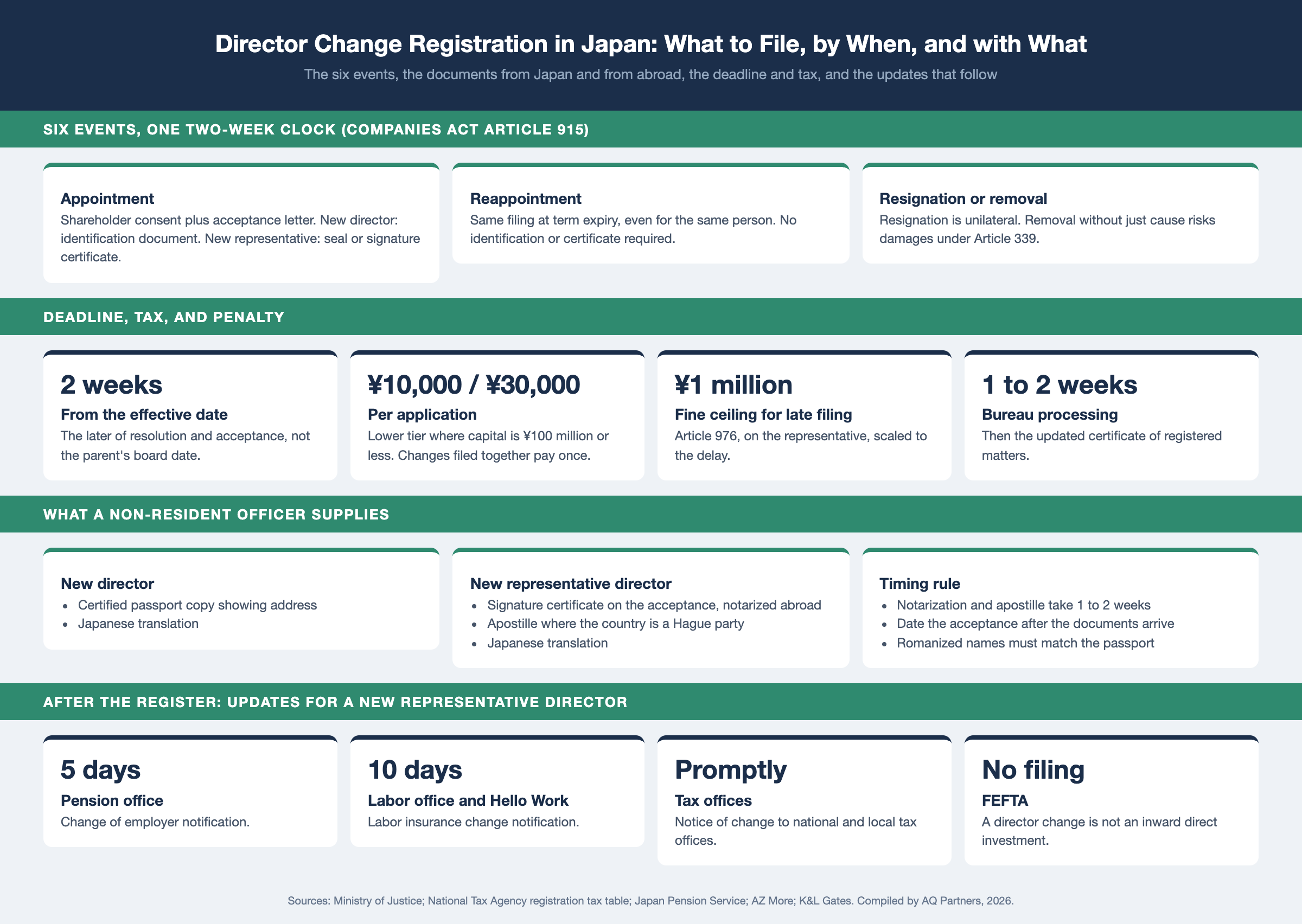
Director change registration (役員変更登記, yakuin henkou touki) is the filing a Japanese kabushiki kaisha (株式会社, KK) makes at the Legal Affairs Bureau (法務局, houmukyoku) whenever a director or statutory auditor joins, leaves, is reappointed, or is removed, and whenever the representative director changes. The Companies Act gives the company two weeks from the effective date to file, charges a registration tax of ¥10,000 or ¥30,000 depending on capital, and exposes the representative to a civil fine of up to ¥1 million if the deadline is missed. For a foreign-owned subsidiary the procedure is routine on the Japanese side and slow on the parent's side, because a newly appointed non-resident officer must supply a notarized signature certificate and a translated identification document from abroad. This guide covers the events, the resolutions, the documents, the deadline, and what has to be updated afterwards.
Key Takeaways
- Six events trigger the filing, and reappointment is one of them. Appointment, resignation, reappointment at term expiry, removal, death, and retirement at term end all change the register, and each must be registered within two weeks under Companies Act Article 915.
- The tax is per application, not per director. A director change registration costs ¥10,000 where stated capital is ¥100 million or less and ¥30,000 above, and several changes filed together on one application pay once.
- A new director needs an identification document; a new representative director needs a seal or signature certificate. Reappointments need neither. A non-resident supplies a passport copy with a Japanese translation and a signature certificate notarized in the country of residence.
- Start the foreign documents before the effective date. Notarization and apostille abroad take one to two weeks, which is the whole filing window, so an acceptance dated before the documents exist is the usual cause of a late filing.
- The register is only the first update. A new representative director means a new seal at the bank, a notice of change to the tax office, a pension office notification within five days, and amendments to every licence and contract that names the representative.
The Events That Change the Register
Six events require a director change registration, each resting on a shareholder decision, the director's own act, or the passage of time. In a wholly owned subsidiary the shareholder is the parent, so a resolution is a written consent of the sole shareholder under Article 319 rather than a meeting.
An appointment (就任, shuunin) requires an ordinary shareholder resolution and the appointee's written acceptance (就任承諾書, shuunin shoudakusho). A resignation (辞任, jinin) is the director's unilateral act, evidenced by a resignation letter. A reappointment (重任, juunin) happens when a term expires and the same person is re-elected, and it is registered exactly like an appointment. A removal (解任, kainin) requires an ordinary resolution, and under Article 339 a director removed before the end of the term without just cause may claim damages for the remainder, which is why groups prefer a resignation. Retirement at term end without re-election (退任, tainin) and death are registered on the minutes or the death certificate.
Where the KK has no board, the representative director is chosen by one of three routes: named in the articles, chosen by shareholder resolution, or chosen by the directors among themselves. The route must match the articles, because the Bureau checks the chain from articles to resolution to acceptance. Who should serve, and the residency and liability questions, are in the guide to representative director residency and nominee directors. In a goudou kaisha (合同会社, GK) the equivalents are the managing member (業務執行社員, gyoumu shikkou shain), the representative member (代表社員, daihyou shain), and, where the member is the parent itself, the individual designated to act for it (職務執行者, shokumu shikkousha).
The Document Set, and What Must Come from Abroad
Each event needs a fixed document set, and the items that come from a non-resident officer decide whether the two-week deadline is met. Japan-side documents take a day; parent-side documents travel through a notary and an apostille office abroad.
A newly appointed director must supply an identification document (本人確認証明書, honnin kakunin shoumeisho). The Ministry of Justice's guidance on identification documents lists a resident record, a driver's licence copy, or a My Number card for a Japan resident, exempts reappointments, and accepts a municipal seal certificate in its place. An officer living abroad supplies a copy of a government identification document showing the address, certified by the officer as a true copy, with a Japanese translation. The requirement dates from the 2015 reform that dropped the resident representative rule, as recorded in K&L Gates' client alert on the change.
A newly appointed representative director's acceptance must carry a registered personal seal with a municipal seal certificate (印鑑証明書, inkan shoumeisho). A non-resident cannot register a personal seal, so the substitute is a signature certificate (署名証明書, shomei shoumeisho): the acceptance is signed before a notary in the country of residence, apostilled where that country is a Hague party, and translated. The mechanics by jurisdiction are in the guide to the parent-company document pack. The application itself carries the company's registered seal, held under the procedure in the guide to delegation of authority and the corporate seal.
| Event | Resolution | Documents prepared in Japan | Documents from abroad (non-resident officer) | Deadline | Registration tax |
|---|---|---|---|---|---|
| Appointment of a director | Sole shareholder written consent | Minutes-equivalent, acceptance letter, application | Certified passport copy with Japanese translation | 2 weeks from acceptance | ¥10,000 or ¥30,000 per application |
| Appointment of a representative director | Per the articles: shareholder consent or directors' mutual vote | Minutes, acceptance letter, application | Notarized and apostilled signature certificate on the acceptance, translated; passport copy | 2 weeks from acceptance | Same |
| Reappointment at term expiry | Sole shareholder written consent at the annual meeting | Minutes, acceptance letter, application | None; identification and certificates are not required on reappointment | 2 weeks from term expiry | Same |
| Resignation | None; unilateral act | Resignation letter, application | Resignation letter signed abroad | 2 weeks from effective date | Same |
| Removal | Sole shareholder written consent (damages risk under Article 339 without just cause) | Minutes, application | None | 2 weeks from resolution | Same |
| Death or retirement at term end | None; evidenced by certificate or minutes | Death certificate or minutes showing no re-election, application | Foreign death certificate with translation | 2 weeks from the event | Same |
Deadline, Tax, and the Fine for Filing Late
The company has two weeks from the effective date to file, pays a flat registration tax per application, and faces a civil fine if it is late. Under Article 915 the effective date for a director change is the later of the resolution and the acceptance, not the date the parent's board decided.
The registration and licence tax (登録免許税, touroku menkyo zei) for a change concerning directors, representative directors, or statutory auditors is ¥10,000 per application for a company whose capital is ¥100 million or less and ¥30,000 above, according to the National Tax Agency's registration and licence tax table. Changes filed together pay once.
A late filing is referred to the court, which may impose a non-criminal fine of up to ¥1 million on the representative under Article 976, scaled to the delay, as AZ More's summary of the rules on directors in Japan explains. A register that lapses long enough is caught by the annual deemed-dissolution sweep described in the guide to corporate secretarial obligations for a foreign-owned KK or GK. Term expiry is the trigger most often missed, and the tracking rules are in the guide to director terms of office and re-election.
Filing is on paper or online. Since 15 February 2021 a company filing online may do so without a seal submitted to the registry, under the Ministry of Justice's amendment to the Commercial Registration Rules, while paper applications still require the registered company seal. The Bureau takes roughly one to two weeks to process a routine change, after which the updated certificate of registered matters (履歴事項全部証明書, rireki jikou zenbu shoumeisho) drives the follow-on updates.
Everything That Changes After the Register Does
A change of representative director is registered once and then notified to a dozen counterparties, several on deadlines shorter than the filing. A change of an ordinary director triggers almost none of these.
The Japan Pension Service requires the change of employer notification (事業所関係変更届, jigyousho kankei henkou todoke) within five days of the fact under the Japan Pension Service's procedure for changes concerning the establishment. The labor standards inspection office and Hello Work take the labor insurance change within ten days. The tax office receives a notice of change (異動届出書, idou todokedesho) promptly, and the prefecture and municipality their own. Then the private-sector items: the bank's signatory mandate and, where the representative held the bank seal, a new seal; every licence naming the representative; and every contract with a notice clause. A director change is not an inward direct investment under the Foreign Exchange and Foreign Trade Act, so there is no Bank of Japan filing unless shares or a qualifying loan move at the same time.
| Counterparty | Filing or update | Deadline | Where |
|---|---|---|---|
| Japan Pension Service | Change of employer (事業所関係変更届) | 5 days from the fact | Pension office or processing centre, online or by post |
| Labor Standards Inspection Office | Labor insurance change of representative | 10 days | Office for the head office address |
| Hello Work | Employer establishment change notification | 10 days | Office for the head office address |
| Legal Affairs Bureau | Director change registration | 2 weeks from effective date | Bureau for the head office |
| Tax office | Notice of change of representative (異動届出書) | Promptly; no fixed day | Tax office for the head office |
| Prefecture and municipality | Notice of change for local taxes | Promptly; local rules vary | Each local tax office |
| Bank | Signatory mandate, bank seal, online banking approver | Per the bank's terms, with the new registry certificate | Branch |
| Licensing bodies | Amendment of the licence holder's representative | Per each licence, often 30 days | Each body |
| Customers, landlord, insurers | Contractual notices of change of representative | Per each contract | Each counterparty |
| Group entity tracker | Officer list, term expiry date, seal custodian | Same day | Headquarters company secretary |
Foreign-Resident Quirks That Cause Rejections and Late Filings
Four details specific to non-resident officers cause most rejections and late filings, and all four are matching or timing problems.
First, the name: a non-resident is registered in katakana with the romanized name in parentheses, and the spelling must match the passport and every prior registration of the same person. Second, the address: the foreign address is registered as written on the identification document, and a move abroad is itself a registrable change with the same two-week deadline. Third, timing: the signature certificate and certified passport copy take one to two weeks in most parent jurisdictions, so the acceptance should be dated on or after the day the documents are in hand, not on the day of the parent's board meeting. Fourth, the seal: where the outgoing representative held the registered company seal and the incoming one is non-resident, the company must settle who will hold the seal before filing, since the application is stamped with it; the custody options are in the guide to corporate governance requirements for Japan entities.
The cleanest practice is to collect the new officer's signature certificate and identification document while the parent's appointment resolution is being drafted, hold the acceptance letter undated until they arrive, and have the resigning officer's letter signed in advance. That turns a two-week scramble into a same-week filing, and it applies equally to the annual reappointment covered in the guide to the annual shareholders' meeting for a foreign-owned KK.
Working with AQ Partners. Our Tokyo team provides back office operations for foreign companies operating in Japan, covering the requirements described above end to end, from the shareholder resolution and registration filing to the pension, labor, tax, and bank updates that follow. Book a consultation to review your Japan entity's compliance calendar.

Yuga Koda is a founding Director at AQ Partners, supporting foreign companies, funds, and families operating in Japan. His experience operating companies in both Japan and international markets gives him a practical understanding of back office operations from both sides.