
From Distributor to Subsidiary: Japan Entry Modes


A Japan entry mode is the legal and commercial form through which a foreign group sells in Japan: an independent distributor, a registered branch of the parent, a wholly owned subsidiary (a kabushiki kaisha, KK, or godo kaisha, GK), a joint venture with a Japanese partner, or an acquired Japanese company. For a group that already has Japanese customers, the question is rarely whether to enter.
The real question is which mode to move to next, because each one fixes who holds the customer contract, who employs the staff, where profit is taxed and which filings follow.
This framework compares the five modes on control, cost, tax, time and filings, using the statutory rules that drive each one, and ends with the signals that a distributor arrangement has run its course. Entity detail for a greenfield start is in the KK vs GK vs branch vs representative office comparison and the guide to entity structuring for Japan entry.
Key Takeaways
- A distributor keeps the parent out of Japanese company law, and out of control. The distributor contracts in its own name, and under the Antimonopoly Act a supplier may not fix the distributor's resale prices without a justifiable reason.
- A branch is the parent itself, registered in Japan. It needs a representative in Japan, at least one of them resident, registration within 3 weeks of appointing the first one, and ¥90,000 of registration and licence tax per office (Companies Act Articles 817 and 933; Registration and License Tax Act).
- A subsidiary ring-fences liability and is taxed as a Japanese company. Shareholder liability is limited to the subscription price (Companies Act Article 104), and according to the NTA the KK registration and licence tax is 0.7% of capital with a ¥150,000 minimum (¥60,000 for a GK).
- In a joint venture, one third is the number that matters. Unless the articles provide otherwise, a KK special resolution needs two thirds of the votes present, so a partner with more than one third can veto amendments to the articles, mergers, business transfers and dissolution.
- An acquisition adds clearance clocks before closing. Under Antimonopoly Act Article 10, a share acquisition crossing 20% or 50% is notified to the Japan Fair Trade Commission when the group and target pass ¥20 billion and ¥5 billion of domestic sales, with a 30-day wait; in designated sectors FEFTA prior notification adds its own 30 days unless the investor qualifies for the post-investment report exemption, which in core sectors is generally not available.
The five entry modes compared
The five modes differ on who holds the customer contract, who employs staff, where profit is taxed, how soon trading starts and what is filed.
A distributor is an independent Japanese company that buys from the parent and resells. A branch is the foreign parent registered as a foreign company (外国会社, gaikoku kaisha) under the Companies Act. A subsidiary is a new Japanese company the group owns outright. A joint venture is a Japanese company the group owns with a partner. An acquisition buys an existing Japanese company, its contracts, its people and its history.
The table sets the five side by side on the rules that differ most. The branch, company and voting rules come from the Companies Act text on e-Gov; tax and screening rules cite their own statutes.
| Dimension | Distributor | Branch | Wholly owned subsidiary | Joint venture | Acquisition |
|---|---|---|---|---|---|
| Legal presence in Japan | None for the parent; the distributor is a separate Japanese business | Foreign company registration of the parent itself | New KK or GK, a Japanese company | Japanese company, usually a KK, owned with a partner | Existing Japanese company, now controlled by the group |
| Who contracts with Japanese customers | The distributor, in its own name | The parent | The subsidiary | The joint venture company | The target, under its existing contracts in a share deal |
| Control of price and customer terms | Set by the distributor; the supplier may recommend but not impose resale prices | Full | Full | Shared, set by the voting thresholds and the shareholders' agreement | Follows the stake: by default, over half for ordinary resolutions and two thirds of votes present for special ones |
| Parent's liability for Japanese obligations | Contractual only | Unlimited: the branch has no separate legal personality | Limited to the subscription price of the shares | Limited to the subscription price | Limited, but the target keeps its own past liabilities |
| Japanese corporate tax | Parent's sales to the distributor fall outside it unless the parent has a permanent establishment in Japan | Parent taxed on income attributable to the Japan permanent establishment | Subsidiary taxed on all of its income | Same as a subsidiary; profit reaches each partner as dividends | Same as a subsidiary; the target's tax history stays with it |
| Statutory cost to set up | None | ¥90,000 registration and licence tax per office | 0.7% of capital, minimum ¥150,000 (KK) or ¥60,000 (GK), plus a notary fee for KK articles | Same as a subsidiary if newly incorporated | No registration for the share transfer itself; new directors are registered |
| Statutory clock before trading | None | No continuous trading before registration; register within 3 weeks of appointing the first representative | The company exists from its incorporation registration | Same as a subsidiary, plus the shareholders' agreement | JFTC and foreign investment waiting periods of 30 days each where they apply |
| Foreign investment screening (FEFTA) | None for the parent | Setting up a branch is inward direct investment where the Cabinet Order specifies | Acquiring shares in an unlisted company is inward direct investment; prior notification in designated sectors unless the post-investment report exemption applies, which as a general rule it does not in core sectors | Same, including consent to appointing the investor's people as directors | Same; for a listed company, 1% or more of its shares (MOF) |
| Recurring Japanese filings for the group | None; the distributor files its own | Corporate and consumption tax returns of the foreign company, payroll if it employs staff | Corporate and consumption tax returns, payroll and social insurance, the annual shareholders' meeting for a KK | Same as a subsidiary, plus reporting to the partner under the agreement | Same as a subsidiary, on the target's existing fiscal year and calendar |
| Exit route | Termination under the distribution agreement | Closure, with creditors given at least 1 month to object when the last resident representative retires | Dissolution and liquidation, or sale of the shares | Buy-out or sale under the agreement's exit clauses | Resale of the shares, or integration and liquidation |
In the JETRO 2025 survey of foreign-affiliated companies already in Japan, which drew 1,520 valid responses from 7,698 companies, about 60% said they intend to strengthen or expand their Japanese operations and 61.6% expected a profit for the current fiscal year.
Distributor: Japanese sales without a Japanese entity
A distributor resells in its own name, so the parent needs no Japanese entity but gives up the customer contract, the price and the customer data.
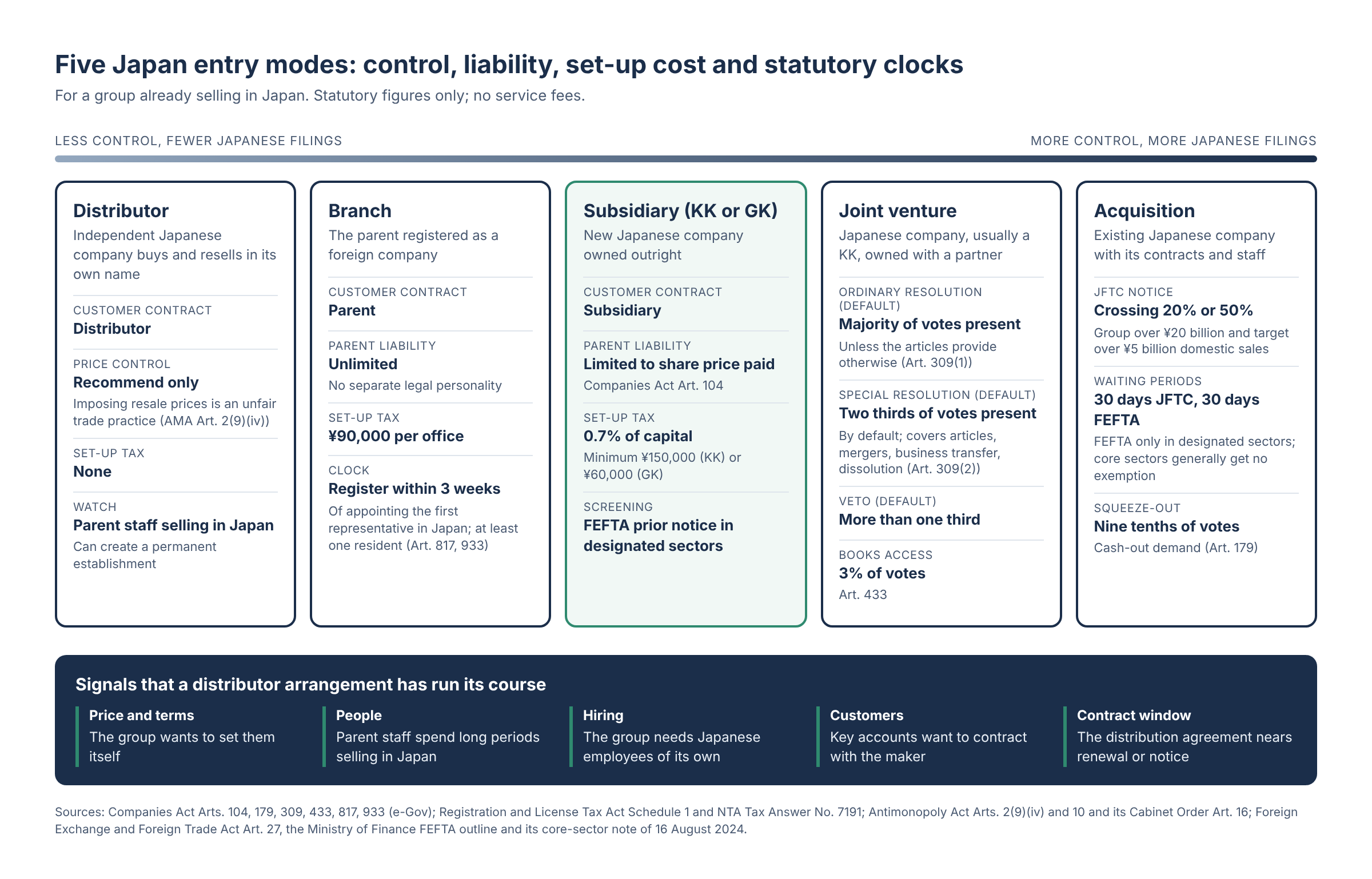
For a group testing demand, that trade is often right. The parent books export sales, the distributor carries stock, credit risk, local staff and the Japanese paperwork, and the group files nothing in Japan. Without a permanent establishment, the parent's business profit from those sales falls outside Japanese corporate tax: Corporation Tax Act Article 141 limits a foreign company without one to a short list of other Japan-source income.
The cost is control. Under Antimonopoly Act Article 2(9)(iv), supplying goods on condition that the buyer maintains a resale price set by the supplier, without a justifiable reason, is an unfair trade practice. The parent can recommend prices; it cannot impose them. Customer relationships, pricing history and service records sit with the distributor, and they leave with it.
What to read in the distribution agreement before any change
- Term, renewal and notice. The termination clause sets the earliest clean date for moving customers to the group.
- Exclusivity. An exclusive territory can bar the group from selling directly, through a branch or through a subsidiary until it ends.
- Stock and spare parts. Buy-back terms for the distributor's inventory decide what the new entity must purchase on day one.
- Customer data and contracts. Whether customer lists, open orders and service contracts can be handed over decides how fast customers can be moved.
- Trademarks and product registrations. Japan registers a trademark to the first applicant (Trademark Act Article 8), so confirm that the group, not the distributor, holds the Japanese trademark.
The risk that ends many distributor models is people. Once parent employees spend long periods in Japan negotiating or closing sales, the parent may have a permanent establishment and a Japanese tax return to file. That analysis is in the guide to permanent establishment risk before the entity exists.
Branch: the parent registered as a foreign company
A branch is not a new company: the foreign parent registers itself in Japan, trades in its own name and stays liable for every branch obligation.
Companies Act Article 817 requires a foreign company that intends to trade continuously in Japan to appoint a representative in Japan, at least one of whom must have an address in Japan. That representative has authority over all judicial and extra-judicial acts relating to the Japanese business. Article 818 bars continuous trading before the foreign company is registered, and anyone who trades in breach is jointly liable with the company for the resulting debts.
Article 933 sets the clock: the registration is due within 3 weeks of appointing the first representative in Japan, at the office location, or at the resident representative's address if there is no office.
The Registration and License Tax Act (Schedule 1, item 24) charges ¥90,000 per office, or ¥60,000 for a foreign company registering without an office or for the first office it sets up later. The registration also records the parent's governing law, its representatives in Japan and, where the parent is most similar to a KK, its method of public notice.
Tax follows the legal form. A foreign company with a permanent establishment in Japan pays corporate tax on the income attributable to it (Corporation Tax Act Articles 138 and 141), so the group must keep branch accounts that separate Japanese income from the rest of the parent's. Contracts, bank accounts and leases are all in the parent's name, and Japanese creditors can claim against the parent's assets.
One limit is easy to miss. Under Article 821, a foreign company that has its head office in Japan, or whose main purpose is to do business in Japan, may not trade continuously in Japan at all. A vehicle created only to hold the Japanese business must be a Japanese company. Moving a branch into a subsidiary later is a transfer, not a conversion, as set out in converting a Japan branch into a subsidiary.
Wholly owned subsidiary: a KK or GK of your own
A wholly owned subsidiary is a Japanese company the group owns outright, with liability limited to its subscribed capital and tax on all its income.
Companies Act Article 104 limits a shareholder's liability to the subscription price of its shares, which is the main reason groups move a growing business out of a branch.
A KK or GK comes into existence when its incorporation is registered at the head office location (Articles 49 and 579). It pays corporate tax on all of its income (Corporation Tax Act Article 5) and sends profit to the parent as dividends, which NTA Tax Answer No. 2878 lists as Japan-source income of the foreign parent. Withholding and treaty rates on those dividends are in the guide to repatriating profits from Japan.
The statutory set-up cost is small. According to NTA Tax Answer No. 7191, registration and licence tax for a KK is 0.7% of paid-in capital with a ¥150,000 minimum, and for a GK 0.7% with a ¥60,000 minimum; a KK also pays a notary fee to certify its articles. The larger costs are the ones that recur: bookkeeping, tax returns, payroll and social insurance for staff the subsidiary employs directly.
Three early decisions carry long effects:
- KK or GK. The US tax classification and the annual governance cycle differ, as compared in KK vs GK for a multinational's subsidiary.
- Capital. Under Consumption Tax Act Article 12-2, a new company with capital of ¥10 million or more is not exempt from consumption tax in the years with no base period, and a subsidiary of a large group can lose the start-up exemption anyway, as explained in the consumption tax start-up exemption for large-group subsidiaries.
- Foreign investment screening. Under the Foreign Exchange and Foreign Trade Act (FEFTA), acquiring even one share of an unlisted Japanese company is inward direct investment. In designated sectors such as semiconductors, software and cybersecurity, infrastructure and defence-related manufacturing, prior notification is filed through a resident agent before investing, according to the Ministry of Finance outline of the FEFTA regime. The outline exempts an investor that files a post-investment report instead and does not appoint itself or a closely related person to the board or access the company's non-public technology; state-owned enterprises cannot use it. In core sectors, the most sensitive designated ones, foreign investors are as a general rule not exempt for share acquisitions (Ministry of Finance, Addition to the Core Business Sectors of the FEFTA, 16 August 2024). A parent that appoints its own directors does not qualify in any sector.
The headquarters view of the full set-up sequence is in the headquarters playbook for a Japan subsidiary.
Joint venture with a Japanese partner: the voting arithmetic
A joint venture is usually a KK owned with a Japanese partner, and the voting thresholds decide what each side can do alone or block.
Groups choose a joint venture for the partner's customers, plant, workforce or standing with regulators and buyers. What the group gives up is defined in law before any agreement is signed.
By default, a KK ordinary resolution passes with a majority of votes present, with a majority of votes as quorum, unless the articles provide otherwise (Article 309(1)), and directors are elected and dismissed by ordinary resolution (Articles 339 and 341).
A special resolution needs two thirds of the votes present, with a majority of votes as quorum; the articles may lower that quorum to one third and raise the two-thirds threshold (Article 309(2)). The thresholds below are the statutory defaults, and the articles are where a joint venture negotiates them.
| Voting share in a KK | What it gives the holder | Legal basis |
|---|---|---|
| 1% of votes, or 300 votes | Right to put items on the shareholders' meeting agenda in a company with a board; the 6-month holding period does not apply in a non-public company | Companies Act Article 303(2) and (3) |
| 3% of votes | Right to inspect and copy the accounting books, stating the reason | Article 433 |
| More than one third | Veto over any special resolution, by voting against it | Article 309(2) |
| More than half | Passes ordinary resolutions and elects and dismisses directors under the default rule, subject to cumulative voting if a shareholder requests it, unless the articles exclude it; the articles can change the ordinary resolution quorum and majority | Articles 309(1), 339, 341 and 342 |
| Exactly half (50/50) | Under the default rule neither partner can pass an ordinary resolution alone: the deadlock the articles and agreement must resolve | Article 309(1) |
| Two thirds of votes present | Passes special resolutions: amending the articles, transferring all or an important part of the business, mergers and other reorganisations under Part V, dissolution, and share issues in a non-public company | Article 309(2), items (v), (xi) and (xii) |
| Nine tenths of all votes | Special controlling shareholder: may require the remaining shareholders to sell their shares | Article 179 |
| GK members (any split) | Business decisions by a majority of members unless the articles provide otherwise; amending the articles needs every member's consent unless the articles provide otherwise | Articles 590(2) and 637 |
Two consequences follow from the Article 309 defaults. At 51%, the group runs the board but still needs the partner for every special resolution unless it holds two thirds. At 50/50, nothing passes without agreement, so the shareholders' agreement must say how a deadlock ends, typically through escalation, a buy-sell mechanism or a put and call. Class shares can give one partner the right to elect a set number of directors in a non-public company (Article 108(1)(ix)).
The back office belongs in the agreement too. Settle whose accounting policies and reporting calendar the joint venture follows, which fiscal year it uses, who can see the books beyond the 3% statutory right, and how intercompany charges from either partner are approved. Approval limits and seal control work as they do in any subsidiary, described in delegation of authority and the corporate seal.
Acquiring a Japanese company: clearances and what transfers
An acquisition buys a business with its contracts, staff and history, but a large deal first needs merger control and investment screening.
Under Antimonopoly Act Article 10(2) and Cabinet Order Article 16, an acquirer must notify the Japan Fair Trade Commission in advance when its group's domestic sales exceed ¥20 billion, the target and its subsidiaries exceed ¥5 billion, and the acquirer's group voting share rises past 20% or past 50%. The acquirer may not complete the acquisition until 30 days after the notification is accepted, unless the Commission shortens the period. The thresholds are in the Antimonopoly Act on e-Gov.
FEFTA runs in parallel. Acquiring 1% or more of a listed company, or any shares of an unlisted company, is inward direct investment, and in designated sectors the investor files prior notification and may not invest for 30 days after it is accepted (FEFTA Article 27(2)), a period the ministers can shorten or extend for review.
The post-investment report exemption described in the subsidiary section can fit a minority investor that does not appoint itself or a closely related person to the board or access non-public technology, but never a state-owned enterprise, and as a general rule not a share acquisition in a core sector (Ministry of Finance, 16 August 2024). Some other investments that need no prior notification still need a report after closing (Article 55-5).
Share deal or business transfer
The structure decides what moves. In a share purchase, the target stays the employer and keeps its contracts, permits and tax history, so nothing transfers except the shares, subject to any change-of-control clauses in its contracts.
In a business transfer, each contract and asset moves individually, employees move only if each one consents (Civil Code Article 625(1)), and the seller needs a special resolution of its shareholders when it transfers all or an important part of its business (Companies Act Article 467), unless the buyer already holds nine tenths of its votes (Article 468).
After closing, a buyer below 100% can reach full ownership by a cash-out demand once it holds nine tenths of the votes (Article 179). The integration work then starts: aligning the fiscal year with the parent, moving the books onto the group close and reporting package, and taking over payroll. Those steps are covered in aligning a Japan subsidiary's fiscal year with the parent and Japan subsidiary finance for the group CFO.
Signals that it is time to move from a distributor to your own entity
The move from a distributor to an own entity is usually triggered by control, people or customers, and each signal points to a different next mode.
| Signal | Why it matters in Japan | Mode it points to |
|---|---|---|
| The group wants to set customer prices or terms | Resale prices remain the distributor's to set | Subsidiary or branch |
| Parent staff spend long periods in Japan selling or closing deals | Their activity can create a permanent establishment and a Japanese tax return | Subsidiary, so the people and the profit sit in one Japanese company |
| The group needs to hire in Japan | A Japanese employer enrols its staff in social and labour insurance and runs payroll locally | Subsidiary or branch; a subsidiary keeps employment liabilities away from the parent |
| Large customers want to contract with the manufacturer | Many buyers prefer a Japanese counterparty that invoices in yen and supports them locally | Subsidiary, or branch for a short bridge |
| The distribution agreement is approaching renewal or its notice window | Termination terms set the earliest clean date to move customers and stock | Subsidiary on the termination date |
| A distributor or competitor with plant or channels wants to sell | A share deal moves its contracts and staff without individual transfers | Acquisition, subject to JFTC and FEFTA clocks |
| A partner brings access the group cannot build | The partner's voting share decides what it can veto | Joint venture, sized around the default one-third and two-thirds thresholds |
| The trademark or product registrations sit with the distributor | Rights registered in the distributor's name stay with the distributor when the agreement ends, unless the agreement requires them to be assigned | Any mode, but recover the rights before announcing the change |
Sequence matters more than the choice. Incorporate before the distribution agreement ends, open the bank account, enrol for tax and social insurance, then move customers and stock on a fixed date, so that no customer is served by an entity that cannot yet invoice. The first-year HQ calendar for a new Japan subsidiary lists the filings that follow incorporation, and the back-office guide to Japan market entry covers what each function needs in place.
Frequently asked questions
How does branch registration in Japan work?
The parent appoints its representative in Japan and applies to the Legal Affairs Bureau for the office location. Commercial Registration Act Article 129 requires documents proving that the head office exists, the representative's authority and the parent's articles or equivalent, each certified by a home-country authority or a Japanese consul.
Is a branch a separate entity in Japan?
No. The parent is liable for damage its representative in Japan causes to third parties in performing their duties (Companies Act Article 817(4)). Limits that the parent places on its representative's authority cannot be asserted against a third party who did not know of them (Companies Act Article 817(3)).
Can a group keep its distributor and still set up a subsidiary?
Yes, if the distribution agreement allows it. An exclusive territory can stop the subsidiary from selling the same products, so one option is to give the subsidiary a different first role, such as service, marketing support or one customer segment, and take over distribution when the agreement ends.
Does a foreign parent need government approval to set up a Japan subsidiary?
Not in most sectors. Incorporating a subsidiary is inward direct investment under FEFTA, but prior notification applies only in designated sectors. There, a post-investment report replaces it only if the investor does not appoint itself or a closely related person to the board or access non-public technology, and as a general rule never for share acquisitions in core sectors (MOF), so it rarely fits a parent running its own subsidiary. Elsewhere, a later report may be required.
Working with AQ Partners. Our Tokyo team provides KK and GK incorporation, post-incorporation filings, monthly bookkeeping, annual tax filings and fractional COO support for foreign companies operating in Japan. Book a consultation to discuss your situation.

Yuga Koda is a founding Director at AQ Partners, supporting foreign companies, funds, and families operating in Japan. His experience operating companies in both Japan and international markets gives him a practical understanding of back office operations from both sides.