
Japan Subsidiary Finance for the Group CFO: Statutory Books, Group Reporting, Audit, and Controls


Japan subsidiary finance, from the group CFO's side, is the work of keeping a Japanese entity's statutory books in Japanese GAAP (J-GAAP) while delivering a monthly reporting package that fits the group's US GAAP or IFRS consolidation and close calendar. The subsidiary has two audiences at once: the Japanese tax office, which receives returns built on J-GAAP books and Japanese tax rules, and headquarters, which needs the same numbers on the group chart of accounts, on the group's policies, by the group's deadline. Most problems in a small subsidiary come from treating those as one deliverable. This guide sets out who owns each finance task, the J-GAAP adjustments a reporting package usually needs, a month-end close calendar that works in Japan, the year-end sequence, which audits apply, the controls headquarters should require, how to connect local software to the group ERP, and how to budget the entity in yen.
Key Takeaways
- Two sets of numbers, one ledger. Keep the statutory books in J-GAAP on local software and produce the group package through a mapped trial balance and a short list of recurring adjustments, rather than running two ledgers.
- Agree the policies before the first close. Depreciation, the capitalisation threshold, the consumption tax method, accruals, FX revaluation, and intercompany cut-off, agreed in writing at set-up, decide how much reconciling the group package needs each month.
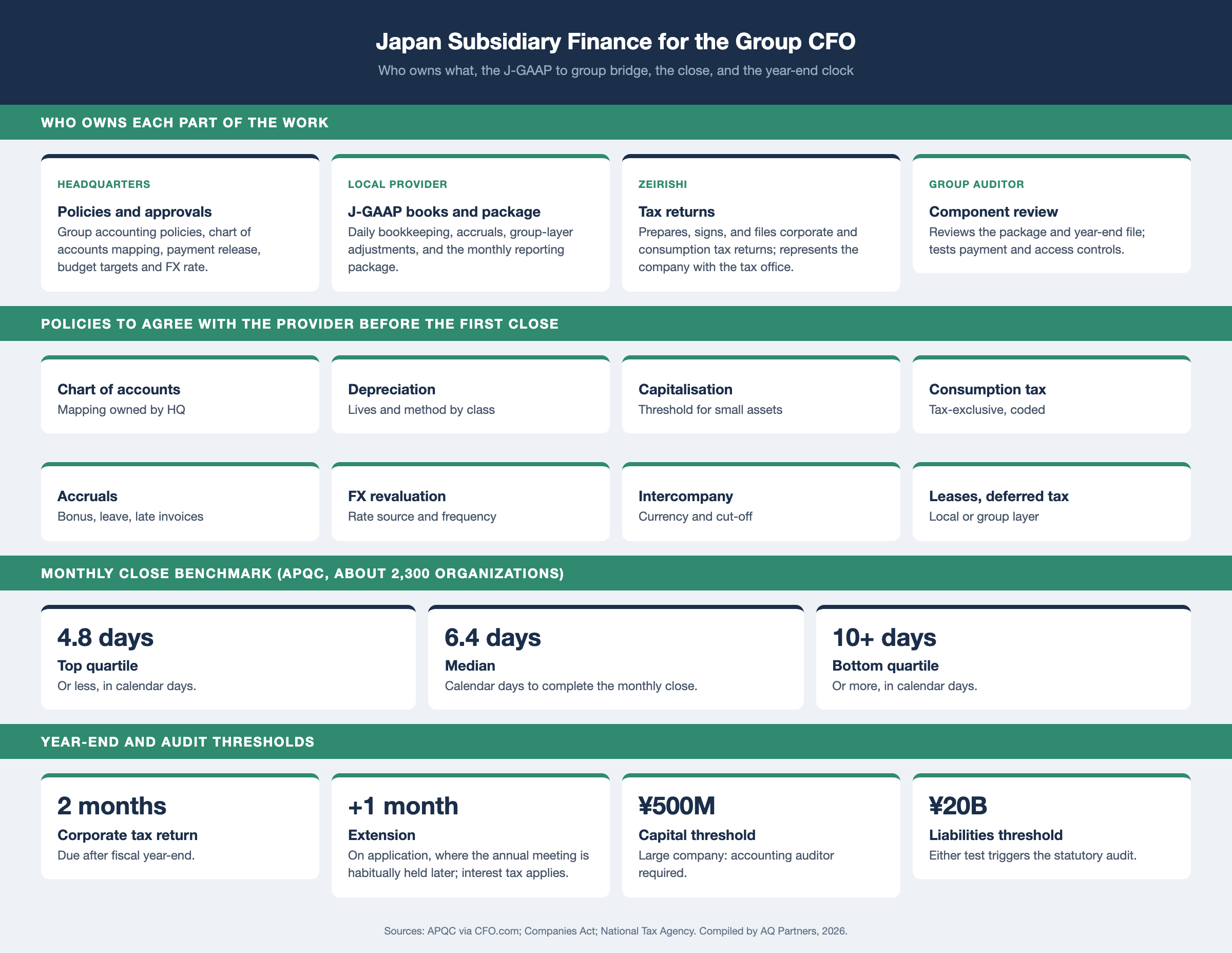
- Japanese inputs set the pace of the close. APQC benchmarks put the median monthly close at 6.4 calendar days. Japanese vendor invoices that arrive after month-end are the main local delay, and an accrual cut-off rule removes most of it.
- Year-end runs on a statutory clock. The corporate tax return is due 2 months after the fiscal year-end, extendable by 1 month, and the shareholder approval of the accounts has to fit inside that window alongside the group audit.
- A statutory audit applies only above a threshold. A company with capital of ¥500 million or more, or liabilities of ¥20 billion or more, must appoint an accounting auditor. Most subsidiaries fall below that and face only the group auditor and the tax office.
What Group Finance Owns in a Japan Subsidiary
Group finance owns policies, approvals, and the group package; the local provider and zeirishi own the statutory books, filings, and tax returns.
A subsidiary of 5 to 50 people rarely has its own finance team. The work is split between headquarters, an outsourced accounting provider, a licensed zeirishi (税理士, certified tax accountant) who signs the tax returns, and the group auditor. Confusion usually starts where those roles meet: who approves an accrual, who decides the depreciation policy, who answers the auditor's questions about a Japanese tax entry. Writing the split down once, before the first close, prevents most of it.
| Task | Headquarters | Local accounting provider | Zeirishi | Group auditor |
|---|---|---|---|---|
| Group accounting policies and chart of accounts mapping | Owns and approves | Applies and maintains the mapping | Consulted on tax effects | Reviews |
| Daily bookkeeping in J-GAAP | Read-only access | Owns | None | None |
| Accruals and cut-off | Approves material items | Prepares | None | Tests at year-end |
| Monthly group reporting package | Receives and consolidates | Prepares | None | Reviews quarterly or annually |
| Intercompany reconciliation | Owns the group side | Owns the Japan side | Consulted on withholding | Tests |
| Payment approval and release | Approves | Prepares the batch | None | Tests controls |
| Corporate tax and consumption tax returns | Approves the figures | Prepares supporting schedules | Prepares, signs, and files | Reviews the tax provision |
| Statutory financial statements and approval | Signs as shareholder | Prepares | Prepares tax-linked notes | None unless a statutory audit applies |
| Annual budget in yen | Sets targets and FX rate | Supplies statutory cost lines | Estimates tax | None |
| Tax office inquiries | Informed | Supplies records | Represents the company | Informed if material |
The zeirishi column matters because tax return preparation and tax advice are reserved for licensed tax accountants in Japan. A provider that keeps the books may not sign the return unless it is, or works with, a zeirishi. A related view of the headquarters set-up decisions is in the headquarters playbook for setting up a Japan subsidiary.
J-GAAP Statutory Books and the Group Reporting Package
A Japan subsidiary keeps J-GAAP books for tax and bridges to group GAAP through policies agreed with its provider before the first close.
Japanese GAAP is set by the Accounting Standards Board of Japan (ASBJ). The corporate tax return in Japan is built directly on the company's accounts, so a provider keeping the books of a small subsidiary will tend to make accounting choices that suit the tax return unless told otherwise. Those choices can be perfectly valid under J-GAAP and still differ from the group's US GAAP or IFRS policies. Headquarters then needs a bridge. The cleanest model keeps one ledger in J-GAAP, maps it to the group chart of accounts, and posts any group-only adjustments in a separate layer, so the statutory return and the group package always reconcile.
How large that bridge becomes depends less on the standards than on decisions made before the first close. The checklist below lists the policy decisions headquarters should agree with the provider in writing at set-up. Each one either removes a recurring group adjustment or makes it mechanical.
| Policy decision | What to agree with the provider | Why it matters for the group package |
|---|---|---|
| Chart of accounts mapping | A mapping from the local accounts to the group chart of accounts, owned by headquarters | Every monthly upload and every variance comment depends on it |
| Depreciation | Useful lives and method by asset class, and whether the local books follow group policy or tax rules | Determines whether a depreciation adjustment is needed each month |
| Capitalisation threshold | The value above which purchases are capitalised in the local books | Avoids reclassifying small assets in the group layer |
| Consumption tax method | Tax-exclusive bookkeeping, with tax codes on every transaction | Presents revenue and expenses net of indirect tax, as group reporting expects |
| Accruals | Which costs are accrued monthly, including bonuses, paid leave, and vendor costs received after month-end | Keeps monthly results comparable and avoids year-end catch-up entries |
| Foreign currency | The rate source and frequency for revaluing bank and intercompany balances | Aligns the Japan balances with the group's translation and elimination |
| Intercompany | Which charges are booked, in which currency, and the cut-off date for agreeing balances | Removes the most common consolidation reconciling item |
| Leases and deferred tax | Whether these are booked locally or only in the group layer, and who prepares the schedules | Prevents the same item being booked twice or not at all |
| Materiality and review | The threshold above which the provider explains variances, and who at headquarters reviews them | Focuses the monthly review on movements that matter to the group |
Two decisions at set-up remove most of this work later. The first is to book consumption tax on the tax-exclusive method, which matches group presentation and makes the consumption tax return easier to reconcile. The second is to align the fiscal year with the parent, so the subsidiary's statutory year and the group year are the same; the trade-offs are covered in aligning the Japan subsidiary's fiscal year with the parent. The standards-level comparison is in IFRS versus J-GAAP for global businesses in Japan, and the day-to-day bookkeeping differences are in how Japanese accounting differs from global standards.
Month-End Close for a Japan Subsidiary on the Group Calendar
A Japan subsidiary keeps pace with the group close when vendor invoice cut-off, payroll, and intercompany balances are settled before month-end.
Group close calendars are usually set by the largest entities, and a small subsidiary is expected to keep up. Benchmarks give a sense of the target. According to APQC data published by CFO.com, drawn from about 2,300 organizations, top-quartile companies complete the monthly close in 4.8 days or less, the median takes 6.4 calendar days, and the bottom quartile needs 10 or more. In a Japan subsidiary, three inputs are worth checking at set-up because they can slow the close. Some suppliers bill on a fixed closing date (締め, shime), so their invoices may arrive after month-end. The payroll date and the timing of social insurance deductions should be confirmed with the sharoushi so the employer cost is accrued in the right month. And some bank accounts may provide statements as file exports rather than live feeds. Each has a fix, and the sequence below puts them in order.
| Step | Task | Owner | Japan-specific note |
|---|---|---|---|
| 1. Before month-end | Confirm intercompany charges and balances with headquarters | Provider and headquarters | Agree the yen amount and the rate before month-end |
| 2. Before month-end | Lock payroll journal for the month | Provider | Confirm the pay date with the sharoushi; accrue employer social insurance for the month it relates to |
| 3. Before month-end | Collect known vendor costs for accrual | Provider with budget holders | Japanese vendors invoice after their month-end closing date |
| 4. After month-end | Import bank and card statements; reconcile | Provider | Request file exports where live bank feeds are unavailable |
| 5. After month-end | Post accruals, prepayments, and depreciation | Provider | Accrue rather than wait for paper invoices |
| 6. After month-end | Revalue foreign currency balances | Provider | Use the group month-end rate, not the bank's posting rate |
| 7. After month-end | Post group-layer adjustments | Provider | Only the items the agreed policies leave to the group layer |
| 8. Review | Variance review and commentary | Provider, reviewed by headquarters | Explain movements over an agreed threshold in English |
| 9. Submit | Submit reporting package and trial balance on the group calendar | Provider | Upload to the group consolidation system |
| 10. Statutory | Remit withholding tax for the prior month | Provider | Due by the 10th of the following month |
The accrual rule is the single biggest lever. Late paper invoices are booked against the accrual when they arrive, and the true-up appears in the following month's variance commentary rather than holding up the close. Intercompany differences are the second lever: management fees and recharges agreed in yen before month-end remove the most common reconciling item. The pricing and withholding mechanics of those charges are covered in intercompany management fees for a Japan subsidiary.
Year-End for a Japan Subsidiary: Tax Return, Shareholder Approval, and Group Audit
Year-end in Japan must fit the group audit, shareholder approval of the accounts, and the tax return due 2 months after year-end.
The statutory sequence for a KK runs in a fixed order. The accounts are closed and the statutory financial statements prepared; the shareholder approves them at the annual shareholders' meeting, which for a wholly owned subsidiary is usually a written resolution; and the corporate tax return, built on the approved accounts, is filed with the tax office. The return is due 2 months after the fiscal year-end. Under Article 75-2 of the Corporation Tax Act, a company whose annual meeting is habitually not held within that period, because of its articles of incorporation or an audit, can apply for a 1 month extension; the application is filed by the end of the first fiscal year it applies to. Interest tax (利子税, rishizei) is charged on tax paid during the extension, so the estimated tax is usually paid by the original due date. The National Tax Agency's corporation tax pages set out the filing and payment rules.
The practical risk is ordering. If the group auditor proposes an adjustment after the Japanese accounts are approved and the return is filed, the subsidiary either carries a permanent difference between its statutory accounts and its group numbers or files an amended return. Agreeing the audit timetable for the Japan entity at the start of the year avoids both. The written resolution, the public notice of the balance sheet, and the minutes that must be kept for 10 years are set out in the annual shareholders' meeting guide for a foreign-owned KK.
Which Audits a Japan Subsidiary Faces
Most Japan subsidiaries face the group auditor and periodic tax audits; a statutory audit applies only to large companies by capital or liabilities.
Under the Companies Act, a large company (大会社, daigaisha) is one with stated capital of ¥500 million or more, or liabilities of ¥20 billion or more, on its last balance sheet, and it must appoint an accounting auditor (会計監査人, kaikei kansanin), in practice an audit firm. Most subsidiaries of 5 to 50 people sit well below both thresholds, so no Japanese statutory audit applies. They can still choose to appoint a statutory auditor (監査役, kansayaku), whose term is 4 years, though few wholly owned subsidiaries need one. The audits they actually face are of a different kind:
- Group audit. The parent's auditor scopes the Japan entity as a component, often with limited procedures or analytical review for a small entity, and sends requests through headquarters.
- Tax audit. The tax office examines corporations periodically, with notice given in advance. Under Article 70 of the Act on General Rules for National Taxes, it can reassess for 5 years from the filing deadline, 10 years where corporate tax losses are concerned, and 7 years where tax was evaded by deception. Preparation and what to expect are covered in tax audits in Japan for foreign companies.
- Social insurance review. The pension office periodically reviews enrolment and standard remuneration records.
- Labour inspection. The Labour Standards Inspection Office can inspect working-hour records, the 36 Agreement, and wage ledgers.
For the group auditor, the most useful preparation is a year-end file that ties the statutory accounts to the group package through the same adjustment layer used each month, with the zeirishi's tax computation attached.
Internal Controls and SOX Scoping for a Small Japan Subsidiary
A small Japan subsidiary is often out of SOX scope by size, but entity-level, payment, and access controls should still meet group standards.
For US-listed groups, the Sarbanes-Oxley Section 404 scoping exercise usually excludes a small subsidiary from detailed process testing on quantitative grounds. That does not remove the control risk; it moves it to a few places where a small foreign entity is exposed. The controls that matter most are the ones an outsourced model can weaken if they are not designed in:
- Payments. The provider prepares payment batches and a named approver at headquarters releases them, with bank administrator rights held by the company rather than the provider.
- Company seal. The registered seal (実印, jitsuin) and the bank seal can authorise contracts and bank changes. A log of each use, approved in advance, is the Japanese equivalent of a signature authority matrix.
- Segregation of duties. Where one provider employee both records and pays, headquarters review of the bank reconciliation each month is the compensating control.
- System access. Headquarters holds administrator access to the accounting software and the e-filing accounts, and removes users when people change.
- Provider assurance. Larger providers can supply a SOC 1 report; smaller ones usually cannot, and a documented walkthrough by the group auditor or internal audit serves instead.
Since January 2024, electronic transaction data such as invoices and receipts received electronically must be kept in electronic form under Japan's electronic bookkeeping rules, which makes the document repository part of the control environment. The provider's storage location, retention, and search capability belong in the controls documentation.
Group ERP or Local Accounting Software for the Japan Entity
Most small Japan subsidiaries run local accounting software for statutory books and send a mapped trial balance to the group ERP each month.
Extending the group ERP to Japan sounds tidy but brings Japanese tax codes, consumption tax reporting, statutory formats, and payroll interfaces into a system rarely configured for them, and the provider has to work in a system it does not know. The bridge model avoids that. The statutory ledger runs on Japanese cloud accounting software that the provider and the zeirishi use daily and that produces Japanese tax reports natively. Each month, a trial balance mapped to the group chart of accounts is loaded into the group ERP or consolidation tool, with the group-layer adjustments posted on the group side. The mapping table is the critical document and should be owned by headquarters.
The bridge model stops working when the subsidiary needs real-time group visibility, shares a procurement or billing process with other entities, or grows past the point where a monthly upload is enough. At that point, a group ERP instance for Japan, with the local software retained for tax filings or replaced by Japanese localisation modules, becomes worth the configuration cost. Cash management across entities is a separate decision, covered in cash pooling and treasury for a Japan subsidiary.
Budgeting a Japan Subsidiary in Yen
A Japan subsidiary budget should be built in yen at a fixed group rate, with the statutory cost lines headquarters most often leaves out.
Budgets prepared at headquarters in the group currency tend to miss Japanese cost lines that do not exist elsewhere, and they mix FX movement with operating variance. Building the budget in yen and translating at a single planning rate set by group treasury keeps the two apart. The cost lines most often missing from a first-year Japan budget are:
- Employer social insurance on top of gross salary, including pension, health, nursing care for employees aged 40 to 64, employment insurance, and workers' accident insurance.
- Bonuses, which in Japan are commonly paid twice a year and carry social insurance on the bonus amount.
- Commuting allowances, which most Japanese employers pay as a matter of practice.
- Per-capita inhabitant tax, payable even in a loss year, from ¥70,000 a year in Tokyo for the smallest companies.
- Professional fees for the zeirishi, the sharoushi, registration changes, and the annual shareholder resolution.
- Office and registered address costs, including deposits that tie up cash for the length of the lease.
A detailed cost breakdown for a first-year entity is in the Japan market entry cost breakdown, and the capital, loan, and repatriation decisions that fund the budget are in funding a Japan subsidiary and getting cash out.
Frequently Asked Questions
Does a Japan subsidiary need to keep its books in J-GAAP?
Yes. The statutory financial statements and the corporate tax return are prepared under Japanese GAAP and Japanese tax rules, so the local books are kept in J-GAAP. Group reporting in US GAAP or IFRS is produced from those books through a mapped trial balance and a set of recurring adjustments, rather than through a second ledger.
Does a small Japan subsidiary need a statutory audit?
Not usually. A statutory audit by an accounting auditor is required for a large company, defined as one with capital of ¥500 million or more or liabilities of ¥20 billion or more. Most subsidiaries of 5 to 50 people are below both thresholds and are audited only as a component of the group audit, alongside periodic tax audits.
What slows the month-end close in a Japan subsidiary?
A common local delay is supplier invoices issued on a fixed closing date and received after month-end. Booking known costs as accruals, rather than waiting for paper invoices, removes most of it. Agreeing intercompany charges in yen before month-end removes the most common reconciling item. For context, APQC data puts the median close at 6.4 calendar days.
When is the Japan corporate tax return due?
The return is due 2 months after the end of the fiscal year. A company whose annual shareholders' meeting is habitually not held within that period, because of its articles or an audit, can apply for a 1 month extension by the end of the fiscal year. Interest tax is charged on tax paid during the extension, so estimated tax is normally paid by the original date.
Working with AQ Partners. Our Tokyo team provides back office operations for foreign companies operating in Japan, including accounting software setup, monthly bookkeeping and reporting, and annual tax filings. Book a consultation to discuss your Japan finance setup.

Yuga Koda is a founding Director at AQ Partners, supporting foreign companies, funds, and families operating in Japan. His experience operating companies in both Japan and international markets gives him a practical understanding of back office operations from both sides.