
How Japanese Accounting Differs from Global Standards

Key Takeaways
- Japanese fiscal year conventions affect consolidation timing for global HQs — approximately 65% of Japanese companies close on March 31, creating a 3-month gap for parent companies on a December 31 calendar year. This misalignment requires interim closing procedures or special consolidation adjustments under IFRS 10 and US GAAP ASC 810, which permit up to a 3-month reporting gap.
- Japan's chart of accounts uses mandatory categories that have no direct Western equivalent — entertainment expenses (kosai-hi), statutory welfare contributions, and director compensation each require separate tracking with specific tax treatment. Entertainment expenses are tax-deductible only up to JPY 8 million annually for SMEs, compared to full deductibility in many other jurisdictions.
- Tax-driven accounting decisions shape daily bookkeeping in Japan — the "confirmed settlement principle" (kakutei kessan shugi) requires tax returns to be based on finalized financial statements. Unlike the US or UK where tax and financial reporting operate largely independently, Japanese tax deductions for items like depreciation are only available if booked in the financial statements first.
- Revenue recognition under J-GAAP still differs from IFRS 15 in practice — while Japan's Revenue Recognition Standard (effective 2021) aligns conceptually with IFRS 15, practical application diverges in areas like construction contracts, software licensing, and multi-element arrangements. According to FSA Japan, only approximately 260 listed companies have adopted IFRS voluntarily.
- Consolidation reporting creates the most friction for foreign parent companies — differences in depreciation schedules, allowance calculations, and revenue timing between the Japan subsidiary's J-GAAP books and the parent's IFRS or US GAAP framework require systematic reconciliation every reporting period.
How Japanese Accounting Practices Differ in Daily Operations
Japanese accounting differences from global standards are not merely theoretical framework distinctions — they manifest as practical, daily operational challenges that affect how foreign companies record transactions, close their books, report to headquarters, and manage tax obligations in Japan.
Most discussions of Japanese accounting differences focus on comparing J-GAAP with IFRS or US GAAP at a standards level. That comparison matters, but it does not prepare a finance team for the day-to-day reality of operating a Japan subsidiary. The differences that consume the most time and create the most errors are operational: a chart of accounts structured around tax categories rather than management reporting, depreciation methods dictated by tax law rather than economic reality, and a fiscal year calendar that puts your Japan subsidiary out of sync with global consolidation. This post focuses on those practical impacts — the daily friction your finance team encounters.
Fiscal Year Misalignment and Consolidation Timing
The dominant March 31 fiscal year in Japan creates consolidation timing challenges for any parent company that does not share the same year-end — and the workarounds require structured interim closing procedures.
When a U.S. parent (December 31 year-end) consolidates a Japanese subsidiary (March 31 year-end), the 3-month gap requires either interim financial statements from the subsidiary or a consolidation adjustment under the applicable reporting framework. Under IFRS 10, the gap between subsidiary and parent reporting dates cannot exceed 3 months, and adjustments must be made for significant transactions occurring in the gap period. US GAAP ASC 810 contains similar provisions.
In practice, this means your Japan finance team may need to perform two closes: one at March 31 for local statutory purposes and one at December 31 for group reporting. Each close involves full reconciliation, accrual adjustments, and intercompany balance confirmation. According to PwC's Japan group taxation summary, companies that align their Japanese subsidiary's fiscal year with the parent eliminate this burden entirely — but doing so places the Japan statutory close at a non-standard time, potentially creating difficulties with local auditors and tax advisors who structure their workflows around the March cycle.
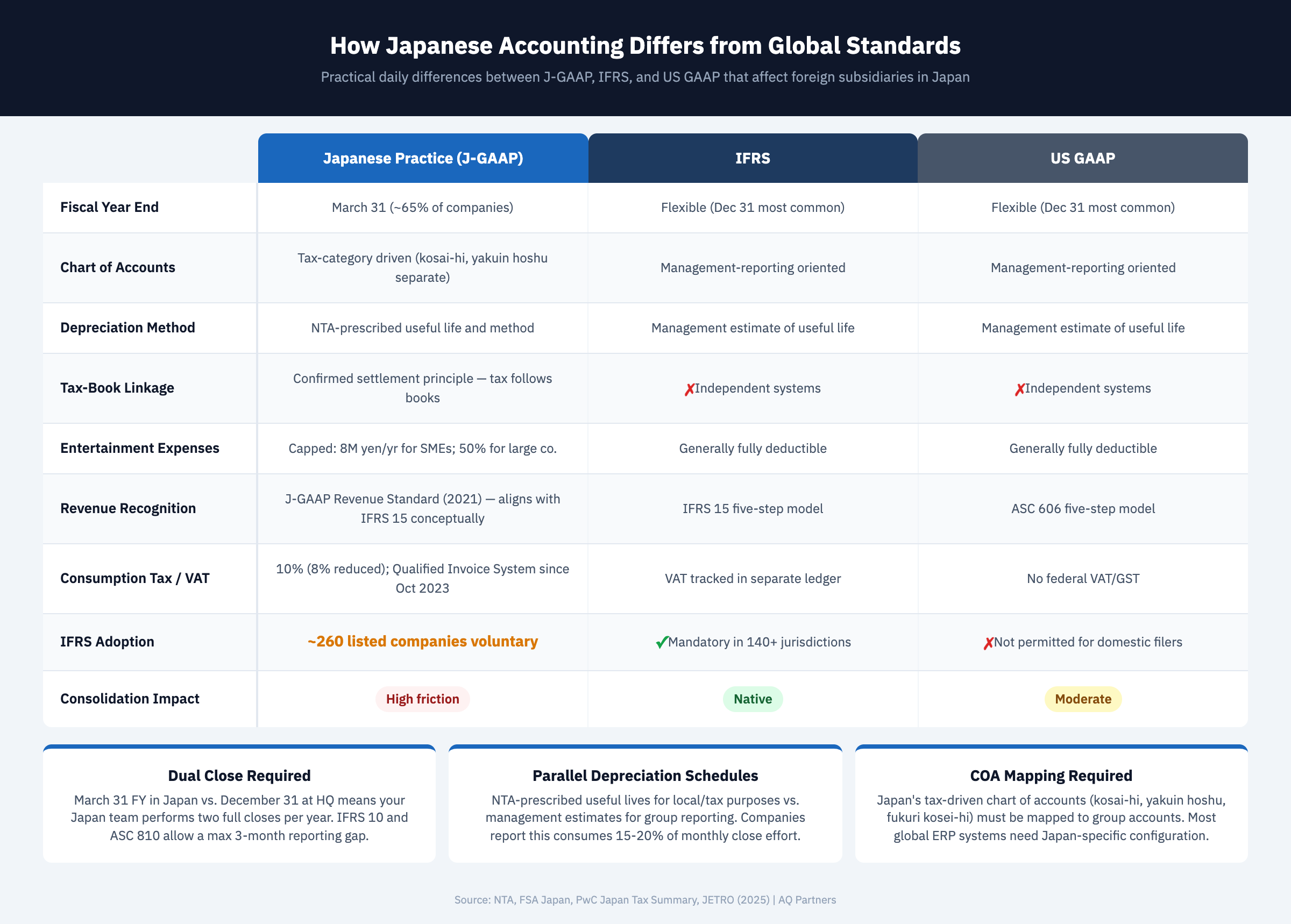
| Operational Area | Typical Global Practice | Japanese Practice | Daily Impact on Foreign Companies |
|---|---|---|---|
| Fiscal year end | December 31 (most global companies) | March 31 (~65% of companies) | Dual close required; interim statements for consolidation |
| Chart of accounts | Management-reporting oriented | Tax-category driven (kosai-hi, etc.) | Mapping table needed between Japan COA and group COA |
| Depreciation method | Management estimate of useful life | NTA-prescribed useful life and method | Parallel depreciation schedules; book-tax reconciliation |
| Entertainment expenses | Generally fully deductible | Capped at JPY 8M for SMEs; 50% above cap for large companies | Separate tracking and monthly categorization required |
| Tax-book linkage | Independent systems (US, UK) | Confirmed settlement principle — tax follows books | Must book deductions in financials to claim on tax return |
| Revenue recognition | IFRS 15 / ASC 606 principles-based | J-GAAP Revenue Recognition Standard (2021) | Timing differences in multi-element and construction contracts |
| Consumption tax | VAT/GST tracked in separate ledger | 10% (8% reduced rate); qualified invoice required since Oct 2023 | Invoice validation adds per-transaction processing step |
| Intercompany pricing | Transfer pricing documentation | Local file, master file, CbCR thresholds | JPY-denominated local file required if revenues exceed JPY 5B |
Chart of Accounts: Tax Categories Over Management Reporting
Japan's chart of accounts is structured primarily around tax compliance categories rather than management reporting needs — requiring foreign companies to maintain a mapping layer between local and group account structures.
In most Western jurisdictions, companies design their chart of accounts around operational reporting: cost centers, business units, and management categories. In Japan, the chart of accounts structure is heavily influenced by tax law requirements. Specific accounts like entertainment expenses (kosai-hi), welfare expenses (fukuri kosei-hi), and director compensation (yakuin hoshu) must be maintained as separate line items because the Corporate Tax Act applies unique deductibility rules to each.
For entertainment expenses specifically, Japan imposes strict limits: SMEs (capital of JPY 100 million or less) can deduct up to JPY 8 million per year, while larger companies can deduct only 50% of entertainment expenses exceeding that threshold. This means every business meal, client gift, and event expenditure must be individually categorized and tracked — a level of granularity that most global ERP systems do not handle natively without Japan-specific configuration.
Tax-Driven Accounting Decisions
The confirmed settlement principle forces accounting decisions in Japan to be made with tax consequences in mind — you cannot separate "what is good for the books" from "what is good for tax" the way you can in the US or UK.
In the United States or United Kingdom, financial reporting and tax reporting operate as largely independent systems. A company can use straight-line depreciation for its financial statements and accelerated depreciation for its tax return without any conflict. Japan's confirmed settlement principle (kakutei kessan shugi) works differently: to claim a tax deduction, the expense must first be recorded in the company's finalized financial statements. If you want to claim accelerated depreciation for tax purposes, you must book that same depreciation amount in your J-GAAP financial statements.
This linkage means that every significant accounting policy choice has immediate tax implications. Decisions about bad debt provisions, asset impairment, and expense timing are inherently tax-driven in Japan. For foreign parent companies reviewing their subsidiary's financial statements, this creates a situation where Japan-subsidiary financials may look different from subsidiaries in other countries — not because the economic reality differs, but because accounting policies are optimized for local tax outcomes rather than global reporting consistency.
Revenue Recognition and Reporting to HQ
Revenue recognition timing differences between J-GAAP and the parent company's framework create recurring reconciliation work that must be built into every reporting cycle.
Japan adopted its Revenue Recognition Standard in 2021, conceptually aligned with IFRS 15 and ASC 606. However, practical application still diverges in several areas. Construction contracts under J-GAAP may apply percentage-of-completion differently than IFRS 15's input/output methods. Software licensing arrangements can produce different revenue timing depending on whether the Japan subsidiary applies J-GAAP's industry-specific guidance or the parent's IFRS 15 five-step model. Multi-element arrangements — common in technology and services companies — frequently produce different allocation results.
For monthly and quarterly reporting to headquarters, these differences require a reconciliation schedule that quantifies the revenue timing difference between J-GAAP books and the group reporting framework. According to Ministry of Finance guidance, the tax treatment of revenue generally follows the financial accounting treatment under the confirmed settlement principle, which means revenue timing decisions also affect Japanese corporate tax obligations. The broader comparison between Japanese and international accounting frameworks provides additional context on how these standards-level differences translate into reporting obligations.
Consolidation Workarounds Foreign Companies Actually Use
Experienced multinational finance teams develop systematic workarounds for Japan consolidation challenges — dual chart of accounts mapping, parallel depreciation schedules, and standardized intercompany reconciliation procedures.
The most effective approach is a structured mapping table between the Japan subsidiary's chart of accounts and the parent company's group chart. This mapping should be established during initial setup and maintained as either structure evolves. Each Japan-specific account (kosai-hi, yakuin hoshu, etc.) maps to the nearest equivalent group account, with documentation explaining any differences in scope or definition.
For depreciation, companies typically maintain two depreciation schedules per asset: one following NTA-prescribed useful lives and methods for local statutory and tax purposes, and one following the parent's IFRS or US GAAP policies for group reporting. The difference between these two schedules flows through the consolidation adjustment as a deferred tax asset or liability. Companies with significant capital expenditure in Japan report that this parallel tracking consumes 15-20% of their monthly close effort, according to JETRO's business operations guide.
For intercompany transactions and transfer pricing, establishing clear documentation protocols from the outset prevents both consolidation errors and transfer pricing audit risk. Every intercompany transaction should be recorded simultaneously in both the Japan subsidiary's local books and the parent's consolidation system, with supporting documentation retained in both locations. The IFRS vs J-GAAP comparison provides a standards-level reference for the specific technical differences driving these consolidation adjustments.
Navigating the practical differences between Japanese and global accounting standards requires Japan-specific expertise combined with an understanding of international reporting frameworks. AQ Partners bridges this gap for foreign companies, handling local compliance while ensuring your Japan subsidiary's financials integrate smoothly with group reporting. Contact us to streamline your Japan accounting operations.

Yuga Koda is a founding Director at AQ Partners, supporting foreign companies, funds, and families operating in Japan. His experience operating companies in both Japan and international markets gives him a practical understanding of back office operations from both sides.