
IFRS vs J-GAAP: Strategic Impacts for Global Businesses in Japan


Key Takeaways
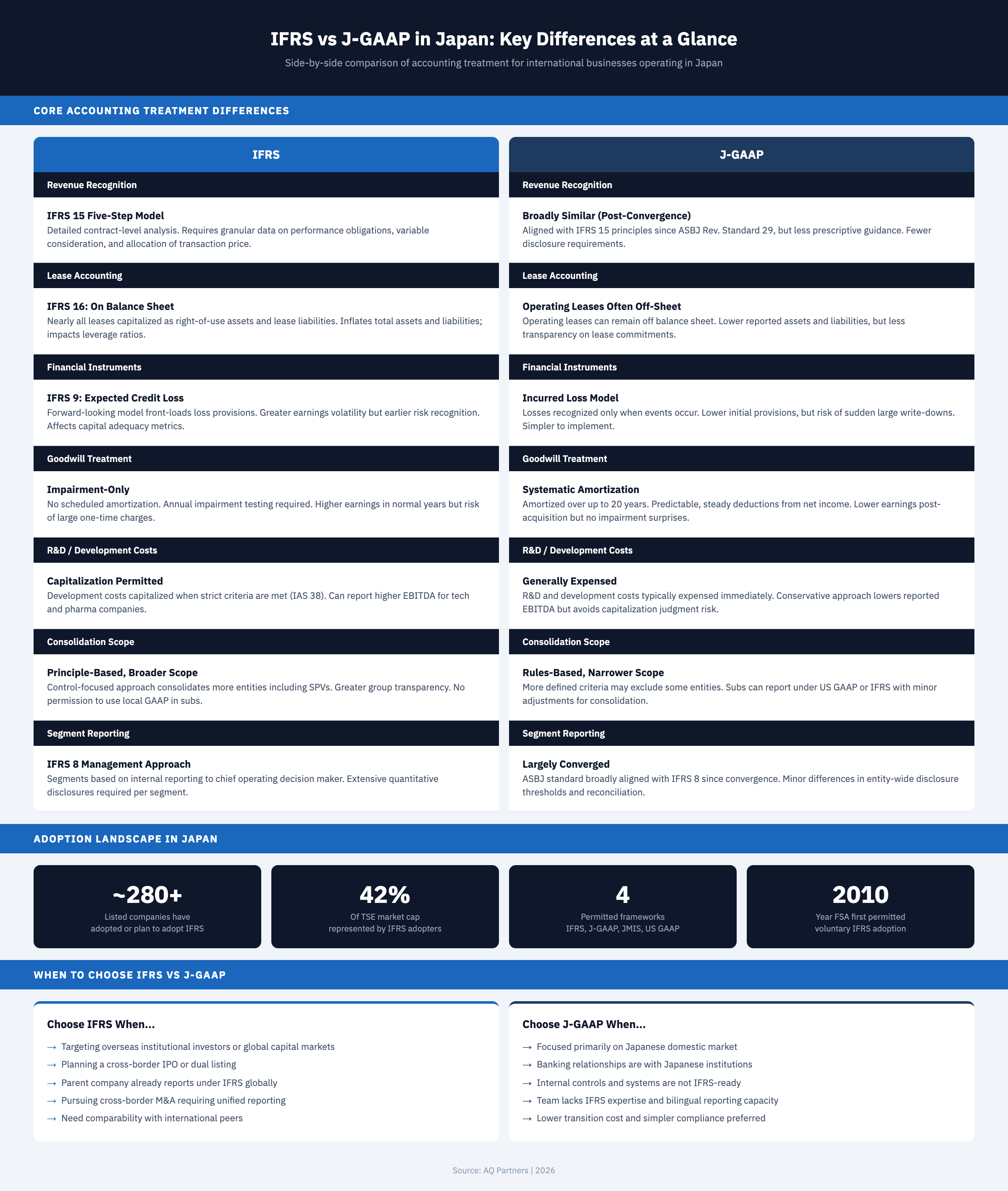
- IFRS is permitted but not required in Japan, with over 280 listed companies now reporting under IFRS — representing approximately 42% of Tokyo Stock Exchange market capitalization. The Financial Services Agency (FSA) allows voluntary adoption for consolidated financial statements, giving companies strategic flexibility in choosing their reporting framework.
- Goodwill treatment creates the most significant profit profile difference between the two standards — J-GAAP mandates systematic amortization over up to 20 years, producing predictable deductions from net income, while IFRS uses impairment-only testing that can result in higher earnings in normal years but large one-time charges when impairments occur.
- Lease accounting under IFRS 16 materially changes balance sheet presentation compared to J-GAAP — capitalizing nearly all leases as right-of-use assets and lease liabilities inflates total assets and liabilities, directly affecting leverage ratios, debt covenants, and investor perception of financial health.
- Companies targeting international capital markets or cross-border M&A should favor IFRS adoption — global institutional investors, syndicated loan providers, and eurobond issuers typically require IFRS-compliant statements, while Japanese domestic banks and local stakeholders generally accept J-GAAP financials without issue.
- Transitioning from J-GAAP to IFRS requires 6-12 months of parallel reporting, system upgrades, and governance maturity — organizations must invest in chart of accounts redesign, bilingual close processes, dual-SOX compliance, and staff training to ensure a reliable and auditable transition.
Establishing or scaling a global business in Japan hinges on key financial decisions that influence operational efficiency, compliance, and long-term growth. For international founders, startup teams, and overseas companies with limited local support, the choice between IFRS and J-GAAP extends far beyond technical accounting. It shapes access to capital, drives group-wide financial processes, and can either support or hinder your expansion objectives. Understanding the differences, decision frameworks, and downstream impacts is crucial for building a resilient, globally credible back-office foundation for Japan market entry.
IFRS vs J-GAAP Essentials That Shape Strategic Decisions
The choice between IFRS and J-GAAP determines how your Japan operations report revenue, measure assets, treat goodwill, and present consolidated results to investors and lenders worldwide.
Whether pursuing rapid growth, an IPO, or seamless cross-border M&A, your selected financial reporting standard fundamentally impacts investor perception and business outcomes. IFRS and J-GAAP are the bedrock of Japanese corporate reporting, yet their divergent approaches to recognition, measurement, goodwill, and consolidation introduce strategic differences throughout your financial statements. Business leaders must assess these distinctions to manage EBITDA, align stakeholder expectations, and ensure transparency across global operations.
According to the IFRS Foundation's jurisdiction profile for Japan, IFRS Standards are permitted but not required for domestic public companies, with over 280 listed companies now voluntarily reporting under IFRS — representing approximately 42% of Tokyo Stock Exchange market capitalization. The Accounting Standards Board of Japan (ASBJ) develops J-GAAP standards subject to FSA endorsement, maintaining Japan's unique four-framework system that also includes JMIS and US GAAP.
| Dimension | IFRS | J-GAAP | Strategic Impact |
|---|---|---|---|
| Revenue Recognition | IFRS 15 five-step model with detailed guidance | Broadly similar post-convergence, but less prescriptive | IFRS requires more granular contract-level data collection |
| Lease Accounting | Capitalize most leases on balance sheet (IFRS 16) | Operating leases often kept off balance sheet | IFRS inflates assets and liabilities; affects leverage ratios |
| Goodwill Treatment | Impairment-only (no scheduled amortization) | Systematic amortization over up to 20 years | J-GAAP shows lower steady-state net income; IFRS carries impairment risk |
| R&D / Development Costs | Capitalization permitted when criteria are met | Generally expensed immediately | IFRS may report higher EBITDA for tech-driven companies |
| Consolidation Scope | Principle-based, control-focused; broader scope | Rules-based; narrower scope | IFRS typically consolidates more entities, improving transparency |
| Financial Instruments | IFRS 9 expected credit loss model | Incurred loss model still common | IFRS front-loads loss provisions; affects capital adequacy metrics |
| Segment Reporting | IFRS 8 management approach with extensive quantitative disclosure | Largely converged with IFRS 8; minor threshold and reconciliation differences | IFRS demands more granular segment-level data for investor transparency |
| Business Combinations | Acquisition method only; remeasure previously held interests at fair value | Acquisition method adopted post-convergence; purchase method historically used | IFRS may produce larger day-one gains or losses on step acquisitions |
| SOX Compliance | Aligned with global SOX expectations | J-SOX allows more flexibility in materiality | Dual compliance requires harmonized controls and documentation |
Recognition and Measurement Differences That Impact EBITDA
For founders and CFOs weighing their options, these are the key recognition and measurement policy differences between Japanese and international accounting standards:
- IFRS requires capitalization of most leases under IFRS 16, significantly increasing recognized assets and liabilities compared to J-GAAP.
- IFRS offers more flexibility in capitalizing development costs, while J-GAAP usually requires immediate expense recognition, especially for R&D and software.
- These differences can cause substantial fluctuations in reported EBITDA, affecting financial ratios and investor perceptions.
- J-GAAP's conservative approach to expense recognition may lower EBITDA, particularly impacting technology and innovation-driven companies. Understanding how tax depreciation categories and methods work in Japan is essential when modeling these effects.
- Aligning your recognition and measurement policy with global comparability or domestic lender preferences is vital for strategic growth.
Goodwill Amortization Under J-GAAP vs Impairment-Only IFRS
Goodwill accounting sees significant policy divergence that affects reported results and performance tracking. J-GAAP mandates systematic goodwill amortization over a set period (up to twenty years), leading to regular, predictable deductions from net income. By contrast, according to KPMG, IFRS prohibits ongoing goodwill amortization and instead requires annual impairment testing, recognizing charges only when necessary.
These differing treatments result in distinct profit profiles post-acquisition. J-GAAP companies report steady goodwill amortization, enabling consistent trend analysis but typically showing lower net income than IFRS reporters. IFRS, meanwhile, often results in higher earnings unless a significant impairment charge occurs.
Consolidation Scope and Special-Purpose Entities Treatment
Your chosen consolidation model impacts transparency, risk oversight, and group governance. Deloitte explains that IFRS follows a principle-based, control-focused approach, requiring consolidation of a broader range of entities — including many special-purpose vehicles and off-balance-sheet entities — whenever effective control exists. In contrast, J-GAAP applies a more rules-based model, often resulting in a narrower consolidation scope and potentially less group-wide transparency. As KPMG notes, J-GAAP permits subsidiaries to be consolidated using financial statements prepared under US GAAP or IFRS with minor adjustments, while IFRS offers no such flexibility — requiring all subsidiaries to convert when the parent adopts IFRS.
For globally active organizations, these differences are tangible. IFRS adoption can increase the number of consolidated subsidiaries, enhancing transparency for investors and aligning disclosures with international standards. While J-GAAP's narrower scope may satisfy local stakeholders, it can prompt questions from foreign investors about the completeness of financial statements.
Choosing IFRS vs J-GAAP: A C-Suite Decision Framework
The right framework depends on your investor base, listing ambitions, financing strategy, and whether your governance infrastructure is ready for the added complexity of IFRS.
Deciding between IFRS and J-GAAP goes beyond compliance. For C-suite leaders at multinationals and high-growth startups, it is a strategic choice balancing global ambitions, investor relations, and operational practicalities. When choosing an accounting framework, executives evaluate factors such as investor profile, potential for multiple listings, access to international financing, maturity of internal controls, and alignment with long-term M&A strategies.
Aligning these elements ensures your chosen standard enables growth, transparency, and access to both Japanese and global capital markets — rather than becoming an obstacle.
Investor Base and Listing Path Scenarios in Japan and Abroad
Investor priorities play a central role in determining the appropriate accounting standard. Consider the following scenarios:
- Companies targeting overseas institutional investors or global hedge funds often opt for IFRS, which satisfies demands for financial transparency and international comparability.
- Firms seeking a cross-border IPO or dual listings typically select IFRS to simplify regulatory requirements and expand capital raising opportunities.
- Businesses focused primarily on the Japanese market and domestic investors tend to use J-GAAP to match local expectations and align with Japanese financial institutions.
- Organizations with distributed teams or limited local support find that adopting IFRS early eases compliance as they scale globally.
- Ultimately, your choice determines compliance pathways and shapes strategic access to global or domestic investor pools.
Financing Plans, Cost of Capital, and Bank Covenant Fit
The accounting standard you adopt directly affects your financing strategy, influencing the metrics used in debt covenants, credit ratings, and investor confidence. Japanese banks generally accept J-GAAP financials, while global banks, syndicated loan providers, and eurobond issuers typically require IFRS-compliant statements. Differences in EBITDA recognition, asset values, and capitalized costs between these frameworks can affect leverage ratios, interest coverage, and borrowing capacity. As highlighted by KPMG, matching your reporting to funding sources is fundamental to effective capital management, especially for companies expanding from local to international banking.
Governance Maturity, Systems Readiness, and Bilingual Close
Transitioning to IFRS requires more than a checkbox approach — it demands robust governance, mature internal controls, and advanced financial systems. IFRS introduces greater complexity in consolidation, disclosure, and measurement, requiring well-integrated data systems and often, teams experienced in bilingual reporting. Achieving a timely and accurate "bilingual close" is frequently a challenge for growing companies, especially those scaling from lean teams.
PwC notes that the transition often involves parallel J-GAAP and IFRS reporting for comparative periods to meet Japanese regulatory obligations. This necessitates system upgrades, process redesigns, and close cross-functional collaboration. For executives, assessing whether your governance and technology infrastructure is truly IFRS-ready is essential for a smooth and reliable transition.
M&A Strategy and Goodwill Policy Alignment Across the Group
For companies expanding through acquisitions, consistent policies for goodwill accounting and acquisition premiums are essential. Differences — systematic amortization under J-GAAP versus impairment-only under IFRS — can lead to inconsistencies across consolidated financials, complicating performance measurement and incentive structures. Deloitte emphasizes that aligning group-wide policies streamlines compliance, aids integration, and ensures consistent messaging to shareholders and analysts.
As businesses move from internal alignment to considering external market effects, the nuances of valuation and capital market access increasingly influence reporting standard decisions.
Operating Model for Multi-GAAP Close and Controls
Companies reporting under both frameworks need synchronized close calendars, a unified chart of accounts, and harmonized SOX documentation to maintain accuracy and audit readiness across standards.
Companies reporting under both IFRS and J-GAAP must develop a robust, unified operating model to ensure compliance, accuracy, and efficiency. Dual-GAAP complexities often arise during international expansion, post-acquisition integration, or when preparing to enter global capital markets. Clear, auditable, and repeatable processes are key to managing risk and maximizing the value of multi-standard reporting.
Parallel Close Calendars and Consolidation Workflow Design
A successful multi-GAAP consolidation workflow involves:
- Synchronizing close calendars to align IFRS and J-GAAP reporting deadlines.
- Coordinating subsidiary data collection to identify standard-specific adjustments early for timely review and approval.
- Designing workflows with thorough checks and controls, especially around key judgment areas during transition years.
- Documenting all IFRS and J-GAAP adjustments for full traceability and audit readiness.
- Embedding review points and fostering cross-functional collaboration to catch discrepancies and drive process improvement.
Chart of Accounts Redesign and Mapping Strategy
J-GAAP and IFRS demand distinct requirements, often necessitating a comprehensive overhaul of your chart of accounts management in Japan. This includes mapping J-GAAP accounts to IFRS line items, creating reconciliation templates, and implementing documentation systems to clearly track adjustments. As PwC notes, full traceability is non-negotiable — auditors will require clear trails from original transactions to consolidated statements under both standards.
This often results in a more granular COA, with new sub-accounts for IFRS-specific items like lease liabilities or capitalized development costs. Many companies employ parallel ledgers or ERP tagging functions to facilitate streamlined reporting and prevent double-booking. An effective COA redesign improves compliance, simplifies auditing, enables real-time analytics, and sets the stage for future growth.
Revenue, Leases, and Financial Instruments Data Models
IFRS's advanced requirements for revenue, leases, and financial instruments prompt enhancements to data collection and reporting models. As the RSM Japan IFRS vs J-GAAP guide explains, IFRS extensively adopts fair value measurement while J-GAAP primarily adheres to historical cost principles, creating fundamental differences in how revenue streams, lease portfolios, and complex financial instruments are valued and reported. These changes place new demands on data gathering, verification, and disclosure practices.
Leading organizations invest in upgraded systems, improved data quality, and targeted staff training to meet these challenges. A strong data architecture ensures revenue streams, lease portfolios, and complex financial instruments are accurately reported under both standards, reducing misstatement risk and enhancing stakeholder communication.
J-SOX vs SOX Materiality, Controls, and Documentation
Maintaining compliance with both Japanese and global SOX regulations involves managing two separate control environments. Japanese SOX (J-SOX), based on US SOX, offers greater flexibility in materiality settings and documentation, with a risk-based focus on financial reporting, as stated by the Financial Services Agency (FSA). Transitioning from J-GAAP to IFRS may require companies to redesign internal controls to address additional disclosures and IFRS-specific requirements.
Global groups seeking to harmonize compliance often align documentation and control processes to satisfy both J-SOX and US SOX. This could include comprehensive audit logs, standardized risk assessment templates, and structured documentation to ensure no internal control gaps. According to Deloitte, this integrated approach not only streamlines compliance but also establishes a strong governance foundation as regulatory expectations continue to evolve in Japan and globally.
Tax, First-Time Adoption, and Regulatory Landscape in Japan
Switching standards triggers deferred tax recalculations, Pillar Two modeling changes, and a phased adoption timeline that typically spans 90 to 365 days depending on organizational readiness.
Switching between IFRS and J-GAAP involves more than accounting — it is a multidisciplinary challenge involving tax planning, tax filing and corporate compliance in Japan, and effective project management. As Japanese and international authorities implement new regulations and minimum tax regimes, companies must update their policies and systems proactively to remain compliant, reduce risk, and capitalize on opportunities.
Deferred Tax from Goodwill, Impairments, and Asset Groups
When managing deferred tax under IFRS and J-GAAP, companies must consider:
- J-GAAP's systematic goodwill amortization produces predictable deferred tax effects, aiding cash flow management and forecasting.
- IFRS's impairment-based approach alters the timing of deferred tax recognition, often leading to larger, less predictable effects during impairments or business combinations.
- These differences can impact consolidated tax provisions and complicate management of the group's corporate income tax rate in Japan.
- Careful modeling is necessary, as volatility in deferred tax balances may disrupt internal forecasts and investor communications.
- Early analysis and planning are essential to avoid transition surprises and support your overall objectives.
Pillar Two, BEPS, and Minimum Tax Modeling for Multinationals
Global minimum tax rules — especially the OECD's BEPS Pillar Two, now enforced in Japan — raise the bar for multinational tax compliance. Both IFRS and J-GAAP figures are used in Pillar Two calculations, affecting effective tax rates, GloBE income, and domestic minimum tax obligations, according to the OECD.
To manage these challenges, leading multinationals invest in tax technology upgrades, strengthen cross-border teams, and update internal policy guides. Deloitte recommends integrating Japanese statutory, local GAAP, and IFRS treatments into tax models to ensure compliance and minimize tax leakage at every reporting cycle.
90/180/365-Day Plan for First-Time Adoption and Resourcing
First-time IFRS adoption typically occurs in phases over three to twelve months, based on company readiness. The initial 90 days are dedicated to gap analysis, benchmarking, and forming a cross-functional leadership group. The next 180 days focus on policy harmonization, parallel reporting, system changes, and staff training. PwC highlights that the final period involves full system integration, multiple dual-close rehearsals, and formal internal and external IFRS reporting. Sufficient financial and personnel resources are vital, as underestimating the effort can lead to delays and compliance risks. Successful companies assign clear project leaders and maintain agile, transparent governance.
FSA and ASBJ Milestones Plus ISSB Integration Timeline
Japan's Financial Services Agency (FSA) and Accounting Standards Board of Japan (ASBJ) guide the IFRS adoption roadmap. Continual updates to accepted frameworks, dual-reporting provisions, and efforts to align with international initiatives — such as the ISSB's sustainability standards — define the regulatory landscape. The integration of ISSB sustainability standards into Japanese reporting begins in 2024, illustrating Japan's commitment to transparency and international best practice, as outlined by both ASBJ and the FSA.
To stay ahead, companies should maintain close contact with auditors, regulators, and international advisors to anticipate regulatory changes, manage risks, and capitalize on new compliance opportunities as they arise. Organizations that proactively address these evolving requirements — including staying current with the Japan tax filing schedule and important dates — often secure early advantages in both capital markets and stakeholder perceptions.
Conclusion
Selecting between IFRS and J-GAAP is a critical, multifaceted decision for international businesses entering Japan, with lasting impacts on accounting, tax, governance, and capital market outcomes. From goodwill treatment and EBITDA recognition to the complexities of BEPS Pillar Two, each standard shapes your company's financial profile and risk exposure.
Forward-thinking executives take a comprehensive approach, aligning investor expectations, internal controls, technological capacity, and regulatory timelines to create an efficient, scalable, and compliant back office. Getting the right entity structuring strategy for Japan entry is a foundational step in this process.
With the latest insights from Deloitte, KPMG, PwC, EY, FSA, and ASBJ, leadership teams can navigate the technical and strategic complexities of Japan's reporting environment with confidence. Through early planning, advanced systems, and ongoing stakeholder engagement, overseas founders and startup teams can remain focused on core business, confident that their Japanese operations are both resilient and globally recognized.
Working with AQ Partners. Our Tokyo team provides monthly bookkeeping and accounting software setup for foreign companies operating in Japan. Book a consultation to discuss your situation.

Yuga Koda is a founding Director at AQ Partners, supporting foreign companies, funds, and families operating in Japan. His experience operating companies in both Japan and international markets gives him a practical understanding of back office operations from both sides.