
Japan Market Entry: Back Office Considerations for Companies Entering Japan


Key Takeaways
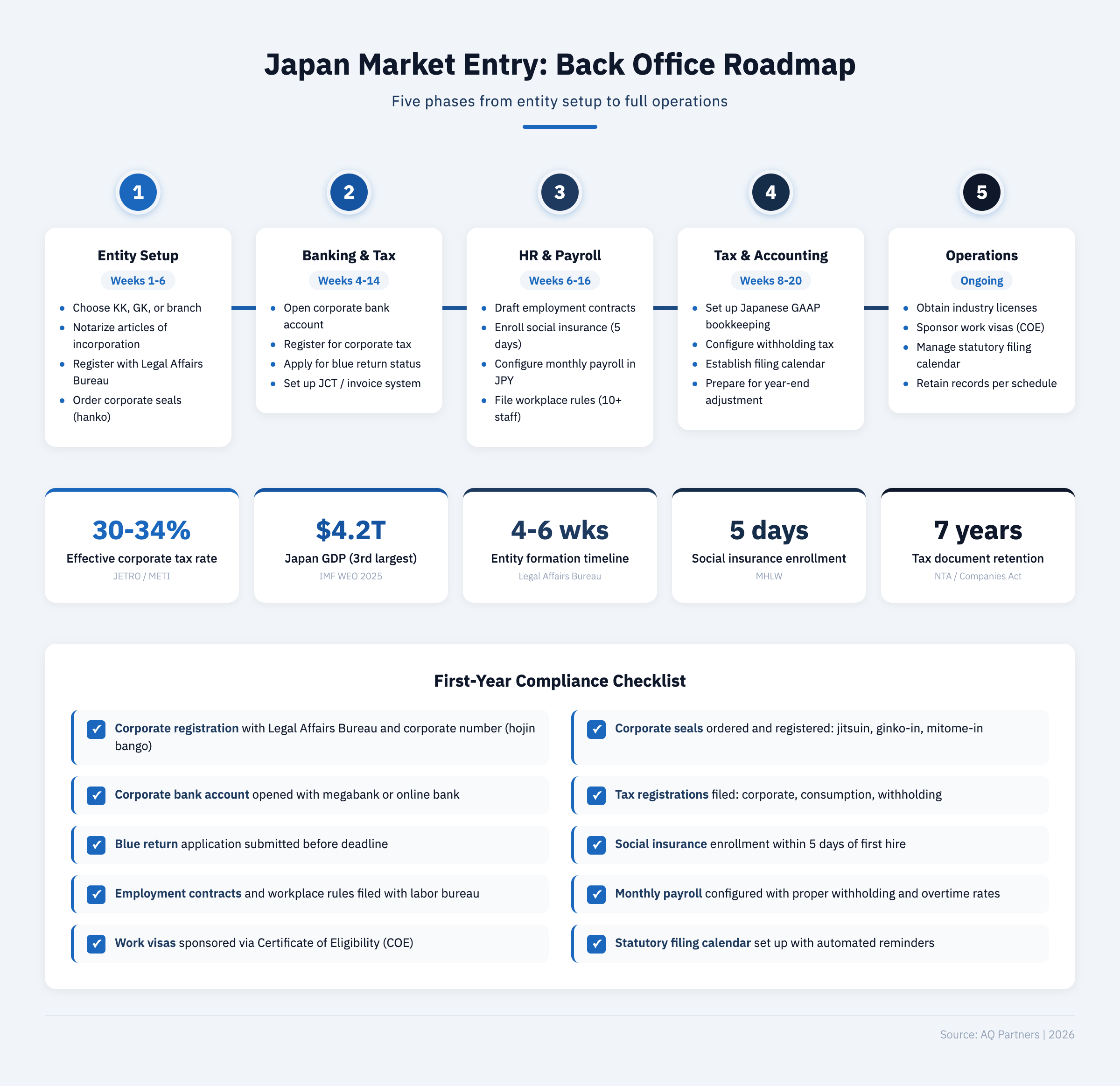
- Back office infrastructure determines whether Japan expansion succeeds or stalls. Companies that build compliant operations from day one avoid the costly delays, penalties, and heightened regulatory scrutiny that derail unprepared foreign entrants.
- Entity formation takes 4-6 weeks and shapes every downstream obligation. Your choice between kabushiki kaisha (KK), godo kaisha (GK), or branch office affects tax treatment, banking access, liability exposure, and market perception among Japanese partners.
- Japan's combined effective corporate tax rate of 30-34% requires precise, bilingual compliance. National corporate tax (23.2%), local enterprise tax, inhabitants tax, and the upcoming defense surtax (April 2026) demand accurate filings within two months of fiscal year-end or face penalties and interest.
- Social insurance enrollment within five days of hiring is non-negotiable. Pension (9.15% each for employer and employee), health insurance (9-10%), employment insurance (1.35%), and workers' compensation must all be administered correctly to attract talent and avoid back-payment penalties.
- Opening a corporate bank account is the single biggest bottleneck for foreign companies. Japanese banks require extensive documentation, multiple in-person meetings, and weeks to months of due diligence, making early preparation and parallel applications essential for maintaining your launch timeline.
Entering the Japanese market offers tremendous opportunities, but success requires more than a compelling product or go-to-market strategy. The back office infrastructure -- often overlooked in favor of sales and marketing initiatives -- frequently determines whether a Japan expansion thrives or stalls.
Japan's business environment operates under distinct administrative, legal, and regulatory frameworks. From corporate seal requirements to multilayered social insurance systems, the operational considerations differ substantially from Western markets. Companies that underestimate these requirements often face costly delays, compliance penalties, and operational disruptions that undermine their market entry.
This guide provides an overview of the essential back office elements for establishing and operating a compliant business in Japan. Understanding these foundational requirements helps you build efficient operations from day one and avoid the common pitfalls that derail unprepared companies. According to the Japan External Trade Organization (JETRO), Japan attracted over 688,000 foreign-affiliated companies and branch offices as of 2024, underscoring the scale of opportunity -- and the administrative complexity that comes with it.
Why Back Office Infrastructure Matters for Japan Market Entry
In Japan, back office infrastructure is not just about efficiency -- it is about compliance, credibility, and capability, and deficiencies in any of these areas can delay or derail your entire market entry.
Japan's regulatory environment demands precision and adherence to established processes. Tax authorities, labor bureaus, and immigration offices expect timely, accurate filings in specific formats. Missing deadlines or submitting incomplete documentation triggers penalties, delays, and heightened scrutiny that can persist for years.
Beyond compliance, proper back office systems directly impact your ability to attract and retain talent. Japan's social insurance and employment systems provide substantial protections and benefits that employees expect their employers to administer competently. Companies struggling with payroll accuracy, tax withholding, or insurance enrollment will find recruiting and retention significantly more difficult. For a deeper look at navigating labor requirements, see our guide on Japan HR compliance strategies for global teams.
The back office also affects your business relationships. Japanese partners and customers often view administrative competence as a proxy for overall business reliability. A company that cannot manage basic compliance obligations raises questions about its commitment to the market and its ability to deliver on larger promises.
Finally, many back office elements are interconnected. Your legal entity type affects tax obligations. Employment contracts influence social insurance requirements. Your corporate bank account is necessary for tax payments and payroll processing. Addressing these systematically, rather than reactively, creates a more robust foundation.
Foreign companies consistently encounter several challenges that can impede their Japan market entry if not properly anticipated and addressed.
Language and documentation barriers create immediate friction. Most government forms, tax documents, and official correspondence are in Japanese. While some agencies offer limited English support, the expectation is that businesses communicate and submit documentation in Japanese. Companies without Japanese-speaking staff or professional support find themselves unable to complete even basic administrative tasks.
Banking relationship hurdles frustrate nearly every foreign entrant. Opening a corporate bank account in Japan is notoriously difficult. Banks conduct extensive due diligence, require substantial documentation, and often insist on multiple in-person meetings. The process can take weeks or months, delaying your ability to process payroll, pay vendors, or conduct basic operations.
Complex social insurance systems involve multiple programs with different enrollment processes, contribution calculations, and reporting requirements. Companies must navigate health insurance, pension insurance, employment insurance, and workers' compensation insurance -- each administered by different agencies with specific rules and deadlines.
Rigid compliance expectations mean there is limited tolerance for learning as you go. Japanese authorities expect strict adherence to rules and deadlines from the outset. Missing a tax filing or incorrectly calculating withholding tax results in penalties and increased scrutiny that can follow your company for years.
Unfamiliar business practices like corporate seals (hanko), paper-based processes, and specific document formats may seem antiquated but remain standard practice. Companies must adapt to local expectations rather than expecting Japan to accommodate foreign preferences.
Legal Entity Formation and Corporate Registration
Establishing a legal presence in Japan begins with selecting the appropriate entity structure and completing corporate registration -- a foundational decision that impacts your tax obligations, liability exposure, operational flexibility, and market credibility.
Choosing the Right Legal Structure
Foreign companies entering Japan typically choose between three main structures: kabushiki kaisha (KK), godo kaisha (GK), or branch office.
A kabushiki kaisha is a stock company similar to a corporation in Western markets. It is the most common choice for companies planning substantial, long-term operations in Japan. A KK can issue shares, has clear governance with directors and shareholders, and carries more prestige in the Japanese business community.
A godo kaisha is a limited liability company offering operational flexibility and simpler governance. GKs have become popular with foreign companies, particularly for smaller operations or market testing. Formation costs are lower, and ongoing administrative requirements are slightly less complex. However, some Japanese partners may perceive GKs as less established.
A branch office extends your foreign parent company into Japan without creating a separate legal entity. This structure is simpler to establish and may suit companies conducting limited activities. However, the parent company remains fully liable for the branch's obligations, presenting greater risk.
Your choice should consider the scale of planned operations, liability concerns, tax implications, how you want to be perceived by Japanese stakeholders, and your long-term market commitment.
Corporate Registration Process
Registration involves several sequential steps that typically take four to six weeks when handled efficiently.
First, determine your company name and confirm availability. Companies need both Japanese and romanized versions, including the appropriate designation (KK, GK, or Branch).
Next, prepare articles of incorporation (teikan), which must be notarized by a Japanese notary. This requires appearing in person or appointing a representative with power of attorney.
You will deposit capital into a representative's personal bank account (before formal registration), then transfer funds to your corporate account once opened after registration.
The registration application is filed with the Legal Affairs Bureau (homukyoku) in your jurisdiction, including notarized articles, proof of capital deposit, director appointment documents, and various forms. Processing takes one to two weeks.
Upon approval, you receive a certificate of registration and a corporate number (hojin bango), which is a 13-digit identifier used across administrative processes.
Corporate Seal (Hanko) and Registered Office
Corporate seals surprise many foreign companies but remain critical in Japanese business operations. Unlike Western reliance on signatures, Japan uses seal impressions to authenticate documents.
Your company needs several seals. The jitsuin (registered seal) is registered with the Legal Affairs Bureau and used for legally binding transactions like contracts, real estate purchases, and bank account openings. The ginko-in (bank seal) is used specifically for banking transactions. The mitome-in (general use seal) handles routine business and internal documents.
Physical seal management is crucial. Seals should be stored securely with access limited to authorized personnel. If lost or stolen, immediate notification and re-registration are necessary. While Japan is gradually adopting digital signatures for some processes, physical seals remain standard practice.
Your registered office is the official address for receiving legal notices and government correspondence. This public information appears on your corporate registration and must be a physical Japanese location. Options include leasing dedicated office space, virtual office services, or serviced offices and coworking spaces. Consider proximity to government offices, accessibility for staff, how the address reflects on your image, and whether the location permits your planned activities.
Tax Structure, Compliance, and Accounting
Japan's tax system is comprehensive and strictly enforced, with a combined effective corporate tax rate of 30-34% in major cities and multiple filing obligations that demand bilingual precision and careful deadline management.
Corporate Tax and the Blue Return System
Japan imposes corporate tax at national and local levels. The national rate is approximately 23.2%, with additional local taxes including local corporate tax, enterprise tax, and municipal inhabitants tax. According to JETRO's tax overview, the combined effective rate in major cities typically falls between 30-31%. Note that a special defense surtax of 4% on corporate income tax will be effective from April 1, 2026, increasing the effective tax rate by approximately 0.9 percentage points.
Tax is calculated on fiscal year profits. Companies choose their fiscal year-end, though many align with Japan's traditional fiscal year (April 1 to March 31) or calendar year. Returns must be filed within two months of fiscal year-end (with possible one-month extension). This is a hard deadline -- late filing triggers penalties and interest.
Japan's blue return system allows companies to carry forward losses for up to 10 years among other benefits. To qualify, maintain proper accounting records and submit required notifications before deadlines.
Consumption Tax and Withholding Obligations
Japan's consumption tax is a value-added tax at a standard rate of 10%, with a reduced 8% rate for certain food items and newspapers. New companies are typically exempt for their first two fiscal years if capital is below 10 million yen. Since October 2023, Japan's qualified invoice system (QIS) requires registered entities to issue proper invoices for purchasers to claim input tax credits.
As an employer, you must withhold income tax from employee salaries based on expected annual income, dependents, and other factors. Withheld amounts must be remitted by the 10th of the following month (or semi-annually for companies with fewer than 10 employees who obtain approval). Withholding also applies to payments to non-residents, interest and dividends, and intellectual property payments. Rates vary by payment type and recipient status, though tax treaties may reduce rates.
The National Tax Agency enforces strict tax filing deadlines and schedules requiring careful planning. Corporate tax returns are due two months after fiscal year-end. Consumption tax follows similar timing. Withholding tax payments are due monthly. Year-end adjustment must be completed by January 31.
Accounting Standards: Japanese GAAP vs IFRS
Companies must maintain records according to accepted standards -- primarily Japanese GAAP or IFRS. Japanese GAAP is used by most small and medium-sized companies, and tax filings are based on Japanese GAAP statements. IFRS is permitted for certain companies, particularly large publicly-traded firms or those with significant international operations. For most foreign subsidiaries, the practical approach is maintaining books under Japanese GAAP for local compliance, then consolidating into parent company statements using whatever standards the parent follows.
Payroll, Social Insurance, and HR Administration
Managing payroll and social insurance in Japan involves navigating multiple interconnected systems -- pension, health, employment, and workers' compensation insurance -- each with specific enrollment deadlines, contribution splits, and reporting requirements that must be addressed within five days of hiring.
Social Insurance Enrollment and Contributions
When hiring employees, you must enroll in mandatory social insurance programs within five days as required by the Ministry of Health, Labour and Welfare. This applies to regular employees and part-time employees meeting certain hour thresholds.
The Employees' Pension Insurance, administered by the Japan Pension Service, covers both the National Pension base layer and employee pension layer. Contributions split equally between employer and employee at approximately 9.15% each of standard monthly remuneration. Health insurance contributions are similarly split, typically ranging from 9-10% of standard monthly remuneration depending on your health insurance association.
Employment insurance provides unemployment benefits and employment stability programs. The premium rate is approximately 1.35% of total salary, split between employer (0.85%) and employee (0.50%) as of April 2026. Report hires, terminations, and changes to Hello Work. When employees leave, provide a separation certificate they will use to claim unemployment benefits if eligible.
Non-compliance results in penalties, back-payment requirements, and recruitment difficulties, as Japanese employees expect proper social insurance administration.
Payroll Processing and Year-End Adjustment
Japanese payroll includes base salary, overtime pay (at rates of 125% regular, 135% late-night, 150% holiday), commuting allowance, and other allowances. Deductions include income tax withholding, employee social insurance premiums, and residence tax (from the second year). Salary must be paid in yen, typically through bank transfer on your designated monthly payment date.
Year-end adjustment (nenmatsu chosei) reconciles each employee's income tax liability based on actual annual income and deductions, then adjusts for over- or under-withholding. In November, distribute forms to employees for information on dependents, insurance premiums, and deductions. Complete the process by January 31, then submit withholding tax reports to the tax office.
Maintain payroll records for seven years after employee departure, including pay statements, time cards, and employment contracts. For key dates and deadlines, see our Japan tax filing schedule and important dates reference.
Banking, Financial Operations, and Regulatory Compliance
Establishing banking relationships and meeting regulatory requirements are among the most challenging aspects of Japan market entry for foreign companies, with corporate bank account opening alone taking two to eight weeks and requiring extensive documentation, in-person meetings, and professional introductions.
Opening a Corporate Bank Account
Opening a corporate account often frustrates foreign companies most. Japanese banks conduct extensive due diligence requiring substantial documentation: corporate registration certificate (issued within three months), articles of incorporation, corporate seal certificate, director identification, business plan, registered office proof, company introduction materials, and sometimes letters of introduction.
Megabanks offer extensive networks but have the strictest requirements, while online banks have simpler processes but potential service limitations. Most banks require in-person meetings. The approval process takes weeks to months, with detailed questions about your business model, customers, transaction volumes, and fund sources.
Improve success by establishing your registered office before applying, preparing detailed business documentation in Japanese, securing professional introductions, and being patient and responsive. Consider applying to multiple banks for backup options.
Payment Systems and Invoice Management
Payment terms of 30-60 days after month-end are standard in Japan, with bank transfer dominating B2B transactions. Since October 2023, the qualified invoice system requires proper invoicing for input tax credits. Qualified invoices must include company name and registration number, transaction date, description, total amount including tax, tax breakdowns, and counterparty name. Many companies still use paper invoices despite growing electronic adoption.
Immigration, Licensing, and Labor Compliance
Foreign employees must hold appropriate work visas. Common categories include engineer/specialist in humanities/international services, highly skilled professional, intra-company transferee, and business manager. As an employer, you typically initiate the process by applying for a Certificate of Eligibility (COE) on the employee's behalf.
Depending on your activities, you may need industry-specific licenses or permits before operations. Regulated industries include restaurants, construction, secondhand goods, employment agencies, real estate, financial services, pharmaceuticals, telecommunications, and travel agencies. Operating without required licenses triggers cease-and-desist orders, fines, and potential criminal penalties.
Companies with employees must fulfill reporting obligations to labor standards inspection offices. Workplace rules (required for companies with 10 or more employees) must be filed with the labor bureau and made available to employees. Labor standards inspection offices conduct inspections, often unannounced, reviewing records and compliance with labor standards.
Ongoing Administration and Compliance Calendar
Operating in Japan requires continuous attention to statutory filings, document retention schedules, and corporate governance obligations -- with deadlines spanning monthly, quarterly, and annual cycles that must be tracked systematically to maintain good standing.
Document Retention and Record-Keeping
Japanese law requires retaining documents for specified periods. Tax-related documents (accounting books, financial statements, tax returns, invoices, bank statements, contracts) must be kept for seven years. Employment records have varying requirements: employee rosters and contracts (three years from termination), wage ledgers (five years), time cards (five years), accident reports (three years). Corporate governance documents like articles of incorporation, meeting minutes, and shareholder registers must be maintained permanently or 10 or more years.
Japan increasingly accepts electronic record-keeping if you comply with requirements including system documentation, alteration prevention, and immediate production capability.
Statutory Filing Calendar and Corporate Governance
Managing Japanese requirements requires tracking numerous deadlines. Monthly: withholding tax payment (10th of following month). Quarterly: consumption tax for quarterly filers. Annually: corporate tax returns (two months after fiscal year-end), consumption tax for annual filers, local tax filings, year-end adjustment (January 31), withholding tax summaries (January 31), social insurance periodic reporting (July), labor insurance reporting (June-July).
Stock companies must hold ordinary general meetings of shareholders at least annually, typically within three months of fiscal year-end. Board of directors meetings should occur regularly -- quarterly is common. All meetings require proper notice, minutes documenting discussions and decisions, appropriate signatures and seals, and retention in corporate record books.
Set up automated reminders, work with professionals who track deadlines, and maintain shared compliance calendars to ensure timely completion.
Reference Tables: Setup Requirements and Cost Benchmarks
Key Back-Office Setup Requirements at a Glance
| Back-Office Area | Key Requirements | Typical Timeline | Critical Considerations |
|---|---|---|---|
| Legal Entity Formation | Choose entity type (KK, GK, or branch), notarize articles of incorporation, register with Legal Affairs Bureau | 4-6 weeks | Entity type affects tax obligations, liability, and market perception; corporate seals (hanko) must be ordered and registered |
| Corporate Banking | Open corporate bank account with extensive documentation and in-person meetings | 2-8 weeks after registration | Apply to multiple banks; megabanks have stricter requirements but broader services; account needed before payroll can begin |
| Tax Registration | Register for corporate tax, consumption tax (if applicable), and withholding tax; select fiscal year-end | Within 2 months of incorporation | Blue return filing unlocks loss carry-forward benefits; qualified invoice system (QIS) registration required for consumption tax credits |
| Accounting and Bookkeeping | Maintain records under Japanese GAAP (or IFRS if eligible); retain documents for 7 years | From day one | Tax filings are based on Japanese GAAP regardless of parent company standards; bilingual record-keeping recommended |
| Payroll Setup | Configure monthly payroll in JPY with proper withholding, overtime calculations, and pay statement issuance | Before first employee start date | Overtime rates of 125-150% are mandatory; year-end tax adjustment (nenmatsu chosei) due by January 31 each year |
| Social Insurance | Enroll in pension, health, employment, and workers' compensation insurance within 5 days of hiring | Immediate upon hiring | Contributions are split between employer and employee; non-enrollment triggers penalties and harms recruitment |
| HR and Labor Compliance | Draft compliant employment contracts, file workplace rules (10+ employees), maintain labor records | Before first hire | Labor inspections can be unannounced; records must be retained 3-5 years; work visa sponsorship required for foreign staff |
| Regulatory Licensing | Obtain industry-specific licenses or permits before commencing regulated activities | Varies (weeks to months) | Operating without required licenses results in cease-and-desist orders, fines, or criminal penalties |
Annual Compliance Cost Benchmarks by Company Size
| Cost Category | Small (1-10 employees) | Mid-size (11-50 employees) | Large (51+ employees) | Notes |
|---|---|---|---|---|
| Tax advisory and filing | 500,000-1,200,000 yen/yr | 1,200,000-3,000,000 yen/yr | 3,000,000-8,000,000+ yen/yr | Includes corporate, consumption, and withholding tax compliance |
| Payroll processing (outsourced) | 300,000-600,000 yen/yr | 600,000-1,800,000 yen/yr | 1,800,000-5,000,000+ yen/yr | Monthly processing, year-end adjustment, and reporting |
| Social insurance administration | 200,000-400,000 yen/yr | 400,000-1,000,000 yen/yr | 1,000,000-3,000,000+ yen/yr | Enrollment, periodic reporting, and contribution management |
| Legal and corporate governance | 300,000-800,000 yen/yr | 800,000-2,000,000 yen/yr | 2,000,000-6,000,000+ yen/yr | AGM preparation, board minutes, regulatory filings |
| Registered office (virtual/serviced) | 600,000-1,800,000 yen/yr | 1,800,000-6,000,000 yen/yr | 6,000,000-20,000,000+ yen/yr | Virtual office from approx. 50,000 yen/month; dedicated office varies by location |
| Immigration and visa support | 200,000-500,000 yen/yr | 500,000-1,500,000 yen/yr | 1,500,000-4,000,000+ yen/yr | Per-employee COE application, renewals, and status changes |
| Statutory audit (if required) | Not typically required | Not typically required | 3,000,000-10,000,000+ yen/yr | Mandatory for KKs with capital over 500 million yen or liabilities over 20 billion yen |
| Estimated annual total | 2,100,000-5,300,000 yen/yr | 5,300,000-15,300,000 yen/yr | 18,300,000-56,000,000+ yen/yr | Excludes employee salaries, rent for full offices, and industry-specific licensing fees |
Frequently Asked Questions
How long does it take to set up a fully operational business in Japan?
From initial entity formation to fully operational status -- including corporate registration, bank account opening, tax registration, payroll setup, and social insurance enrollment -- most foreign companies need 12 to 20 weeks. Entity formation itself takes four to six weeks. Corporate banking adds another two to eight weeks and is often the longest single step. Companies that prepare documentation in advance and engage professional support can compress timelines, but banking approval remains largely outside their control.
Do I need a physical office in Japan to register a company?
Yes. Japanese corporate registration requires a physical registered office address within Japan. This address appears on your corporate registry and is where official government correspondence is sent. However, a full dedicated office is not required -- many foreign companies use virtual office services (starting from approximately 50,000 yen per month) or serviced offices for their registered address. The address should be established before you begin the bank account application process, as banks verify your registered office during due diligence.
What happens if I miss a tax filing deadline in Japan?
Missing a tax filing deadline triggers immediate penalties. Late corporate tax returns incur a delinquent filing penalty of 15-20% of the tax due, plus interest (延滞税) calculated at approximately 2.4-8.7% annually depending on the delay period. Beyond financial penalties, late filing can disqualify your company from blue return status, eliminating the ability to carry forward losses for up to 10 years. Repeated late filings also result in heightened scrutiny from the National Tax Agency, with more frequent audits and additional documentation requests that persist for years.
Can a foreign national serve as the sole director of a Japanese company?
Yes. Since the 2015 amendment to the Companies Act, a foreign national can serve as the sole director of both a KK and a GK without requiring a Japan-resident representative director. However, practical challenges remain: the director will need a personal seal (or signature certification) for registration, and some banks prefer or require a Japan-based representative for account opening. For branch offices, a representative in Japan must be appointed to receive legal notices. Companies with non-resident directors should plan for power of attorney arrangements and consider appointing a local administrative representative.
What are the minimum capital requirements for registering a company in Japan?
The legal minimum capital for both a KK and a GK is just 1 yen. However, practical considerations dictate a higher amount. Banks evaluate your capitalization during the account opening process -- companies with capital below 5 million yen may face greater difficulty or outright rejection. Additionally, capitalization below 10 million yen qualifies new companies for a consumption tax exemption during their first two fiscal years. A common approach for foreign SMEs is capitalizing between 5 million and 10 million yen to balance banking credibility with the consumption tax exemption benefit. Registration fees set by the Ministry of Justice are approximately 242,000 yen for a KK and 100,000 yen for a GK.
Establishing robust back office infrastructure is fundamental to Japan market entry success. The elements covered -- legal formation, tax compliance, payroll and social insurance, banking, regulatory compliance, and ongoing administration -- form an interconnected system. Addressing them systematically creates a stable foundation for your operations.
Most foreign companies benefit from engaging professional support, at least initially, for accounting and tax compliance, payroll processing and social insurance administration, legal and corporate governance matters, and immigration services. These professionals provide expertise, handle Japanese-language requirements, and ensure compliance while you focus on core business activities.
With proper back office infrastructure, you can focus on what brought you to Japan in the first place: serving customers, building partnerships, and growing your business in one of the world's most sophisticated markets.
Working with AQ Partners. Our Tokyo team provides back office operations and KK and GK incorporation for foreign companies operating in Japan. Book a consultation to discuss your situation.

Yuga Koda is a founding Director at AQ Partners, supporting foreign companies, funds, and families operating in Japan. His experience operating companies in both Japan and international markets gives him a practical understanding of back office operations from both sides.