The Complete Guide to Japan Work Visas

Introduction
Japan's economy is increasingly global, with businesses from around the world establishing operations and hiring international talent. Whether you're a startup expanding into the Japanese market or an established enterprise building a local team, understanding Japan's work visa system is critical for successful hiring and compliance.
The Japanese immigration system can feel complex at first glance, with multiple visa categories, sponsorship requirements, and documentation processes. However, with proper planning and knowledge, businesses can navigate this system efficiently to bring skilled foreign talent into their Japanese operations.
This comprehensive guide walks you through everything your business needs to know about Japan work visas—from understanding the different visa categories to managing the Certificate of Eligibility process, renewals, and ongoing compliance obligations. Whether you're hiring your first employee in Japan or managing an established team, this guide will help you make informed decisions and avoid costly mistakes.
Understanding Japan's Work Visa Categories
Status of Residence vs. Visa: What's the Difference?
Before diving into specific visa categories, it's important to understand a fundamental distinction in Japanese immigration law: the difference between a visa and a status of residence.
A visa is permission to enter Japan, issued by a Japanese embassy or consulate abroad. It's essentially an entry permit. Once a foreign national enters Japan, the visa's purpose is complete.
A status of residence (在留資格, zairyu shikaku) is what actually authorizes a foreign national to live and work in Japan. It's granted upon entry and determines what activities the person can engage in while in Japan, how long they can stay, and under what conditions.
For employers, this distinction matters because your sponsorship obligations primarily relate to the status of residence, not the visa itself. When we talk about "work visas" in this guide, we're really referring to work-authorized statuses of residence.
Main Work Visa Categories for Businesses
Japan offers several work visa categories, each designed for different types of employment and skill levels. Understanding which category applies to your hire is the first step in the sponsorship process. Before you even begin the hiring process, you should have already determined your entity structure in Japan, as only properly established entities can sponsor work visas.
Engineer/Specialist in Humanities/International Services (技術・人文知識・国際業務)
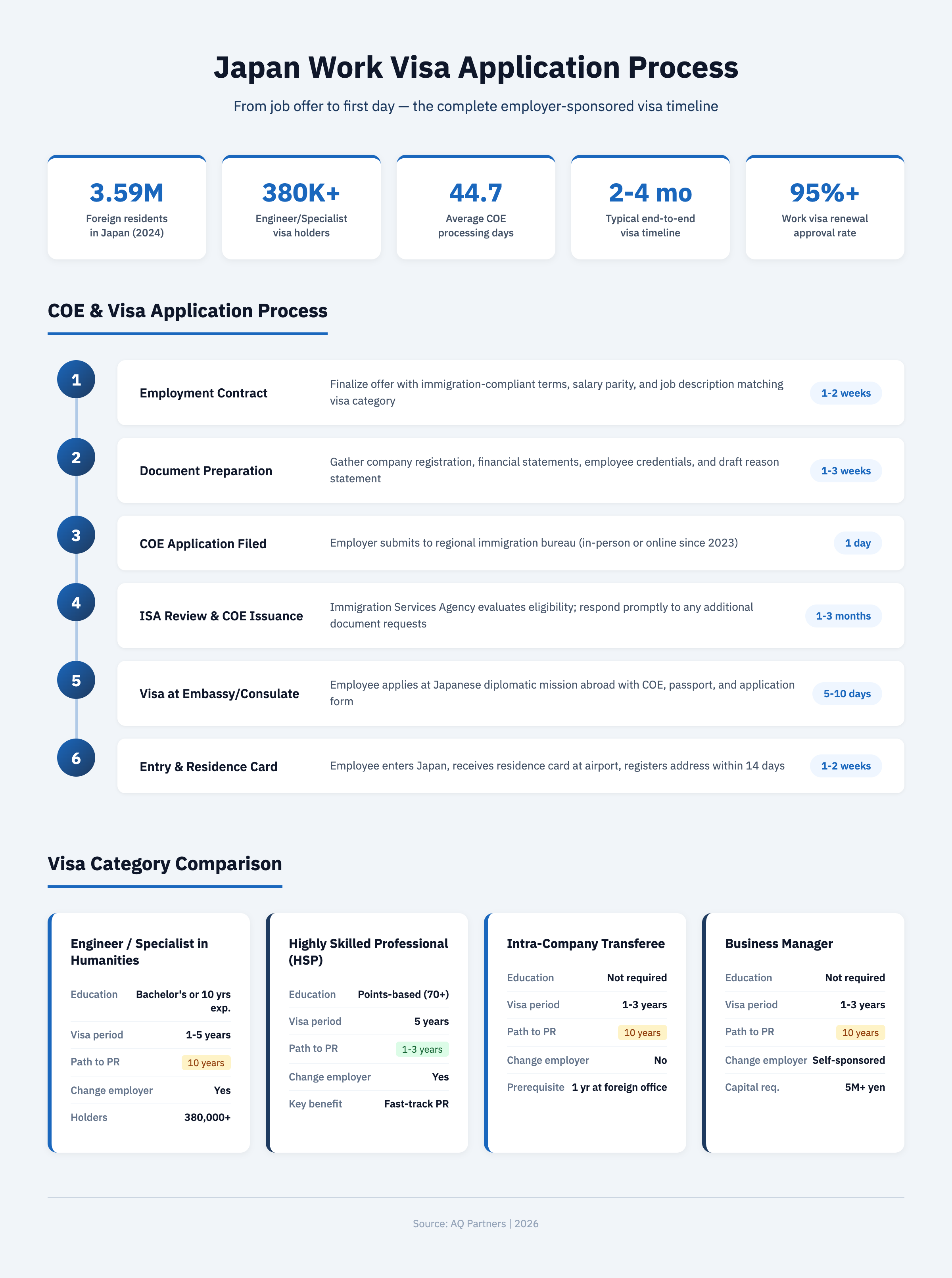
This is the most common work visa for foreign professionals in Japan. It covers a broad range of skilled positions including engineers, IT professionals, translators, marketing specialists, business analysts, and corporate managers. To qualify, applicants typically need at least a bachelor's degree in a relevant field or 10 years of relevant work experience (3 years for interpreter, teacher, or international services roles).
The work performed must require specialized knowledge or skills. Basic manual labor, retail work, or service positions don't qualify. The employer must also demonstrate that the salary offered is comparable to what would be paid to a Japanese national with similar qualifications.
Intra-company Transferee (企業内転勤)
This category is specifically for employees being transferred from a foreign branch, subsidiary, or parent company to a Japanese office of the same corporate group. It's commonly used by multinational companies rotating staff into their Japanese operations.
The transferred employee must have worked for the company abroad for at least one year before transfer, and they must be moving to a position in technology, humanities, or international business. The key advantage of this category is that it doesn't require the employee to have a specific educational background—the one-year work history with the company is sufficient.
Highly Skilled Professional (高度専門職)
Japan's Highly Skilled Professional (HSP) visa is a points-based system designed to attract top global talent. Points are awarded based on academic background, professional experience, annual salary, age, and Japanese language ability. Applicants need at least 70 points to qualify.
The HSP visa offers significant benefits over standard work visas: longer periods of stay (5 years initially), faster path to permanent residency (as little as 1 year for those with 80+ points), permission to engage in multiple types of work activities, and easier procedures for bringing family members including parents and domestic helpers.
For businesses competing for top talent, sponsoring HSP-eligible candidates can be a strategic advantage. We'll discuss this category in more detail in our dedicated cluster article on the Highly Skilled Professional visa.
Business Manager (経営・管理)
The Business Manager visa is designed for company executives, board members, and business owners. This visa underwent major regulatory changes effective October 16, 2025.
Current Requirements (Effective October 16, 2025):
To qualify for a Business Manager visa under the new requirements, applicants must meet ALL of the following criteria:
1. Capital Requirement: Minimum 30 million yen paid-in capital (increased from the previous 5 million yen requirement). For joint-stock companies (kabushiki kaisha), this refers to paid-in capital. For partnerships or limited liability companies, the total investment applies.
2. Employment Requirement: Must employ at least one full-time employee who is either:
- A Japanese national, OR
- A Permanent Resident, OR
- A Spouse or Child of a Japanese national or Permanent Resident, OR
- A Long-Term Resident, OR
- A Special Permanent Resident
This is now mandatory—previously, having 2+ employees was an alternative to capital requirements, but both are now required.
3. Japanese Language Proficiency: Either the applicant OR one full-time employee must possess Japanese language ability at JLPT N2 (B2 level) or equivalent as defined by the Agency for Cultural Affairs' Japanese Language Education Reference Framework.
4. Educational or Experience Background: The applicant must have ONE of the following:
- Master's degree or higher in business management, OR
- University degree in a field related to the business or technology sector, OR
- At least 3 years of management or business operation experience
5. Business Plan Verification: The business plan must be verified or certified by a qualified third party, such as a certified public accountant, SME management consultant, or similar professional.
6. Physical Office Requirement: A genuine physical office is required. Virtual offices or home offices are generally not permitted under the new requirements.
Important Notes on the October 2025 Changes:
Impact on HSP Type 1(c) Holders: These strengthened requirements also apply to Highly Skilled Professional Type 1(c) visa holders engaged in business management activities. HSP 1(c) applicants and renewals must also meet the capital, employment, Japanese language, educational/experience, and business plan verification requirements.
Transitional Measures:
- Applications submitted before October 15, 2025 were evaluated under the previous requirements (5 million yen capital OR 2+ employees)
- Existing Business Manager visa holders have a 3-year grace period until October 16, 2028 for renewals
- During the grace period, renewal decisions will consider current business performance and progress toward meeting the new standards
- After October 16, 2028, all renewals must fully meet the new requirements
What This Means for Entrepreneurs:
The new requirements represent a significant policy shift toward attracting only serious, well-capitalized foreign entrepreneurs with proven management experience and Japanese market understanding. The 30 million yen threshold is substantially higher than the average capital of Japanese SMEs, but it ensures business sustainability and credibility.
For foreign entrepreneurs without access to 30 million yen in capital, alternative pathways include:
- The Startup Visa program (Special Activities status allowing 1-2 years to prepare before transitioning to Business Manager)
- Highly Skilled Professional Type 1(c) visa if points qualify (though same capital requirements now apply)
- Initially working under an Engineer/Specialist visa while building capital
What Counts as "Management":
Immigration authorities carefully scrutinize whether Business Manager visa applications involve actual management activities.
Actual management responsibilities required:
- Strategic planning and business direction decisions
- Budget management and financial oversight
- Supervising and managing staff (the mandatory 1+ full-time employee requirement ensures there is staff to supervise)
- Business development and operations management
- Authority to make binding decisions for the company
What doesn't qualify:
- Advisory roles without decision-making authority
- Individual contributor positions, even if highly skilled
- Nominal "manager" titles without actual management duties
- Passive investor roles without operational involvement
Office requirements: You must have a physical office space—not a virtual office or residential address under the new requirements. The office should be appropriate for the claimed business operations. Immigration may request office photos, lease agreements, and evidence of actual business activity at the location.
Skilled Labor (技能)
This category covers workers with specialized technical skills acquired through extensive experience, such as chefs specializing in foreign cuisine, pilots, sports trainers, and sommeliers. Unlike the Engineer/Specialist category, Skilled Labor visas are for practical, hands-on skills rather than academic or business expertise.
Applicants typically need at least 10 years of professional experience (3 years for certain food service specialties). For businesses in industries like hospitality or specialized manufacturing, this visa category allows hiring of skilled craftspeople and technicians who may not have formal academic credentials but possess valuable practical expertise.
How to Choose the Right Visa Category
Selecting the appropriate visa category requires matching your hire's qualifications and job responsibilities to the immigration requirements. Here's a practical framework:
Start with the job description. What will this person actually do day-to-day? The visa category must align with the actual work, not just the job title. Immigration authorities review job descriptions carefully and may reject applications where the stated duties don't match the visa category.
Check educational requirements. Does your candidate have the necessary degree or years of experience? If they have a bachelor's degree in a relevant field, Engineer/Specialist is usually appropriate. If they lack a degree but have 10+ years of experience, they may still qualify.
Consider company structure. If you're transferring someone from an overseas office, Intra-company Transferee may be the natural choice. If you're hiring a senior leader, Business Manager might apply. Understanding these distinctions early in your Japan market entry planning is essential.
Calculate HSP points. If your candidate might qualify for Highly Skilled Professional status, use the points calculator on the Immigration Services Agency website. The benefits often make this worth pursuing even if other categories are available.
When in doubt, consult with immigration professionals. Choosing the wrong category can result in application rejection and delays of several months. Many businesses work with immigration lawyers (gyoseishoshi) for initial applications to ensure proper categorization.
Employer Sponsorship Requirements
Legal Obligations for Sponsoring Companies
Not every business in Japan can sponsor work visas. To act as a visa sponsor, your company must meet specific legal and operational requirements established by Japan's Immigration Services Agency.
Business registration. Your company must be properly registered with the Legal Affairs Bureau and have a valid company registration certificate (登記事項証明書, toki jiko shomeisho). This applies whether you've established a Kabushiki Kaisha (KK), Goudou Kaisha (GK), or branch office. For newly established companies, you'll need to complete all post-incorporation filing requirements before you can sponsor work visas.
Business stability and substance. Immigration authorities assess whether your company has genuine business operations in Japan. They look for evidence of real business activity: office space, business contracts, financial transactions, and an established business plan. Companies operating from virtual offices or without clear business substance may face additional scrutiny or rejections. This is particularly important for Business Manager visa sponsorships, where the October 2025 amendments now explicitly require physical office space and prohibit virtual offices.
Tax and social insurance compliance. Your company must be current on all tax obligations and social insurance premium payments. Immigration authorities can request tax payment certificates and will reject applications from companies with outstanding tax debts. This includes corporate tax, consumption tax, and employee withholding obligations.
Employment law compliance. As a sponsor, you're certifying that you'll employ the foreign national according to Japanese labor law. This means complying with minimum wage requirements, working hour regulations, mandatory insurance enrollment, and proper employment contracts. Understanding Japanese labor compliance requirements is essential before sponsoring any foreign employees.
Required Business Documentation
When applying for work visa sponsorship, you'll need to provide extensive documentation about your company. The specific requirements vary slightly based on company size and category, but generally include:
Registration and structure documents:
- Company registration certificate (toki jiko shomeisho) issued within the past 3 months
- Articles of incorporation
- Corporate organization chart showing where the foreign employee will fit
- Office lease agreement or property registration documents
Financial documents:
- Most recent financial statements (balance sheet and profit/loss statement)
- Tax payment certificates from the tax office
- For newer companies without full financial history, business plans and financial projections
Employment documents:
- Employment contract or letter of employment offer
- Detailed job description outlining specific duties and responsibilities
- Explanation of why this position requires hiring a foreign national
- Salary breakdown showing the offered compensation is appropriate for the role
Category-specific documents:
- For Intra-company Transferees: documentation proving the corporate relationship between the Japanese entity and foreign entity, plus the employee's work history
- For Highly Skilled Professionals: evidence supporting all claimed points (diplomas, certificates, employment records, salary documentation)
- For Business Managers: articles of incorporation showing 30 million yen capitalization, business plan with third-party verification, proof of at least one eligible full-time employee, evidence of Japanese language proficiency (applicant or employee), documentation of educational background or 3+ years management experience, and physical office lease agreement
Financial and Compliance Requirements
Beyond documentation, your company must meet ongoing financial and compliance standards to maintain your status as an approved visa sponsor.
Financial stability. While there's no specific minimum revenue or asset requirement for most visa categories, your company must demonstrate financial ability to pay the employee's salary consistently. Startups and small companies may need to provide additional documentation such as shareholder funding commitments or bank balance certificates.
For Business Manager visas specifically, the 30 million yen paid-in capital requirement (as of October 2025) serves as the formal financial threshold.
For some hiring scenarios, using an Employer of Record (EOR) initially can help you hire before your own entity is fully established and financially stable enough for visa sponsorship.
Salary requirements. The offered salary must be "appropriate" based on the employee's role, qualifications, and industry standards. As a general rule, Immigration authorities expect salaries comparable to what Japanese nationals receive for similar work. Significantly below-market salaries often result in application rejections.
Compliance tracking. Once approved as a sponsor, you have ongoing obligations to report certain changes to immigration authorities, including changes in the employee's work location, job duties, or employment status. You must also maintain records of employment contracts, working hours, and salary payments for potential immigration audits.
Category-specific business requirements. Business Manager visa sponsorships have additional requirements as of October 2025, including minimum capitalization of 30 million yen AND employment of at least one full-time employee with specified residency status. Companies seeking to hire multiple foreign nationals should ensure they have sufficient office space and organizational capacity to support their planned headcount.
The Certificate of Eligibility (COE) Process
What is a Certificate of Eligibility?
The Certificate of Eligibility (COE) is a crucial document in Japan's work visa process, yet it often confuses first-time employers. Understanding what it is and why it matters is essential for managing your hiring timeline effectively.
A COE (在留資格認定証明書, zairyu shikaku nintei shomeisho) is a document issued by Japan's Immigration Services Agency that confirms a foreign national is eligible for a specific status of residence. Think of it as pre-approval from Japanese immigration authorities before the person even applies for their visa.
The COE process exists to streamline immigration procedures. Instead of Japanese embassies abroad having to verify whether someone qualifies for a work visa, the vetting happens in Japan where the Immigration Services Agency can directly review employer documentation and verify business legitimacy. Once a COE is issued, obtaining the actual visa at a Japanese embassy is usually straightforward and quick.
For employers, the COE is the most time-consuming and document-intensive part of the visa process. However, it's also where you have the most control. Once you receive the COE, your employee can typically obtain their visa and start work within 2-4 weeks.
Step-by-Step COE Application Process
The COE application process involves several distinct steps, each requiring careful attention to detail and proper documentation.
Step 1: Prepare all required documents
Gather all employer documentation (company registration, financial statements, tax certificates) and employee documentation (passport copy, diploma, resume, employment contract). The employee doesn't need to be in Japan for COE application—they can be anywhere in the world.
Create a detailed job description that clearly explains the role, daily responsibilities, and why it requires the specific visa category you're applying under. Immigration officers read these carefully, so vague or generic descriptions often lead to requests for additional information.
Step 2: Complete the COE application form
The standard application form varies slightly by visa category. These forms are available on the Immigration Services Agency website in Japanese and English. Key information includes personal details, educational background, work history, salary, job title, and visa category requested.
Accuracy is critical. Any discrepancies between the application form and supporting documents can trigger delays or rejection. Double-check that passport names, dates, and addresses match exactly across all documents.
Step 3: Submit to the appropriate Regional Immigration Bureau
COE applications are submitted to the Regional Immigration Bureau that has jurisdiction over your company's registered address. You cannot submit to any bureau—it must be the one responsible for your business location.
Many larger companies designate an administrative staff member or work with an immigration lawyer to handle submissions. Some businesses prefer working with immigration lawyers (gyoseishoshi) who can submit applications, respond to inquiries, and handle any complications that arise.
Step 4: Respond to any requests for additional information
Immigration authorities often request clarification or additional documents during their review. These requests (called tsuika shiryo) must be responded to promptly—typically within 2-4 weeks. Common requests include more detailed business plans, additional financial documentation, or clarification about job duties.
For Business Manager visa applications submitted after October 16, 2025, be prepared for potential requests regarding the third-party verification of your business plan, proof of Japanese language proficiency, or documentation of management experience.
Don't be discouraged by these requests. They're routine and don't necessarily indicate problems with your application. Respond comprehensively and quickly to keep your application moving forward.
Step 5: Receive the COE
Once approved, the COE is mailed to the address provided in the application. You'll need to send this original document to your employee abroad (keeping a copy for your records). They'll need the original COE to apply for their visa at a Japanese embassy or consulate.
Required Documents and Information
Document requirements for COE applications are extensive and vary by visa category and company situation. Here's what you'll typically need to provide:
For the employee:
- Application form (properly completed and signed)
- Passport-quality photograph (4cm x 3cm, taken within last 3 months)
- Photocopy of passport identity page
- Original diplomas and transcripts (with certified translations if not in Japanese or English)
- Detailed resume showing all work history
- Letters of recommendation or employment certificates from previous employers
- For HSP applications: documents proving all claimed points
- For Business Manager applications: documents proving educational background or 3+ years management experience, JLPT N2 certificate if applicant will fulfill language requirement
For the employer:
- Company registration certificate (toki jiko shomeisho) issued within last 3 months
- Company pamphlets, brochures, or website printouts showing business activities
- Office layout diagram or photographs showing physical workplace
- Most recent financial statements
- Tax payment certificates
- Number of employees certificate from the tax office
- Detailed organizational chart
- Employment contract or offer letter
- Job description explaining role and responsibilities
- Documentation of similar roles/salaries in the company (if available)
Category-specific additions:
- Intra-company Transferees: corporate relationship documentation and proof of one year employment abroad
- Business Managers: articles of incorporation showing 30 million yen capitalization, business plan with third-party verification certificate, employment contract for the required full-time employee(s), proof of employee's residency status, office lease agreement (must show physical office, not virtual), documentation of applicant's educational background or 3+ years management experience, JLPT N2 certificate or proof of employee's Japanese proficiency
- Skilled Labor: documentation proving required years of experience
The key is completeness. Missing documents are the most common cause of delays. Before submitting, double-check you have everything listed for your specific visa category.
Processing Times and Common Rejection Reasons
Typical processing timelines:
Standard COE processing takes 1-3 months from submission to decision, though this varies based on several factors:
- Company category: Businesses are classified into categories based on size and tax payment history. Category 1 companies (listed corporations and companies with 50+ employees) typically receive faster processing. Newer or smaller companies may face longer review times.
- Visa complexity: Straightforward Engineer/Specialist applications for clearly qualified candidates usually process faster than Business Manager or Skilled Labor applications that require more detailed review. Business Manager applications submitted after October 16, 2025 may face additional processing time due to the new verification requirements.
- Time of year: March-April and September-October are peak immigration periods in Japan. Applications submitted during these months may take longer.
- Completeness: Applications with all documentation properly prepared typically process faster than those requiring multiple rounds of additional document requests.
Common reasons for COE rejection:
Understanding why applications get rejected helps you avoid these pitfalls:
- Insufficient qualification match: The candidate's education or experience doesn't clearly align with the job requirements or visa category. For example, a literature degree holder applying for an engineering position, or someone with only 5 years of experience applying for a role requiring 10 years.
- Job description problems: The stated job duties don't match the visa category, seem too vague, or suggest work that doesn't actually require a foreign national. Immigration wants to see why this specific role needs the specific person being hired.
- Salary too low: The offered salary is significantly below market rates for similar positions. Immigration authorities use industry salary data to assess whether compensation is appropriate.
- Company credibility issues: The company appears unstable financially, has tax compliance problems, lacks business substance, or has a history of visa sponsorship issues. New companies without established track records face more scrutiny.
- Documentation problems: Missing required documents, documents in wrong language without proper translation, expired certificates, or inconsistencies between different documents.
- Previous immigration violations: If the applicant has overstayed visas, violated work restrictions, or had previous applications rejected, this raises red flags requiring extensive explanation.
- Business Manager-specific issues (post-October 2025): Failure to demonstrate 30 million yen capitalization, inability to prove employment of qualified full-time employee, lack of third-party business plan verification, insufficient proof of Japanese language proficiency, inadequate documentation of management experience or education, or use of virtual office instead of physical space.
If your application is rejected, you'll receive a written explanation. You can reapply after addressing the stated issues, though you'll need to submit a completely new application with all documentation again.
The Work Visa Application Process
From COE to Work Visa
Once you receive the Certificate of Eligibility, you're past the hardest part of the visa process. The COE confirms that Japanese immigration authorities have approved your sponsorship and the foreign national's eligibility. The next phase—obtaining the actual visa—is typically much faster and more straightforward.
Send the COE to your employee
The original COE document must be sent to the employee abroad. While you should keep copies for your records, the employee needs the physical original to submit with their visa application. Many companies send this via international courier (DHL, FedEx, etc.) with tracking to ensure safe delivery. Standard international mail can take 1-2 weeks, while courier services typically deliver within 3-5 days.
Employee applies at Japanese embassy/consulate
With COE in hand, the employee applies for their visa at the Japanese embassy or consulate in their country of residence. They'll need:
- Original COE
- Valid passport (must have at least 6 months validity remaining)
- Completed visa application form
- Recent passport photo
- Any additional documents the specific embassy requires (check the embassy website)
Most embassies process COE-based visa applications within 5 working days, though this can vary. Some embassies offer expedited processing for urgent cases.
Visa stamp and entry preparation
Once approved, the embassy stamps the visa in the employee's passport. This visa allows entry to Japan within 3 months of issuance (in most cases). The employee can then book travel and prepare for their move.
Before departure, ensure your employee has:
- All original documents they'll need at Japanese immigration (COE, diploma, etc.)
- Confirmation of address where they'll initially stay in Japan (required for residence card)
- Understanding of what happens at arrival (next section explains this)
Entry into Japan and Obtaining a Residence Card
The employee's arrival in Japan marks a crucial transition point. Here's what happens and what you need to know as the employer:
At the airport immigration checkpoint
Upon arrival at a major Japanese airport (Narita, Haneda, Kansai, Chubu), the employee goes through foreign national immigration processing. They'll present their passport with visa and the original COE. Immigration officers will review these documents and the entry landing card.
Residence card issuance
At major airports, residence cards (在留カード, zairyu card) are issued on the spot. This plastic card is the employee's official status of residence document—far more important than the visa stamp, which has now served its purpose.
The residence card shows:
- Full name
- Date of birth
- Sex and nationality
- Status of residence type and period
- Work permission status
- Residence card number (for verification purposes)
The employee should keep this card with them at all times. Japanese law requires foreign residents to carry either their residence card or passport when outside their home.
If entering through a smaller airport or seaport, the employee will receive a temporary landing permission stamp and must visit a Regional Immigration Bureau within 14 days to receive their residence card.
Setting up residence registration
Within 14 days of arrival, the employee must register their address at the local city or ward office. This is called residence notification (転入届, tennyu todoke). They'll need:
- Residence card
- Passport
- Address where they're living
The city office will update the residence card with the registered address. This registration is essential—it's required for opening bank accounts, signing apartment leases, and enrolling in national health insurance.
Supporting your employee's transition
As the employer, you should help coordinate these initial steps. Many companies assign an HR contact or buddy to assist with these administrative tasks. Creating a comprehensive HR compliance framework helps ensure you're supporting employees properly from day one.
Consider providing:
- Temporary accommodation assistance for the first weeks
- Guidance on address registration procedures (some companies arrange for staff to accompany new employees)
- Information about opening bank accounts and enrolling in insurance
- Overview of daily life essentials (transportation cards, mobile phones, etc.)
Many foreign employees arrive without Japanese language ability, making these initial administrative tasks daunting. Employer support during this transition period significantly impacts employee satisfaction and retention.
Complete Timeline from Offer to Start Date
Understanding the full timeline helps with hiring planning and setting realistic expectations with candidates. Here's a typical timeline breakdown:
Weeks 1-2: Offer acceptance and document gathering
- Extend employment offer
- Candidate accepts and begins gathering required documents (diplomas, transcripts, passport copy, etc.)
- Company prepares employer documentation
Weeks 3-4: COE application preparation and submission
- Finalize all documents
- Complete COE application forms
- Submit application to Regional Immigration Bureau
Weeks 5-16: COE processing
- Immigration authorities review application (1-3 months typical)
- Respond to any requests for additional information
- Receive COE approval
Weeks 17-18: Visa application
- Send original COE to employee via courier (3-5 days)
- Employee applies at Japanese embassy/consulate
- Visa processed (typically 5 working days)
Weeks 19-20: Travel and arrival
- Employee books flights to Japan
- Prepares for relocation
- Arrives in Japan, receives residence card at airport
Total timeline: 4-5 months minimum from initial offer to employee start date, assuming no complications or delays.
Factors that can extend the timeline:
- Peak season submissions (March-April, September-October)
- Requests for additional documentation
- Company is new or small (more thorough vetting)
- Complex visa categories (Business Manager post-October 2025 with new requirements, Skilled Labor)
- Employee location (some countries' embassies have longer processing times)
Strategies to accelerate the process:
- Prepare all documentation thoroughly before submission
- Use immigration lawyers familiar with your specific Regional Immigration Bureau
- For HSP applicants, the points system can lead to faster processing
- Consider temporary solutions like short-term business visitor status while work visa processes (though this has limitations)
Plan your hiring timeline with these realities in mind. If you need someone to start by a specific date, begin the visa process at least 5-6 months in advance to account for potential delays.
Visa Renewal and Status Changes
Understanding Visa Periods and Renewals
Work visas in Japan are not permanent. They're issued for limited periods that must be renewed to maintain legal status. Understanding the renewal cycle and requirements is essential for long-term employment planning.
Standard visa periods
Most work visas are initially granted for 1, 3, or 5 years. The period granted depends on several factors:
- First-time applicants typically receive 1-year visas initially, regardless of qualifications
- Renewals for established employees may receive 3-year or 5-year periods
- Highly Skilled Professionals typically receive 5-year periods from the start
- Company stability and size influences period granted—larger, established companies are more likely to receive longer periods for their employees
When to apply for renewal
Visa renewal applications should be submitted 3 months before expiration, though they can be submitted as early as 6 months before. Never wait until the last moment—if the visa expires before renewal is approved, the employee must stop working.
Applications submitted with sufficient time before expiration allow the employee to continue working even if processing extends beyond the expiration date (this is called special permission to continue activities).
Employer's role in renewal
As the sponsoring employer, you have continuing obligations for visa renewals:
- Provide updated employer documentation: Company registration certificate, recent financial statements, tax payment certificates. Immigration wants to confirm the company remains stable and compliant.
- Confirm employment continuation: A letter confirming the employee remains employed in the same or similar capacity, with current salary information.
- Report any material changes: If the job duties, work location, or employment terms have changed significantly since the original application, these must be explained.
- Address any compliance issues: If there have been labor law violations, tax problems, or other compliance issues, these can negatively impact renewal decisions.
- For Business Manager visas: As of October 2025, renewals require demonstrating continued compliance with all six requirements (30M yen capital, 1+ qualified employee, Japanese language proficiency, educational/experience background, business plan verification, physical office). Existing visa holders have until October 16, 2028 to meet these requirements, with renewals evaluated based on progress toward compliance.
Renewal processing and decisions
Renewal processing typically takes 2-4 weeks, considerably faster than initial COE applications. However, Immigration authorities can deny renewals if:
- The employee or company has violated immigration or employment laws
- The business situation has changed significantly (company closing, major financial problems)
- The employment relationship has issues (unpaid wages, improper working conditions)
- The employee has engaged in activities outside their authorized work
- For Business Manager visas: failure to maintain required capital, loss of qualified employees, or operating from virtual office instead of physical space
Denial of renewal means the employee must leave Japan, typically within 30 days. This makes careful compliance throughout the visa period crucial.
Changing Visa Categories for Existing Employees
Sometimes employees need to change their status of residence while already in Japan. This commonly happens when:
- An employee on one work visa takes a new job requiring a different category
- An employee starts their own business (changing from work visa to Business Manager—note that post-October 2025 requirements apply)
- Someone initially on a student or dependent visa enters the workforce
- An employee marries a Japanese national (changing to Spouse status)
The change of status application
Status change applications are submitted to the Regional Immigration Bureau where the employee lives. Unlike COE applications (handled by employer), status change applications are typically submitted by the individual, though employers provide supporting documentation.
Required documents include:
- Application form for status change
- Passport and current residence card
- Documents supporting the new status (employment contract, job description, etc.)
- Employer documentation (company registration, financial statements, etc.)
- Reason for the change explained in writing
- For changes to Business Manager status: all documentation required under October 2025 requirements including proof of 30M yen capital, qualified employee, Japanese proficiency, educational/experience background, third-party verified business plan, and physical office
Processing and work authorization
Status change processing typically takes 2-4 weeks. During this period:
- The employee can generally continue working in their current role
- Once the new status is approved, they receive an updated residence card
- The new status period may be different from what remained on the previous status
Important consideration for job changes
If a foreign employee changes employers, they technically need to apply for a status change even if remaining in the same visa category. While the category doesn't change, Immigration authorities want to verify the new employer meets sponsorship requirements and the new role matches the visa category.
In practice, the requirement is to notify Immigration within 14 days of the job change. However, many immigration lawyers recommend submitting a formal application to ensure proper documentation, especially if the new job differs significantly from the previous role.
Strategic status changes
Some employees may strategically change status as their situation evolves:
- Moving from standard work visa to HSP status to gain benefits and faster permanent residency path
- Changing to Business Manager status when starting their own company (must meet all October 2025 requirements)
- Changing to Spouse status if married to a Japanese national (this removes work restrictions)
Each change requires meeting the requirements for the new status and submitting a complete application. Employers should support these transitions when they benefit both the employee and business relationship.
Compliance and Common Pitfalls
Ongoing Employer Obligations
Visa sponsorship isn't a one-time event—it creates ongoing compliance responsibilities that extend throughout the employment relationship. Failure to meet these obligations can result in penalties, difficulty sponsoring future employees, or even revocation of current employees' visas.
Employment contract and working conditions
You must employ the foreign national according to the terms specified in their visa application. This means:
- Paying the stated salary: The salary reported in visa documents must be actually paid. Significant reductions without Immigration notification can cause problems at renewal.
- Maintaining job responsibilities: The actual work should match what was described in the COE application. Minor adjustments are fine, but substantially different work may require a status change application.
- Following labor law: All Japanese employment laws apply fully to foreign workers. This includes working hour limits, overtime compensation, paid leave, social insurance, and employment termination procedures.
Notification obligations
Japanese immigration law requires employers to notify Immigration authorities of certain changes within 14 days:
- Employee no longer works for the company (resignation, termination, retirement)
- Significant changes to the employee's duties or work location
- Company name change, address change, or other corporate changes
- Employee has been absent from work for an extended period
These notifications are submitted online through Immigration's notification system. Failure to submit required notifications can be treated as a violation and may affect future visa applications.
Record-keeping requirements
Employers must maintain employment records for all foreign workers, including:
- Copy of residence card
- Employment contract
- Salary records
- Working hour records
- Any documents related to visa applications and renewals
These records may be requested during immigration audits or when applying for additional visa sponsorships. Keep them organized and readily accessible.
Social insurance enrollment
Foreign workers must be enrolled in Japan's social insurance systems (health insurance, pension, employment insurance, workers' compensation) just like Japanese employees. Failure to enroll is both a labor law violation and can cause visa problems.
Many employers mistakenly think foreign workers on temporary visas are exempt from pension enrollment. This is incorrect—enrollment is mandatory regardless of visa type or intended length of stay. Proper enrollment is part of proper back office setup for any company hiring in Japan.
Immigration audits and inspections
Immigration authorities can audit companies sponsoring foreign workers at any time. During audits they review:
- Employment records and contracts
- Salary payment documentation
- Working hour records
- Social insurance enrollment status
- Tax compliance
- Physical workplace and business operations
- For Business Manager visa holders: verification of continued compliance with capital requirements, employee status, office space, and business operations
Companies with good compliance records typically face routine, non-intrusive audits. Companies with issues or multiple foreign employees may face more detailed scrutiny.
When to Hire an Immigration Specialist
While it's possible for companies to handle visa applications independently, working with immigration professionals (called gyoseishoshi or immigration lawyers) offers significant advantages in many situations.
When professional help is most valuable:
- First-time visa sponsorship: If your company has never sponsored a work visa before, guidance through the process helps avoid costly mistakes and delays.
- Complex cases: Business Manager visas (especially post-October 2025 with new requirements), Skilled Labor visas, or cases where the candidate's qualifications don't perfectly align with standard categories benefit from expert preparation.
- Previous rejections: If an application was rejected, an immigration lawyer can analyze what went wrong and how to strengthen a resubmission.
- Multiple nationalities: Some countries' documentation is more challenging to verify and translate. Immigration specialists familiar with specific nationalities know what additional documentation helps.
- New or small companies: Newer companies without established track records face more scrutiny. Professional representation can help present your company's legitimacy effectively.
- Urgent timeline: If you need faster processing, immigration lawyers know which Regional Immigration Bureaus process faster and how to prepare applications for optimal processing speed.
- Language barriers: If your HR team doesn't have strong Japanese capability, immigration specialists handle all Japanese documentation and communication with Immigration authorities.
- October 2025 Business Manager requirements: The new requirements for Business Manager visas are complex and involve third-party verification. Immigration specialists can coordinate the verification process and ensure all new documentation requirements are met.
What immigration specialists do:
- Review candidate qualifications and recommend optimal visa category
- Prepare all application documents and forms
- Translate documents when necessary
- Coordinate third-party business plan verification for Business Manager applications
- Submit applications to Immigration Bureau (they can submit directly rather than you needing to visit in person)
- Respond to requests for additional information
- Follow up on processing status
- Handle visa renewals and status changes
- Advise on compliance obligations
- Represent you in case of application denials or problems
Costs and considerations:
Immigration lawyer fees typically range from ¥100,000 to ¥300,000 per COE application, depending on complexity and the lawyer's experience. Business Manager applications post-October 2025 may fall at the higher end due to additional requirements. Renewal applications are typically ¥50,000 to ¥150,000.
While this seems expensive, consider it against the cost of:
- Employee time spent navigating the process
- Salary costs while waiting for rejected applications to be resubmitted
- Lost productivity from delays in getting the employee started
- Risk of making mistakes that cause long-term sponsorship difficulties
Many companies use immigration specialists for initial applications and complex cases, then handle straightforward renewals internally once familiar with the process. This balanced approach controls costs while ensuring quality on high-stakes applications.
Conclusion
Navigating Japan's work visa system is a fundamental capability for any business hiring international talent in Japan. While the process involves multiple steps, substantial documentation, and careful compliance, understanding the system enables you to hire effectively and maintain good standing with immigration authorities.
The key takeaways for businesses:
Start early. With typical timelines of 4-5 months from job offer to employee start date, factor visa processing into your hiring plans. Don't promise start dates without accounting for realistic processing times.
Choose the right visa category. Matching your hire's qualifications and job duties to the appropriate visa category is essential for approval. Take time to understand the requirements and select carefully. Be particularly aware of the significantly strengthened Business Manager visa requirements effective October 2025.
Prepare thoroughly. The Certificate of Eligibility application requires extensive documentation from both employer and employee. Complete, accurate documentation accelerates processing and improves approval chances. For Business Manager visas, budget time for third-party business plan verification.
Maintain compliance. Visa sponsorship creates ongoing obligations for employment conditions, notifications to Immigration, record-keeping, and social insurance enrollment. Meeting these obligations protects both your employee's status and your company's ability to sponsor future visas.
Invest in expertise when needed. For complex cases, first-time sponsorships, Business Manager visas under the new requirements, or when facing tight timelines, immigration specialists provide valuable guidance that often more than pays for itself in avoided delays and problems.
Plan for the long term. Think beyond the initial visa application to renewals, potential status changes, and eventual permanent residency paths for valuable employees. Understanding the full lifecycle helps with workforce planning.
Stay informed about regulatory changes. The October 2025 Business Manager visa amendments demonstrate that immigration requirements can change significantly. Working with immigration professionals or monitoring official Immigration Services Agency announcements helps ensure continued compliance.
Japan's work visa system, while detailed and procedural, is navigable with proper preparation and understanding. Companies that invest in learning the system and building compliant processes find they can effectively bring international talent into their Japanese operations, supporting business growth and team diversity.