
Unlocking Japanese Labor Compliance: Hidden Risks Every Business Should Know


Expanding your business into Japan offers significant growth opportunities, but Japan's intricate labor compliance regulations can present unexpected challenges for international founders, startups, and overseas teams. Compliance involves much more than following simple checklists—overlooking local payroll, documentation, or reporting practices can lead to severe penalties or even an operational shutdown. To protect your business and stay focused on growth, it is essential to master Japan's evolving labor laws, required filings and compliance deadlines from the very start.
Key Takeaways
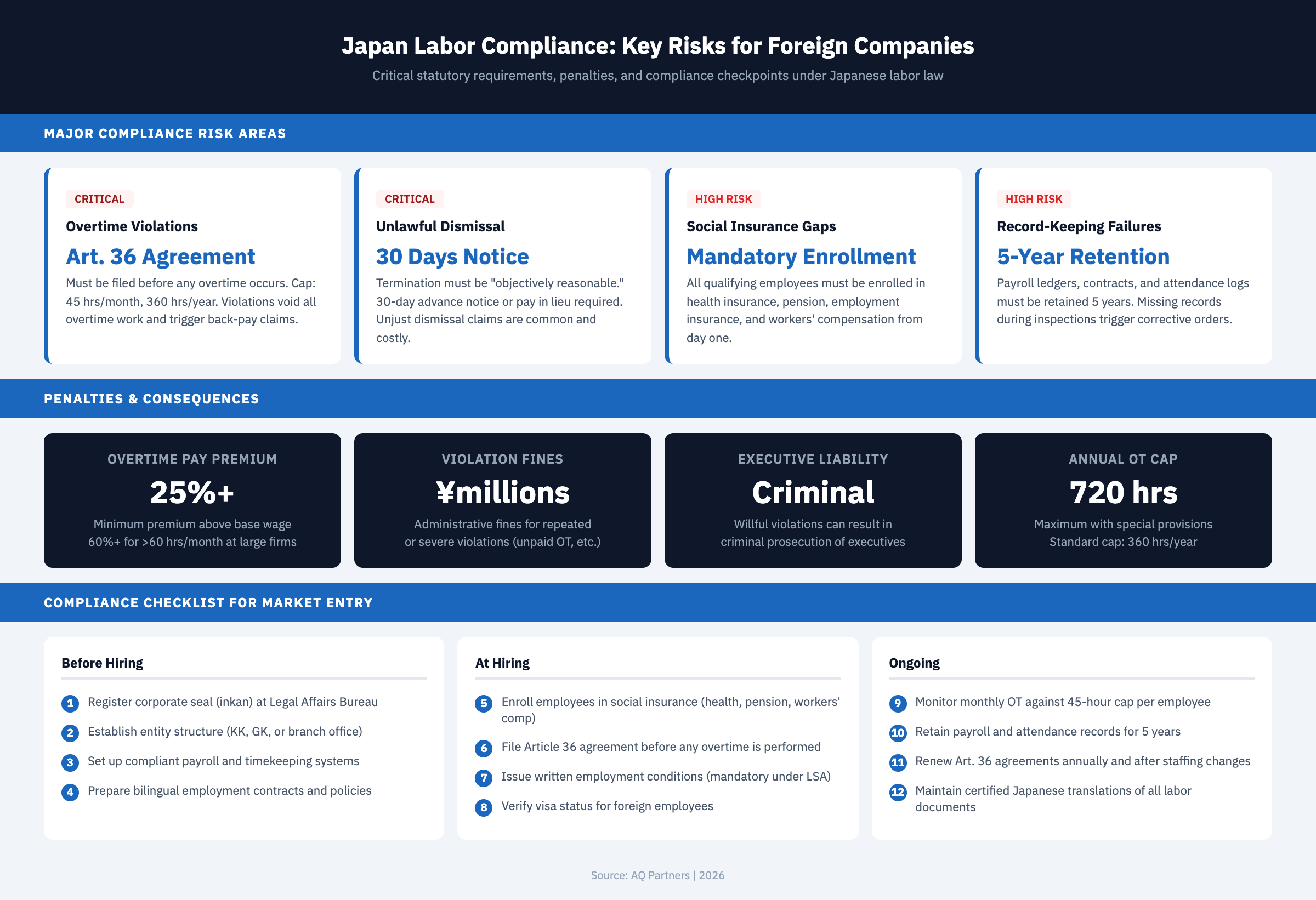
- Article 36 agreements are non-negotiable. Any overtime beyond 8 hours per day or 40 hours per week requires a filed Article 36 agreement with the Labor Standards Inspection Office before any overtime work begins—failure to file invalidates all overtime and exposes the company to back-pay claims.
- Overtime caps are among the strictest globally. Japan's Work Style Reform limits overtime to 45 hours per month and 360 hours per year by default, with a hard ceiling of 720 hours annually even with special provisions.
- Record-keeping has a 5-year retention mandate. Since April 2020, payroll ledgers, wage statements, and attendance records must be retained for at least five years—missing a single document during an inspection can trigger corrective orders.
- Executive liability extends to criminal prosecution. Willful labor law violations can result in criminal charges against company executives, with fines reaching millions of yen for repeated or severe offenses such as unpaid overtime.
- Bilingual documentation is a legal requirement. All formal labor filings must be in Japanese, and foreign-managed companies must maintain certified Japanese translations of contracts, policies, and employment records to pass inspections.
Japan labor compliance map and required filings
Every company employing staff in Japan—regardless of origin or size—must comply with a layered system of labor statutes, mandatory filings, and documentation standards enforced by the Ministry of Health, Labour and Welfare.
Japan's employment compliance system is built on a complex web of statutes and regulatory agencies. Any company employing staff in Japan—regardless of its home country or team size—must navigate these requirements to operate legally and minimize risk. Understanding the key laws, necessary paperwork, and the interplay between company incorporation, payroll, and company seals is critical for avoiding costly mistakes and establishing a stable local presence, as emphasized by the Japan Ministry of Health, Labour and Welfare.
Core statutes and regulators employers must know
Japanese labor compliance is grounded in several foundational laws that impose specific obligations on every employer. The most significant is the Labor Standards Act, which establishes minimum workplace conditions, wage regulations, and working hour limits. This law is supported by the Labor Contracts Act and the Employment Security Act. The Ministry of Health, Labour and Welfare sets the framework, while local Labor Standards Inspection Offices enforce these regulations through inspections and ongoing oversight.
Ignoring these statutes is not a minor issue—it can result in significant penalties or even criminal charges. Authorities require strict compliance and proactively audit companies regardless of size or origin. For foreign-funded startups and new market entrants, lacking familiarity with Japanese legal requirements or forms offers no exemption from these obligations.
Mandatory records and retention timelines in Japan
Document management is a central compliance responsibility. Key recordkeeping requirements for Japanese employers include:
- Payroll ledgers must be maintained and retained for at least five years starting April 2020, reflecting increased regulatory scrutiny.
- Employee contracts, attendance logs, and personnel notices also have retention requirements. Wage statements and attendance records must generally be kept for at least three years.
- Organized and complete documentation enables companies to handle inspections, defend against employee disputes, and respond efficiently to regulatory inquiries.
- Failing to provide required documents or maintaining incomplete files can result in fines, operational disruptions, or reputational damage, especially during surprise labor office inspections.
- Proactive, comprehensive recordkeeping helps digital-first or international teams meet local expectations and significantly reduce risk.
Retaining these documents is not just an administrative step—it is vital for surviving inspections or litigation. In case of a dispute or a surprise inspection, you must be able to produce these records immediately. Poor documentation, missing records, or lack of sufficient backups can quickly lead to fines, reputational harm, or forced operational changes. For lean, digital-first teams adapting from non-Japanese workflows, proactively establishing compliant recordkeeping early serves as a strong risk mitigation strategy.
How incorporation, payroll, and seals intersect compliance
In Japan, official business activities are intimately linked to the use of corporate seals rather than digital signatures alone. These physical stamps are used to authenticate all major filings, including incorporation documents, payroll paperwork, and required tax or social insurance forms, as outlined by JETRO. Registering the corporate seal during company establishment and entity structuring is mandatory; neglecting this step can delay future compliance actions.
This requirement continues through every phase of employment: whether enrolling new hires in social insurance, submitting payroll ledgers, or updating company records, all require the official stamp. For foreign founders and distributed teams, delayed seal registration or failing to secure the physical stamp introduces operational and security risks. Seals legally bind the company to government filings and establish accountability, as every document can be traced to an authorized representative. Integrating seal management with digital workflows and payroll systems is therefore essential to maintaining seamless compliance.
Working time compliance: Article 36 and overtime
Companies must file an Article 36 agreement before requiring any overtime, with strict monthly and annual caps that carry criminal penalties for violations under Japan's Work Style Reform.
Adhering to Japan's strict working hour regulations is a central labor law obligation. Under Article 36 of the Labor Standards Act, companies may not require overtime or work beyond statutory hours without complying with specific legal procedures. Lack of awareness or accidental violations—even by startups—can immediately result in legal consequences and inspections, as detailed by the Ministry of Health, Labour and Welfare.
When an Article 36 agreement is required
Employers must take the following steps when overtime beyond 8 hours per day or 40 hours per week is necessary:
1. Assess whether your operations require overtime beyond the statutory limits, which triggers the need for an Article 36 agreement.
2. Draft a tailored Article 36 agreement that outlines overtime terms, pay rates, limits, and approval processes, specifically tailored to your workforce structure.
3. Obtain signatures from authorized employee representatives to validate the agreement, ensuring that employees understand and accept the terms.
4. Officially file the signed Article 36 agreement with the local Labor Standards Inspection Office before any overtime is performed.
5. Regularly review and update the agreement as workforce or job structures change, and renew filings annually to ensure all overtime work remains lawful and properly documented.
This requirement is far more than a formality. The agreement forms the foundation for lawful working time management, clearly establishing terms for overtime pay, limits, and approval processes. International startups lacking experience with such processes risk invalidating all overtime work—and exposing themselves to back-wage claims, fines, or penalties—if this step is missed. The agreement must be specific, signed by authorized representatives, and kept up to date as employment conditions change.
Monthly and annual overtime caps explained
Japan enforces some of the world's strictest overtime limits to prevent worker fatigue and ensure employer accountability. The Work Style Reform sets a default maximum of 45 hours of overtime per month and 360 hours per year, with limited exceptions allowing up to 720 hours annually under specific conditions, as noted by JETRO. The 2019 reforms further tightened these caps amid widespread concerns about overwork.
Labor offices diligently enforce these limits, carefully reviewing both Article 36 agreements and time records. Companies exceeding these limits must provide legally mandated overtime compensation and risk regulatory sanctions. Therefore, HR and finance teams managing global compliance must closely monitor working hours, ensure all overtime complies with legal and agreed terms, and actively manage workloads to avoid breaches of monthly or annual caps.
Filing and renewal workflow with inspectors
Managing Article 36 agreements requires ongoing attention and regular engagement with the Labor Standards Inspection Office. Agreements must be submitted before overtime work begins and are typically valid for one year. Renewal is required when agreements expire or when there are significant changes in employment, as outlined by the Ministry of Health, Labour and Welfare.
At each renewal, companies must ensure the updated terms reflect the current workplace situation and staffing levels. All documentation must be readily available for inspection and promptly refiled when changes occur. Keeping track of the Japan tax filing schedule and important dates helps teams stay ahead of overlapping compliance deadlines. For remote or distributed teams, coordination between payroll, HR, and government relations is essential to avoid compliance gaps—any lapse will render all overtime work unlawful, regardless of the intention.
Timekeeping controls for onsite and telework teams
As telework becomes increasingly common, Japanese authorities require robust, reliable timekeeping for all work locations. Employers must accurately track and document working hours—electronically or with detailed manual logs—as specified by the Ministry of Health, Labour and Welfare. Telework is held to the same standards as office work, including those for overtime, breaks, and record retention.
Failing to implement effective time controls or accurate reporting for remote employees can lead to disputes over unpaid overtime or negative findings in labor inspections. As remote work grows, global businesses entering Japan must ensure their time-tracking solutions fully comply with Japanese legal standards, including the ability to generate verifiable, exportable records for every working arrangement.
Labor inspections, enforcement, and documentation
Japanese labor authorities conduct both scheduled and surprise inspections with broad powers to demand immediate access to records, and noncompliance can result in fines reaching millions of yen or criminal prosecution.
Japanese labor authorities conduct both scheduled and surprise inspections to enforce the country's rigorous labor standards. For international founders and lean teams, understanding what can trigger an inspection, what is expected, and the potential consequences of noncompliance—including documentation and bilingual recordkeeping obligations—is critical.
Our Japan market entry and back office guide provides broader context for integrating compliance, regulatory filings, and ongoing risk management for foreign startups.
Triggers and process of labor inspections
Labor inspections are commonly triggered by employee complaints, workplace accidents, and government campaigns targeting specific sectors or regions, which may prompt both scheduled and unannounced audits by the Ministry of Health, Labour and Welfare or local Labor Standards offices.
Inspectors typically start by reviewing submitted records and then conduct onsite visits, where they may interview staff, inspect facilities, and review day-to-day operations. Japanese inspectors have broad authority to demand immediate access to records and personnel, making diligent preparation necessary regardless of company size or office status. Failing to cooperate or present required documentation during an inspection can result in deeper investigations, repeat audits, or increased scrutiny, especially for foreign or distributed teams.
During these inspections, officials will examine records and then verify compliance through onsite visits. Inspectors may interview employees, inspect facilities, and examine operational conditions in detail. Unlike in many Western countries, Japanese inspectors are empowered to demand immediate access to both documents and staff. As such, careful preparation is essential, and not having a physical office does not exempt international or remote teams from scrutiny. Inadequate cooperation may lead to further investigations or repeat inspections.
Records to present and onsite expectations
When faced with an inspection, companies must be prepared to immediately produce a complete set of documentation. Required materials include payroll ledgers, time cards, employment contracts, personnel files, and policies on workplace harassment and health, as specified by JETRO. Inspectors also expect to see accurate attendance logs, overtime approval records, and proof of wage payments. The absence of a single required record can trigger corrective orders or even more extensive audits of company operations.
Onsite, employers should expect a thorough process. Inspectors may require detailed explanations of operational practices, payroll, and timekeeping procedures—especially for distributed or remote teams—and will check that all documentation accurately reflects real workplace practices. Being able to provide complete, accurate records—and demonstrate that processes align with legal standards—is the best defense against negative findings.
Corrective orders, penalties, and executive liability
If violations are found, inspectors issue corrective orders outlining mandatory remedies and deadlines. Ignoring these orders can result in administrative fines, back-pay requirements, or, in cases of willful violation, criminal liability for executives, according to the Ministry of Health, Labour and Welfare. Fines can amount to millions of yen for repeated or severe violations, such as unpaid overtime or unlawful dismissal. In grave cases, companies even face criminal prosecution, jeopardizing their ability to operate in Japan.
The risks are particularly high for overseas or startup teams unfamiliar with Japanese procedures, as cultural misunderstandings or delayed responses can be interpreted as negligence. Executives have direct responsibility for ensuring compliance, and proactive management must be a leadership priority, not merely an administrative matter.
Bilingual documentation and certified translations
Since Japanese is the official language for all labor compliance matters, all formal filings and records must be maintained in Japanese. Foreign-managed companies therefore face a crucial requirement: robust bilingual internal documentation is needed for daily operations, with certified translations provided as necessary, as explained by JETRO. During inspections or legal disputes, only Japanese-language documents are considered legally valid. Non-Japanese contracts, manuals, or policies must be supplemented with certified Japanese versions to avoid delays, misunderstandings, or charges of noncompliance.
Strong bilingual documentation also streamlines onboarding for non-Japanese-speaking staff and reduces the risks of litigation or audits. Companies hiring foreign talent should also review the complete guide to Japan work visas to ensure immigration compliance alongside labor law obligations. For distributed or tech-focused teams, using digital document systems with multilingual support is essential to meet this non-negotiable requirement of Japanese labor law.
Key Japanese Labor Law Requirements at a Glance
| Requirement | Statutory Standard | Key Details |
|---|---|---|
| Standard Working Hours | 8 hours/day, 40 hours/week | Exceeding these limits requires a filed Article 36 agreement |
| Overtime Cap (Monthly) | 45 hours/month | Default limit under the Work Style Reform Act; special provisions may allow temporary exceptions |
| Overtime Cap (Annual) | 360 hours/year (up to 720 with exceptions) | Annual cap strictly enforced; exceeding limits triggers penalties |
| Overtime Pay Premium | 25% minimum above base wage | 60%+ premium for overtime exceeding 60 hours/month at large firms |
| Annual Paid Leave | 10 days minimum (after 6 months) | Increases with tenure; employers must ensure at least 5 days are taken annually |
| Payroll Record Retention | 5 years (from April 2020) | Includes payroll ledgers, wage statements, and attendance records |
| Termination Protections | 30 days advance notice or pay in lieu | Dismissal must be objectively reasonable; unjust dismissal claims are common |
| Social Insurance Enrollment | Mandatory for all qualifying employees | Covers health insurance, pension, employment insurance, and workers' compensation |
Companies considering whether to use an EOR or establish an entity in Japan should factor these labor requirements into their hiring strategy from the outset.
Conclusion
Japan's labor compliance landscape is defined by its complexity, rigor, and strong emphasis on employee protections. For international founders, startups, or lean teams without in-house local expertise, strict adherence to recordkeeping, payroll, and procedural standards is not optional—it is fundamental for successful market entry and sustainable growth. The intersection of legal documentation, mandatory filings, time management, payroll calculations, and bilingual practices is unique in Japan. Cutting corners or neglecting compliance invites heavy penalties, regulatory actions, potential criminal liability, and damages trust with employees and regulators.
By investing in proactive compliance measures—including reliable payroll systems, transparent internal policies, timely social insurance enrollment, and certified bilingual documentation—companies build a strong foundation of integrity and reliability. This enables leaders to focus less on administrative risks and more on expanding their business. Ultimately, mastering Japanese labor compliance serves both as protection against operational disruptions and as a driver for sustainable growth within one of the world's most competitive markets, as emphasized by the Ministry of Health, Labour and Welfare.
Working with AQ Partners. Our Tokyo team provides 36 Agreement drafting and annual refiling and monthly payroll coordination with a licensed sharoushi for foreign companies operating in Japan. Book a consultation to discuss your situation.

Yuga Koda is a founding Director at AQ Partners, supporting foreign companies, funds, and families operating in Japan. His experience operating companies in both Japan and international markets gives him a practical understanding of back office operations from both sides.