
Japanese HR Compliance: Essential Strategies for Global Teams


Establishing and growing a business in Japan comes with unique challenges, especially regarding HR compliance. For international founders, early-stage teams, and overseas companies entering the Japanese market without local operational staff, understanding Japan's complex back-office requirements is crucial. Building compliance from day one, streamlining hiring, and putting a solid legal foundation in place are essential for long-term success. This guide provides a clear, actionable roadmap, drawing on proven strategies and credible data, to help global teams confidently master every stage of Japanese HR compliance.
Key Takeaways
- Japan HR compliance begins before the first hire: choosing between a legal entity and an EOR determines the scope of your regulatory obligations, administrative burden, and long-term cost structure.
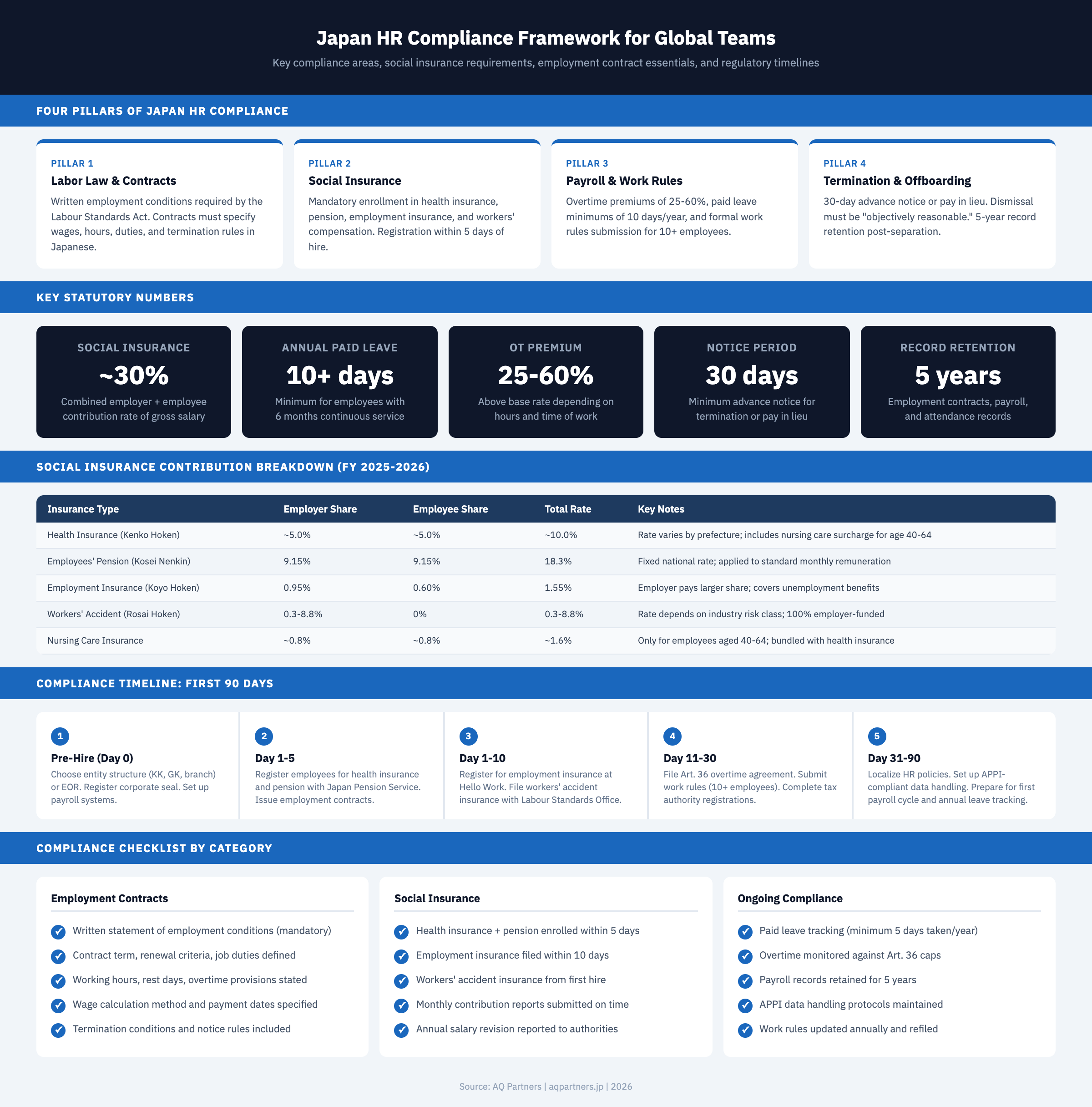
- Social insurance enrollment is mandatory within 5 days of hire, and combined employer-employee contributions total roughly 30% of gross salary, making payroll planning a critical early priority.
- Employment contracts must include written statements of conditions as required by the Labour Standards Act; failure to provide them is itself a violation, regardless of verbal agreements.
- Termination in Japan is among the most employee-protective in the world: dismissal must be "objectively reasonable," with 30 days' notice or pay in lieu, and detailed documentation at every step.
- Data governance under APPI requires explicit lawful purpose notices and strict controls on cross-border transfers, making HRIS vendor selection and policy localization critical compliance areas.
Japan HR Compliance Roadmap: Setup to Operations
A structured, milestone-based approach to Japan HR compliance ensures that global teams meet every regulatory deadline from entity formation through the first 90 days of operations. Launching operations in Japan requires founders and HR teams to navigate a series of legal, regulatory, and policy milestones. Missing or mishandling early compliance obligations can lead to costly delays, reputational damage, and regulatory penalties from labor compliance risks. This section details the critical milestones for new entrants, from pre-hire entity decisions to mandatory filings within the first 30 days, as well as localizing policies and managing labor actions by day 90. Following this roadmap helps your organization fulfill legal requirements and establishes a scalable HR foundation for future growth.
Pre‑Hire Entity vs EOR Decisions
Choosing between establishing a full legal entity or using an Employer of Record (EOR) is the first major HR compliance decision when entering Japan. For a detailed comparison, see our EOR vs entity Japan hiring guide. This decision affects how quickly you can hire staff, the complexity of administration, and your level of legal exposure. Setting up a legal entity gives your business full operational control and is ideal for companies with long-term or large-scale ambitions in Japan. However, this route involves complex registration processes, ongoing compliance obligations, and sustained local management, as outlined by the Japan External Trade Organization (JETRO).
Key considerations when choosing between forming a legal entity and using an EOR include:
- Setting up a legal entity provides full control and is best for long-term growth, but requires handling detailed registration and ongoing compliance responsibilities.
- Choosing an EOR allows companies to onboard talent quickly—often within weeks—by outsourcing payroll, tax, social insurance, and contract management, reducing administrative burdens significantly.
- Companies using an EOR relinquish some control to the service provider and must carefully assess the EOR's compliance track record to mitigate future risks.
- According to PwC, EORs enable rapid, compliant hiring, but organizations remain responsible for monitoring evolving local labor regulations.
- The right choice will balance the need for speed and flexibility with the desire for direct oversight, stability, and effective risk management in Japan.
Day 0–30 Filings and Authority Checklist
The first 30 days of HR operations in Japan are marked by critical registrations and filings. Compliance at this stage is crucial, as it forms the foundation for all future HR activities. Upon hiring their first employee, all new employers must register for labor insurance, social insurance, health insurance, pension, and with the relevant tax authorities, as specified by the Japan Cabinet Office. For a full overview of deadlines, refer to the Japan tax filing schedule and important dates.
Employers with ten or more staff are also required to prepare and submit employment contracts and formal work rules to the local Labor Standards Inspection Office. This legal infrastructure formalizes employment relationships and helps resolve disputes. The Ministry of Health, Labour and Welfare (MHLW) stresses that registration for social or health insurance, pension, and employment insurance is mandatory for all employers.
Failure to fulfill these requirements within the first month can result in penalties, onboarding delays, and trust issues with new hires. Adopting a proactive, thorough approach to these registrations allows founders and HR teams to focus on growing the business instead of addressing compliance shortcomings retroactively.
| Social Insurance Type | Enrollment Threshold | Employer Obligation | Authority |
|---|---|---|---|
| Health Insurance (Kenko Hoken) | All employees working ≥3/4 of standard hours | Register within 5 days of hire; share premiums 50/50 with employee | Japan Pension Service / Health Insurance Association |
| Employees' Pension (Kosei Nenkin) | All employees working ≥3/4 of standard hours | Register within 5 days of hire; share premiums 50/50 with employee | Japan Pension Service |
| Employment Insurance (Koyo Hoken) | Employees working ≥20 hours/week, expected employment ≥31 days | Register within 10 days of first hire; employer pays larger share of premiums | Hello Work (Public Employment Security Office) |
| Workers' Accident Compensation (Rosai Hoken) | All employees from first hire, no exceptions | Register within 10 days of first hire; employer bears full premium cost | Labour Standards Inspection Office |
| Childcare / Nursing Care Insurance | Employees aged 40–64 (nursing care); bundled with health insurance | Deduct and remit premiums alongside health insurance contributions | Japan Pension Service / Health Insurance Association |
| National Pension (Kokumin Nenkin) | Self-employed, freelancers, or employees not qualifying for Kosei Nenkin | Inform non-qualifying workers of individual enrollment obligation | Japan Pension Service / Municipal Office |
| Long-Term Care Insurance (Kaigo Hoken) | All residents aged 40+; additional premium for ages 65+ | Deduct premiums via payroll for employees aged 40–64; coordinate with municipal office for 65+ | Municipal Government / Health Insurance Association |
| Special Case: Part-Time Worker Insurance Expansion | Part-time workers at firms with 51+ employees (from Oct 2024), ≥20 hrs/week, ≥¥88,000/month | Enroll qualifying part-time workers in health insurance and pension; file notifications on time | Japan Pension Service |
Day 31–90: Setup, Policy Localization, and Approvals
After completing initial filings, companies should focus on localizing core HR policies to comply with Japanese legal and cultural standards. By day 90, employers should update employee handbooks, implement compliant procedures for work hours, leave, and data privacy, and update workplace safety documentation. These policies are not mere formalities—they must be properly filed or approved by authorities, with work rules submitted to the local Labor Standards Office for teams of ten or more, as required by the Ministry of Health, Labour and Welfare.
If your company intends to allow overtime, labor-management agreements (known as Article 36 agreements, or "36 kyotei") are necessary to define extra pay and safeguards against overwork. Thorough preparation of safety documentation demonstrates a commitment to risk management and staff welfare, and is essential to pass both routine and unannounced inspections. Because regulatory and cultural requirements are dynamic, policies should be reviewed and updated at least once a year. Treating this phase as more than just a legal obligation and instead as an opportunity to build people-centric operations can prevent avoidable disputes and compliance setbacks. Proper planning empowers leadership and distributed teams to operate confidently across Japan.
Employment Contracts and Mandatory Written Conditions
Japanese labor law requires employers to provide written statements of employment conditions to every employee at the time of hiring, and failure to do so is itself a compliance violation. Under the Labour Standards Act (LSA), employers must deliver a written document specifying key terms and conditions of employment. This obligation applies regardless of whether the employee is full-time, part-time, or on a fixed-term contract. Since April 2024, electronic delivery of these conditions via email or messaging platforms is permitted, provided the employee can print the document.
Mandatory Items in Employment Contracts
The LSA specifies that the following items must be included in the written statement of employment conditions:
- Contract duration (indefinite or fixed-term, including renewal criteria for fixed-term contracts).
- Place of work and scope of duties, including any anticipated changes.
- Working hours: start and end times, rest periods, days off, and shift rotation rules if applicable.
- Overtime provisions: whether overtime is expected, applicable caps, and premium pay rates.
- Wage calculation and payment method, including pay dates and pay period.
- Retirement and resignation rules, including retirement age and voluntary resignation procedures.
- Termination conditions and grounds for dismissal.
Since April 2024, employers must also clarify the scope of potential changes to work location and job duties for all employees, and include renewal limits and conversion-to-permanent criteria for fixed-term contract workers. These updates are part of the MHLW's ongoing effort to strengthen worker protections and reduce disputes arising from ambiguous employment terms.
Fixed-Term Contracts and the Five-Year Conversion Rule
Japan's Labour Contract Act includes a critical provision known as the "five-year rule." When a fixed-term employment contract has been renewed repeatedly and the total contract duration exceeds five years, the employee gains the right to request conversion to an indefinite-term (permanent) contract. The employer cannot refuse this request. Global teams must track contract durations carefully and plan for conversions, as failing to honor this right can result in labor disputes and regulatory action. Properly structuring contract terms and communicating renewal expectations to employees from the outset is essential to avoid misunderstandings and legal exposure.
Social Insurance: Contribution Rates and Payroll Planning
Social insurance contributions in Japan are substantial, totaling roughly 30% of gross salary when employer and employee shares are combined, and must be factored into payroll budgets from the first hire. The Japan Pension Service administers the pension and health insurance systems, while employment insurance and workers' accident compensation are managed by separate agencies. Understanding the breakdown of these contributions is essential for accurate payroll planning and compliance.
| Insurance Type | Employer Share | Employee Share | Total Rate (approx.) | Notes |
|---|---|---|---|---|
| Health Insurance (Kenko Hoken) | ~5.0% | ~5.0% | ~10.0% | Rate varies by prefecture and insurer; includes nursing care surcharge for ages 40–64 |
| Employees' Pension (Kosei Nenkin) | 9.15% | 9.15% | 18.3% | Fixed national rate; applied to "standard monthly remuneration" bands |
| Employment Insurance (Koyo Hoken) | 0.85% | 0.50% | 1.35% | FY2026 rate; employer pays larger share; covers unemployment and retraining benefits |
| Child-Care Support Levy (Kodomo Kosodate Shienkin) | 0.115% | 0.115% | 0.23% | New from April 2026; collected with health insurance premiums; scheduled to rise to roughly 0.4% by FY2028 |
| Workers' Accident Compensation (Rosai Hoken) | 0.3–8.8% | 0% | 0.3–8.8% | Rate depends on industry risk class; 100% employer-funded |
| Nursing Care Insurance (Kaigo Hoken) | ~0.8% | ~0.8% | ~1.6% | Only for employees aged 40–64; bundled with health insurance premium |
| Childcare Contribution (Kodomo/Kosodate) | ~0.36% | 0% | ~0.36% | Employer-only surcharge; collected alongside pension contributions |
| Combined Typical Total | ~16.5% | ~15.6% | ~30–32% | Varies based on industry, prefecture, and employee age |
| Bonus Contributions | Same rates as monthly | Same rates as monthly | Same rates | Health insurance and pension contributions also apply to bonuses, capped annually |
Employers must calculate contributions based on "standard monthly remuneration" (hyojun houshu getsu-gaku), which is a banded system rather than a straight percentage of actual pay. This system is updated annually, and employers must report salary revisions to the Japan Pension Service each July through the "santeikiso todoke" (annual remuneration notification). Bonuses are also subject to social insurance contributions, though annual caps apply. Proper payroll software or a knowledgeable payroll provider is strongly recommended to ensure accuracy and avoid underpayment or overpayment penalties (see our payroll software guide for Japan for a comparison of leading options).
For the full operational walkthrough of running payroll in Japan — monthly cycle, annual compliance calendar, and employee deductions — see our Japan payroll complete operational guide.
Paid Leave, Working Hours, and Overtime Regulations
Japan mandates a minimum of 10 days of annual paid leave for employees with six months of continuous service, and employers must ensure at least five of those days are actually taken each year. The paid leave system in Japan is progressive: the minimum entitlement increases with years of service, reaching a cap of 20 days per year after 6.5 years of continuous employment. Unused leave generally carries over for up to two years, but the 2019 amendment to the Labour Standards Act introduced an employer obligation to ensure each eligible employee takes at least five days of paid leave per year. Failure to meet this requirement can result in fines of up to ¥300,000 per affected employee.
Standard Working Hours and Overtime Caps
The legal standard for working hours in Japan is 8 hours per day and 40 hours per week. Any work beyond these limits constitutes overtime, which requires both a valid Article 36 (saburoku) agreement filed with the Labour Standards Inspection Office and premium pay. The standard overtime premium is 25% above the base hourly rate. Late-night work (between 10 p.m. and 5 a.m.) carries an additional 25% premium, and work on designated rest days requires a 35% premium. For large employers, overtime exceeding 60 hours per month triggers a 50% premium (with the option for compensatory leave in lieu of the additional premium for SMEs, which will be phased out).
The Article 36 agreement sets the framework for legal overtime, but even with a valid agreement, monthly overtime is generally capped at 45 hours and annual overtime at 360 hours. Special provisions allow temporary extensions up to 100 hours per month and 720 hours per year, but these are subject to strict averaging rules and health safeguards. Employers who exceed these caps face enforcement action, and in serious cases, criminal prosecution of responsible officers is possible.
Governance, Data Protection, and Cross‑Border HRIS
Effective governance and data protection are non-negotiable for international teams operating in Japan, where APPI imposes strict requirements on the collection, use, and cross-border transfer of employee personal data. As companies expand globally, governance and data protection become crucial for international teams operating in Japan. Today's HR information systems must comply with Japanese legal requirements, particularly relating to personal data, international workflows, and policy localization. A comprehensive strategy is vital to maintaining compliance and building workforce trust.
APPI Lawful Purpose Notices and Access Controls
Japan's Act on the Protection of Personal Information (APPI) requires employers to clearly state the lawful purpose of collecting and processing personal information, such as employment history, social insurance details, and health data. Transparent communication fosters trust and helps employees understand their privacy rights, according to the Personal Information Protection Commission.
To comply with APPI and maintain strong data governance, organizations should:
- Clearly define the specific purposes for which employee personal data is collected and processed, using employee handbooks or contracts for transparency.
- Specify which categories of personal data are collected, their intended uses, the parties with access, and employees' rights to data access or correction.
- Implement strict IT access controls, allowing access to sensitive records only to authorized personnel.
- Apply these protocols consistently to cloud-based HR systems, utilizing audit trails and scheduling regular reviews of user access rights.
- Foster a culture of trust and regulatory preparedness through open communication on privacy practices and regular policy updates in line with new legal guidance.
Cross‑Border Transfers and Vendor Agreements
With many global teams using centralized HR platforms, cross-border employee data transfers carry significant risks if not managed according to Personal Information Protection Commission standards. Japanese law prohibits sending personal data overseas without explicit employee consent and guarantees of equivalent privacy protections from third-party recipients.
To mitigate these risks, companies must ensure contracts with international partners—such as payroll or cloud service providers—include enforceable data privacy, breach notification, and employee redress clauses. Routine vendor due diligence and transparent communication protocols help maintain compliance and protect against legal or reputational harm in the event of a data breach. Employers should also provide employees with clear notice about where and why their data may be transferred abroad, as required by Japanese law.
Global‑to‑Japan Policy Localization and RACI
Multinational businesses often need to adapt global HR and privacy policies to meet Japanese legal requirements. Localization is mandatory—work rules, privacy documentation, and compliance training must all reflect local laws and norms, according to the Japan External Trade Organization.
An effective approach is to use a RACI (Responsible, Accountable, Consulted, Informed) matrix to clarify roles and responsibilities. This framework ensures all required stakeholders—such as local HR, global legal, and IT—are involved in every compliance process, from policy rollouts to incident management. Regular policy updates and training support ongoing compliance and readiness for inspections or audits. This structured, collaborative method reduces risk and accelerates policy adoption across the organization.
2025–2026 HR Compliance Changes and Actions
Japan's HR compliance environment is evolving rapidly, driven by digital transformation and updated labor standards. The Digital Agency of Japan's new initiatives will introduce online labor filings—reducing reliance on paper documents as early as 2025. This shift aims to eliminate administrative bottlenecks and increase regulatory transparency, as outlined by the Digital Agency of Japan.
At the same time, expected reforms will expand whistleblower protections and clarify rules around remote and telework. Companies should monitor legislative proposals and participate in public consultations. Preparing for these shifts—by updating HR information systems to support electronic filings or refreshing training materials to address new rights—will help organizations maintain resilient, compliant HR operations in Japan.
Offboarding and Termination Compliance Obligations
Japan's termination laws are among the most employee-protective in the developed world, and global teams must follow a precise sequence of consultation, notice, documentation, and post-separation reporting to avoid costly disputes. HR compliance in Japan extends beyond hiring and ongoing operations—offboarding and termination procedures are strictly regulated and must be managed systematically. Overlooking these requirements can result in costly employee disputes, reputational harm, or regulatory penalties. Adhering to each required step ensures compliant, seamless separations.
Valid Reasons, Notice, and Allowance
Dismissal in Japan is highly regulated, with limited grounds and strict processes. Terminations are allowed only for objectively valid reasons—such as proven incompetence, serious misconduct, or legitimate business redundancy—and must never be arbitrary, as stated by the Ministry of Health, Labour and Welfare.
Steps for compliant dismissal include:
- Ensuring every termination is based on objective grounds, such as documented poor performance, severe misconduct, or genuine economic reasons.
- Providing at least 30 days' notice to employees, or pay in lieu, unless a legal exception applies.
- Honoring all severance entitlements outlined in contracts or collective agreements.
- Meticulously documenting the reasons and procedures for each dismissal to protect company and employee rights.
- Following a structured process to minimize the risk of unfair dismissal claims or penalties.
Redundancy Dismissals: The Four-Factor Test
When termination is based on business redundancy rather than individual performance, Japanese courts apply a well-established four-factor test to determine whether the dismissal is valid. All four conditions must generally be satisfied:
- There is a genuine business necessity for the workforce reduction (e.g., financial difficulty or operational restructuring).
- The employer made reasonable efforts to avoid dismissal, such as offering voluntary retirement, reducing overtime, or reassigning employees to other roles or locations.
- The selection criteria for which employees are dismissed are objective and fair, not arbitrary or discriminatory.
- The employer followed adequate procedural steps, including explanation and consultation with affected employees and, where applicable, labor unions.
Courts scrutinize redundancy dismissals closely, and failure to satisfy any of these factors can result in the dismissal being declared void, with the employee entitled to reinstatement and back pay. Global teams accustomed to at-will employment jurisdictions must adjust their expectations and processes significantly when managing headcount reductions in Japan.
Consultation Sequence and Documentation
Before termination, employers must consult with the employee, explaining the grounds for dismissal and allowing them to respond. All interactions should be thoroughly documented, as recommended by the Japan External Trade Organization.
Written records of these discussions—preferably acknowledged by the employee—serve as a powerful safeguard, demonstrating procedural fairness and reducing ambiguity in case of disputes. Employers should issue clear notice documents specifying the termination date, the reason for separation, and details of any financial or benefits arrangements. Transparency is essential for compliance, even in challenging offboarding situations.
Final Pay Timing, Benefits Closure, and Rehiring Checks
Prompt payment of final wages is a legal obligation in Japan. All outstanding pay, including unused paid leave and overtime, must be settled within seven days of termination unless another agreement is in place, as specified in the Labour Standards Act.
Employers must also confirm the cut-off dates for social insurance and all company benefits to prevent administrative issues or disputes. Checking for any contractual terms or waiting periods related to rehiring maintains compliance with both internal policies and legal norms. Attention to these details ensures smooth separations and maintains regulatory trust.
Post‑Separation Recordkeeping and Employer Reporting
Compliance obligations extend beyond an employee's departure. Japanese law requires employers to retain essential records—including employment contracts, pay slips, timekeeping records, and termination documentation—for at least five years after separation (extended from three years under the 2020 LSA amendment), as mandated by the Ministry of Health, Labour and Welfare. Understanding your post-incorporation filing requirements in Japan helps ensure nothing is missed during these transitions.
Employers must also promptly notify the relevant social insurance and labor authorities of the separation to complete benefit certifications and legal closure. Diligent recordkeeping not only satisfies regulatory requirements but also provides legal protection in case of future claims or investigations, supporting both legal certainty and business integrity.
Frequently Asked Questions
What happens if my company misses the social insurance registration deadline in Japan?
If an employer fails to register employees for social insurance within the required timeframe (5 days for health insurance and pension, 10 days for employment insurance), the Japan Pension Service and relevant authorities can impose back-dated enrollment, requiring the employer to pay all missed premiums retroactively, plus late payment surcharges. In serious cases, the company may face administrative penalties and reputational damage during labor inspections. Prompt registration from the first hire is essential to avoid these consequences.
Can I terminate an employee in Japan without cause, similar to at-will employment in the US?
No. Japan does not recognize at-will employment. Dismissal must be based on objectively valid and socially reasonable grounds, such as documented poor performance, serious misconduct, or genuine business redundancy satisfying a four-factor test. Even with valid grounds, the employer must provide at least 30 days' advance notice (or pay in lieu) and follow a structured consultation and documentation process. Arbitrary or poorly documented terminations are frequently overturned by Japanese courts, resulting in reinstatement orders and back pay.
Is it mandatory to provide employment contracts in Japanese?
While the Labour Standards Act does not explicitly mandate that contracts be in Japanese, the written statement of employment conditions must be understandable to the employee. In practice, Japanese authorities expect that key documents—especially work rules filed with the Labour Standards Inspection Office—are in Japanese. For foreign employees, bilingual contracts (Japanese plus the employee's native language) are strongly recommended to ensure both regulatory compliance and the employee's informed consent. When there is a discrepancy between language versions, the Japanese version typically takes precedence in legal proceedings.
How does Japan's paid leave system differ from other countries?
Japan mandates a minimum of 10 days of annual paid leave for employees who have completed six months of continuous service with at least 80% attendance. This entitlement increases annually up to a maximum of 20 days per year. Uniquely, since 2019, Japanese employers are legally required to ensure each eligible employee takes at least 5 days of paid leave per year—one of the few countries where employers face fines (up to ¥300,000 per employee) for employees not using their leave. Unused leave carries over for up to two years before it expires.
What are the key APPI requirements for HR data when using a global HRIS platform?
Under APPI, employers must clearly state the purpose of collecting employee personal data, limit data use to those stated purposes, and implement appropriate security measures. When transferring employee data to overseas servers or third-party service providers (such as a global HRIS or payroll platform), the employer must obtain explicit employee consent and verify that the recipient provides an equivalent level of data protection. Vendor contracts must include enforceable data privacy, breach notification, and employee redress clauses. Regular audits of vendor access and data handling practices are strongly recommended.
Conclusion
Successfully managing Japanese HR compliance as a global team is a complex process requiring careful attention from initial setup through every stage of employment. Strategic choices—such as whether to incorporate a legal entity or use an Employer of Record—must be weighed considering long-term control and compliance risks. Understanding the differences between KK, GK, and branch office structures is an important part of this decision. For teams evaluating how to choose the right Japan work visa categories, aligning visa planning with HR compliance timelines ensures a smoother hiring process. Timely filings with authorities, transparent recruitment procedures, strict adherence to local labor laws, accurate payroll and time management, and robust data protection are all critical.
Staying ahead of digital trends and regulatory updates will keep operations resilient as Japan's compliance environment evolves. Achieving HR compliance in Japan isn't just about meeting legal requirements—it's a strategic advantage that builds trust, supports staff, and enables founders and teams to focus on growth. For teams planning their first hire, reviewing the complete guide to Japan work visas is a valuable next step. Companies navigating banking setup alongside HR compliance should also consult our guide to opening a corporate bank account in Japan. By staying informed, adapting to local practices, and proactively preparing for legal reforms, international teams can establish a reliable, efficient, and compliant HR foundation to drive sustainable growth in Japan's dynamic business environment.
Working with AQ Partners. Our Tokyo team provides rules of employment, employment contracts and offer letters and social and labour insurance enrolment for foreign companies operating in Japan. Book a consultation to discuss your situation.

Yuga Koda is a founding Director at AQ Partners, supporting foreign companies, funds, and families operating in Japan. His experience operating companies in both Japan and international markets gives him a practical understanding of back office operations from both sides.