
Japan Market Entry Cost Breakdown: Realistic Budget for Foreign Companies


Understanding the realistic costs of entering the Japanese market is critical for foreign companies budgeting their expansion. Total first-year costs vary dramatically—from under ¥3 million for a solo founder operating from a virtual office to over ¥50 million for a 20-person subsidiary with physical office space—and many cost components are Japan-specific, including mandatory social insurance at 15–16% of gross payroll, key money on commercial leases, and hanko (company seals) that remain legally required for certain transactions. This breakdown covers every major cost category with realistic ranges based on current 2025–2026 pricing.
Key Takeaways
- KK incorporation costs ¥202,000–¥250,000 in government fees alone—this includes ¥150,000 registration tax and ¥52,000 notarization fee, plus ¥40,000–¥50,000 for revenue stamps on articles of incorporation. GK formation costs ¥60,000 in registration tax with no notarization required, saving roughly ¥140,000.
- Employer social insurance costs add 15–16% on top of gross salaries—the employer's share of health insurance, pension, employment insurance, and workers' accident insurance is approximately 15.4% of employee gross pay, making a ¥5 million annual salary actually cost the employer ~¥5.77 million.
- Tokyo commercial lease upfront costs can reach 12–18 months of rent—standard commercial leases require security deposit (6–12 months), key money (1–2 months), first/last month rent, real estate agent fee (1 month), and guarantor company fee (0.5–1 month), creating a significant cash outlay before operations begin.
- Back office outsourcing costs ¥50,000–¥300,000/month depending on scope—accounting, payroll, tax filing, and compliance management through an outsourced provider typically costs less than a single full-time back office hire (average salary ¥4–5 million/year plus benefits) while providing broader expertise coverage.
- A solo founder can operate for under ¥3 million in the first year—using GK formation, virtual office, digital banking, and outsourced accounting, total costs including the founder's minimum social insurance contributions can stay below ¥250,000/month, though this excludes the founder's personal living expenses.
One-Time Incorporation Costs
| Cost Item | KK (株式会社) | GK (合同会社) | Branch Office |
|---|---|---|---|
| Registration tax (登録免許税) | ¥150,000 | ¥60,000 | ¥90,000 |
| Notarization fee (定款認証) | ¥30,000–¥50,000 | Not required | Not required |
| Revenue stamps (収入印紙) | ¥40,000 (paper) / ¥0 (electronic) | ¥0 | ¥0 |
| Company seals (hanko set) | ¥10,000–¥30,000 | ¥10,000–¥30,000 | ¥10,000–¥30,000 |
| Legal/judicial scrivener fees | ¥80,000–¥250,000 | ¥60,000–¥150,000 | ¥150,000–¥400,000 |
| Document translation/apostille | ¥30,000–¥100,000 | ¥30,000–¥100,000 | ¥50,000–¥200,000 |
| Registration certificate copies | ¥2,000–¥5,000 | ¥2,000–¥5,000 | ¥2,000–¥5,000 |
| Total government + professional fees | ¥312,000–¥625,000 | ¥162,000–¥345,000 | ¥302,000–¥725,000 |
The entity type comparison in the KK vs GK vs branch office guide covers the non-cost factors (governance, credibility, liability) that should drive the entity decision beyond just formation expense.
Recurring Monthly Operating Costs
| Cost Category | Solo Founder | 5-Person Team | 20-Person Subsidiary |
|---|---|---|---|
| Office / registered address | ¥5,000–¥30,000 (virtual) | ¥150,000–¥400,000 (serviced/coworking) | ¥500,000–¥2,000,000 (commercial lease) |
| Director compensation | ¥300,000–¥500,000 | ¥500,000–¥1,000,000 | ¥800,000–¥2,000,000 |
| Employee salaries (total) | N/A | ¥1,500,000–¥3,000,000 | ¥7,000,000–¥15,000,000 |
| Employer social insurance (~15.4%) | ¥46,000–¥77,000 | ¥308,000–¥616,000 | ¥1,200,000–¥2,600,000 |
| Accounting / tax advisor | ¥30,000–¥50,000 | ¥50,000–¥100,000 | ¥100,000–¥300,000 |
| Payroll processing | Included above | ¥20,000–¥50,000 | ¥50,000–¥150,000 |
| Cloud software (accounting, HR) | ¥3,000–¥5,000 | ¥10,000–¥30,000 | ¥30,000–¥80,000 |
| Total monthly | ¥384,000–¥662,000 | ¥2,538,000–¥5,196,000 | ¥9,680,000–¥22,130,000 |
Office Space Costs by City
Office rental costs vary significantly across Japan. Tokyo commands the highest rents, but other major cities offer substantial savings while maintaining access to talent and business infrastructure.
| City | Grade A Office (per tsubo/month) | Serviced Office (per desk/month) | Virtual Office (per month) |
|---|---|---|---|
| Tokyo (Minato/Chiyoda) | ¥25,000–¥40,000 | ¥60,000–¥120,000 | ¥5,000–¥30,000 |
| Tokyo (Shibuya/Shinjuku) | ¥20,000–¥32,000 | ¥50,000–¥100,000 | ¥5,000–¥25,000 |
| Osaka | ¥13,000–¥22,000 | ¥40,000–¥80,000 | ¥3,000–¥15,000 |
| Nagoya | ¥11,000–¥18,000 | ¥35,000–¥70,000 | ¥3,000–¥12,000 |
| Fukuoka | ¥10,000–¥16,000 | ¥30,000–¥60,000 | ¥3,000–¥10,000 |
| Yokohama | ¥12,000–¥20,000 | ¥35,000–¥75,000 | ¥3,000–¥15,000 |
One tsubo (坪) equals approximately 3.3 square meters or 35.6 square feet. A 5-person office in central Tokyo requires roughly 15–25 tsubo, meaning monthly rent of ¥375,000–¥1,000,000 before upfront costs. Serviced offices and coworking spaces eliminate key money and deposit requirements, making them a practical first-year option. The office setup guide covers lease terms and alternatives in detail.
Hidden and Commonly Overlooked Costs
Foreign companies frequently underbudget for Japan market entry by missing costs that are standard in the local business environment:
- Company seals (hanko): ¥10,000–¥30,000 for a set of three (representative seal, bank seal, company stamp). While Japan is gradually digitizing, seals remain required for bank account applications, real estate contracts, and certain government filings. See the company seal guide for required seal types.
- Business cards (meishi): ¥3,000–¥10,000 per batch. Japanese business etiquette requires exchanging physical cards at every meeting. Bilingual cards (Japanese on one side, English on the other) are standard for foreign companies.
- Lease guarantor company (保証会社): 50–100% of monthly rent as a one-time fee. Most commercial landlords require either a guarantor company or a personal guarantee from the representative director.
- Professional translations: ¥10,000–¥30,000 per document for certified translations of parent company documents, board resolutions, and powers of attorney required during incorporation and bank account opening.
- Annual labor insurance settlement: ¥50,000–¥500,000+ depending on total payroll. The estimated premium paid at enrollment is reconciled against actual payroll annually, potentially creating an unexpected additional payment.
- Year-end tax adjustment costs: ¥50,000–¥200,000 in additional accounting fees for year-end employee tax reconciliation (年末調整), separate from the annual corporate tax filing fee.
- Consumption tax impact: Companies with capital of ¥10 million or more owe consumption tax from day one, while those under this threshold are exempt for the first two fiscal years. The consumption tax guide covers the calculation method and filing requirements.
First-Year Total Budget Scenarios
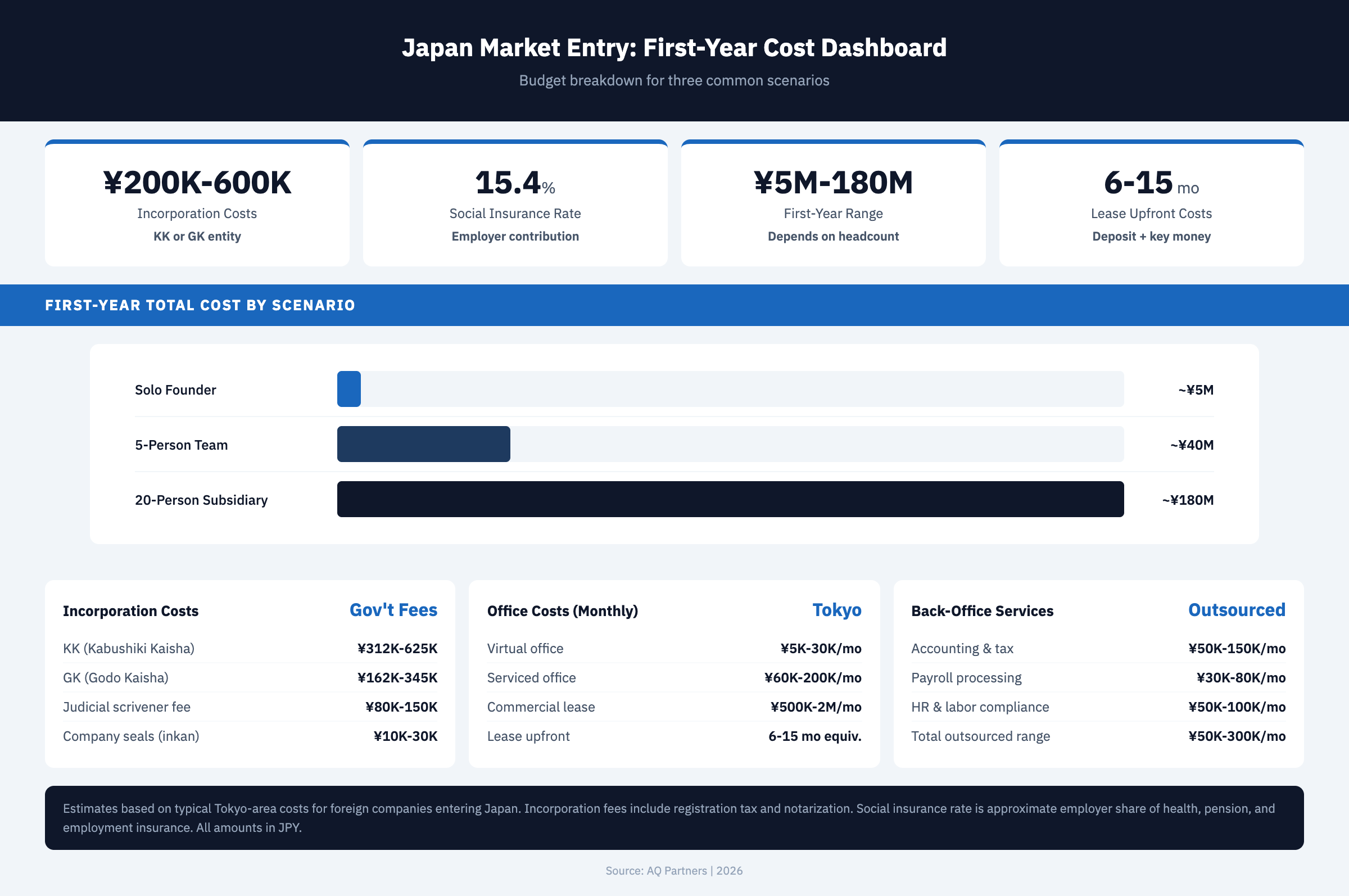
| Cost Category | Solo Founder (GK) | 5-Person Team (KK) | 20-Person Subsidiary (KK) |
|---|---|---|---|
| Incorporation | ¥200,000 | ¥450,000 | ¥600,000 |
| Office (12 months) | ¥120,000 | ¥3,000,000 | ¥15,000,000 |
| Office upfront (deposit + key money) | ¥0 | ¥0 (serviced) | ¥12,000,000–¥20,000,000 |
| Compensation (12 months) | ¥3,600,000 | ¥30,000,000 | ¥130,000,000 |
| Social insurance (employer share) | ¥554,000 | ¥4,620,000 | ¥20,000,000 |
| Back office (accounting, payroll, tax) | ¥500,000 | ¥1,200,000 | ¥3,000,000 |
| Software and tools | ¥50,000 | ¥200,000 | ¥600,000 |
| Miscellaneous (seals, meishi, etc.) | ¥50,000 | ¥150,000 | ¥300,000 |
| First-Year Total | ~¥5,074,000 | ~¥39,620,000 | ~¥181,500,000 |
These figures exclude revenue-generating costs (sales, marketing, product development) and focus purely on the operational and compliance infrastructure required to maintain a legal, functioning entity in Japan. The month-by-month timeline shows when each cost is incurred relative to the incorporation date.
Accurate cost forecasting prevents the two most common financial mistakes in Japan market entry: undercapitalizing the entity (leading to cash flow crises and bank account problems) and overbudgeting based on worst-case estimates (tying up capital unnecessarily). AQ Partners provides detailed cost projections and manages ongoing back office operations for foreign companies at every stage of Japan market entry. Contact us at hello@aqpartners.jp.

Yuga Koda is a founding Director at AQ Partners, supporting foreign companies, funds, and families operating in Japan. His experience operating companies in both Japan and international markets gives him a practical understanding of back office operations from both sides.