
Paper vs Digital: Navigating Document Rules in Japanese Back Offices


Paper vs Digital: Navigating Document Rules in Japanese Back Offices
Expanding into Japan's market takes much more than product expertise or a winning sales strategy. For international founders and distributed startup teams, the real challenge often lies in navigating the intricate maze of Japanese back-office workflows—systems still heavily reliant on paper documents, personal seals, and nuanced regulatory requirements. Understanding where tradition intersects with digital transformation is not just about compliance; it is essential for accelerating business and ensuring operational reliability in Japan.
Key Takeaways
- Physical seals remain legally mandatory for key transactions. Articles of incorporation and bank account openings still require physical jitsuin and ginkoin seals respectively—no digital alternative is permitted for these documents as of 2026.
- Japan recognizes e-signatures with full legal parity. The 2001 Act on Electronic Signatures (AESCB) grants electronic signatures the same legal standing as handwritten signatures or seals, provided accredited platforms and cryptographic identity verification are used.
- A risk-based framework determines the correct signing method. High-risk documents (M&A, employment contracts, board resolutions) require qualified e-signatures with PKI certificates, while routine approvals and internal documents can use standard digital workflows.
- Foreign companies must register a corporate seal before conducting any business. Jitsuin registration at the Legal Affairs Bureau is the first step in company formation and is a prerequisite for signing contracts, opening bank accounts, and filing with government agencies.
- Hybrid paper-digital workflows are the operational reality. Japanese law accepts bilingual contracts and cross-border e-signatures from accredited overseas providers, but companies should expect a mix of physical and digital processes across different document categories.
Paper, Digital, and Seals in Japanese Back-Office Reality
Despite ongoing digitization efforts, the foundation of Japanese administrative operations largely remains tied to paper and the iconic hanko seal. For overseas founders and lean teams, this blend of old and new introduces a range of challenges, from delayed contract sign-offs to uncertainty about the legal validity of documents. The continued use of paper and seals is deliberate: cultural trust, legal certainty, and risk management all reinforce their relevance—especially for documents with significant legal, financial, or reputational impact, as noted by JETRO. Successfully navigating this environment requires a practical understanding of what is not only possible digitally, but also what is permitted—and advisable—by Japanese standards.
What Hanko Seals Mean Operationally for Approvals and Risk
For those unfamiliar with the dual nature of hanko seal usage in Japanese business, the main implications are:
- Hanko seals function as formal, binding signatures in most business and legal settings, serving as clear proof of intent and accountability, especially when registered and securely managed.
- Manual, in-person seal use minimizes risks of unauthorized signatures. However, any lapse in controls or misuse can increase legal exposure, since affixed seals are presumed genuine by default.
- Distributed or remote teams face delays, as seal-dependent documents must be routed through local custodians, adding complexity to workflows.
Seal Taxonomy and Remaining Business Use-Cases
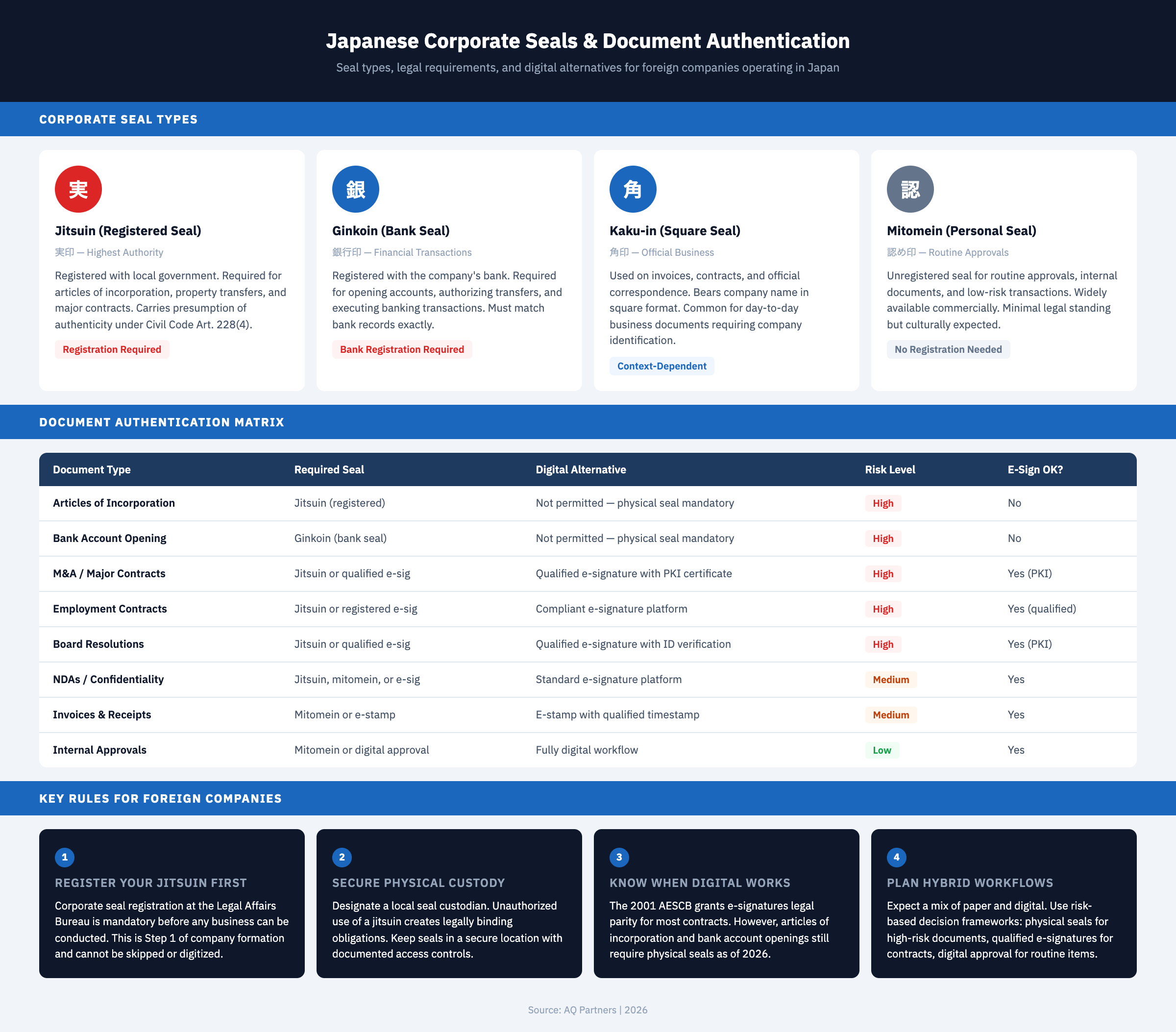
To navigate Japan's document landscape, it is crucial to understand the different types of seals. The jitsuin is the most authoritative seal: it is registered with a local government office and used for legally binding contracts, articles of incorporation, and property transactions. Ginkoin are specialized for bank transactions and are directly linked to company accounts—learn more about opening a corporate bank account in Japan. Mitomein seals are informal and typically used for routine approvals or documents of lesser importance, as outlined by JETRO and the Japan Ministry of Justice.
While digital alternatives are increasingly used—especially for internal approvals and lower-risk transactions—jitsuin and ginkoin are still required for significant agreements, employment contracts, and banking matters. For a deeper understanding of how these seals fit into company formation, see our guide to the Japan inkan corporate seal system. Consequently, even as electronic workflows become more common, physical seals remain indispensable for major milestones and transactions involving Japanese parties or regulated sectors. The takeaway for startups and foreign companies is clear: prepare for hybrid workflows and prioritize understanding when a physical seal is non-negotiable.
How Ringi Workflows Translate to Digital Without Slowing Teams
The traditional Japanese ringi process—in which proposals or contracts are sequentially reviewed and stamped by multiple stakeholders—ensured transparency and consensus, but often led to operational slowdowns, especially in global or distributed companies.
Today, modern digital workflow solutions in Japan replicate the ringi process with secure e-signature chains and automated routing. Documents are circulated electronically for sequential approval, preserving the integrity of the original process while introducing features such as digital audit trails and real-time handoffs, as noted by McKinsey. Digital ringi maintains organizational control and accountability while significantly reducing administrative cycle times and improving traceability. For international businesses, this represents a practical path to compliance that supports business agility.
Regulatory Framework for E-Signatures, Seals, and Retention in Japan
Japan's regulatory framework gives e-signatures legal parity with physical seals for most business documents, while imposing strict retention and timestamp requirements for tax and accounting records. Regulations established over the past two decades specify when and how electronic signatures and seals may replace traditional methods, along with requirements for storing and accessing these records. By understanding these standards, startups and new market entrants can make informed decisions that balance efficiency, compliance, and risk. Those evaluating their entity structuring strategy for Japan entry should factor these document requirements into their planning from the outset.
Act on Electronic Signatures in Plain English
Key elements of the Act on Electronic Signatures and Certification Business (AESCB):
- The law grants legal parity between electronic and handwritten signatures or personal seals, as long as standards-based technology and accredited providers are used.
- Legal validity requires ensuring both signer identity and document integrity, primarily through cryptographically secure solutions.
- Standard business contracts can be executed online if compliant e-signature platforms are used and the parties' identities and intentions are authenticated reliably.
- For startups and international firms, the AESCB enables digital signing of contracts, governance, and HR documents at speed, retaining full legal certainty often without physical paperwork.
Electronic Books and Record Retention Requirements
Japan's approach to e-signatures is supported by modernized document retention requirements. The amended Electronic Books Maintenance Act requires companies to store accounting, tax, and certain business records in systems that ensure long-term accessibility, readability, and, crucially, immutability, as outlined by the National Tax Agency Japan.
Compliant storage systems must use safeguards such as access logs, versioning, and qualified timestamps to demonstrate that records have not been altered. These requirements are especially strict for tax-related documents and materials required during audits. For guidance on structuring your financial records, see our article on chart of accounts management in Japan. The benefit: digital archives, when properly implemented, reduce paperwork, enable rapid data access, and simplify regulatory audits.
Qualified Timestamps and Long-Term Validation Basics
Japanese law increasingly requires qualified timestamps for digital documents. These timestamps serve two main purposes: proving a document existed at a specific time and confirming its integrity since then, under criteria set by trusted authorities, as described by the Japan Agency for Local Authority Information Systems.
This technology is central to secure digital archiving and is recognized by law as protection against backdating or tampering claims. For accounting and HR records, applying qualified timestamps and verifying provider compliance delivers significant audit assurance. For companies transitioning from paper, this means digital records are both convenient and carry legal weight.
Timeline of Reforms and Recent Updates
Japan's move toward paperless administration has evolved gradually. The foundational e-signature act debuted in 2001, paving the way for further progress. Major reforms in 2018 expanded acceptance of electronic contracts, while changes in 2022–2023 advanced digital archiving, particularly for tax and financial documentation, according to JETRO and the Cabinet Office Japan.
For global founders and agile startups, these regulatory advances bring a valuable opportunity: each update makes digital operations not only possible but increasingly advantageous, allowing companies to use e-signatures and secure digital archives with confidence. The focus has shifted from whether digital is permissible, to how extensively it can accelerate business.
Decision Framework and Document Matrix by Document Type
A risk-based decision framework is the most effective way to determine the correct signing and archiving method for each document type in Japan. Japan's complex document regulations make a one-size-fits-all approach to digitalization impractical. Leading practice is now a risk-based framework tailored to document type, legal risk, and business importance. Whether for low-risk internal communications or high-value contracts, understanding which documents can be digitized—and how—is vital for compliance and operational efficiency.
Risk-Based Decision Tree by Document Category
The main principles guiding this decision matrix for signing and archiving methods are:
- High-risk documents—such as M&A contracts, IP assignments, or board resolutions—require strong safeguards such as robust e-signatures, advanced identity verification, and occasionally physical documents with registered seals.
- Routine documentation (like expense claims, internal HR approvals, and vendor requests) generally qualifies for digital solutions, using standard e-signatures and cloud-based records with access logs.
- This approach streamlines approvals while minimizing compliance risk or audit gaps. The level of document risk—not procedural convenience—drives workflow choices.
- A tailored strategy boosts efficiency by focusing detailed controls where they matter most.
| Document Type | Seal/Signature Requirement | Digital Alternative | Risk Level |
|---|---|---|---|
| Articles of Incorporation | Jitsuin (registered seal) required | Not permitted — physical seal mandatory | High |
| Major Sales Contracts / M&A | Jitsuin or qualified e-signature | Qualified e-signature with PKI certificate | High |
| Employment Contracts | Jitsuin or registered e-signature | Compliant e-signature platform accepted | High |
| Bank Account Opening Documents | Ginkoin (bank seal) required | Not permitted — physical bank seal mandatory | High |
| Board Resolutions | Jitsuin or qualified e-signature | Qualified e-signature with identity verification | High |
| NDAs / Confidentiality Agreements | Jitsuin, mitomein, or e-signature | Standard e-signature platform accepted | Medium |
| Purchase Orders | Mitomein or digital approval | E-stamp via workflow platform | Medium |
| Invoices & Receipts | Mitomein or e-stamp | E-stamp with qualified timestamp | Medium |
| Internal Approvals / Expense Claims | Mitomein or digital approval | Fully digital workflow accepted | Low |
| Daily Operations Logs | No seal required | Read-only PDF with access controls | Low |
Identity Assurance, Signing Methods, and Exception Handling
Selecting the right identity assurance level and signing method for each document category is essential for both legal enforceability and operational efficiency in Japan. Companies must align signing and retention practices with regulatory requirements, business norms, and operational needs. Implementing a clear decision framework ensures every document—from a sales agreement to an internal memo—follows the correct approval path and remains enforceable, auditable, and compliant.
Risk Stratification and Signing Protocols
Risk stratification shapes effective signing protocols. Each document is evaluated for its purpose, legal exposure, and business impact, then matched to a suitable approval and storage method. For example, high-risk documents like key sales contracts or employment agreements require the highest level of assurance—typically qualified e-signatures and strong archiving. In contrast, routine travel requests or basic purchase orders can be processed through simpler, entirely digital workflows. As noted by Deloitte Japan, such decision trees help teams quickly determine when a wet signature, high-assurance digital signature, or standard internal authentication suffices.
This approach offers substantial benefits: it prevents excessive process for low-risk approvals and ensures critical records withstand legal and audit scrutiny. It also streamlines onboarding for local and distributed teams, clarifying expectations for every scenario.
Identity Assurance Levels and Certificate Choices
The credibility of Japan's digital signature regime depends on robust signer identification. For high-value or regulated documents, verifying who signed is essential. Most companies use PKI-based certificates—such as X.509 certificates—to ensure tamper-resistance and dependable authentication. Key documents like labor contracts, shareholder consents, and regulatory filings typically require this cryptographic protection to connect digital certificates to individuals or entities, as detailed in the METI e-Seal Guidelines.
Lower-risk documents can use standard e-signature platforms that guarantee traceability without always relying on personal certificates. This multi-tiered method lets organizations choose the right provider and supports onboarding of international signers, since global PKI certificates are increasingly accepted under Japanese law. The result is a scalable, defensible system matched to business complexity and compliance risk.
Document Matrix Mapping Permitted Signing Methods
A comprehensive document matrix clearly specifies signing and retention practices by document category within the company. This clarity removes uncertainty—even for new staff or cross-border teams. For instance, employment contracts might require a registered e-signature to satisfy all legal requirements, while daily operations logs could be stored as read-only PDFs with strong access controls, as provided by Japan e-Gov.
Such specificity helps companies avoid costly errors, like invalidating agreements with the wrong type of signature or failing tax audits due to poor archiving. It also enables operational flexibility, as the matrix can quickly adapt to new regulations or technologies, ensuring compliance is maintained with minimal disruption.
Exception Handling, Counterparties, and Escalation Paths
For multinational companies, hybrid workflows and exceptions are inevitable, especially when cooperating with local partners less familiar with digital tools. In these instances, the decision framework includes escalation protocols: documents that require traditional signatures or cannot be processed digitally are referred to legal or compliance teams for review. These teams assess risk, may add extra controls, or revert to paper workflows for critical matters, according to TMI Associates.
This flexibility maintains business continuity, accommodates less digitalized vendors, and aligns with global compliance standards. Detailed documentation of exceptions strengthens audit readiness and maintains governance as digital transformation continues.
Workflow Blueprints and Hybrid Cross-Border Execution
Hybrid workflows that combine physical seals with digital signatures are the standard operating model for multinational teams in Japan. For overseas-founded or multinational teams, executing compliant workflows across paper and digital boundaries is crucial. These workflows must adhere to Japanese legal standards while supporting bilingual documentation, integration with parent company systems, and seamless engagement with international partners. Japanese organizations are thus adopting hybrid models, combining traditional seal-based steps with fully digital signature and document management workflows.
Procurement POs from Request to E-Stamp
Here's how digital procurement workflows are transforming approval and record-keeping:
- Digital Purchase Order (PO) requests are initiated in the system, which then routes approval sequentially to all necessary stakeholders.
- Approvers digitally affix an e-stamp or authorized seal at each stage, with all actions time-stamped and recorded within the platform.
- Once finalized, POs are archived with a qualified timestamp, creating a complete, tamper-proof record for audits or reviews.
- This e-stamping method shortens approval cycles, reduces manual errors, and strengthens compliance with a secure approval chain.
Sales Contracts and NDAs with E-Sign Compatibility
Sales contracts and NDAs are vital to relationship-driven business in Japan. Today, these documents are often signed using qualified e-signature solutions—provided identity, document integrity, and audit standards are fully met. Platforms compliant with Japanese regulations (such as METI or e-Gov standards) enable streamlined, multi-device execution, speeding deal cycles and reducing cross-border complexity, as described by CMS Law.
When counterparties require paper signatures or incompatible digital systems, hybrid signing—one party digital, the other paper—is still accepted if the process is properly safeguarded. This ensures business moves forward without losing enforceability or auditability.
Invoicing and Receipt Stamps Under Digital Workflows
Japanese regulations now recognize digital invoices and receipts, provided they are e-stamped or e-signed and meet strict standards for readability, integrity, and retrieval. The National Tax Agency Japan supports this shift, encouraging digital archiving and tax-aligned workflows.
For international teams and lean startups, this change removes the last barrier of paper reliance and shortens payment cycles. As clients and tax authorities accept digital documentation, operational costs drop and financial accuracy improves.
Cross-Border and Bilingual Execution Accepted in Japan
Bilingual and cross-border contracts are increasingly the norm in global operations. Japanese law allows contracts in both Japanese and other languages, and accepts e-signatures from accredited overseas providers as legally binding, provided regulatory standards are observed. Hybrid execution is now widespread, securing both parties' interests and enforceability under Japanese law, as explained by JETRO.
As a result, businesses can close contracts that are enforceable in Japanese courts and meet global compliance standards. Companies choosing between a Kabushiki Kaisha, Goudou Kaisha, or branch office should consider how each structure affects their document execution requirements. For teams managing HR compliance for global teams in Japan, understanding cross-border document execution is particularly important for employment agreements and labor filings.
Operational Controls and Implementation Patterns for Digital Seals
Strong operational controls are what separate a legally defensible digital seal implementation from one that exposes the company to compliance risk. Migrating to digital seals does not reduce security or integrity—in fact, it raises the governance standard. Strong security, careful vendor selection, and integrated compliance processes are necessary at every step. Organizations excelling in these controls gain real competitive advantages, combining risk mitigation with audit readiness.
Vendor-Neutral Criteria for E-Signature Platforms
Best practices for compliance-driven, vendor-neutral e-signature platforms include:
- Choosing solutions that enable interoperability across systems, minimizing future lock-in while supporting evolving regulatory requirements.
- Ensuring platforms adhere to both Japanese and international standards to preserve legal validity for cross-border transactions.
- Neutral vendors reduce operational risk and allow smoother integration with changing technology and business partners.
- For startups and founders, these strategies lower onboarding costs, support scalable growth, and guarantee long-term access to records, regardless of platform changes.
Integrations with ERP, HRIS, and Approval Systems
To maximize efficiency and minimize manual work, digital seal deployments should integrate closely with core business applications—ERP for finance, HRIS for people management, and workflow tools for daily approvals. API-driven integrations embed e-signature and seal steps directly in processes, making compliance a natural part of the workflow, as described by Box Japan Blog.
This automation shortens approval times, reduces data entry errors, and consolidates compliance reporting. It is especially valuable for distributed or remote teams, uniting approvals across locations and reducing dependence on physical presence.
Audit Trails and Segregation of Duties
As with physical seals, digital signature and seal workflows must log every action—who signed, when, by what method, and on which device. Audit trails are a legal requirement under Japanese law, as detailed by Deloitte Japan. Advanced systems also enforce segregation of duties, ensuring that no single person can both initiate and approve the same agreement.
This setup minimizes fraud, unauthorized changes, and liability risk. During audits or investigations, these immutable logs provide essential evidence, building trust with regulators, partners, and clients.
Governance for Lost Seals and Certificate Rotation
Digital systems have unique risks. If a digital seal or certificate is compromised, immediate action is necessary: revoke the credential, issue a replacement, and notify all affected parties. Japanese standards formalize these procedures, treating a digital credential loss as seriously as losing a physical hanko, according to METI.
Proactive certificate rotation—regular updates and documentation—ensures that no credential remains a weak point. When applied rigorously, these controls embed resilience and trust throughout the digital document lifecycle.
Conclusion
Japan's back-office transformation stands at the crossroads of tradition and innovation. While paper and physical seals remain necessary for certain processes, robust regulations and advanced technology now enable digital signing, electronic archiving, and cross-border execution to be both practical and legally robust. Companies that implement risk-based frameworks, vendor-neutral platforms, and strong audit controls can confidently master Japanese document management. Be sure to review the post-incorporation filing requirements in Japan to ensure your document workflows are complete from day one. As regulatory changes accelerate and market expectations evolve, those pursuing pragmatic, hybrid workflows will be best positioned for credibility, agility, and sustained growth in Japan's dynamic business environment.
Working with AQ Partners. Our Tokyo team provides back office operations and entity seal storage and administration for foreign companies operating in Japan. Book a consultation to discuss your situation.

Yuga Koda is a founding Director at AQ Partners, supporting foreign companies, funds, and families operating in Japan. His experience operating companies in both Japan and international markets gives him a practical understanding of back office operations from both sides.