
Replacing Your Japan Distributor with a Subsidiary

Replacing a Japan distributor with your own subsidiary means moving Japanese sales from a third party that buys your products and resells them in its own name to a company you own, usually a KK or GK. The distributor relationship ends, and customers, data, stock, invoicing, product registrations and brand move to the new entity.
This guide covers the signals, the law on ending a distributorship, and the handover order so customers see no gap.
Key Takeaways
- Japan has no distributor indemnity statute. Companies Act Art. 19 sets two months' notice only for commercial agents whose contract has no fixed term; a distributor's exit turns on the contract and good faith.
- Long relationships carry expectations. The distributor's investment, its dependence on your products and the notice you give shape how defensible an exit is.
- Buying the business changes the rules. It brings shareholder approval tests, a default 20-year non-compete on the seller and a route for customer data to move without individual consent.
- Brand and registrations come first. Check whose name the Japanese trademark and any product approvals are in before notice is served.
- The subsidiary must be able to invoice on day one. Settle qualified invoice registration and the consumption tax position before the first order moves.
Signals That It Is Time to Take Japan Sales in House
Replace a distributor when its margin exceeds the cost of running your own entity, or when it blocks market access you now need. That access means customers, pricing and product feedback.
The distributor's margin on Japan sales is the budget the subsidiary has to beat. Our guide to budgeting a Japan subsidiary in yen lists the statutory cost lines HQ usually misses.
| Signal | What it tells you | Check before acting |
|---|---|---|
| Distributor margin exceeds the cost of a small team | The economics favour a direct model | Full yen budget for the entity, not only headcount |
| Key accounts ask to contract with the manufacturer | Customers already see you as the counterparty | Whether those contracts can be assigned or must be re-signed |
| Sales effort is flat or the distributor adds competing lines | Your products are no longer its priority | Minimum purchase and exclusivity clauses you can rely on |
| No access to end-customer data or pricing | You cannot plan or defend the market | What data rights the contract gives you after it ends |
| Brand or product approvals held in the distributor's name | Your market access depends on a third party | Registration records and any transfer obligations |
| Contract term is nearing its end | A natural exit window is coming | Renewal and non-renewal notice dates in the agreement |
If HQ staff already negotiate with Japanese customers, read our note on permanent establishment risk before the entity exists.
How Japanese Law Treats Ending a Distributorship
Japan has no statute that sets notice or compensation for ending a distributorship. The contract governs, read against the good-faith duty in the Civil Code. A fixed statutory notice period exists only for commercial agents, which sell on the principal's behalf rather than buying and reselling.
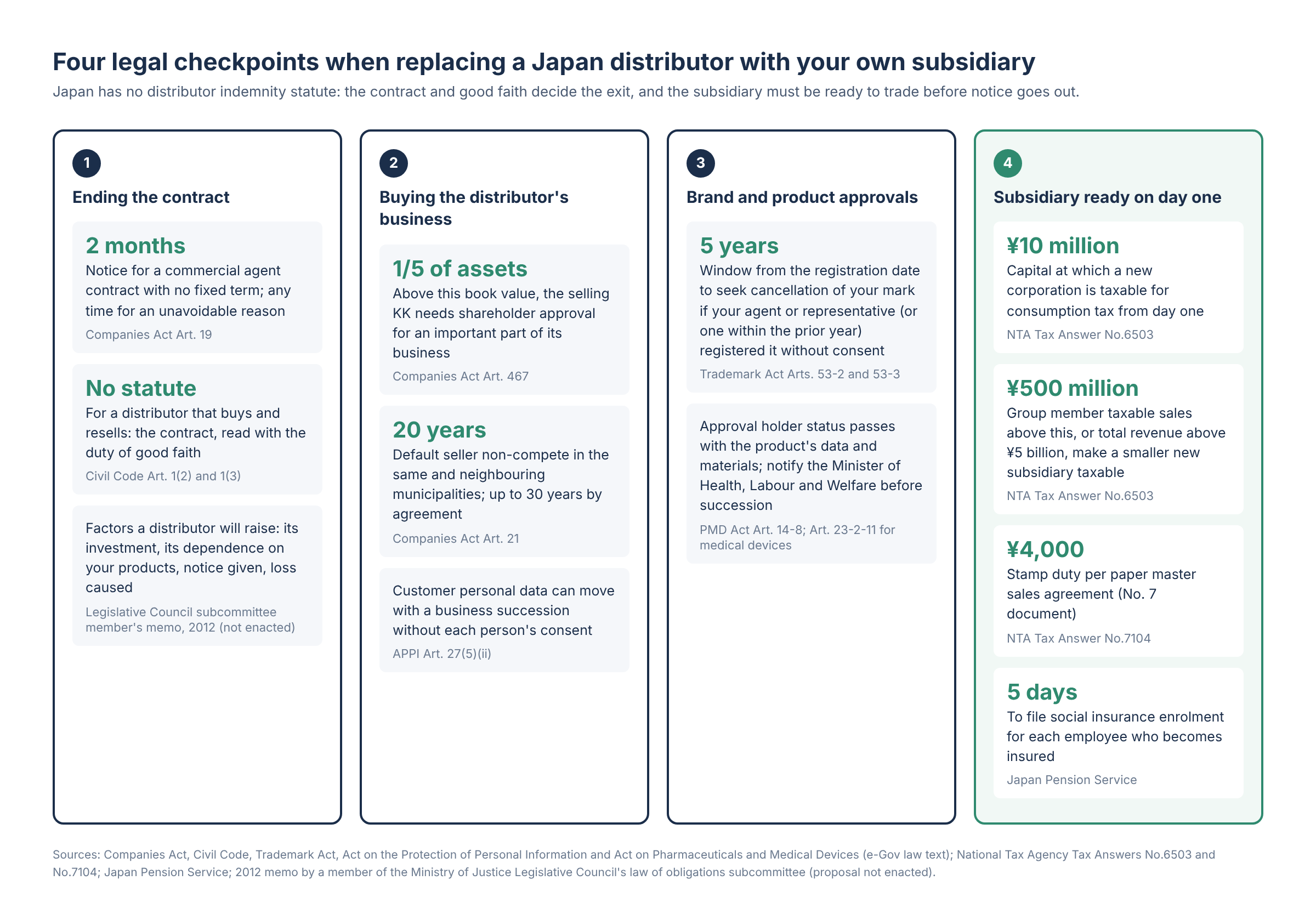
The Companies Act defines a commercial agent (代理商, dairishō) in Art. 16 as a non-employee who acts as agent or intermediary in the company's ordinary transactions. Art. 19 lets either side end an agency contract with no fixed term on two months' notice, or at any time for an unavoidable reason. A distributor that resells in its own name falls outside that definition.
For a distributor, the Civil Code Art. 1(2) requires rights to be exercised and duties performed in good faith, and Art. 1(3) prohibits abuse of rights. The Civil Code contains no specific rule on ending long-running supply contracts. A 23 October 2012 memo by a member of the Ministry of Justice Legislative Council's law of obligations subcommittee proposed one; it was not enacted. The factors it listed are still a practical checklist of what a distributor will raise:
- the content and purpose of the contract and who the parties are;
- investment the distributor made to keep the relationship going;
- how dependent the distributor is on your products;
- how the decision to end came about, and whether notice was given;
- the loss the ending causes the distributor.
A distributor that built a warehouse, hired staff or ran years of exclusive marketing for your line has the strongest case for long notice or compensation.
Choosing the Exit Route
There are four exits: let the contract expire, give contractual notice, negotiate a run-off, or buy the distributor's Japan business; the last row checks whether the partner is really an agent. The choice decides what moves automatically and what has to be rebuilt customer by customer.
| Route | Legal anchor | What moves to the subsidiary | Watch for |
|---|---|---|---|
| Non-renewal at term end | Contract term; Civil Code Art. 1(2) | Nothing automatically; customers are won over one by one | Missing the non-renewal notice date, which can roll the term over |
| Notice under the contract | Contract notice clause; Civil Code Art. 1(2) and 1(3) | Nothing automatically | Short notice after a long, exclusive relationship |
| Negotiated exit with run-off | Termination agreement | Whatever the agreement covers: stock, open orders, introductions | Customer data the distributor cannot hand over without consent |
| Buy the Japan business | Companies Act Arts. 21 and 467 | Assets, contracts and data named in the transfer agreement | Each customer contract and employee still needs consent to move |
| Agent rather than distributor | Companies Act Art. 19 | Customer contracts are already yours | Two months' notice if the contract has no fixed term |
Under Companies Act Art. 467, a KK selling all of its business, or an important part whose book value exceeds one-fifth of its total assets, needs, in principle, approval at a shareholders' meeting. If the distributor is a company, Art. 21 bars it from running the same business in the same municipality and neighbouring ones for 20 years after the transfer unless the parties agree otherwise, and a contractual non-compete is valid for up to 30 years.
Brand, Product Registrations and Customer Data
Before serving notice, confirm who legally holds the Japanese trademark, any product approvals and the customer records. Each has its own legal route back to you.
Trademark. Search the Japan Patent Office register for your marks. If your agent or representative, or someone who was one in the year before filing, registered your mark without your consent or a justifiable reason, Trademark Act Art. 53-2 lets the holder of the right in a Paris Convention, WTO or Trademark Law Treaty country request a trial to cancel it. Art. 53-3 bars that request 5 years after the registration date.
Product approvals. For regulated products (drugs, cosmetics, medical devices), find out whose name each approval is in. Under Art. 14-8 of the Act on Pharmaceuticals and Medical Devices (Art. 23-2-11 for medical devices), an approval holder's status passes to a transferee that receives the product's data and materials for that purpose, with notice to the Minister of Health, Labour and Welfare before the succession. The subsidiary also needs its own marketing business licence (Art. 12; Art. 23-2 for devices). Plan both with a regulatory specialist; they set the earliest sale date.
Customer data. Names and contact details of buyers at corporate customers are personal data. Art. 27 of the Act on the Protection of Personal Information prohibits passing personal data to a third party without each person's consent, but Art. 27(5)(ii) does not treat a recipient as a third party when the data moves with a business succession by merger or similar event. A plain termination has no such route; a business transfer does.
Setting Up the Subsidiary to Invoice From Day One
Customers switch smoothly only if the subsidiary can sign contracts and issue a valid qualified invoice from day one. That means incorporation, qualified invoice registration and a settled consumption tax position before the first order moves.
A new corporation is taxable for consumption tax in each of its first two years that starts with capital of ¥10 million or more, so from day one if incorporated with that much.
Below that, NTA Tax Answer No.6503 still removes the exemption for a specified new corporation: one more than 50% owned, directly or indirectly, by a person whose group includes a member with taxable sales above ¥500 million in the reference period or, for periods starting on or after 1 October 2024, total revenue above ¥5 billion. Our guide to the start-up exemption for large-group subsidiaries covers the test.
Business customers need the subsidiary's registration number (T followed by its 13-digit corporate number, per NTA Tax Answer No.6498) to claim input tax credit. Apply early; qualified invoice registration for a new subsidiary explains the timing.
New master sales agreements carry stamp duty: a paper basic contract for continuing sales that fixes items such as product type, quantity, unit price or payment terms is a No. 7 document taxed at ¥4,000 per copy, unless its term is 3 months or less with no renewal clause (NTA Tax Answer No.7104).
Moving Customers, Stock and People
The handover is a sequence of contracts and filings, and most steps need the consent of the customer, distributor or employee involved.
| Workstream | Legal point | Documents | Common mistake |
|---|---|---|---|
| Customer contracts | The customer's contract is with the distributor; it moves only with consent | New master agreement or tripartite novation | Announcing the switch before the subsidiary can contract |
| Stock buyback | A domestic sale taxed at the applicable rate (10% standard, 8% reduced for food and non-alcoholic beverages) | Purchase agreement, stock count, qualified invoice from the distributor | Buying from an unregistered seller, which limits the input tax credit |
| Imports | If the subsidiary imports, it becomes the importer and pays import consumption tax | Customs broker appointment, intercompany supply agreement | No intercompany price set before the first shipment |
| Distributor staff | Civil Code Art. 625(1): an employer cannot assign its rights to a third party without the worker's consent | Offer letter and employment contract with the subsidiary | Assuming staff transfer with the business |
| Social insurance | Employer files the acquisition notification within 5 days of an employee becoming insured (Japan Pension Service) | New application for the office, then one notification per employee | Hiring before the office is enrolled |
Sequencing the Handover
Work backwards from the date the distributor stops selling. The subsidiary should be incorporated, registered for qualified invoices and able to contract before that date, and notice should go out only once the brand and approvals position is known.
- Review the distributor agreement for term, notice, exclusivity, sell-off, stock buyback and data clauses.
- Confirm trademark and product approval holders and start any transfer or cancellation steps.
- Incorporate the subsidiary; see the headquarters playbook for setting up a Japan subsidiary and KK vs GK for a multinational, or converting a branch to a subsidiary.
- Complete post-incorporation filings, including tax office notifications, the bank account and qualified invoice registration.
- Serve notice or sign the exit agreement, with a run-off period that matches the subsidiary's readiness.
- Move customers, stock and staff and close out the distributor's open orders.
FAQ
Do we have to compensate the distributor when we end the agreement?
Settle it in the exit agreement: run-off length, stock buyback price, open orders and who serves each customer until the switch. These terms can stand in place of cash for a distributor with a long exclusive history.
Can the subsidiary hire the distributor's sales team?
Yes, if each person agrees and resigns from the distributor; the subsidiary then hires them on its own contracts. Check the distributor agreement for any non-solicitation clause first.
Should the new subsidiary be a KK or a GK?
Both can trade, import and register for qualified invoices. For a multinational the differences are customer perception, governance and US check-the-box treatment, covered in our KK vs GK guide.
Working with AQ Partners. Our Tokyo team provides KK and GK incorporation, qualified invoice issuer registration and customer invoicing administration for foreign companies operating in Japan. Book a consultation to review your Japan setup plan before notice goes to your distributor.

Yuga Koda is a founding Director at AQ Partners, supporting foreign companies, funds, and families operating in Japan. His experience operating companies in both Japan and international markets gives him a practical understanding of back office operations from both sides.