
Budgeting a Japan Subsidiary in Yen: FX Assumptions and the Statutory Cost Lines HQ Forgets


Budgeting a Japan subsidiary in yen means building the entity's annual plan in its operating currency, translating it into the group currency at a single planning rate set by group treasury, and including the Japanese statutory cost lines that do not exist in the parent's home budget. A yen budget lets headquarters separate two things a group-currency budget mixes together: how the subsidiary performed and how the exchange rate moved. It also forces questions that are easy to skip in a first Japan budget, such as what employer social insurance adds to each salary, which taxes are due even in a loss year, and when cash leaves the entity as opposed to when costs hit the profit and loss account. This guide sets out the planning-rate method, the statutory contribution rates to budget, a line-item template with how to estimate each line, and the cash timing differences that catch new subsidiaries.
Key Takeaways
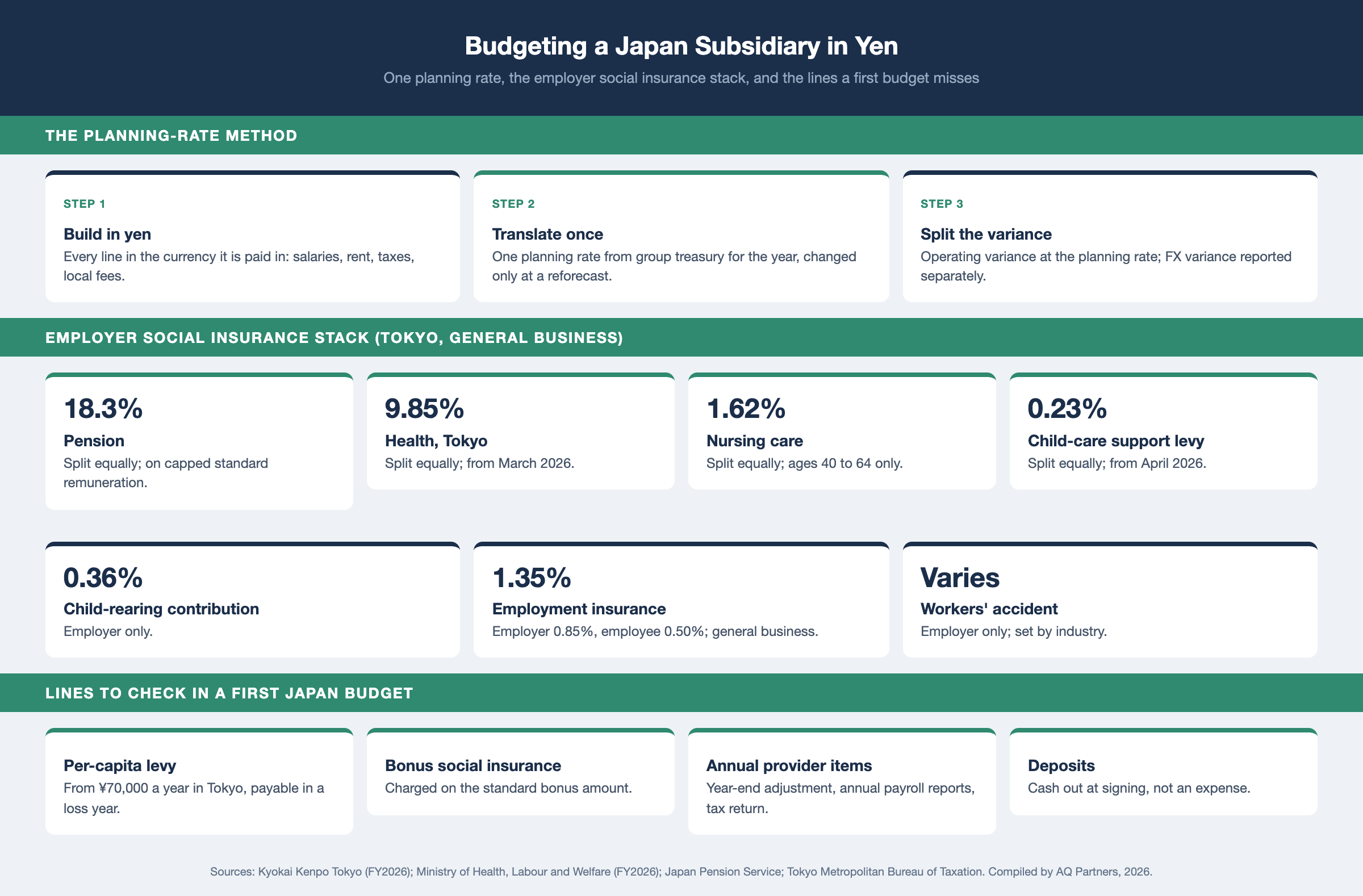
- Budget in yen, translate once. Build every line in yen and translate at one planning rate from group treasury, so operating variance and FX variance can be reported separately.
- Employer social insurance is a percentage stack, not one rate. Pension, health, nursing care, the child-care support levy, the employer-only child-rearing contribution, employment insurance, and workers' accident insurance each have their own rate and split.
- Some taxes are due in a loss year. The corporate inhabitant tax per-capita levy in Tokyo starts at ¥70,000 a year and is payable regardless of profit.
- Cash timing differs from the profit and loss. Lease deposits, consumption tax, bonus months, and withholding remittances move cash at different times from the expense they relate to.
- Professional fees belong in the budget by scope. The provider, zeirishi, sharoushi, and shiho-shoshi each bill for different work, and the budget should name the scope behind each line rather than one "admin" figure.
Why a Japan Subsidiary Budget Should Be Built in Yen
A yen budget keeps Japanese costs in the currency they are paid in, so exchange rate movement cannot be mistaken for the subsidiary's performance.
Almost every cost a Japan subsidiary incurs is fixed in yen: salaries, rent, social insurance, taxes, and local professional fees. If headquarters builds the budget in dollars or euros and the yen moves, every line shows a variance that the local team did nothing to cause. The standard group approach is to build the budget in yen, ask group treasury for a single planning rate for the year, and translate the whole budget at that rate for consolidation. Intercompany charges deserve a separate decision: whether management fees and recharges are invoiced in yen or in the group currency determines which entity carries the FX risk, and the budget should reflect that choice. The mechanics and withholding treatment of those charges are covered in intercompany management fees for a Japan subsidiary, and the operating side of holding foreign currency in Japan is covered in multi-currency accounts and FX in Japan.
Separating FX Movement from Operating Variance
Restating actual yen results at the budget planning rate splits each variance into an operating part and an FX part that headquarters can read.
The method needs three figures for each line: the budget in yen, the actual in yen, and the planning rate. The operating variance is the difference between actual and budget, both in yen and both translated at the planning rate. The FX variance is the difference between translating the actual yen figure at the actual average rate and translating it at the planning rate. Reported side by side, the two answer different questions. The operating variance asks whether the subsidiary spent or earned what it planned; the FX variance asks how much the exchange rate changed the group-currency result. Headquarters reviews and challenges the first and simply notes the second.
Two practical points keep the split clean. The planning rate should be fixed for the whole year and only changed through a formal reforecast, so month-to-month comparisons stay on one basis. And balance sheet items such as intercompany balances and bank accounts held in a foreign currency should be revalued under the group's policy, so that revaluation gains and losses appear as a separate line rather than inside operating costs. Both decisions belong in the policy checklist agreed with the accounting provider before the first close, as set out in the group CFO's guide to Japan subsidiary finance.
Employer Social Insurance Rates to Budget for a Japan Subsidiary
Employer social insurance in Japan is a stack of separate contributions, each with its own rate, base, and split between employer and employee.
Budgeting social insurance as a single flat percentage of salary understates or overstates the cost, because the contributions apply to different bases, some are split equally and some fall on the employer alone, and the rates change on a statutory calendar. The rates below are the current figures for a Tokyo employer in a general business. Health insurance and nursing care rates are set by the Japan Health Insurance Association (Kyokai Kenpo) Tokyo branch and applied from March 2026; the employment insurance rate is published by the Ministry of Health, Labour and Welfare for the fiscal year from April 2026; and pension contribution tables are published by the Japan Pension Service.
| Contribution | Total rate | Who pays | Budgeting note |
|---|---|---|---|
| Employees' pension insurance (厚生年金, kousei nenkin) | 18.3% | Split equally between employer and employee | Applied to standard monthly remuneration, which is capped; very high salaries pay less than the headline rate |
| Health insurance, Kyokai Kenpo Tokyo | 9.85% | Split equally | Rates differ by prefecture and change each March; groups enrolled in another health insurance society use that society's rate |
| Nursing care insurance (介護保険, kaigo hoken) | 1.62% | Split equally | Applies only to employees aged 40 to 64, so it depends on the age profile of the team |
| Child-care support levy | 0.23% | Split equally | Collected with health insurance from April 2026; scheduled to rise in later years |
| Child-rearing contribution | 0.36% | Employer only | Collected with pension contributions |
| Employment insurance, general business | 1.35% | Employer 0.85%, employee 0.50% | Applied to total wages including bonuses; different rates for construction and agriculture |
| Workers' accident compensation insurance | Varies by industry | Employer only | Rate set by industry classification; confirm with the sharoushi rather than assuming |
Two further points affect the total. Social insurance is also charged on bonuses, through the standard bonus amount, so a bonus-heavy compensation design carries social insurance in the bonus months. And employer contributions are remitted monthly in arrears, so the cash leaves one month after the payroll it relates to. A worked view of what these contributions mean for a single salary is in the Japan payroll breakdown and true cost of hiring.
A Line-Item Template for a Japan Subsidiary Budget
A Japan subsidiary budget template lists each statutory and local cost line with its estimation basis, so nothing rests on a generic overhead rate.
The template below is a starting structure for a subsidiary of roughly 20 people. It deliberately contains no salary or fee amounts, which depend on roles, scope, and quotes; instead it records how each line should be estimated and the error to check for on each line.
| Budget line | How to estimate | What to check |
|---|---|---|
| Base salaries | Headcount plan by month and role, from offer letters or market data for each role | Hiring months entered as full-year costs |
| Bonuses | Per the employment contracts or rules of employment, in the months paid | Social insurance on the bonus amount left out |
| Employer social insurance | Each contribution in the rate table, on the correct base and split | One flat percentage applied to all pay |
| Allowances | Commuting and other allowances as set in the employment terms | Treated as optional when the contracts promise them |
| Recruitment | Agency fees per hire under the agency terms, in the hiring month | Left in headquarters' budget while the subsidiary signs the agency contract |
| Office and registered address | Rent, service charges, and deposits from the lease or serviced office terms | Deposits treated as expense, or missing from the cash plan |
| Accounting, payroll, and corporate secretarial provider | Quote for the agreed scope, including annual items billed outside the monthly fee | Year-end adjustment, annual payroll reports, and the tax return left out |
| Licensed professionals | Zeirishi, sharoushi, and shiho-shoshi fees per their scope where not inside the provider quote | Assumed to be included when they are billed separately |
| Corporate inhabitant tax per-capita levy | From ¥70,000 a year in Tokyo for the smallest companies, rising with capital and headcount | Omitted because the entity expects a loss |
| Corporate income taxes | From the forecast taxable income, estimated with the zeirishi | Group effective rate applied instead of Japanese rates |
| Intercompany charges | Agreed management fees and recharges, in the invoicing currency | Budgeted in only one of the two entities |
| FX revaluation | Nil in the operating budget; reported separately in actuals | Mixed into operating costs |
The per-capita levy figure comes from the Tokyo Metropolitan Government Bureau of Taxation, which confirms that corporations with an office in Tokyo must file and pay the metropolitan inhabitant tax even when their results are a loss. A broader first-year view of incorporation, office, and setup costs is in the Japan market entry cost breakdown.
Cash Timing in a Japan Subsidiary Budget
A Japan subsidiary's cash plan differs from its profit and loss because deposits, taxes, bonuses, and withholding are paid on their own schedules.
Headquarters usually funds the subsidiary against a cash forecast rather than the profit and loss budget, so the timing lines matter as much as the totals. Lease deposits leave the entity at signing and return only at the end of the lease, so they appear in the cash plan but not in expenses. Consumption tax collected on sales and paid on purchases is settled through the consumption tax return, which can produce a payment or a refund depending on the balance, and interim payments may apply once the entity has a filing history. Income tax withheld from salaries is remitted by the 10th of the following month. Corporate tax on the year's results is due with the return 2 months after the fiscal year-end. Bonuses, where the contracts provide for them, create cash peaks in the months they are paid.
Building the cash plan month by month from these schedules gives headquarters the funding profile it needs to decide between capital and a parent loan, a choice covered in funding a Japan subsidiary and getting cash out.
Frequently Asked Questions
What exchange rate should a Japan subsidiary budget use?
A single planning rate set by group treasury for the whole year, changed only through a formal reforecast. The budget is built in yen and translated at that rate, and actual results are restated at the same rate so operating and FX variances can be reported separately.
What percentage should be added to salaries for employer social insurance?
There is no single figure. Pension, health, nursing care, the child-care support levy, the child-rearing contribution, employment insurance, and workers' accident insurance each have their own rate and base, and health rates differ by prefecture. Budgeting each contribution separately, on the correct base, gives a figure that holds up when actual payroll arrives.
Does a loss-making Japan subsidiary still pay tax?
Yes. The per-capita levy of the corporate inhabitant tax is payable regardless of profit, from ¥70,000 a year in Tokyo for the smallest companies. Withholding on salaries and payments, and consumption tax where the entity is a taxpayer, also continue in a loss year.
Working with AQ Partners. Our Tokyo team provides back office operations for foreign companies operating in Japan, including monthly bookkeeping and reporting, payroll coordination with a licensed sharoushi, and annual tax filings. Book a consultation to discuss your Japan budget.

Yuga Koda is a founding Director at AQ Partners, supporting foreign companies, funds, and families operating in Japan. His experience operating companies in both Japan and international markets gives him a practical understanding of back office operations from both sides.