
Joint Ventures in Japan: KK Governance and Deadlock


A joint venture KK is a kabushiki kaisha (株式会社, stock company) owned by a foreign group and a Japanese partner together, such as a former distributor or manufacturing partner. Japanese company law has no dedicated joint venture form, so a corporate JV is an ordinary KK shaped through two documents: the articles of incorporation (定款, teikan) and a private shareholders agreement.
The split between those two documents decides what each partner can enforce and which deadlocks the company can break on its own. This guide covers the provisions that matter, where 50/50 structures stall, and what HQ should settle before notarisation.
Key Takeaways
- Stake size sets the default power. With the Companies Act default quorum, a 50% partner can block ordinary and special resolutions but pass neither alone.
- The articles bind the company; the agreement binds the partners. A decision needing a class meeting under the articles has no effect without it; a veto kept only in the agreement gives a contract claim.
- A non-public KK unlocks the JV tools. Restricting transfer of all shares allows class shares that elect directors and per-shareholder rights.
- The Act gives two hard exits. A partner can ask to sell and require a buy-out if refused, or a 10% shareholder can sue for dissolution. Softer exits must be agreed in advance.
- Each parent may classify the KK differently. It can be the Japanese partner's subsidiary under the Companies Act while the foreign parent equity-accounts it, and neither partner can bring it into a Japanese group tax sharing election.
What Each Partner's Stake Controls in a JV KK
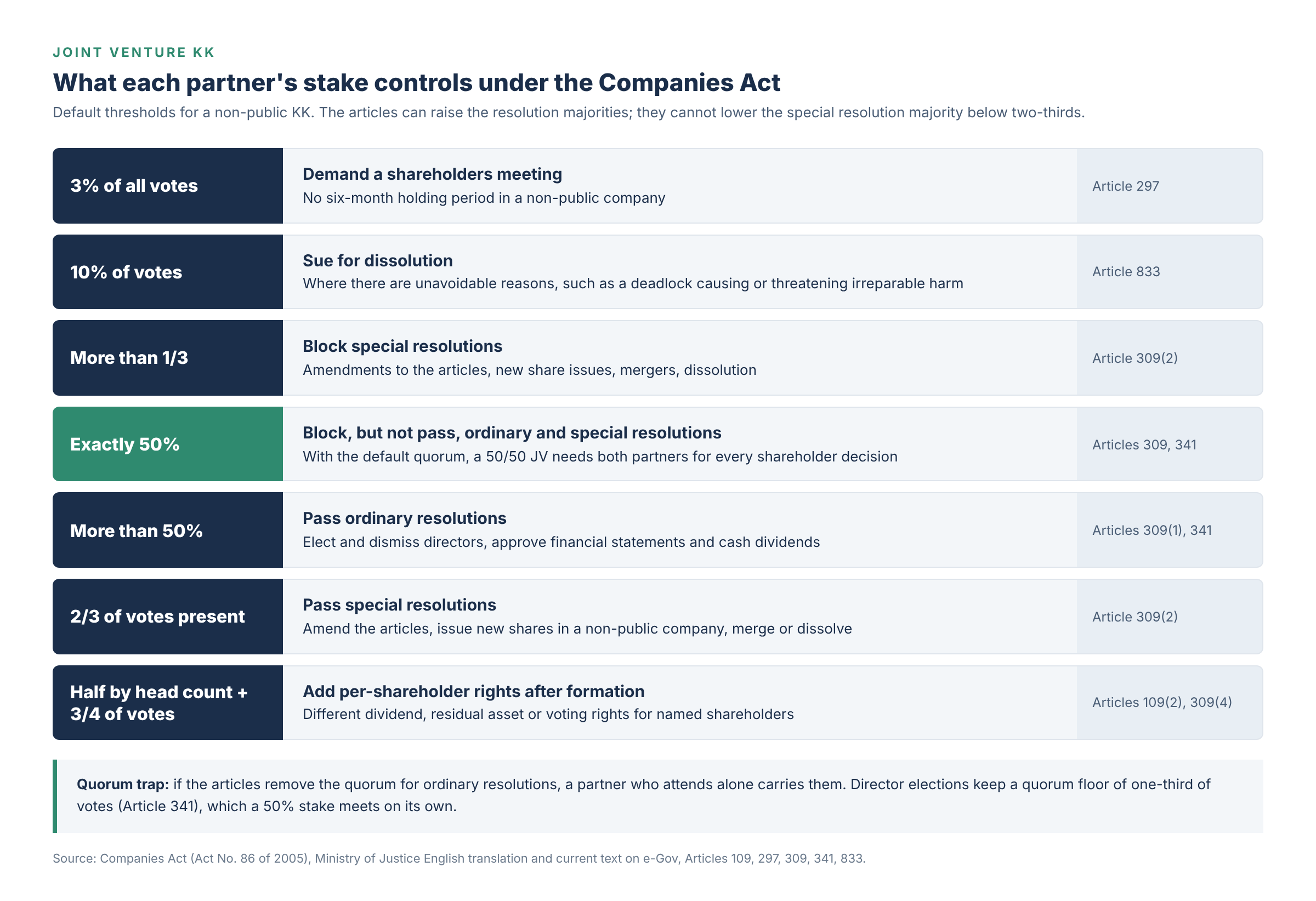
Voting power in a JV KK follows the Companies Act thresholds: more than 50% passes ordinary resolutions, two-thirds passes special resolutions, and smaller stakes carry minority rights.
Under Article 309 of the Companies Act (Ministry of Justice translation), an ordinary resolution also needs holders of a majority of all votes attending; for director elections, Article 341 lets the articles lower that quorum to one-third.
| Stake or vote | What it allows | Companies Act basis |
|---|---|---|
| 3% of all votes | Demand a shareholders meeting; no six-month holding period in a non-public company | Article 297 |
| 10% of votes or of issued shares | Sue for dissolution where there are unavoidable reasons | Article 833 |
| More than one-third of votes present | Block any special resolution, including amendments to the articles | Article 309(2) |
| Exactly 50% | Block ordinary and special resolutions; with the default quorum, pass neither alone | Articles 309(1), 309(2), 341 |
| More than 50% of votes present | Elect and dismiss directors, approve financial statements and cash dividends | Articles 309(1), 341 |
| Two-thirds of votes present | Amend the articles, issue new shares in a non-public company, merge or dissolve | Article 309(2) |
| Half of all shareholders by head count and three-quarters of all votes | Add per-shareholder rights to the articles of a non-public company after formation | Articles 109(2), 309(4) |
The articles can raise any of these majorities, which is how a minority partner gains a shareholder-level veto, but cannot lower the special resolution majority below two-thirds.
Why a JV KK Should Be a Non-Public Company
A KK whose articles require company approval for every share transfer is a non-public company under Article 2, a status that unlocks the governance tools a joint venture needs.
Class shares that elect directors at a class meeting are barred for public companies (Article 108(1)(ix)). Article 109(2) lets a non-public company give named shareholders different dividend, residual asset or voting rights. Director terms can run up to ten years instead of two (Article 332), and kansayaku terms up to ten instead of four (Article 336).
The transfer restriction is weaker than it looks. The company must answer an approval request within two weeks or approval is deemed given (Article 145). If it refuses a request that asked it to buy on refusal, it or a designated purchaser must buy the shares (Articles 138, 140) at an agreed price, a court-set price, or net assets per share (Article 144). The restriction controls who comes in; it does not lock a partner in.
Articles of Incorporation vs the Shareholders Agreement
Terms in the articles bind the company and every future shareholder, while the shareholders agreement binds only its signatories, so each JV protection belongs in the document that can enforce it.
Where the articles require a class meeting, the decision has no effect without it (Article 323), and a shareholders meeting resolution that breaches the articles can be revoked by court action within three months (Article 831). Limits on a representative director's authority cannot be asserted against a good-faith third party wherever they sit (Article 349(5)), so a reserved-matters list in the agreement gives a claim against the other partner, not a block on the deal.
| JV term | Can it go in the articles? | Effect and visibility |
|---|---|---|
| Transfer restriction and approving body | Yes (Articles 107, 139) | Registered; the articles can name the approving body and deem intra-group transfers approved |
| Board seats per partner | Yes, through class shares electing directors (Article 108(1)(ix)) | Class terms appear in the commercial register (Article 911(3)(vii)) |
| Veto over listed matters | Yes, through a class meeting requirement (Article 108(1)(viii)) or higher resolution majorities | The decision does not take effect without the class meeting resolution (Article 323) |
| Different dividend or voting rights per partner | Yes, in a non-public company (Article 109(2)) | Deemed class shares for Parts II and V of the Act (Article 109(3)) |
| Board quorum and majority | Yes, only upwards (Article 369) | A higher majority also raises deadlock risk |
| Business plan, funding duties, non-compete | No; these bind the partners, not the company | Enforced as a contract; stays confidential |
| Deadlock steps, put and call options, buy-sell | Partly, through class shares the company may call (Article 108(1)(vi)) | Triggers and pricing sit in the agreement |
Our post on articles of incorporation in Japan covers the mandatory contents and notarisation; for a JV, the class share terms and the transfer approval clause need agreeing before the notary appointment, because changing them later takes at least a special resolution.
How 50/50 Deadlocks Arise in a JV KK
A 50/50 JV KK deadlocks wherever the law needs a majority, at the shareholders meeting through votes or quorum, and on a board split evenly between the partners' appointees.
At shareholder level, neither partner reaches a majority, and either can stop a meeting being quorate by staying away. The reverse risk appears if the articles strip the quorum: a partner attending alone carries ordinary resolutions, and a 50% stake already meets the one-third director-election floor in Article 341.
At board level, Article 369 requires a majority of the directors present, so a two-two board cannot pass contested items; a KK with a board needs at least three directors (Article 331(5)). Without a board, Article 348(2) decides business by a majority of directors, and under Article 349(2) each director represents the company alone unless a representative director is chosen. Naming the representative director is itself a deadlock decision.
When nothing else works, Article 833 lets a shareholder with 10% of the votes ask the court to dissolve the company if extreme difficulty in conducting business has caused, or threatens, irreparable harm. That outcome ends the business for both sides, so escalation steps, mediation and buy-out mechanics belong in the agreement at formation.
Group Reporting and Tax Questions to Settle at Formation
Each parent classifies the JV KK under its own rules, so the same company can be an equity-accounted joint venture for the foreign parent and a subsidiary of the Japanese partner under the Companies Act definition.
Under IFRS, joint control exists only when decisions about relevant activities need the unanimous consent of the parties sharing control (IFRS 11), and a joint venture is equity-accounted under IAS 28 (IFRS Foundation), which according to the standard presumes significant influence from 20% of the voting power. Vetoes over relevant activities granted to the Japanese partner can therefore turn a majority holding into joint control and equity accounting, a judgment to document with the group auditor.
Japanese company law runs a different test. Under Article 3 of the Ordinance for Enforcement of the Companies Act (e-Gov), a holder of 40% or more of the votes controls a company if, for example, its officers or employees fill more than 50% of the board.
| Question | Rule that decides it | Source |
|---|---|---|
| Does the foreign parent consolidate? | Joint control needs unanimous consent on relevant activities; a joint venture is equity-accounted | IFRS 11, IAS 28 |
| Is the KK the Japanese partner's subsidiary under the Companies Act? | More than 50% of votes, or 40% or more plus board majority, a control contract or other listed facts | Companies Act Ordinance Article 3 |
| Does it need an accounting auditor? | Yes once stated capital reaches ¥500 million or liabilities reach ¥20 billion (large company) | Companies Act Articles 2(vi), 328 |
| Can it use the SME corporate tax rate? | Capital of ¥100 million or less and not wholly owned by companies with capital of ¥500 million or more | NTA Tax Answer No. 5759 |
| Can it join a Japanese group tax sharing election? | No; only companies under a parent's complete (100%) control qualify | NTA Tax Answer No. 5900 |
| Does the foreign partner's share subscription need a FEFTA filing? | Yes; acquiring shares of an unlisted company is inward direct investment, with prior notification in designated sectors | MOF FEFTA rules |
| Is the JV KK itself a foreign investor? | Yes if foreign investors hold 50% or more of its voting rights, which matters for its own investments | MOF FEFTA rules |
The National Tax Agency applies a 15% rate, for fiscal years beginning by 31 March 2027, to the first ¥8 million of annual income (17% in a year with income over ¥1 billion) for companies with capital of ¥100 million or less, and its exclusion targets companies wholly owned by large corporations. A KK split between two unrelated groups is wholly owned by neither, so that exclusion does not bite, though the NTA's other exclusions still apply.
The Ministry of Finance FEFTA guidance sets a 45-day deadline for post-investment reports, and our post on FEFTA notifications covers the forms. The consolidation package is covered in the J-GAAP to IFRS or US GAAP reporting bridge and the year-end choice in fiscal year alignment with the parent.
When a Wholly Owned KK Is the Better Starting Point
A joint venture suits a group that needs the partner's customers, plant or know-how from day one; a group that needs only market access can keep full control through its own subsidiary.
A sole-shareholder KK has no quorum risk, no class share design and no dissolution suit to plan around. Our posts on KK vs GK for a multinational's subsidiary and the headquarters playbook for a Japan subsidiary cover that route.
FAQ
Does a joint venture KK need a kansayaku?
It needs one if it has a board of directors, unless a non-public company appoints an accounting advisor instead, or if it has an accounting auditor (Article 327). Because the kansayaku audits the directors' execution of duties (Article 381), a seat nominated by the minority partner is one way to give it oversight. Our kansayaku guide covers qualifications and duties.
Can the joint venture be a GK instead of a KK?
It can, but in a GK transferring an equity interest needs the approval of all other members (Article 585) and the articles change only with all members' consent (Article 637), unless the articles say otherwise. Every member is a veto holder by default.
Should JV directors have short or long terms?
Short terms give each partner a regular chance to revisit its nominees, while long terms reduce registration work. The articles or a shareholders resolution can shorten a term (Article 332(1)), so nominees can serve until the agreement's next review. Our post on director terms of office covers the re-election filings.
Working with AQ Partners. Our Tokyo team provides KK and GK incorporation, annual shareholder meeting and minutes, and director change registration for foreign companies operating in Japan. Book a consultation to review your Japan setup plan.

Yuga Koda is a founding Director at AQ Partners, supporting foreign companies, funds, and families operating in Japan. His experience operating companies in both Japan and international markets gives him a practical understanding of back office operations from both sides.