
J-GAAP to US GAAP or IFRS: The Reporting Package Bridge for a Small Japan Subsidiary


The J-GAAP to group GAAP bridge is the set of entries that turns a Japan subsidiary's statutory books, kept under Japanese GAAP (J-GAAP), into the figures its parent consolidates under IFRS or US GAAP. For a small foreign-owned KK, the statutory books usually follow the Small and Medium-sized Entities accounting guideline, which permits several simplifications that group standards do not. The bridge does not need a second ledger. It needs a list of the specific differences that apply to the entity, a decision for each one on whether the provider books it locally or posts it in a separate group layer, and the same treatment every reporting period. This guide sets out the differences that most often reach a subsidiary reporting package, with the source for each, and explains how to run the bridge each month without changing the statutory books the zeirishi signs.
Key Takeaways
- Know which Japanese rulebook applies. The SME accounting guideline covers kabushiki kaisha other than companies subject to the Financial Instruments and Exchange Act and their subsidiaries and affiliates, and companies with an accounting auditor and their subsidiaries.
- The differences are specific and sourced. Paid vacation, functional currency, depreciation, retirement benefits, and leases are the areas where Japanese rules and IFRS diverge in ways a small subsidiary package will show.
- Some assumed gaps do not exist. The SME guideline requires a bonus provision and applies deferred tax accounting, so neither should be treated as a structural J-GAAP difference.
- Leases are converging. ASBJ Statement No. 34 brings a right-of-use model for lessees from fiscal years beginning on or after 1 April 2027, close to IFRS 16, though its reach into SME bookkeeping is a separate question.
- Book once, adjust in a layer. Keeping the J-GAAP ledger intact and posting group-only entries separately means the tax return and the group package always reconcile.
Which Japanese Accounting Rules a Small Japan Subsidiary Follows
A foreign-owned KK with no Japanese listing and no accounting auditor is within the scope of the SME accounting guideline for its books.
Japanese accounting standards are issued by the Accounting Standards Board of Japan (ASBJ). Alongside them, the Japan Federation of Certified Public Tax Accountants' Associations, the Japanese Institute of Certified Public Accountants, the Japan Chamber of Commerce and Industry, and the ASBJ publish the Guideline on Accounting for Small and Medium-sized Entities (中小企業の会計に関する指針, chusho kaikei shishin), most recently revised on 19 September 2025. Its scope is every kabushiki kaisha except two groups: companies subject to the Financial Instruments and Exchange Act together with their subsidiaries and affiliates, and companies that have an accounting auditor together with their subsidiaries. A godo kaisha is encouraged to follow it as well.
A wholly owned subsidiary of a foreign parent with no Japanese listing and no accounting auditor therefore usually falls within the guideline. That matters for the bridge, because the guideline permits several simplified treatments that full ASBJ standards and IFRS do not. Whether the subsidiary needs an accounting auditor at all is covered in the group CFO guide to Japan subsidiary finance.
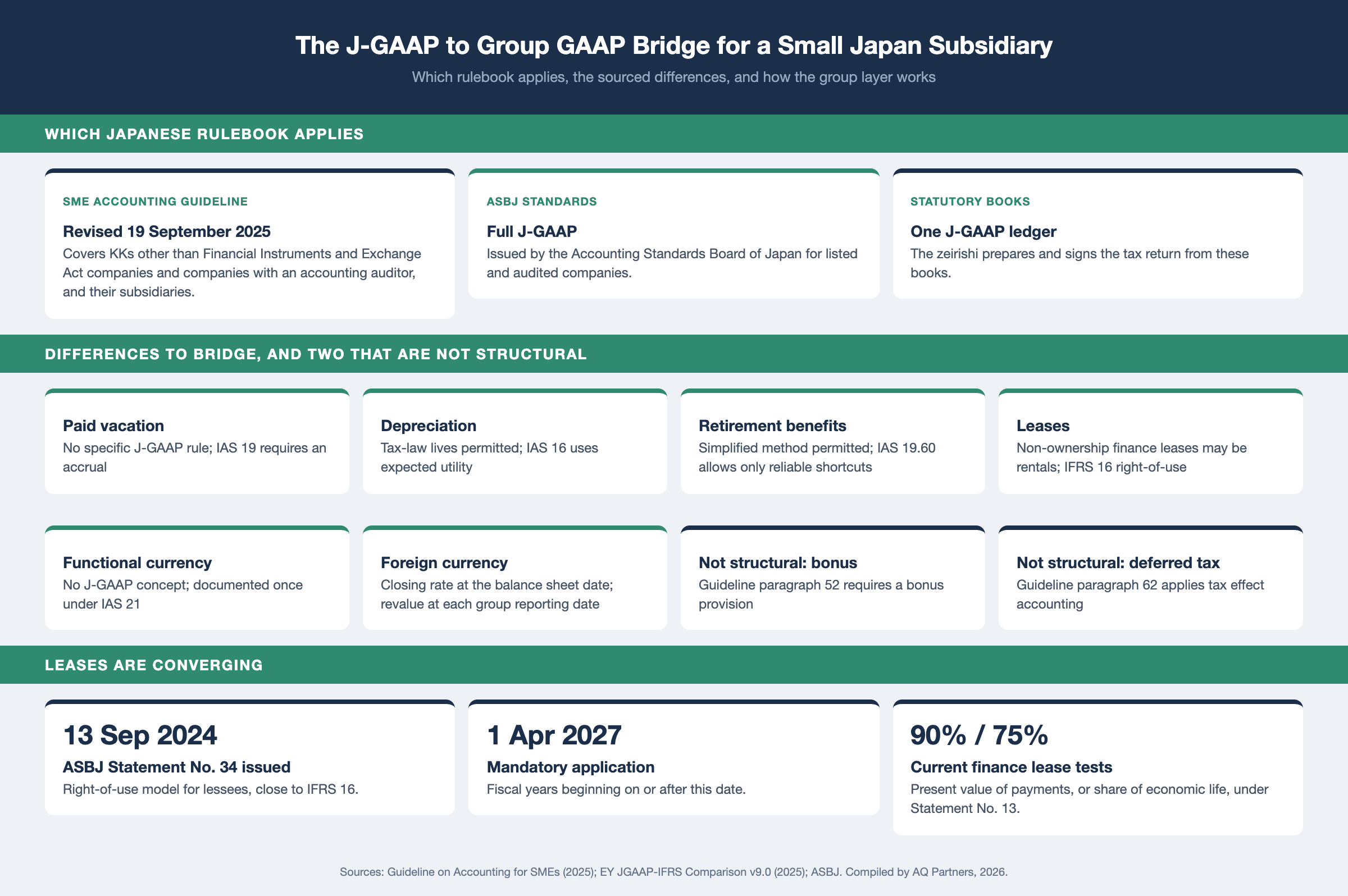
J-GAAP and IFRS Differences That Reach a Japan Subsidiary Reporting Package
Nine sourced areas decide the bridge for a small Japan subsidiary; most need a group entry, and two are not structural differences at all.
The table compares what the SME guideline or J-GAAP permits with what IFRS requires, using the guideline itself and EY's JGAAP-IFRS Comparison of the Standards, version 9.0 (2025) as sources. Where a row says the Japanese rule permits a treatment, the subsidiary's provider may or may not use it; the first step of the bridge is asking which options the books actually apply.
| Area | SME guideline or J-GAAP | IFRS | Bridge treatment |
|---|---|---|---|
| Functional currency | No concept similar to IFRS (EY, section 14) | Management determines the functional currency from the primary economic environment (IAS 21) | Document the yen as functional currency once, in the group accounting memo |
| Paid vacation | No specific rules (EY, section 19) | Accumulating compensated absences must be provided for (IAS 19.13 to 18) | Group-layer accrual unless the provider books it locally |
| Bonuses | The portion of the next bonus attributable to the current period must be recorded as a bonus provision (guideline paragraph 52) | Short-term benefits are recognised when the employee renders the service (IAS 19) | No structural difference; agree the accrual method and frequency |
| Depreciation: useful life | Lives set reasonably, but depreciation at tax-law useful lives is also permitted (guideline paragraph 34) | Expected utility to the entity, reviewed at least each year-end (IAS 16.51, 16.57) | Group lives in the layer, or a documented conclusion that tax lives approximate them |
| Depreciation: method | Declining balance based on tax law is applied in many cases, with straight-line required by tax law for buildings acquired from 1 April 1998 (EY, section 9) | Method reflects the pattern in which benefits are consumed (IAS 16.60) | Method difference posted by asset class |
| Retirement benefits | Simplified method permitted: obligation measured at the period-end voluntary termination amount (guideline paragraph 55) | Estimates and shortcuts allowed only where they give a reliable approximation (IAS 19.60) | Confirm with the group auditor whether the simplified figure is acceptable |
| Leases | Non-ownership-transfer finance leases may be accounted for as rentals with a note (guideline paragraph 75-3); operating leases stay off balance sheet under ASBJ Statement No. 13 | Lessees recognise right-of-use assets and lease liabilities (IFRS 16) | Lease schedule maintained in the group layer |
| Deferred tax | Tax effect accounting applies to temporary differences such as accrued enterprise tax and bonus provisions (guideline paragraph 62) | IAS 12 | No structural difference; align rates and recoverability with the group |
| Foreign currency balances | Monetary items translated at the closing rate at the balance sheet date; long-term items may stay at historical rates if immaterial (guideline paragraph 77) | On consolidation, assets and liabilities translated at the closing rate at each balance sheet date (IAS 21.39) | Revalue at each group reporting date in the package |
Two rows correct a common assumption. The guideline requires a bonus provision and applies deferred tax accounting, so neither is a gap by design; where a package lacks them, the cause is how the books were kept, which is a policy conversation with the provider rather than a standards difference.
How the Monthly J-GAAP to Group GAAP Bridge Works
The monthly bridge maps the J-GAAP trial balance to the group chart of accounts and posts a fixed set of group-only entries in a separate layer.
The bridge has three parts. The first is the J-GAAP ledger itself, kept by the provider on local accounting software and used by the zeirishi (税理士, certified public tax accountant) to prepare and sign the corporate tax return. The second is a mapping table from local accounts to the group chart of accounts, owned by headquarters and changed only with its approval. The third is the group layer: a separate set of entries, posted either in a consolidation tool or a worksheet attached to the package, that applies the bridge treatments in the table each period.
Keeping the layer separate has a practical advantage beyond tidiness. The statutory accounts approved by the shareholder and the tax return built on them stay exactly as filed, while the group package carries every adjustment visibly. When the group auditor asks why Japan's group result differs from its statutory result, the answer is the layer, line by line. Before the first close, headquarters should decide for each row whether the provider books it locally (for example, group useful lives used in the local books from day one) or whether it stays in the layer. That decision belongs in the policy checklist covered in the group CFO guide. The fiscal year matters too: a subsidiary whose year-end differs from the parent's adds a timing bridge on top, which is why aligning the subsidiary's fiscal year with the parent is worth settling at incorporation.
Lease Accounting in Japan Is Moving Toward IFRS 16
ASBJ Statement No. 34 introduces a right-of-use model for lessees from fiscal years starting on or after 1 April 2027, close to IFRS 16.
Under the current ASBJ Statement No. 13, a lease is a finance lease when it is non-cancellable and full pay-out, tested by whether the present value of lease payments is 90% or more of the asset's cash price or the lease term is about 75% or more of its economic life, and everything else is an operating lease kept off the balance sheet. IFRS 16 has no lessee classification at all. On 13 September 2024 the ASBJ issued Statement No. 34, Accounting Standard for Leases, with Implementation Guidance No. 33. According to the ASBJ's explanatory material, it applies from the beginning of fiscal years starting on or after 1 April 2027, with early application permitted from fiscal years starting on or after 1 April 2025, and lessees recognise a right-of-use asset and a lease liability for leases, as under IFRS 16, with exemptions for short-term and low-value leases.
For a small subsidiary under the SME guideline, the new standard does not automatically change the local books, since the guideline sets its own lease treatment. Until headquarters and the provider confirm how the guideline treats leases for the subsidiary's fiscal years, the safe assumption is that the office lease stays in the group layer as a right-of-use schedule.
What US GAAP Groups Should Map Separately
A US GAAP parent should map each row of the bridge to the matching ASC topic, because the IFRS column is a reference point, not its own rulebook.
The sources above compare J-GAAP with IFRS. A group reporting under US GAAP uses the same bridge structure but must confirm the treatment for each row against its own Accounting Standards Codification topics, for example ASC 842 for leases and ASC 710 for compensated absences, and record the conclusion in the group accounting memo. The functional currency determination, the paid vacation accrual, and the lease schedule usually need that confirmation first. The broader standards comparison is covered in IFRS versus J-GAAP for global businesses in Japan, and the bookkeeping habits behind many of these rows are described in how Japanese accounting differs from global standards.
Frequently Asked Questions
Does a Japan subsidiary need to keep two sets of books?
No. The statutory books stay in J-GAAP because the corporate tax return is built on them. Group figures come from mapping the J-GAAP trial balance to the group chart of accounts and posting group-only adjustments in a separate layer, so both sets of numbers reconcile to one ledger.
Is a bonus accrual a J-GAAP to IFRS difference?
Not by design. The SME accounting guideline requires the portion of the next bonus attributable to the current period to be recorded as a bonus provision, and IAS 19 recognises short-term benefits as the service is rendered. Any gap in a package comes from how the books are kept, which the provider and headquarters can agree.
Does the new Japanese lease standard remove the lease adjustment?
ASBJ Statement No. 34 applies from fiscal years beginning on or after 1 April 2027 and uses a right-of-use model close to IFRS 16. A small subsidiary following the SME guideline should confirm how the guideline treats its leases before removing the group-layer lease schedule.
Working with AQ Partners. Our Tokyo team provides back office operations for foreign companies operating in Japan, including accounting software setup, monthly bookkeeping and reporting, and annual tax filings. Book a consultation to discuss your group reporting setup.

Yuga Koda is a founding Director at AQ Partners, supporting foreign companies, funds, and families operating in Japan. His experience operating companies in both Japan and international markets gives him a practical understanding of back office operations from both sides.