
Compliance Obligations for Companies in Japan

Key Takeaways
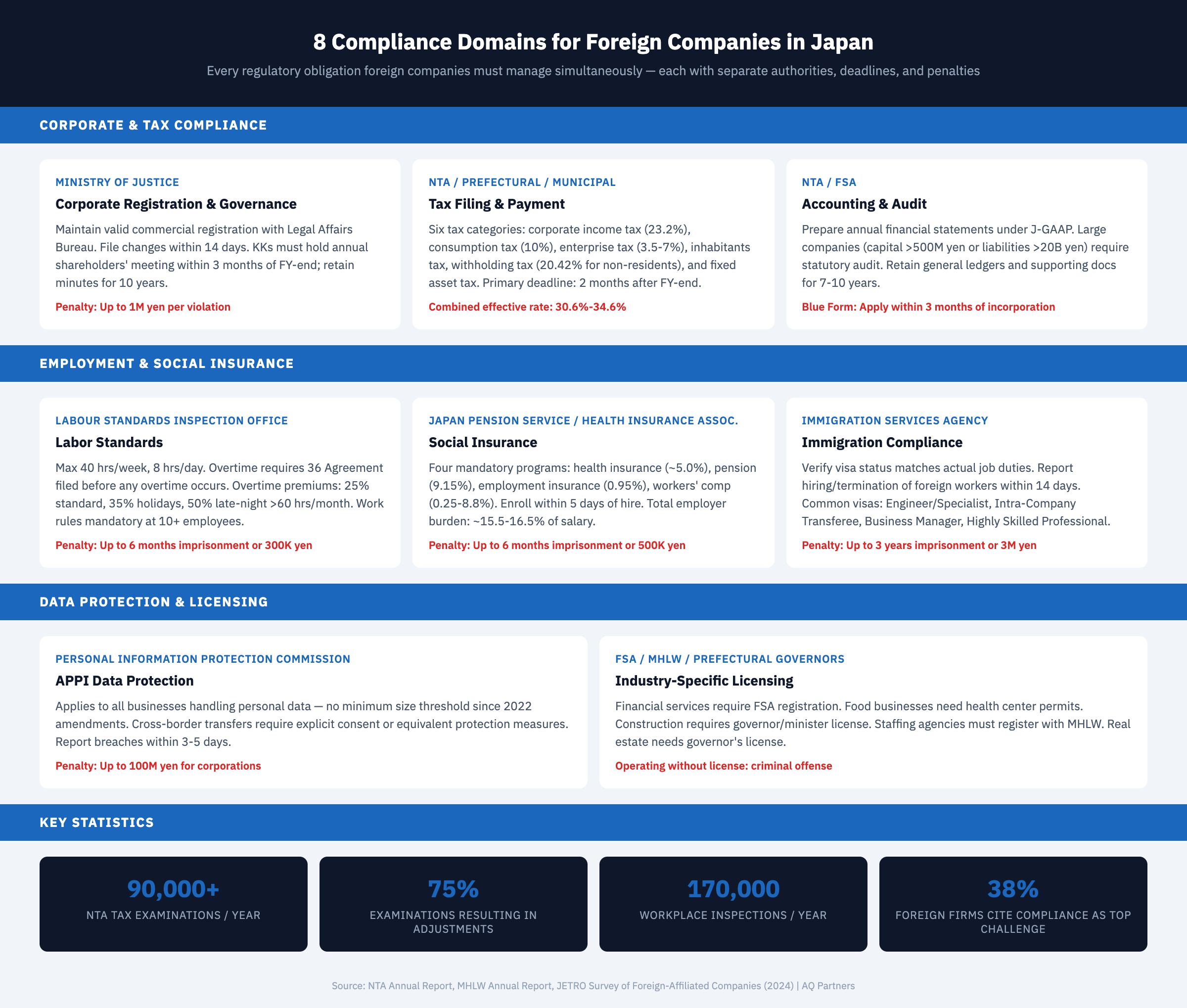
- Foreign companies in Japan face compliance obligations across eight regulatory domains simultaneously — corporate registration, tax filings, labor standards, social insurance, immigration reporting, accounting and audit, data protection (APPI), and industry-specific licensing. Missing any single domain can trigger penalties, director liability, or business suspension.
- Japan's National Tax Agency conducts over 90,000 corporate tax examinations per year — with approximately 75% resulting in adjustments (NTA Annual Report, 2024). Tax compliance alone spans corporate income tax, consumption tax, withholding tax, enterprise tax, inhabitants tax, and transfer pricing documentation, each with separate filing deadlines and authorities.
- Social insurance enrollment is mandatory from day one of hiring — employers must enroll employees in health insurance (kenkou hoken), pension (kousei nenkin), employment insurance (koyou hoken), and workers' compensation (rousai hoken) within five days of the employment start date. Non-enrollment carries penalties of up to six months' imprisonment or fines up to 500,000 yen under the Health Insurance Act.
- The Act on Protection of Personal Information (APPI) applies to all businesses handling personal data in Japan — with no minimum size threshold since the 2022 amendments. Cross-border data transfers require explicit consent or equivalent protection measures, and violations carry penalties of up to 100 million yen for corporations (Personal Information Protection Commission, 2022).
- A structured compliance calendar covering all eight domains prevents the most common failures — JETRO's 2024 survey of foreign-affiliated companies found that 38% of respondents cited regulatory compliance as their top operational challenge in Japan, ahead of language barriers and talent acquisition.
What Compliance Obligations Mean for Foreign Companies in Japan
Compliance obligations in Japan refer to the full set of legal, regulatory, and administrative requirements that a company must continuously satisfy to operate lawfully within Japanese jurisdiction. For foreign companies — whether structured as a Kabushiki Kaisha (KK), Goudou Kaisha (GK), or branch office — these obligations span corporate governance, taxation, employment law, social insurance, immigration, accounting standards, data protection, and industry-specific licensing. Each domain is administered by a different government ministry or agency, with distinct deadlines, filing formats, and penalty structures.
Unlike jurisdictions that consolidate business compliance into a single regulatory body, Japan distributes oversight across the Ministry of Justice (MOJ), the National Tax Agency (NTA), the Ministry of Health, Labour and Welfare (MHLW), the Immigration Services Agency, the Financial Services Agency (FSA), and the Personal Information Protection Commission (PPC), among others. According to JETRO's guide to setting up business in Japan, foreign companies must navigate these parallel systems from the date of incorporation, making early-stage compliance planning critical to avoiding costly gaps.
This guide provides a comprehensive overview of every compliance domain that foreign companies encounter in Japan, with cross-references to detailed pillar guides on tax filing, HR compliance, and post-incorporation filings. For an in-depth look at what happens when obligations are missed, see our guide on compliance failure consequences in Japan. For a practical approach to managing all of these obligations systematically, see our guide on building a sustainable compliance framework.
Corporate Registration and Governance Obligations
Every company operating in Japan must maintain a valid commercial registration with the Legal Affairs Bureau (houmukyoku), and any changes to registered details must be filed within two weeks of occurrence.
Corporate registration establishes the company's legal existence. For a KK or GK, the registration covers the company name, head office address, stated purpose, capital amount, directors and representative directors, fiscal year-end, and share structure. Branch offices of foreign companies must register the parent company details, the branch's Japan representative, and the scope of business activities. The Ministry of Justice administers this registry, and the information is publicly accessible.
Changes to any registered item — including director appointments, resignations, address relocations, capital increases, or amendments to the articles of incorporation — must be filed as a registration change (henkou touroku) within 14 days. Failure to file changes within this window triggers a fine of up to 1 million yen per violation under the Companies Act (Article 976). For companies structured as a KK, GK, or branch office, the specific governance requirements differ significantly.
Annual Governance Requirements
KK companies must hold an annual shareholders' meeting (teiji kabunushi soukai) within three months of fiscal year-end to approve financial statements, appoint or reappoint directors, and approve dividends. Minutes of these meetings must be retained for 10 years at the head office. Large KK companies (capital exceeding 500 million yen or total liabilities exceeding 20 billion yen) must appoint a statutory auditor (kansayaku) or establish an audit committee and engage an independent accounting auditor. Director terms in a KK default to two years (one year for companies with a board committee structure), requiring regular reappointment filings.
GK companies face lighter governance requirements — no shareholders' meeting is required, and member consent can be documented more flexibly. However, GK companies must still maintain updated registration records and comply with all other regulatory domains. For a detailed walkthrough of what to file immediately after incorporation, see our post-incorporation filing requirements guide.
Tax Filing and Payment Obligations
Japan's tax compliance system requires companies to file returns and make payments to national, prefectural, and municipal authorities — with the primary filing deadline falling two months after fiscal year-end.
The tax compliance landscape for foreign companies spans six major categories: corporate income tax, local corporate taxes (enterprise tax and inhabitants tax), consumption tax, withholding tax, transfer pricing documentation, and fixed asset reporting. According to PwC's Worldwide Tax Summaries, the combined effective corporate tax rate in Japan ranges from approximately 30.6% for large corporations to 34.6% for SMEs — placing Japan in the upper-middle range among OECD nations.
| Tax / Filing Type | Authority | Deadline | Key Compliance Points |
|---|---|---|---|
| Corporate Income Tax | National Tax Agency (NTA) | 2 months after FY-end | 1-month filing extension available; payment still due at original deadline |
| Consumption Tax | NTA | 2 months after FY-end | No extension permitted; 10% standard rate (8% reduced rate on food/newspapers) |
| Enterprise Tax | Prefectural Tax Office | 2 months after FY-end | Deductible against next year's corporate income tax; rates 3.5%–7% |
| Inhabitants Tax | Municipal / Prefectural Office | 2 months after FY-end | Separate returns for each jurisdiction; per-capita levy starts at 70,000 yen/year |
| Withholding Tax (employment) | NTA | 10th of following month | Semi-annual option for companies with fewer than 10 employees |
| Withholding Tax (non-resident) | NTA | 10th of month after payment | Standard rate 20.42%; treaty rates may reduce to 5–10% |
| Transfer Pricing Documentation | NTA | By tax return filing deadline | Contemporaneous preparation required; CbCR for groups over 100B yen revenue |
| Fixed Asset Tax Return | Municipal Office | January 31 annually | Reports all depreciable assets; municipal tax rate approximately 1.4% |
| Blue Form Application | NTA | Within 3 months of incorporation | Enables 10-year loss carryforward; essential for startups |
| Interim Tax Payments | NTA / Prefectural / Municipal | 6 months after FY start | Required when prior year tax exceeds 200,000 yen; typically 50% of prior year |
Blue Form (aoiro shinkoku) status is a day-one priority for any new entity in Japan. Companies that apply within three months of incorporation gain access to 10-year loss carryforward, immediate expensing of assets under 300,000 yen, and enhanced deductions — benefits unavailable under White Form status. For complete guidance on tax filing deadlines and calendar management, see our Japan tax filing schedule and our comprehensive tax filing and compliance guide.
Labor Standards and Employment Law Compliance
Japan's Labor Standards Act (roudou kijun hou) establishes minimum working conditions that apply to all employers regardless of company size, nationality, or industry — with enforcement by the Labour Standards Inspection Office (roudou kijun kantokusho).
The Labor Standards Act sets maximum working hours at 40 hours per week and 8 hours per day. Overtime requires a written labor-management agreement (commonly called a "36 Agreement" after Article 36 of the Act), which must be filed with the local Labour Standards Inspection Office before any overtime work occurs. The 2019 work-style reform amendments introduced hard caps on overtime: 45 hours per month and 360 hours per year as the general limit, with special provisions allowing up to 100 hours per month (including holiday work) and 720 hours per year during peak periods, subject to multiple conditions.
Overtime premium rates are strictly prescribed: 25% above base pay for regular overtime, 35% for work on statutory holidays, and 50% for overtime between 10 PM and 5 AM. Companies exceeding 60 hours of monthly overtime must pay 50% premium (applicable to all companies since April 2023). According to the Ministry of Health, Labour and Welfare (MHLW), violations of overtime limits carry penalties of up to 6 months' imprisonment or fines up to 300,000 yen per offense.
Employment Documentation Requirements
Employers must provide written working conditions (roudou jouken tsuchi sho) to each employee at the time of hire, specifying contract duration, workplace location, job duties, working hours, wages, and termination conditions. Failure to provide written conditions gives employees the right to immediately terminate employment. Companies must also establish formal work rules (shugyo kisoku) when employing 10 or more workers, filing these rules with the Labour Standards Inspection Office.
Annual paid leave accrues from the date an employee completes six months of continuous service with 80% or better attendance, starting at 10 days and increasing to 20 days after 6.5 years. Since 2019, employers must ensure employees with 10 or more days of leave entitlement take at least 5 days per year. Non-compliance with this mandatory leave requirement triggers fines of up to 300,000 yen per employee. For a deeper look at employment law risks, see our guide on Japan labor compliance risks.
Social Insurance and Pension Enrollment
Employers must enroll eligible employees in Japan's four social insurance programs within five days of the employment start date — late enrollment exposes companies to retroactive premium assessments and criminal penalties.
Japan's social insurance system consists of four mandatory programs: health insurance (kenkou hoken), employees' pension (kousei nenkin), employment insurance (koyou hoken), and workers' compensation insurance (rousai hoken). All companies with even one employee must participate in workers' compensation. Companies that are incorporated (KK or GK) must participate in health insurance and pension regardless of employee count — the obligation attaches to the legal entity, not employee numbers.
| Insurance Program | Coverage | Approximate Rate (Employer Share) | Administering Body |
|---|---|---|---|
| Health Insurance (kenkou hoken) | Medical expenses, maternity, injury/illness leave | ~5.0% of salary | Japan Health Insurance Association (kyoukai kenpo) or corporate health insurance society |
| Employees' Pension (kousei nenkin) | Retirement income, disability, survivor benefits | 9.15% of salary | Japan Pension Service (nenkin jimusho) |
| Nursing Care Insurance (kaigo hoken) | Long-term care services | ~0.8% of salary | Japan Health Insurance Association (employees aged 40–64) |
| Employment Insurance (koyou hoken) | Unemployment, childcare leave, vocational training | 0.85% of salary (FY2026) | Hello Work (public employment security office) |
| Child-Care Support Levy (kodomo kosodate shienkin) | Child allowance expansion and childcare programmes | 0.23% of salary, split 50/50 (from April 2026) | Collected with health insurance premiums |
| Workers' Compensation (rousai hoken) | Work-related injury, illness, commuting accidents | 0.25%–8.8% (industry-based) | Labour Standards Inspection Office |
| Children/Childcare Contribution | Childcare facility support | 0.36% of salary (employer only) | Japan Pension Service |
| Total Employer Burden (approximate) | All programs combined | ~15.5%–16.5% of salary | Multiple agencies |
| Total Employee Burden (approximate) | Health, pension, nursing, employment insurance | ~14.5%–15.5% of salary | Deducted from salary by employer |
The combined employer social insurance burden amounts to approximately 15.5–16.5% of salary on top of gross wages. Failure to enroll employees in health insurance and pension carries penalties under the Health Insurance Act of up to six months' imprisonment or fines of up to 500,000 yen. The Japan Pension Service actively investigates non-enrolled companies and can assess retroactive premiums for up to two years. For a broader look at how social insurance fits into HR strategy, see our guide on HR compliance strategies for global teams in Japan.
Immigration Compliance and Visa Obligations
Companies sponsoring foreign workers in Japan must ensure each employee holds the correct visa status for their job duties — and must report hiring, departure, and changes to the Immigration Services Agency within 14 days.
Japan's immigration system ties visa status directly to specific work activities. The most common categories for foreign companies include the Engineer/Specialist in Humanities/International Services visa, the Intra-Company Transferee visa, the Business Manager visa (for directors and founders), and the Highly Skilled Professional visa. Each category has distinct eligibility criteria, permitted activities, and renewal conditions.
Employers must verify that each foreign employee's visa category matches their actual job responsibilities. An employee hired on an Engineer/Specialist visa for translation work cannot be reassigned to accounting duties without applying for a status change. The Immigration Control and Refugee Recognition Act imposes penalties of up to three years' imprisonment or fines of up to 3 million yen on employers who knowingly employ workers engaged in activities outside their permitted visa status.
Companies must submit a notification to the nearest Immigration Services Bureau within 14 days when they hire or terminate a foreign employee — a requirement that many companies overlook. Since 2012, the immigration system also requires companies employing highly skilled professionals to maintain updated organizational charts and business plans on file. For a detailed breakdown of visa categories, processing times, and documentation requirements, refer to our complete guide to Japan work visas.
Accounting, Audit, Data Protection, and Licensing
All companies in Japan must maintain proper accounting records and prepare annual financial statements — with additional audit requirements for large companies exceeding specified capital or liability thresholds.
The Companies Act requires every KK and GK to prepare annual financial statements consisting of a balance sheet, income statement, statement of changes in shareholders' equity, and explanatory notes. These statements must be prepared in accordance with Japanese Generally Accepted Accounting Principles (J-GAAP), although companies listed on Japanese exchanges may elect to use International Financial Reporting Standards (IFRS).
Large companies — defined as those with stated capital of 500 million yen or more, or total liabilities of 20 billion yen or more — must engage an independent accounting auditor (kaikei kansa nin) and undergo a statutory audit. Audit reports must be presented at the annual shareholders' meeting, and the auditor's appointment requires shareholder approval. According to JETRO's business setup guidance, even companies not subject to statutory audit requirements must maintain records sufficient for tax examination — the NTA expects detailed general ledgers, subsidiary ledgers, and supporting documentation retained for a minimum of seven years (10 years for certain documents under the Companies Act).
Companies must also file statutory financial reports (kessansho) with the tax authorities as attachments to their corporate tax returns. These include not only the financial statements but also detailed schedules of fixed assets, depreciation, reserves, and intercompany transactions. Inaccurate or incomplete financial records undermine every other compliance domain — tax filings, social insurance calculations, and transfer pricing documentation all depend on reliable accounting data.
Data Protection (APPI) and Industry-Specific Licensing
APPI Data Protection
Since the 2022 amendments removed the minimum threshold (formerly 5,000 records), APPI applies to all businesses handling personal information in Japan, regardless of company size. Key obligations include: specifying the purpose of use and obtaining consent before collecting personal data; maintaining accurate records and implementing security measures; providing individuals with access, correction, and deletion rights upon request; and reporting data breaches to the Personal Information Protection Commission (PPC) and affected individuals within 3–5 days of discovery.
Cross-border data transfers — common for foreign companies sending employee or customer data to overseas headquarters — require either obtaining the data subject's explicit consent, confirming equivalent data protection measures in the destination country, or implementing contractual safeguards recognized by the PPC. Violations carry administrative orders, public naming, and penalties of up to 100 million yen for corporations (increased from 30 million yen under the 2022 amendments). Individual offenders face up to one year of imprisonment or fines of up to 1 million yen.
Industry-Specific Licensing
Many business activities in Japan require specific licenses, permits, or registrations beyond the standard commercial registration. Financial services (banking, insurance, securities) require FSA registration. Food manufacturing and restaurants require health center permits. Construction companies must obtain a governor's or minister's license depending on the geographic scope of operations. Temporary staffing agencies (hakengyo) must register with the MHLW. Real estate agencies require a governor's license.
Operating without the required license is a criminal offense in most regulated industries, carrying fines and potential imprisonment. Companies must identify all applicable licensing requirements during the planning phase — ideally before incorporation — and budget for the time required to obtain approvals, which can range from a few weeks to several months depending on the industry. For guidance on identifying which licenses apply, see our Japan market entry back office guide.
Master Compliance Calendar: Annual Obligations by Domain
Managing eight compliance domains simultaneously requires a structured calendar approach — the table below consolidates the most critical deadlines into a single reference, assuming a March 31 fiscal year-end.
| Month | Domain | Obligation | Authority |
|---|---|---|---|
| January | Tax | Fixed asset tax return (Jan 31); Legal records report (houtei choushuu) to NTA | Municipal Office / NTA |
| January | Tax / Payroll | Withholding tax summary (gensen choushuu hyou) and employee payment reports to municipalities | NTA / Municipal Offices |
| April | Social Insurance | Labour insurance annual update (roudou hoken nendo koushinn) begins | Labour Bureau |
| May | Tax | Corporate income tax, consumption tax, enterprise tax, inhabitants tax returns (May 31) | NTA / Prefectural / Municipal |
| June | Governance | Annual shareholders' meeting (within 3 months of FY-end); director reappointment filings | MOJ (Legal Affairs Bureau) |
| July | Social Insurance | Social insurance standard remuneration review (santeikiso todoke) — July 1–10 | Japan Pension Service / Health Insurance Association |
| July | Social Insurance | Labour insurance annual renewal and premium payment (July 10) | Labour Bureau |
| October | Tax | Interim corporate tax payment (6 months after FY start) | NTA / Prefectural / Municipal |
| November | Payroll | Year-end tax adjustment preparation (nenmatsu chousei) — distribute deduction forms to employees | NTA |
| December | Payroll | Complete year-end tax adjustment; reconcile annual withholding with actual liability | NTA |
| Monthly | Tax / Payroll | Withholding tax remittance (by 10th of following month) | NTA |
| Monthly | Social Insurance | Social insurance premium payments; employee enrollment/withdrawal notifications within 5 days | Japan Pension Service / Health Insurance Association |
| As Needed | Immigration | Foreign employee hire/termination notifications within 14 days | Immigration Services Agency |
| As Needed | Governance | Registration change filings within 14 days of any changes (directors, address, capital, etc.) | MOJ (Legal Affairs Bureau) |
This calendar represents the minimum baseline for a standard foreign company. Companies in regulated industries, those with multiple office locations, or those approaching audit thresholds face additional obligations. The key to managing this complexity is assigning clear ownership for each domain and building review cycles that flag upcoming deadlines well in advance. For a practical approach to building the systems that keep this calendar on track, see our guide on building a sustainable compliance framework for Japan operations.
Frequently Asked Questions
What are the most critical compliance deadlines for a newly incorporated company in Japan?
The highest-priority deadlines after incorporation are: filing the Blue Form tax return application with the NTA within three months of incorporation; enrolling employees in social insurance within five days of the employment start date; registering as a withholding tax agent within one month of the first salary payment; filing the 36 Agreement with the Labour Standards Inspection Office before any overtime work occurs; and establishing written work rules if employing 10 or more workers. Missing the Blue Form deadline forfeits loss carryforward benefits for the first fiscal year, while missing social insurance enrollment triggers retroactive premium assessments.
Does a branch office of a foreign company face the same compliance obligations as a KK?
A registered branch office faces nearly all the same tax, labor, social insurance, and immigration obligations as a KK. The branch must file corporate tax returns on Japan-source income, withhold taxes from employees, enroll staff in social insurance, and comply with the Labor Standards Act. Key differences are governance-related: a branch does not hold shareholders' meetings, does not require a statutory auditor regardless of size, and files a simpler annual registration update. However, a branch's activities are legally attributed to the foreign parent, meaning the parent bears unlimited liability for the branch's obligations in Japan.
How does APPI affect foreign companies that transfer employee data outside Japan?
Foreign companies that collect employee personal data in Japan and transfer it to overseas headquarters or affiliates must comply with APPI's cross-border transfer restrictions. The company must either obtain explicit prior consent from each data subject, confirm that the destination country has been recognized by the PPC as having equivalent data protection standards, or implement contractual measures ensuring equivalent protection. Since the 2022 amendments, companies must also inform data subjects of the destination country and the data protection regime in place there. Penalties for APPI violations reach 100 million yen for corporations.
What compliance obligations are often overlooked by foreign companies entering Japan?
The most frequently overlooked obligations include: the fixed asset tax return (January 31 deadline, separate from corporate tax returns); the requirement to file 36 Agreements before any overtime work begins; the social insurance standard remuneration review in July; immigration hire/termination notifications within 14 days; and the requirement to maintain work rules when employing 10 or more workers. Many foreign companies also underestimate the documentation burden of transfer pricing compliance and the filing obligations associated with operating in multiple municipalities.
Can a company outsource all compliance functions in Japan?
Companies can outsource most compliance functions — tax filing to licensed tax accountants (zeirishi), social insurance administration to licensed labor and social insurance consultants (sharoushi), and accounting to certified public accountants (kounin kaikeishi) or professional service firms. However, legal responsibility remains with the company and its directors. Director liability under the Companies Act cannot be delegated to third parties, and certain filings (such as registration changes) require the company representative's seal. Outsourcing compliance functions to a qualified back office partner is one of the most effective strategies for foreign companies, as it provides access to licensed professionals across all domains while maintaining a single point of coordination.
How frequently do Japanese authorities audit or examine foreign companies?
Audit frequency varies by domain. The NTA conducts over 90,000 corporate tax examinations annually, with large companies typically examined every three to five years and smaller companies less frequently. The Labour Standards Inspection Office conducts approximately 170,000 workplace inspections per year (MHLW Annual Report, 2023), focusing on overtime management, wage payment, and safety standards. The Japan Pension Service conducts targeted investigations of companies suspected of non-enrollment. Immigration audits have increased since 2019, particularly for companies employing workers under the Specified Skilled Worker visa categories. Companies with cross-border transactions face heightened scrutiny from the NTA's international examination division.
Managing compliance across all eight domains is one of the defining operational challenges for foreign companies in Japan. Each domain has its own licensed professionals, filing deadlines, and penalty structures — and the cost of gaps compounds when a failure in one area (such as accounting) undermines compliance in another (such as tax or social insurance). AQ Partners provides integrated back office services that cover corporate administration, accounting, tax coordination, payroll, HR administration, and compliance support — giving foreign companies a single partner to manage the full compliance landscape. Contact us at hello@aqpartners.jp to discuss how we can simplify your Japan compliance operations.

Yuga Koda is a founding Director at AQ Partners, supporting foreign companies, funds, and families operating in Japan. His experience operating companies in both Japan and international markets gives him a practical understanding of back office operations from both sides.