
Building a Compliance Framework for Japan Ops

Key Takeaways
- A compliance calendar covering all eight regulatory domains is the single most effective tool for foreign companies in Japan — the majority of compliance failures stem from missed deadlines rather than substantive errors. Building a unified calendar that tracks tax, labor, social insurance, governance, immigration, accounting, APPI, and licensing obligations prevents the most common penalty triggers.
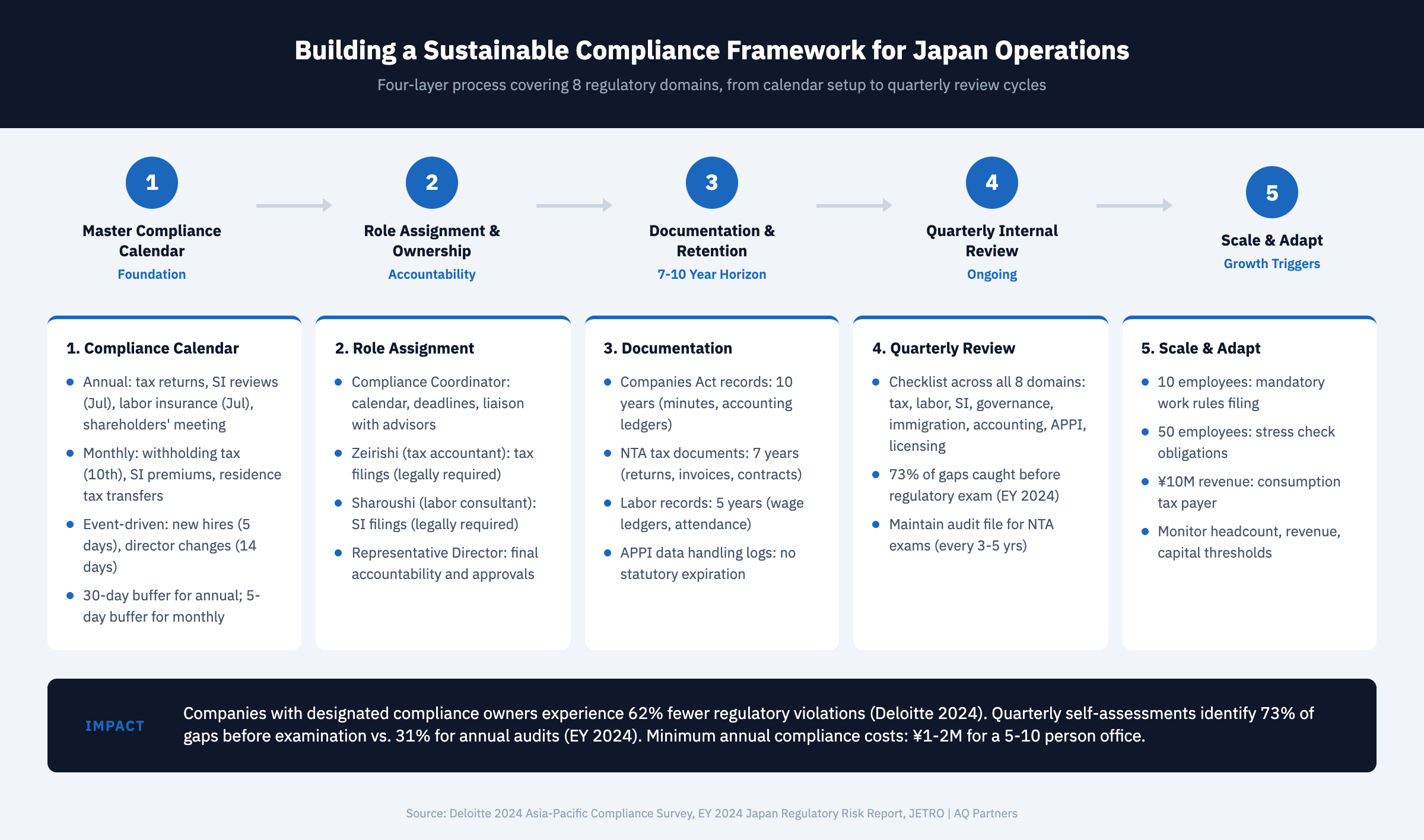
- Assigning a named compliance owner for each domain reduces failure rates significantly — Deloitte's 2024 Asia-Pacific Compliance Survey found that companies with designated compliance owners experienced 62% fewer regulatory violations than those relying on informal responsibility allocation. For small foreign offices in Japan, a single compliance coordinator who interfaces with licensed specialists (zeirishi, sharoushi, kounin kaikeishi) can cover all domains effectively.
- Licensed professionals are legally required for certain compliance functions in Japan — only licensed tax accountants (zeirishi) may prepare and file tax returns on behalf of companies, and only licensed labor and social insurance consultants (sharoushi) may handle social insurance filings as agents. Building a framework means building relationships with the right licensed advisors, not just internal processes.
- Documentation retention requirements in Japan range from 7 to 10 years — the Companies Act mandates 10-year retention for shareholder meeting minutes and accounting records, while the NTA requires 7-year retention for tax-related documents. APPI adds a layer requiring logs of personal data handling and cross-border transfer records with no statutory expiration.
- Quarterly internal compliance reviews catch issues before they become penalties — according to EY's 2024 Japan Regulatory Risk Report, companies conducting quarterly compliance self-assessments identified 73% of compliance gaps before regulatory examination, compared to 31% for companies relying solely on annual external audits.
What a Compliance Framework Means for Japan Operations
A compliance framework for Japan operations is a structured system of calendars, role assignments, documentation standards, review cycles, and professional relationships that enables a foreign company to meet all of its regulatory obligations consistently, on time, and with auditable evidence. The framework transforms compliance from a reactive scramble around individual deadlines into a proactive, repeatable process that scales with the business.
For foreign companies operating in Japan, the need for a structured framework is particularly acute. Japan distributes regulatory oversight across multiple agencies — the NTA, MHLW, MOJ, Japan Pension Service, Immigration Services Agency, Personal Information Protection Commission, and industry-specific regulators — each with distinct filing requirements, deadlines, and penalty structures. According to JETRO's business setup guide, the layered regulatory environment means that even companies with strong compliance cultures in their home markets need Japan-specific systems.
This guide provides a practical framework that foreign companies can implement immediately, covering compliance calendar design, role assignment, documentation systems, audit preparation, and the strategic use of outsourced compliance functions. For a complete overview of the obligations this framework must cover, see our guide to compliance obligations for companies in Japan. For the consequences of gaps in this framework, see our guide on what happens when companies fail compliance requirements.
Building a Master Compliance Calendar
The compliance calendar is the foundation of any Japan compliance framework — it consolidates every deadline across all regulatory domains into a single, actionable schedule with built-in buffer periods and escalation triggers.
An effective Japan compliance calendar operates on three time horizons. The annual layer captures fixed deadlines — corporate tax returns (two months after fiscal year-end), social insurance standard remuneration reviews (July 1-10), labor insurance annual renewal (July 10), and shareholders' meetings (within three months of fiscal year-end). The monthly layer tracks recurring obligations like withholding tax remittance (10th of each month) and social insurance premium payments. The event-driven layer handles obligations triggered by business changes: employee onboarding (insurance enrollment within 5 days), director changes (registration within 14 days), and foreign employee hire notifications (14 days to Immigration).
| Calendar Layer | Obligation Examples | Recommended Buffer | Escalation Trigger |
|---|---|---|---|
| Annual — Tax Filing | Corporate income tax, consumption tax, enterprise tax, inhabitants tax returns | 30 days before deadline | Draft return not reviewed by T-14 days |
| Annual — Social Insurance | Standard remuneration review (July), labor insurance renewal (July) | 14 days before deadline | Payroll data not compiled by T-21 days |
| Annual — Governance | Shareholders' meeting, director reappointment, financial statement approval | 21 days before meeting date | Financial statements not finalized by T-30 days |
| Annual — Payroll | Year-end adjustment (Dec), withholding summary and payment reports (Jan) | 14 days before deadline | Employee deduction forms not collected by Nov 15 |
| Monthly — Withholding | Withholding tax remittance (10th of following month) | 5 business days | Payroll not finalized by month-end |
| Monthly — Social Insurance | Premium payments, enrollment/withdrawal notifications | 5 business days | New hire not enrolled within 3 days of start date |
| Event-Driven — HR | Employee onboarding (insurance enrollment), offboarding (withdrawal notifications) | Same-day initiation | Day 3 without enrollment submission |
| Event-Driven — Governance | Director changes, address relocation, capital changes (registration within 14 days) | Same-day initiation | Day 7 without filing submission |
Each calendar entry should specify: the obligation name, the governing regulation, the filing authority, the responsible person, the preparation start date, the review date, and the final filing date. Building 30-day buffers for annual filings and 5-business-day buffers for monthly obligations provides enough margin to handle unexpected issues without risking penalties. For the full list of deadlines this calendar must include, see the master compliance calendar in our compliance obligations guide.
Assigning Compliance Ownership and Roles
Clear role assignment eliminates the ambiguity that causes compliance gaps — every obligation must have a named owner who is accountable for its completion, even when the actual work is performed by external advisors.
For foreign offices in Japan (5–50 employees), a practical compliance structure consists of three layers. The Compliance Coordinator maintains the master calendar, tracks deadlines, and coordinates with external advisors — this person needs organizational discipline, not necessarily compliance expertise. The Licensed Professionals perform the technical work: a zeirishi (tax accountant) for tax filings, a sharoushi (labor consultant) for social insurance filings, and a kounin kaikeishi (CPA) for accounting. The Management Layer — typically the representative director — holds final accountability and approves key filings.
Deloitte's 2024 Asia-Pacific Compliance Survey found that companies with designated compliance owners experienced 62% fewer regulatory violations — attributed primarily to deadline visibility and escalation clarity. For a broader perspective on building effective HR compliance teams, see our guide on HR compliance strategies for global teams.
Documentation Systems and Record Retention
Japan's compliance environment demands meticulous documentation — and retention periods of 7 to 10 years mean companies must implement systematic storage and retrieval systems from day one.
The Companies Act mandates 10-year retention for shareholder meeting minutes, board meeting minutes, and accounting records, as specified in the Japanese Law Translation database. The NTA requires 7-year retention for all tax-related documents including returns, receipts, invoices, and contracts. APPI requires records of personal data handling and cross-border transfer documentation with no statutory expiration. The Labor Standards Act requires retention of employee wage ledgers and attendance records for 5 years (extended from 3 years under the 2020 amendments).
| Document Category | Retention Period | Governing Law | Practical Notes |
|---|---|---|---|
| Shareholder meeting minutes | 10 years | Companies Act | Must be kept at head office; copies at branch offices for 5 years |
| Accounting records (ledgers, journals) | 10 years | Companies Act | Includes general ledger, subsidiary ledgers, and trial balances |
| Tax returns and supporting documents | 7 years | National Tax Agency regulations | Fraud statute extends to 7 years; retain all returns for maximum protection |
| Invoices, receipts, contracts | 7 years | NTA / Consumption Tax Act | Invoice System (2023) requires qualified invoice retention for input tax credit |
| Employee wage ledgers and attendance records | 5 years (transitional: 3 years) | Labor Standards Act | Extended from 3 years under 2020 amendments; 5-year standard now in effect |
| Social insurance enrollment/withdrawal records | 2+ years (recommended: 7 years) | Health Insurance Act / Pension Act | Retroactive premium assessment period is 2 years; retain longer for dispute protection |
| Transfer pricing documentation | 7 years | NTA transfer pricing regulations | Must be prepared contemporaneously; retroactive preparation receives reduced credibility |
| APPI personal data handling records | No statutory expiration | Act on Protection of Personal Information | Consent records, cross-border transfer logs, breach notifications |
Cloud-based document management with automated retention scheduling offers the most practical solution. Japanese authorities accept electronic records under the Electronic Books Preservation Act (denshi chobo hozon hou), provided they include tamper-proof timestamps, searchability, and system documentation. Establish naming conventions and folder structures from the outset rather than retrofitting after records accumulate.
Audit Preparation and Internal Review Cycles
Quarterly internal compliance reviews provide the best balance between thoroughness and practicality — catching issues early enough to correct them before they attract regulatory attention.
EY's 2024 Japan Regulatory Risk Report found that quarterly self-assessments identified 73% of compliance gaps before regulatory examination, versus 31% for annual-only audits. Structure the review as a domain checklist: tax filings current, social insurance enrollments up to date, registration changes filed, APPI records maintained, industry licenses valid.
When NTA examinations occur (large companies face examination every three to five years), preparation quality determines outcomes. Maintain an "audit file" with organized copies of all filed returns, intercompany agreements, and transfer pricing documentation. The NTA expects documents within days — companies that cannot produce organized records face longer examinations and less favorable outcomes. For tax-specific guidance, see our tax filing and compliance guide.
Labour Standards Inspection Office visits are often unannounced. Maintaining current 36 Agreements, work rules, wage ledgers, and attendance records in an accessible format ensures readiness. Inspections typically request records for the most recent 12 months, focusing on overtime hours and wage payments.
Outsourcing Compliance Functions Strategically
Outsourcing compliance functions to licensed professionals is not a concession — it is the standard operating model for foreign companies in Japan, including those with dedicated local teams.
Japan's professional licensing system means certain functions can only be performed by specific licensed individuals — tax returns by zeirishi, social insurance filings by sharoushi, and statutory audits by kounin kaikeishi. Unlicensed performance of these functions is a criminal offense. The strategic question is not whether to use licensed professionals, but how to organize the relationship.
Three models work well. The individual advisor model engages separate zeirishi, sharoushi, and accounting firms independently — offering cost control but requiring internal coordination. The integrated firm model engages a single firm providing all services — simplifying coordination at potentially higher cost. The back office partner model engages a firm like AQ Partners as the compliance coordination layer between the company and licensed professionals, handling day-to-day administration while managing the professional relationships.
According to PwC's Japan corporate tax overview, the complexity of Japan's multi-authority tax system makes professional advisory essentially mandatory for foreign companies — the risk of errors in a system with penalties reaching 40% is too high for non-specialists.
Scaling the Framework as Operations Grow
A compliance framework must scale alongside the business — what works for a 5-person office will not suffice for a 50-person operation with multiple locations and regulated activities.
Growth triggers new compliance requirements at specific thresholds: 10 employees requires formal work rules filed with the Labour Standards Inspection Office; multiple municipalities require separate tax returns for each jurisdiction; capital reaching 500 million yen or liabilities of 20 billion yen triggers statutory audit requirements; entering regulated industries adds domain-specific licensing.
The framework should include threshold monitoring — tracking headcount, revenue, capital, and geographic expansion against known regulatory triggers. This prevents the common failure where a company grows past a threshold without activating corresponding obligations. For companies evaluating entity structures, see our guide on KK vs. GK vs. branch office structures in Japan.
Cloud-based accounting platforms with Japanese tax functionality (freee, Money Forward, Yayoi) automate consumption tax calculations, withholding computations, and financial statement preparation. Payroll platforms integrated with social insurance reduce manual errors, and document management systems with automated retention scheduling prevent accidental deletion of records within statutory periods.
Frequently Asked Questions
How often should a foreign company in Japan review its compliance framework?
Quarterly internal reviews provide the best balance between thoroughness and practicality. Each quarterly review should assess all eight compliance domains using a structured checklist: tax filings current, social insurance enrollments up to date, registration changes filed, APPI records maintained, industry licenses valid, labor documentation current, immigration notifications submitted, and accounting records reconciled. EY's 2024 Japan Regulatory Risk Report found that quarterly self-assessments identified 73% of compliance gaps before regulatory examination. Additionally, the framework itself should undergo a comprehensive annual review to account for regulatory changes, business growth, and new compliance triggers.
What is the minimum cost of maintaining compliance for a small foreign office in Japan?
For a small office (5–10 employees) with a March fiscal year-end, minimum annual compliance costs typically include: zeirishi (tax accountant) fees of 500,000–1,200,000 yen per year for monthly bookkeeping support and annual tax filings; sharoushi (labor consultant) fees of 300,000–600,000 yen per year for social insurance administration and labor compliance; and corporate registration support of 50,000–150,000 yen per filing event. Total baseline professional service costs typically range from 1,000,000 to 2,000,000 yen per year for a straightforward operation. These costs increase with employee count, multi-jurisdiction presence, and regulated industry activities.
Can a foreign company manage Japan compliance entirely from overseas?
No — certain compliance functions require a physical presence or resident representative in Japan. KK and GK companies must have at least one representative director with a registered address in Japan (though the Companies Act revision effective April 2015 removed the requirement that the representative be a Japan resident, the practical reality is that banking, tax, and social insurance processes heavily favor resident representatives). Branch offices must appoint a Japan-based representative. Tax filings require a Japan-based tax agent, and social insurance enrollment requires interaction with local offices. The most effective approach is a combination of overseas strategic oversight and Japan-based operational execution — either through a local hire or a professional back office partner.
What should a compliance framework include for APPI data protection?
An APPI compliance framework should include: a personal information handling policy specifying purposes of use; consent collection mechanisms for employee and customer data; a record of all personal data categories held and their storage locations; cross-border transfer documentation showing the legal basis for any data sent outside Japan; a data breach response plan with notification procedures to the PPC and affected individuals within 3–5 days; annual training for employees who handle personal data; and regular audits of third-party service providers who process personal data on the company's behalf. Since the 2022 amendments removed the 5,000-record threshold, all companies handling any personal data must maintain these elements regardless of company size.
Building a sustainable compliance framework is one of the highest-return investments a foreign company can make in Japan. The cost of systematic compliance is predictable and manageable; the cost of compliance failures — financial penalties, criminal liability, reputational damage, and operational disruption — is not. AQ Partners provides integrated back office services that function as your compliance framework in practice — covering accounting, tax coordination, payroll, HR administration, and compliance management through a single coordinated team of licensed professionals. Contact us at hello@aqpartners.jp to discuss how we can build the compliance infrastructure your Japan operations need.

Yuga Koda is a founding Director at AQ Partners, supporting foreign companies, funds, and families operating in Japan. His experience operating companies in both Japan and international markets gives him a practical understanding of back office operations from both sides.