
How to Close a Company in Japan: KK, GK and Branch


Closing a company in Japan is a three-stage procedure under the Companies Act (会社法, kaishahou). Dissolution (解散, kaisan) ends the business and puts a liquidator in charge. Liquidation (清算, seisan) is the period in which the liquidator collects assets, pays creditors after a statutory notice period and hands what is left to the shareholder. Completion of liquidation (清算結了, seisan ketsuryou) is then registered at the Legal Affairs Bureau, and the company ceases to exist.
For a foreign-owned kabushiki kaisha (KK) or goudou kaisha (GK), the parent company takes the decisions reserved to the sole shareholder or member, and the timetable is set by a creditor notice period of at least two months that cannot be shortened.
A branch of a foreign company has no dissolution resolution or liquidator of its own and closes by deregistration, although a court can order a liquidation of the foreign company's property in Japan. This guide sets out the sequence, the documents the parent signs, the tax returns, the employee and social insurance filings, and the statutory cost of closing each entity type.
Key Takeaways
- The two-month creditor period sets the floor. A KK or GK must publish a notice in the Official Gazette (官報, kanpou) inviting claims for at least two months and may not pay its debts during that period, so no voluntary liquidation can complete faster.
- The parent decides and signs at up to three points, plus an annual meeting each liquidation year in a long KK liquidation. The dissolution resolution and the approval of the final report or accounts are shareholder or member acts in a KK and a GK. Only a KK's shareholders approve the opening inventory and balance sheet; a GK's members are just notified of it. The registrations that follow run on two-week deadlines.
- Solvency is decided before dissolution, not during it. If the subsidiary's assets cannot cover its debts, the liquidator must file for bankruptcy or, in a KK, for special liquidation, so any capital injection or loan waiver has to come first.
- The tax year ends on the dissolution date. A return is due within two months for the year cut short by dissolution, and the final return for the year in which the residual property is fixed is due within one month and before the last distribution.
- Registration tax is small; the time cost is not. Under the Registration and License Tax Act the three registrations for a KK or GK cost ¥41,000, and a branch pays ¥9,000 per application, while the per-capita local levy keeps accruing until the office closes.
The Month-by-Month Timeline for a Voluntary Liquidation
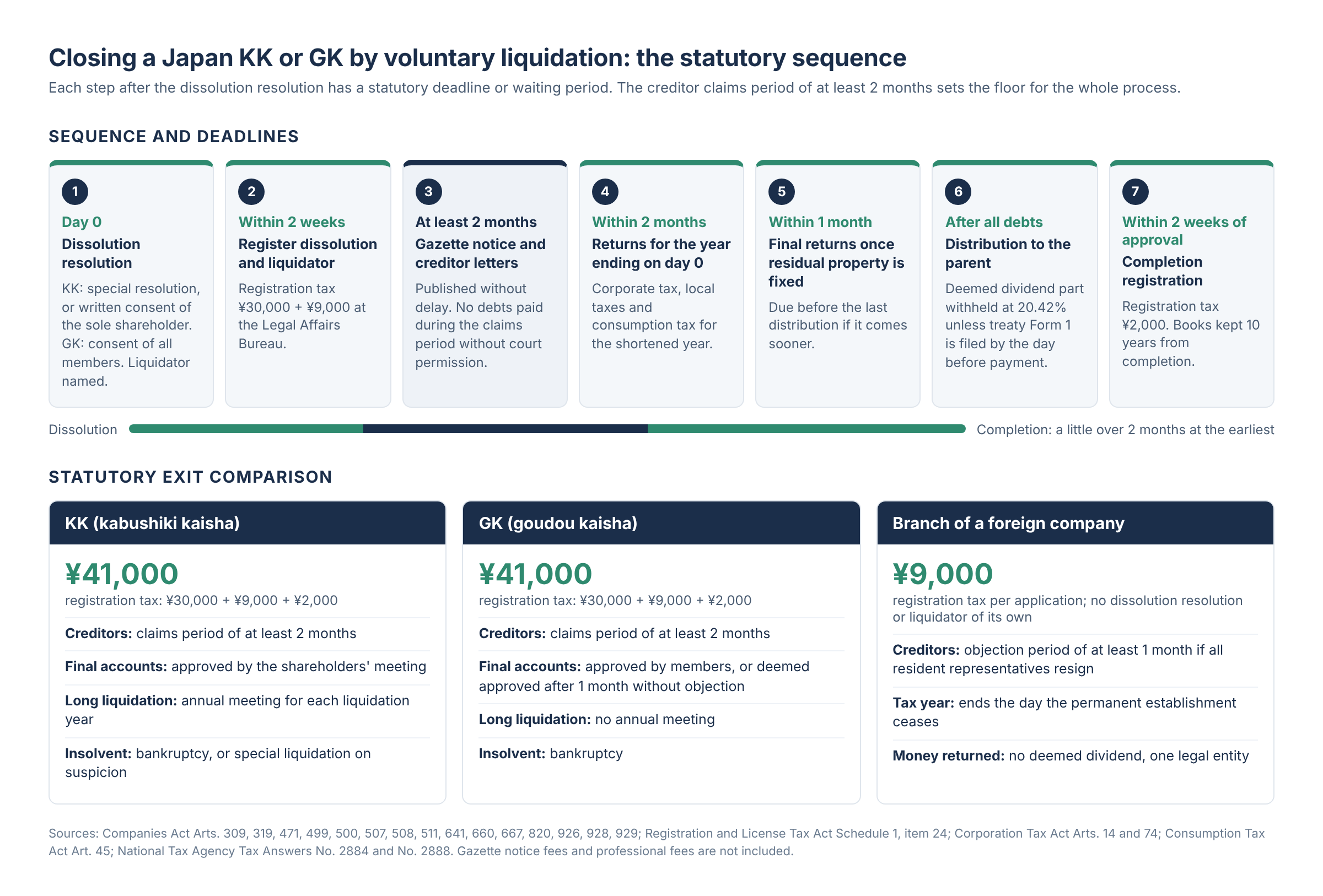
A voluntary liquidation of a solvent KK or GK runs from the shareholder resolution to the completion registration in a little over two months at the earliest. Every step after the resolution has a statutory deadline or a statutory waiting period, set out below.
The clock starts on the dissolution date stated in the resolution. Within two weeks the company registers both the dissolution and its liquidators (Companies Act Articles 926 and 928).
The liquidator then publishes the creditor notice in the Official Gazette without delay and writes individually to every known creditor, giving a claims period of at least two months (Article 499 for a KK, Article 660 for a GK). During that period the company may not pay its debts except with court permission for small or secured claims (Articles 500 and 661).
Once the period ends, the liquidator pays the creditors, realises the remaining assets and fixes the residual property. The final tax returns are filed, the residual property goes to the parent, and the shareholder or members approve the liquidation accounts. The completion registration within two weeks of that approval closes the register (Article 929).
| Stage | Earliest timing | Documents and decisions | Legal basis |
|---|---|---|---|
| Preparation | Before the dissolution date | Solvency test on a current balance sheet; plan for intercompany balances; staff notices given at least 30 days ahead | Companies Act Arts. 484, 511; Labour Standards Act Art. 20 |
| Dissolution resolution | Day 0 | KK: special resolution of the shareholders' meeting, or written consent of the sole shareholder; GK: consent of all members. Liquidator appointed | Arts. 471(iii), 309(2)(xi), 319, 641(iii) |
| Dissolution and liquidator registration | Within 2 weeks of day 0 | Application, minutes or consent, liquidator's acceptance, shareholder list for a KK | Arts. 926, 928 |
| Gazette notice and letters to known creditors | Without delay after day 0 | Notice in the Official Gazette; individual letters to known creditors | Arts. 499, 660 |
| Inventory and balance sheet at the dissolution date | Without delay after the liquidator takes office | KK: approved by the shareholders' meeting; GK: contents notified to each member | Arts. 492, 658 |
| Tax returns for the year ending on the dissolution date | Within 2 months of day 0 | Corporate tax, local corporate taxes and consumption tax for the shortened year | Corporation Tax Act Arts. 14(1)(i), 74(1) |
| Creditor period ends; debts paid | Month 2 onward | Payment of claims filed and known; assets realised | Arts. 500, 502, 661, 664 |
| Residual property fixed; final tax returns | Within 1 month of the fixing date, and before the last distribution | Final corporate and consumption tax returns | Corporation Tax Act Art. 74(2); Consumption Tax Act Art. 45(4) |
| Distribution to the parent | After all debts are paid | Liquidator's decision on the distribution; treaty relief form filed the day before payment at the latest | Arts. 502, 504; Income Tax Act Art. 25 |
| Final liquidation report approved | After the liquidation affairs end | KK: shareholders' meeting approves the final report; GK: members approve the liquidation accounts, deemed approved after 1 month without objection | Arts. 507, 667 |
| Completion registration | Within 2 weeks of the approval | Application with the approved report or accounts; tax offices notified | Art. 929 |
| Records kept | 10 years from the completion registration | Books and important records of the business and the liquidation | Arts. 508, 672 |
Two further rules shape the timetable. A KK whose liquidation runs past one year must prepare a balance sheet and administrative report for each liquidation year, which starts on the day after the dissolution date, and present them to an annual shareholders' meeting (Articles 494 and 497); a GK has no such step.
A dissolution date also cannot be set in the future by resolution alone: the Ministry of Justice's specimen minutes note that a future date requires an articles amendment fixing the company's duration, which is itself registered.
What the Parent Company Must Decide, Sign and Fund
The parent company resolves the dissolution, approves the final report or accounts and, before anything else, makes sure the subsidiary can pay every creditor in full. As sole shareholder of a KK it also approves the opening inventory and balance sheet; as sole member of a GK it is only notified of them.
The dissolution resolution
A KK dissolves by special resolution of the shareholders' meeting, which needs two-thirds of the votes present at a meeting with a quorum of a majority of voting rights, unless the articles provide otherwise (Articles 471(iii) and 309(2)(xi)). A sole shareholder can replace the meeting with written or electronic consent under Article 319, and the consent counts as the resolution.
A GK dissolves by the consent of all members (Article 641(iii)), which for a wholly owned GK is the parent's own consent.
The resolution should name the dissolution date and the liquidator. In a KK the directors become liquidators automatically unless the articles or the resolution name someone else, and a representative director becomes the representative liquidator (Articles 478 and 483).
In a GK the executive members become liquidators unless the articles or a majority of members choose others (Article 647). Where the parent is itself the executive member, it becomes the liquidator and acts through the individual it appoints to perform its duties, whose name and address are registered (Article 928(2)).
The registration file
The Ministry of Justice's specimen application for a KK dissolution with a single liquidator lists the attachments: the articles of incorporation, the minutes of the shareholders' meeting, the shareholder list (株主リスト, kabunushi risuto), the liquidator's acceptance of office and a power of attorney where an agent files.
Where the company files with a registered seal, a seal notification for the representative liquidator may also be attached. The GK form follows the same pattern with the members' consent in place of minutes. The procedure for routing signatures through the group approval matrix is in the guide to delegation of authority and the corporate seal in a Japan subsidiary.
The two approvals during liquidation
Two later documents need the parent's approval. The first is the inventory of assets and balance sheet as at the dissolution date, which the liquidator prepares without delay and a KK's shareholders' meeting approves (Article 492); a GK liquidator instead notifies each member of its contents (Article 658).
The second is the final liquidation report for a KK (決算報告, kessan houkoku), approved by the shareholders' meeting under Article 507, or the liquidation accounts for a GK, approved by the members under Article 667. Approval of a KK's final report releases the liquidators from liability for neglect of duty, except for misconduct. The rules for running a sole-shareholder meeting without convening it are in the guide to the annual shareholders' meeting for a foreign-owned KK.
Funding: solvency comes first
A company in liquidation may distribute nothing to its shareholder until its debts are paid (Articles 502 and 664). If it becomes clear that the assets cannot cover the debts, the liquidator must immediately apply for bankruptcy (Articles 484 for a KK and 656 for a GK). A KK liquidator who merely suspects insolvency must apply for special liquidation (特別清算, tokubetsu seisan), a court-supervised procedure (Article 511(2)). Special liquidation exists only for a KK.
For a subsidiary funded by parent loans, the result is that the parent decides before dissolution how the negative equity will be cleared, typically by injecting capital or waiving intercompany debt, and the subsidiary records any waiver as income.
The loan side is covered in the guide to intercompany loans to a Japan subsidiary. The parent also funds the cash the subsidiary needs to the end: final salaries, any pay in lieu of notice, the local tax levies for the fiscal years during the liquidation and the final tax payments.
Tax Returns During Dissolution and Liquidation
Dissolution cuts the fiscal year short, and the year in which the residual property is fixed ends on that date with a one-month filing deadline. Corporate tax, local corporate taxes and consumption tax are filed for every fiscal year during the liquidation.
Under Article 14(1)(i) of the Corporation Tax Act (法人税法, houjinzeihou), a company that dissolves partway through its fiscal year ends that year on the dissolution date, and the next year starts the following day.
What follows depends on the entity type. For a KK, each later fiscal year is a liquidation year (清算事務年度, seisan jimu nendo) of one year running from the day after the dissolution date, whatever its articles say (Companies Act Article 494(1); National Tax Agency basic circular 1-2-9). That rule does not cover a GK, whose later fiscal years follow the fiscal year set in its articles.
The return for the shortened year is due within two months under Article 74(1), on the same basis as any other year, and a return follows for each fiscal year during the liquidation. The tax office is notified of the dissolution, and later of the completion, on a change notification (異動届出書, idou todokedesho), which the National Tax Agency asks companies to file promptly after the event.
The final year and its one-month deadline
The year in which the residual property is fixed ends on the fixing date (Article 14(1)(v)). Article 74(2) shortens the filing deadline for that year to one month, and if the last distribution of residual property is made within that month, the return is due by the day before the distribution.
Article 45(4) of the Consumption Tax Act applies the same rule to the final consumption tax return. In practice the final returns are prepared before the money leaves Japan, because the subsidiary must still be able to pay the tax shown on them.
Tax losses in a liquidation
Ordinary loss carryforwards remain available in the fiscal years during the liquidation under the usual rules, covered in the guide to tax loss carryforward rules in Japan.
Article 59(4) of the Corporation Tax Act adds a narrower relief. It applies only to a dissolved company that expects no residual property, and only in a fiscal year that ends during the liquidation: an amount based on the losses of earlier years, including losses past the ordinary carryforward period, is then deductible against that year's income, such as a gain on a debt waiver received during the liquidation.
Article 59(6) makes the deduction conditional on attaching a computation statement and a document explaining why no residual property is expected. Under the National Tax Agency's basic circulars 12-3-7 and 12-3-8 on the Corporation Tax Act, the test looks at the position at the end of each fiscal year in the liquidation, and a company whose debts exceed its assets at that date qualifies. A subsidiary made solvent before dissolution that will distribute residual property to the parent does not.
The distribution to the parent is partly a deemed dividend
Under Article 25(1)(iv) of the Income Tax Act, the part of a residual property distribution that exceeds the capital-related amount (資本金等の額, shihonkin tou no gaku) attributable to the shares is a deemed dividend (みなし配当, minashi haitou). Withholding applies to that part.
The National Tax Agency's table of withholding rates for non-residents and foreign corporations sets the domestic rate on dividends from unlisted shares at 20.42%, which is 20% income tax under Article 213 plus the special reconstruction income tax.
A tax treaty can reduce the rate, but only if the parent's application form for relief on dividends (Form 1) reaches the tax office through the subsidiary by the day before the payment, according to the National Tax Agency's guidance on treaty relief applications (Tax Answer No. 2888). Without it, the subsidiary withholds at the domestic rate and the parent must claim a refund afterwards.
Treaties with a limitation on benefits article also require a residence certificate and an attachment form. The same split between a return of capital and a deemed dividend applies to a capital reduction or a share buyback, as described in the guide to repatriating profits from Japan, and the treaty mechanics are in the guide to withholding tax on dividends and royalties in Japan.
The per-capita levy runs until the office closes
The corporate inhabitants tax per-capita levy (均等割, kintouwari) is charged for each fiscal year in which a company keeps an office, with or without profit.
According to the Tokyo Metropolitan Government Bureau of Taxation's corporate tax Q&A, the minimum in Tokyo is ¥70,000 a year for a company with capital of ¥10 million or less and 50 employees or fewer, and a part year is charged by months held, with any fraction of a month dropped unless the whole period is under one month.
Each month the liquidation runs past the creditor period therefore has a small fixed tax cost, in addition to the filings themselves.
Employees, Payroll and Social Insurance When the Company Closes
Closing the business does not remove the employer's duties to its staff. Notice or pay in lieu is still required, final wages have a seven-day deadline on request, and the social and labour insurance offices each need a closure filing within 5 to 50 days of the closure.
Article 20 of the Labour Standards Act requires at least 30 days' advance notice of dismissal, or at least 30 days' average wages in lieu, and allows the days to be shortened by paying wages for each day cut.
Its exceptions cover a business made impossible to continue by a natural disaster or similar unavoidable cause, and causes attributable to the worker; a parent's decision to close the subsidiary is not a cause of either kind. How courts review economic dismissals is covered in the guide to employee dismissal rules in Japan, and statutory and contractual retirement payments in the guide to severance pay and retirement allowances in Japan.
When an employee leaves and asks for payment, Article 23 of the Labour Standards Act requires the employer to pay the wages due within seven days and return anything belonging to the employee. Leavers' residential tax also changes collection method in the month they go, and the guide to resident tax payroll deduction for leavers sets out the options.
The insurance filings follow the employees. For employment insurance, each employee's loss of coverage is reported to Hello Work within 10 days under Article 7 of the Ordinance for Enforcement of the Employment Insurance Act, and the abolition of the establishment within 10 days under Article 141.
For health insurance and employees' pension, the Japan Pension Service's procedure for an establishment that ceases to be covered requires the establishment closure notice (適用事業所全喪届, tekiyou jigyousho zensou todoke) within five days of the closure, attaching a copy of the registry certificate showing the dissolution or the employer's copy of the Hello Work abolition notice.
For labour insurance, Article 19 of the Labour Insurance Premium Collection Act requires the final premium return within 50 days of the date the insurance relationship ends. On the income tax side, Article 230 of the Income Tax Act requires notice to the tax office within one month that the office paying salaries has closed.
Filings Checklist After the Dissolution Resolution
A closing KK or GK files with seven offices: the Legal Affairs Bureau, the tax office, the prefectural and municipal tax offices, the Japan Pension Service, Hello Work and the Labour Standards Inspection Office or Prefectural Labour Bureau. Each has its own deadline, counted from a different event.
| Filing | Where | Deadline | Basis |
|---|---|---|---|
| Dissolution and liquidator registration | Legal Affairs Bureau | 2 weeks from the dissolution date | Companies Act Arts. 926, 928 |
| Creditor notice in the Official Gazette and letters to known creditors | Official Gazette; each known creditor | Without delay; claims period of at least 2 months | Arts. 499, 660 |
| Change notification for the dissolution | Tax office; prefectural and municipal tax offices | Promptly after the dissolution | National Tax Agency procedure; local tax rules |
| Establishment closure notice for health insurance and pension | Japan Pension Service | 5 days from the closure | Japan Pension Service procedure |
| Loss of employment insurance coverage, per employee | Hello Work | 10 days from the day after the employee leaves | Employment Insurance Ordinance Art. 7 |
| Abolition of the employment insurance establishment | Hello Work | 10 days from the day after the abolition | Employment Insurance Ordinance Art. 141 |
| Final labour insurance premium return | Labour Standards Inspection Office or Prefectural Labour Bureau | 50 days from the end of the insurance relationship | Labour Insurance Premium Collection Act Art. 19 |
| Notice that the salary payment office has closed | Tax office | 1 month from the closure | Income Tax Act Art. 230 |
| Tax returns for the year ending on the dissolution date | Tax office; local tax offices | 2 months from the dissolution date | Corporation Tax Act Art. 74(1) |
| Final returns for the year the residual property is fixed | Tax office; local tax offices | 1 month from the fixing date, or the day before the last distribution if earlier | Corporation Tax Act Art. 74(2); Consumption Tax Act Art. 45(4) |
| Treaty relief form for the deemed dividend | Tax office, through the subsidiary | Day before the distribution | National Tax Agency Tax Answer No. 2888 |
| Withholding tax on the deemed dividend | Tax office | 10th of the month after payment | Income Tax Act Art. 212 |
| Completion of liquidation registration | Legal Affairs Bureau | 2 weeks from the approval of the final report or accounts | Art. 929 |
| Change notification for the completion | Tax office; prefectural and municipal tax offices | Promptly after the completion | National Tax Agency procedure |
Late registration has a price beyond the delay. Under Article 976 of the Companies Act the court can impose a civil fine of up to ¥1 million for a registration not made on time, and liquidators are among the officers the article names. A missed deadline at the start, such as a dissolution registration filed in week three, is an avoidable exposure.
Closing a Branch of a Foreign Company
A branch closes by deregistration, with no dissolution resolution or liquidator of its own. The foreign company closes its Japanese business office and its Japan representatives resign, with a one-month creditor objection period if all of the resident representatives leave.
A liquidation can still be imposed. Under Article 822 of the Companies Act, once a foreign company stops carrying on business in Japan, the court may, on the application of an interested party such as a creditor or of its own motion, order a liquidation of all of the foreign company's property in Japan and appoint a liquidator.
Under Article 817 of the Companies Act, a foreign company that carries on business in Japan must have at least one representative in Japan with an address in Japan. When all the resident representatives intend to resign, Article 820 requires a notice in the Official Gazette and letters to known creditors inviting objections within a period of at least one month.
A creditor who objects must be paid, secured or protected through a trust unless the resignation cannot harm them, and the resignation takes effect only when it is registered after that procedure. The closure of the business office is registered at the same Legal Affairs Bureau.
The branch's corporate tax position is set by the Corporation Tax Act provisions for foreign corporations. Under Article 14(1)(viii), when a foreign corporation with a permanent establishment ceases to have one partway through its fiscal year, the year ends on the day it ceases.
Under Article 144-6(1), the return is normally due within two months of the year end, but a foreign corporation that ceases to have a permanent establishment without notifying a tax agent (納税管理人, nouzei kanrinin) must file by the earlier of that date and the day it ceases. Payroll and the insurance closures follow the same rules as for a subsidiary.
The cash that a branch sends back is the foreign company's own money moving within one legal entity, so there is no distribution to a shareholder and no deemed dividend under Article 25 of the Income Tax Act. That is one of the trade-offs set out in the guide to foreign company registration versus a Japan subsidiary.
Closing a KK vs a GK vs a Branch: Statutory Cost Comparison
The statutory cost of closing is close to identical for a KK and a GK, at ¥41,000 in registration tax plus a gazette notice and the final returns. A branch is cheaper and faster on paper, with ¥9,000 per registration and a one-month objection period.
The registration figures come from Schedule 1, item 24 of the Registration and License Tax Act (登録免許税法, touroku menkyozeihou). A company dissolution registration is ¥30,000 per application, a liquidator registration ¥9,000 and a completion of liquidation registration ¥2,000, a total of ¥41,000 (30,000 + 9,000 + 2,000) for a KK or a GK. For a foreign company, item 24(2)(c) of the same Act taxes registrations other than setting up a business office at ¥9,000 per application.
The gazette notice is charged per line by the gazette publisher and is not included.
| Item | KK | GK | Branch of a foreign company |
|---|---|---|---|
| Decision to close | Special resolution of shareholders, or written consent of the sole shareholder | Consent of all members | Foreign company's own decision under its home law |
| Who winds up | Directors as liquidators unless others are appointed | Executive members as liquidators unless others are chosen | Japan representatives until their resignation is registered |
| Creditor procedure | Gazette notice and letters, claims period of at least 2 months | Gazette notice and letters, claims period of at least 2 months | Gazette notice and letters, objection period of at least 1 month, if all resident representatives resign |
| Registration and License Tax Act: dissolution | ¥30,000 | ¥30,000 | None (no dissolution resolution in Japan) |
| Registration and License Tax Act: liquidator | ¥9,000 | ¥9,000 | None |
| Registration and License Tax Act: completion or closure | ¥2,000 | ¥2,000 | ¥9,000 per application (office closure, representative resignation) |
| Registration and License Tax Act: total | ¥41,000 | ¥41,000 | ¥9,000 per application |
| Annual meeting while in liquidation | Required for each liquidation year that ends before completion | Not required | Not applicable |
| Approval of final accounts | Shareholders' meeting approves the final report | Members approve, or are deemed to after 1 month without objection | Not applicable |
| Insolvency route | Bankruptcy, or special liquidation on suspicion of insolvency | Bankruptcy | No liquidation of its own; a court can order a liquidation of the foreign company's property in Japan (Art. 822) |
| Tax year end on closure | Dissolution date, then each liquidation year (Companies Act Art. 494(1)), then the residual property fixing date | Dissolution date, then the fiscal year set in its articles, then the residual property fixing date | Day the permanent establishment ceases |
| Money returned to the parent | Deemed dividend on the part above the capital-related amount, withheld at the NTA domestic rate of 20.42% before treaty relief | Same as a KK | No deemed dividend; funds stay within one legal entity |
| Records after closing | Books kept 10 years from completion | Books kept 10 years from completion | No Japanese liquidation records duty unless a court orders a liquidation |
The comparison changes the entity decision at setup less than it might seem. The difference in exit cost between a KK and a GK is nil on registration tax and comes down to the KK's annual meeting in a long liquidation. The branch's advantage is speed, but it is offset by the foreign company's direct liability for everything the branch did. The full entity comparison is in the guide to KK vs GK vs branch vs representative office.
Common Mistakes That Delay Completion
Three avoidable errors add time to a liquidation: dissolving with a negative balance sheet, booking the gazette notice late and leaving routine bills unpaid at the dissolution date.
- Dissolving before the balance sheet is solvent. Once the liquidator sees that debts exceed assets, the voluntary route closes. Settling intercompany balances before the resolution keeps the liquidation in the parent's hands.
- Publishing the gazette notice late. The two-month period runs from the notice, not from the dissolution date, so every week of delay in booking the notice is a week added to the end.
- Leaving routine bills open at the dissolution date. Rent, utilities and supplier invoices that fall due during the claims period cannot be paid without court permission, and the company stays liable for the default (Articles 500 and 661), so they are best settled before the dissolution date.
A subsidiary that is left dormant instead of liquidated is not closed. A KK with no registration entry for 12 years receives a notice from the Ministry of Justice and is dissolved by the registrar unless, within 2 months of the notice, it files a statement that it is still in business or makes a registration.
The deemed dissolution process is set out in the guide to deemed dissolution of a dormant Japan subsidiary.
Frequently Asked Questions
How long does it take to close a Japan subsidiary?
A solvent KK or GK takes a little over two months at the earliest.
Beyond that floor, the length depends on how quickly receivables are collected, leases and contracts end and the final tax position is settled. A branch has a shorter floor, with an objection period of at least one month when all resident representatives resign.
What happens to a creditor who claims after the claims period?
An unknown creditor who did not file within the period is excluded from the liquidation and can be paid only out of residual property not yet distributed (Article 503 for a KK, Article 665 for a GK). A creditor the company knew about is not excluded, which is why the individual letters matter as much as the gazette notice.
Can the parent change its mind after the dissolution resolution?
Yes, until the liquidation is completed. A KK can resolve to continue by special resolution under Article 473 of the Companies Act and a GK by the consent of its members under Article 642, and the continuation itself is registered at ¥30,000.
Is it cheaper to keep a dormant entity than to liquidate it?
Only in the short term. A dormant KK or GK still files a return every year and pays the per-capita levy for every year it keeps an office, while a liquidation is a one-time cost that ends those obligations.
Working with AQ Partners. Our Tokyo team provides commercial registration changes, including dissolution and liquidation registrations, annual tax filings and employee life-cycle filings for foreign companies operating in Japan. Book a consultation to discuss your situation.

Yuga Koda is a founding Director at AQ Partners, supporting foreign companies, funds, and families operating in Japan. His experience operating companies in both Japan and international markets gives him a practical understanding of back office operations from both sides.