
Dormant Japan Subsidiary: Keep It or Close It?

A dormant Japan subsidiary is a KK or GK that has stopped trading but is still registered, so it remains a taxpayer with directors, filings and a registered head office. Liquidation is the alternative: the shareholder resolves to dissolve, a liquidator settles creditors and distributes what is left, and the company ends with a completion registration at the Legal Affairs Bureau.
Japan has no dormant status in the commercial register, so "dormant" means notices to tax and insurance offices plus costs that recur every year. This memo sets those against the one-off steps of closing.
Key Takeaways
- Dormancy is not a legal status. The register does not change; the company tells the tax offices, the Japan Pension Service and Hello Work that it has stopped operating.
- The returns never stop. Every fiscal year still needs a corporate tax return within 2 months of the year end unless extended (Corporation Tax Act Art. 75-2(1)), even with no income.
- The per-capita levy keeps running. Local inhabitants tax charges a flat amount while the company has an office in the municipality, profit or loss; in Tokyo the floor is ¥70,000 a year at the Tokyo Metropolitan Tax Bureau's published rates.
- Skipped returns cost more than the filing fee. Tax losses carry forward only if a blue return was filed for the loss year and returns every year since, and a KK that stops registering its directors moves toward deemed dissolution after 12 years.
- Liquidation has a legal floor of about two months. The creditor notice period cannot be shorter than 2 months, and the three registrations it needs carry ¥41,000 in tax under the Registration and Licence Tax Act.
What "dormant" means for a Japan subsidiary
A dormant subsidiary is one that has stopped business but has not dissolved, so it still exists in law and in the commercial register. Nothing is filed at the Legal Affairs Bureau to become dormant; the notices go to the offices that collect tax and insurance.
Each office wants its own notice, on its own clock. Kagoshima City's tax guidance, for example, tells a stopped company to file the municipal notice of change (houjin-tou idou todokedesho) for suspension, and again when it restarts.
| Notice or filing | Filed with | Deadline | Basis or source |
|---|---|---|---|
| Notice of change reporting suspension of business | Municipal (and, where required, prefectural) tax office | Set by each local government's form | Local tax ordinances (Kagoshima City guidance as an example) |
| Closure of the salary payment office | National tax office | 1 month from the closure | Income Tax Act Art. 230 |
| Full-loss notice for health insurance and pension (tekiyou jigyousho zensou todoke) | Japan Pension Service | 5 days from the suspension | Japan Pension Service procedure for offices that stop being covered |
| Closure of the employment insurance office | Hello Work | 10 days, counted from the day after closure | Employment Insurance Act Enforcement Regulation Art. 141 |
| Corporate tax and local tax returns | Tax offices | Every fiscal year, unchanged by dormancy | Corporation Tax Act Art. 74 |
The Japan Pension Service lists suspension of business (kyuugyou) as a trigger for the full-loss notice. Its standard attachment is a register extract showing dissolution or a copy of the Hello Work closure notice; failing those, alternatives include the salary payment office closure notice or board minutes resolving the suspension.
The costs that keep running while the entity sleeps
A dormant subsidiary still pays the per-capita levy where it keeps an office, files yearly tax returns and, if a KK, re-registers its directors.
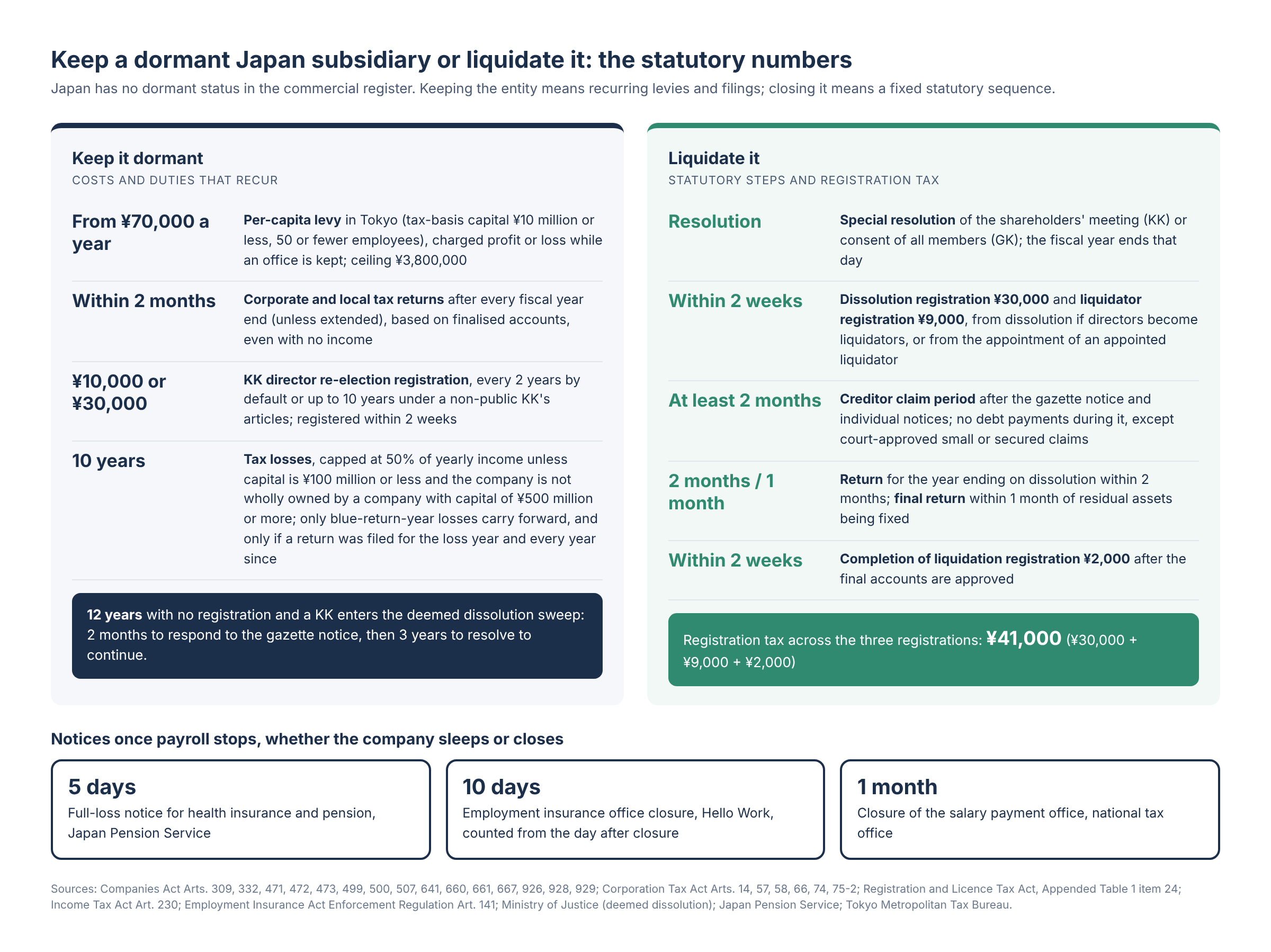
The per-capita levy (kintouwari) is the one cost that does not depend on activity. The Tokyo Metropolitan Tax Bureau states that it is charged by capital and headcount regardless of results, so a company with an office in Tokyo files and pays even in a loss year.
The lowest band in the bureau's rate table covers tax-basis capital (shihonkin-tou no gaku) of ¥10 million or less and 50 or fewer employees. The broader mechanics are in our guide to local enterprise tax and inhabitants tax.
| Recurring item | Statutory amount or rule | How often | Applies to | Basis |
|---|---|---|---|---|
| Inhabitants tax per-capita levy | From ¥70,000 a year in Tokyo, up to ¥3,800,000 by capital and headcount | Every year an office is kept | KK and GK | Local Tax Act; Tokyo Metropolitan Tax Bureau rate table |
| Corporate tax return | Within 2 months of the fiscal year end, based on finalised accounts | Every fiscal year | KK and GK | Corporation Tax Act Art. 74 |
| Local tax returns (inhabitants tax, enterprise tax) | Filed with the corporate tax cycle | Every fiscal year | KK and GK | Local Tax Act |
| Director re-election and registration | Registration tax ¥10,000 (capital ¥100 million or less) or ¥30,000 (over ¥100 million) | Every 2 years by default; up to 10 years if a non-public KK's articles extend the term | KK only | Companies Act Art. 332; Registration and Licence Tax Act |
| Annual shareholders' meeting and balance sheet public notice | Notice after the annual meeting | Every fiscal year | KK only | Companies Act Art. 440 |
| Books and records | Kept to support each return and any loss carryforward | Continuous | KK and GK | Corporation Tax Act Art. 57(10) |
| Registered head office and a contact for official mail | Needed for the register and for tax notices | Continuous | KK and GK | Companies Act |
Director terms are a KK rule: the GK provisions of the Companies Act contain no equivalent of Art. 332. Each KK re-election must be registered within 2 weeks; timing is covered in director terms of office and re-election.
What dormancy protects, and what skipped filings put at risk
Keeping the entity alive preserves its tax losses, its registration history and the option to restart, but only while the annual filings continue.
Three rules decide this. Under Corporation Tax Act Art. 57, losses from fiscal years that began within the previous 10 years can be set against future income, capped at 50% of each year's taxable income, unless the subsidiary has capital of ¥100 million or less and is not wholly owned by a company with capital of ¥500 million or more (Arts. 57(1), 57(11), 66(5)).
Art. 57(10) allows this only if a return was filed for the loss year and returns were filed continuously after it. Art. 58(1) adds that losses from a year without a blue return carry forward only as disaster losses. Under Art. 127(1)(iv), a return filed late lets the tax office revoke blue-return approval back to that year, so its losses and later ones lose ordinary carryforward.
Finally, a KK with no registration of any kind for 12 years is a dormant company under Companies Act Art. 472, and that is where strike-off begins. The Ministry of Justice publishes a notice in the official gazette; a KK that neither files a notice that it is still in business nor registers a change within 2 months is registered as dissolved. It can resolve to continue within 3 years by special resolution.
A KK that re-registers its directors at every term end never reaches 12 years. The sweep and its notices are explained in how deemed dissolution strikes off a dormant subsidiary.
What liquidation involves, step by step
Liquidation runs dissolution, a creditor notice of at least 2 months, settlement, final accounts and completion registration, so it cannot finish sooner.
A KK dissolves by special resolution of the shareholders' meeting (Companies Act Arts. 471 and 309(2)); a GK dissolves with the consent of all members (Art. 641). The fiscal year ends on the date of dissolution under Corporation Tax Act Art. 14, which creates a short tax year with its own return.
| Step | Legal deadline or minimum | Registration tax | Basis |
|---|---|---|---|
| Dissolution resolution (KK) or members' consent (GK) | Date chosen by the shareholder or members | None | Companies Act Arts. 471, 641 |
| Dissolution registration | Within 2 weeks of dissolution | ¥30,000 | Companies Act Art. 926 |
| Liquidator registration | Within 2 weeks of dissolution if the directors become liquidators; within 2 weeks of appointment if a liquidator is appointed | ¥9,000 | Companies Act Art. 928(1) to (3) |
| Gazette notice and individual notice to known creditors | Claim period of at least 2 months; no debt payments during it, except court-approved small or secured claims | None | Companies Act Arts. 499, 500 (KK), 660, 661 (GK) |
| Return for the year ending on the dissolution date | Within 2 months of that date | None | Corporation Tax Act Arts. 14, 74 |
| Final return once residual assets are fixed | Within 1 month, or before the final distribution if that comes sooner | None | Corporation Tax Act Art. 74(2) |
| Final accounts approved | After liquidation work ends | None | Companies Act Arts. 507 (KK), 667 (GK) |
| Completion of liquidation registration | Within 2 weeks of approval | ¥2,000 | Companies Act Art. 929 |
The registration tax amounts come from the Registration and Licence Tax Act, Appended Table 1, item 24: ¥30,000 + ¥9,000 + ¥2,000 = ¥41,000 across the three registrations.
The tax office needs a notice of change for the dissolution and for the completion (National Tax Agency procedure C1-8).
The part of a residual distribution that exceeds the tax-basis capital (shihonkin-tou no gaku) attributable to the parent's shares is treated as a deemed dividend (Income Tax Act Art. 25); dividend withholding and treaty relief for a foreign parent are covered in repatriating profits from Japan.
Keep or close: how HQ can decide
Keep the entity when a restart, its tax losses or its contracts are worth more than the yearly filings and levy; close it when none of those exists.
First, is there a dated plan to restart in Japan? Re-incorporating later means registration tax of 0.7% of capital under the Registration and Licence Tax Act (at least ¥150,000 for a KK, ¥60,000 for a GK), plus new tax, insurance and bank setup.
Second, are there tax losses the subsidiary can still use? They only survive with unbroken annual returns. Third, does anything need the entity to exist, such as a lease, an intercompany agreement, a licence or a customer contract?
The board pack should set the yearly cost of keeping against the one-off cost of closing, over the years the entity would sit idle. The wider annual calendar is in our corporate secretarial obligations checklist.
FAQ
Does a dormant company in Japan still pay inhabitant tax?
Yes, if it still keeps an office or similar premises in the municipality, as Akita City's guidance on the per-capita levy shows. The part calculated on corporate tax falls away when there is no corporate tax to base it on.
Does a dormant KK still need a representative director in Japan?
Yes. Where a term ends with no successor elected and the company would otherwise be short of the number of directors the Companies Act or its articles require, the outgoing directors keep their duties until successors take office (Companies Act Art. 346(1)), but the overdue registration can draw a fine of up to ¥1 million (Art. 976). The rules on residency and signing authority are in our post on representative director residency.
Can a dormant company restart without a new company registration in Japan?
Yes, if it was never dissolved, or if a KK dissolved by resolution resolves to continue before liquidation is complete; a deemed-dissolved KK has 3 years (Companies Act Art. 473). It notifies the local tax offices that it has restarted, and its registration, corporate number and history carry on.
Does a dormant subsidiary still need bookkeeping in Japan?
Yes, at a low volume. To use a loss later, the books for the loss year must be kept for 10 years from the day after that year's return deadline (Corporation Tax Act Enforcement Regulation Art. 26-3), so they cannot be discarded when activity stops.
Working with AQ Partners. Whether your group keeps its Japan subsidiary dormant or closes it, our Tokyo team provides annual tax filings, director change registration and other commercial registration changes, including dissolution and completion of liquidation registrations, along with the monthly bookkeeping behind them, for foreign companies operating in Japan. Book a consultation to discuss your situation.

Yuga Koda is a founding Director at AQ Partners, supporting foreign companies, funds, and families operating in Japan. His experience operating companies in both Japan and international markets gives him a practical understanding of back office operations from both sides.