
Japan Subsidiary Withdrawal Checklist for HQ

A Japan subsidiary withdrawal checklist lists the operational closures a foreign parent completes alongside the formal dissolution and liquidation of its kabushiki kaisha (KK) or godo kaisha (GK). The commercial registry records the dissolution; the pension office, Hello Work, the labour bureau, the tax office, the municipalities, the bank and the landlord each need their own filing or notice, some within days. Each item below carries its legal basis.
Key Takeaways
- Social insurance moves in days. Each leaver's loss notification and the establishment closure notification are due at the Japan Pension Service within 5 days.
- Hello Work and the labour bureau follow. Employment insurance filings are due within 10 days, and the final labour insurance premium return within 50 days of the business ending.
- Payroll closes at the tax office too. Leavers receive a withholding slip within 1 month, and the payroll office closure notification is due within 1 month.
- The invoice registration ends with the business, not the dissolution vote. It lapses the day after the closure date on the business-closure notification.
- The bank account closes last and the books outlive the company. Debts are paid before any distribution, and the books are kept for 10 years after completion.
What a Japan subsidiary withdrawal checklist covers
A withdrawal checklist covers every closure outside the commercial registry: insurance, payroll tax, consumption tax, bank, lease and records.
For a KK, the directors become the liquidators unless the articles or a shareholder resolution appoint someone else (Companies Act Article 478). For a GK, the members who execute the business do, unless the articles or a majority of members choose others (Article 647). The liquidator represents the company from dissolution onward (Articles 483 and 655).
Under the Companies Act (official English translation), a liquidating KK or GK must publish a notice to creditors in the Official Gazette with a claim period of at least two months and notify each known creditor individually (Articles 499 and 660).
That two-month floor sets the minimum length of the liquidation. The dissolution date also closes a tax year: under Corporation Tax Act Article 14, a company that dissolves mid-year ends that business year on the dissolution date. If the parent is still weighing a dormant entity instead, see deemed dissolution of a dormant Japan subsidiary. Employment law for letting staff go sits in terminating a Japan employee when the group restructures.
The master checklist: filings, deadlines and where they go
Most exit filings in Japan carry a statutory deadline counted from a specific event, so the trigger date matters as much as the form itself.
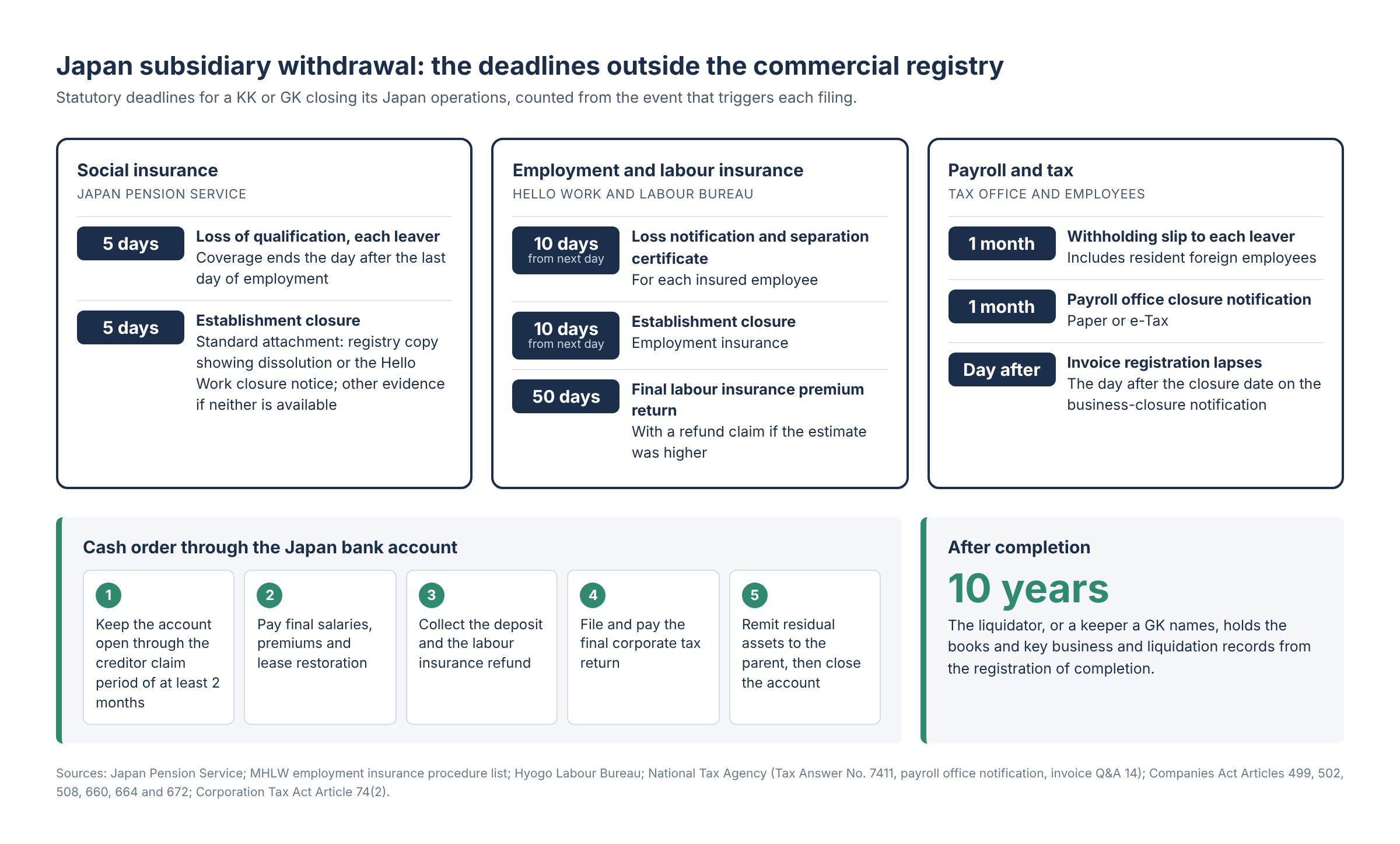
| Filing | Trigger | Deadline | Filed with |
|---|---|---|---|
| Health and pension insurance loss of qualification (被保険者資格喪失届) | Each employee leaves; coverage ends the day after the last day of employment | Within 5 days | Japan Pension Service |
| Establishment closure (適用事業所全喪届) | The establishment closes or no longer qualifies | Within 5 days | Japan Pension Service |
| Employment insurance loss of qualification and separation certificate (資格喪失届, 離職証明書) | Each employee stops being insured | Within 10 days, counted from the following day | Hello Work |
| Employment insurance establishment closure (適用事業所廃止届) | The establishment closes | Within 10 days, counted from the following day | Hello Work |
| Final labour insurance premium return (確定保険料申告書), with a refund claim if overpaid | The business is abolished | Within 50 days | Labour standards inspection office, prefectural labour bureau or a receiving bank |
| Withholding slip for each leaver (源泉徴収票) | An employee leaves during the year | Within 1 month of leaving | The employee |
| Payroll office closure notification (給与支払事務所等の廃止届出書) | The office that pays salaries closes | Within 1 month | Tax office |
| Resident tax leaver notification (Local Tax Act Article 321-5(3)) | An employee on special collection stops being paid | By the 10th of the following month (Enforcement Regulations Article 9-24) | Each employee's municipality |
| Change notification for the dissolution (異動届出書) | Dissolution, and later completion of liquidation | Promptly after the change | Tax office |
| Consumption tax business-closure notification (事業廃止届出書) | The business ends | Invoice registration lapses the day after the closure date | Tax office |
| Final corporate tax return for the liquidation | Residual assets are determined | Within 1 month, or by the day before the final distribution if earlier | Tax office |
Sources: Japan Pension Service procedure pages; the MHLW employment insurance procedure list; Hyogo Labour Bureau guidance on businesses that close; National Tax Agency Tax Answer No. 7411 and procedure C1-8; Local Tax Act Article 321-5 and its Enforcement Regulations Article 9-24; Consumption Tax Act Articles 57 and 57-2; Corporation Tax Act Article 74(2).
The returns for the business year that ends on dissolution, and the dissolution notices to the prefectural and municipal tax offices for local corporate taxes, follow the dissolution date and sit with the registry-side timeline.
Social and labour insurance: closing the employer registrations
Social insurance closes in two layers: each employee's coverage ends, then the establishment is deregistered at the pension office and Hello Work.
Each leaver. Health and pension coverage is lost on the day after the last day of employment, so an employee who leaves on 31 March loses coverage on 1 April. For Kyokai Kenpo members, the employer returns the eligibility certificate (資格確認書) and other certificates issued, or attaches a non-recovery notice. Our guide to social insurance for foreign employers covers the enrolment these filings reverse.
At Hello Work, the loss notification runs from the day after insured status ended. The separation certificate can be omitted only when the employee does not need a separation slip (離職票).
The establishment. The Japan Pension Service establishment closure procedure takes, in principle, a copy of the registry certificate showing the dissolution entry or the employer's copy of the Hello Work closure notice. If neither can be attached, it accepts other evidence, such as the payroll office closure notice or board minutes resolving the closure. The MHLW employment insurance procedure list gives the Hello Work deadlines.
Labour insurance. Premiums are paid in advance on an estimate. On closure, the employer files the final premium return, pays any shortfall and, if the estimate was higher, files a refund claim at the same time (Hyogo Labour Bureau guidance).
Final payroll, withholding and resident tax
The last Japan pay run triggers three tax duties: a withholding slip per leaver, the payroll office closure notice and resident tax settlement.
The withholding slip goes to every mid-year leaver, including foreign employees who are tax residents (National Tax Agency Tax Answer No. 7411). Once salaries stop, the payroll office closure notification goes to the tax office, on paper or through e-Tax. Seconded staff returning to the parent follow the same leaver steps; see final payroll for a seconded employee leaving Japan.
Resident tax depends on the month. Under Local Tax Act Article 321-5(2), for a leaver between 1 January and 30 April, the employer must collect the remaining instalments up to May in one lump sum from the final salary or retirement allowance, if that payment exceeds the amount due. For a leaver between June and December, the employer has no duty to collect them unless the employee asks.
Either way, the employer notifies the municipality of the leaver and the amount already collected; the mechanics are in resident tax payroll deduction for leavers. Separately, Labour Standards Act Article 23 requires wages and money belonging to a departing worker to be paid within 7 days of the worker's request, so final pay needs a working account.
Consumption tax and the qualified invoice registration
An invoice registration survives the dissolution vote; it lapses the day after the closure date on the consumption tax business-closure notice.
A business that closes must file a business-closure notification with its tax office, and the registration loses effect on the day after the business closed. The National Tax Agency sets this out in its invoice system Q&A on business closure, adding that the tax office can cancel a registration without the notification once it finds the business has ended.
A liquidating company often still sells equipment or invoices final services, and customers claiming input tax credit need a qualified invoice. The closure date on the notice should therefore come after the last such sale. The dissolution itself goes on the change notification. For the system in normal operation, see the Japan qualified invoice system for foreign companies.
Bank accounts: time the closure against the final distribution
Close the Japan bank account last: creditors, final taxes and refunds all clear through it before residual assets can go to the parent company.
The Companies Act fixes the order: a liquidating company cannot distribute property to its shareholders or members until its obligations are performed, apart from amounts held back for disputed claims (Article 502 for a KK, Article 664 for a GK). A workable sequence is:
- Keep the account open through the creditor claim period.
- Pay final salaries, social insurance premiums, the final labour insurance premium and lease restoration.
- Collect the deposit, the labour insurance refund and other amounts owed to the company.
- File and pay the final corporate tax return.
- Remit residual assets to the parent, then close the account once no further receipt is expected.
Office lease: notice period, restoration and the deposit
An office lease runs on its contract terms, so its notice period, restoration scope and deposit deductions decide the exit date and cost.
The Civil Code supplies the defaults. If the lease has no fixed term, a tenant's notice ends it three months later (Article 617), and the same applies when a fixed-term lease reserves a right to terminate (Article 618). The tenant restores damage arising after it took possession, excluding normal wear and tear and ageing (Article 621); the lease may define restoration differently, so read its clause against this default.
The landlord returns the deposit after the lease ends and the premises are handed back, net of unpaid rent and other amounts owed (Article 622-2). Our post on Japan office setup and leases covers where these clauses come from.
Records to keep after the company is gone
The liquidator, or a keeper a GK's members name, holds the books and key business and liquidation records for 10 years after completion is registered.
| Record | Retention period | Legal basis |
|---|---|---|
| Books and important business and liquidation records of a KK | 10 years from registration of completion | Companies Act Article 508(1) |
| Books and important business and liquidation records of a GK | 10 years from registration of completion | Companies Act Article 672(1) |
| Corporate tax books and transaction documents | 7 years from the day after the return deadline; 10 years for a blue-return loss year in fiscal years beginning on or after 1 April 2018 (9 years before) | National Tax Agency Tax Answer No. 5930 |
| Worker roster, wage ledger and key employment records | 5 years, read as 3 years for the time being | Labour Standards Act Articles 109 and 143 |
| Employment insurance documents | 4 years for documents on insured persons, 2 years for others | Employment Insurance Act Enforcement Regulations Article 143 |
| Labour insurance premium documents | 3 years | Labour Insurance Premium Collection Act Enforcement Regulations Article 72 |
| Employees' pension insurance documents | 2 years | Employees' Pension Insurance Act Enforcement Regulations Article 28 |
The Companies Act period is the longest. A GK can name a different keeper in its articles or by a majority of members (Article 672(2)), and for either form the court can appoint one on an interested party's petition (Article 508(2) for a KK, Article 672(3) for a GK). Decide before completion where the archive sits and who at the parent can retrieve it.
Frequently asked questions
What happens to Japan social insurance for employees when the subsidiary closes?
Company health insurance ends, but a Kyokai Kenpo member with at least 2 months of continuous coverage can apply for voluntary continuation (任意継続). The application must reach Kyokai Kenpo within 20 days of the loss date, so tell leavers before their last day.
Does a liquidating company still file consumption tax returns?
Yes, unless it is exempt from consumption tax or has no taxable sales and no tax payable for the period (Consumption Tax Act Article 45(1)). For the taxable period in which the residual assets are determined, the return is due within 1 month of that date instead of the usual 2 months, or by the day before the final distribution if that comes first (Article 45(4)).
Can foreign employees reclaim Japanese pension contributions when the subsidiary closes?
A foreign national with 6 or more months of employees' pension coverage can claim a lump-sum withdrawal payment within 2 years of leaving Japan if outside any Japanese public pension, short of the 10-year old-age qualifying period and never entitled to a disability pension (Japan Pension Service). Payment is capped at 60 months, but every insured period it was calculated on, not only 60 months, then counts as never insured (Employees' Pension Insurance Act Supplementary Provisions Article 29(5)).
Working with AQ Partners. Our Tokyo team provides employee life-cycle filings, monthly payroll coordination with a licensed sharoushi, annual tax filings, commercial registration changes and corporate document storage for foreign companies operating in Japan. Book a consultation to review your Japan exit plan.

Yuga Koda is a founding Director at AQ Partners, supporting foreign companies, funds, and families operating in Japan. His experience operating companies in both Japan and international markets gives him a practical understanding of back office operations from both sides.