
Terminating a Japan Employee When the Group Restructures: Why At-Will Does Not Travel

Terminating a Japan employee when the group restructures means ending the employment of someone at a Japanese subsidiary because of a decision made at headquarters, such as a global reduction in force, a merger of functions, or a change in regional strategy. In at-will countries the group decision itself is often enough. In Japan it is not. Every dismissal, including one driven by a group reorganisation, is tested against the Labor Contract Act, and a dismissal that fails that test is invalid rather than merely expensive. This guide, for group HR and legal teams, explains why the global playbook does not transfer and what the Japan process needs instead.
Key Takeaways
- A group decision is not a ground for dismissal in Japan. Article 16 of the Labor Contract Act makes any dismissal lacking objectively reasonable grounds and social appropriateness an abuse of right and invalid, and it applies to collective dismissals as well as individual ones.
- Redundancy dismissals are judged on four factors. Courts look at the economic necessity of the reduction, efforts to avoid dismissal, fair selection on objective criteria, and the extent of consultation with employees or their union.
- Consultation is part of the legal test, not a courtesy. How far the employer explained and consulted is one of the four factors, so the Japan process has to be designed before the global announcement, not after it.
- Mutual separation is the agreed alternative to dismissal. JILPT describes employers soliciting voluntary retirement and offering a severance payment on top of the retirement benefit when they reduce the workforce. Severance itself is not required by statute.
- Notice and paperwork still apply to every exit. A dismissal needs 30 days' notice or average wages in lieu, the employee can request a certificate of the reasons, and the social and employment insurance filings follow every separation.
Why a Global Restructuring Decision Does Not Settle a Japan Dismissal
In Japan a dismissal is valid only if it has objectively reasonable grounds and is socially appropriate, whatever the group decided centrally.
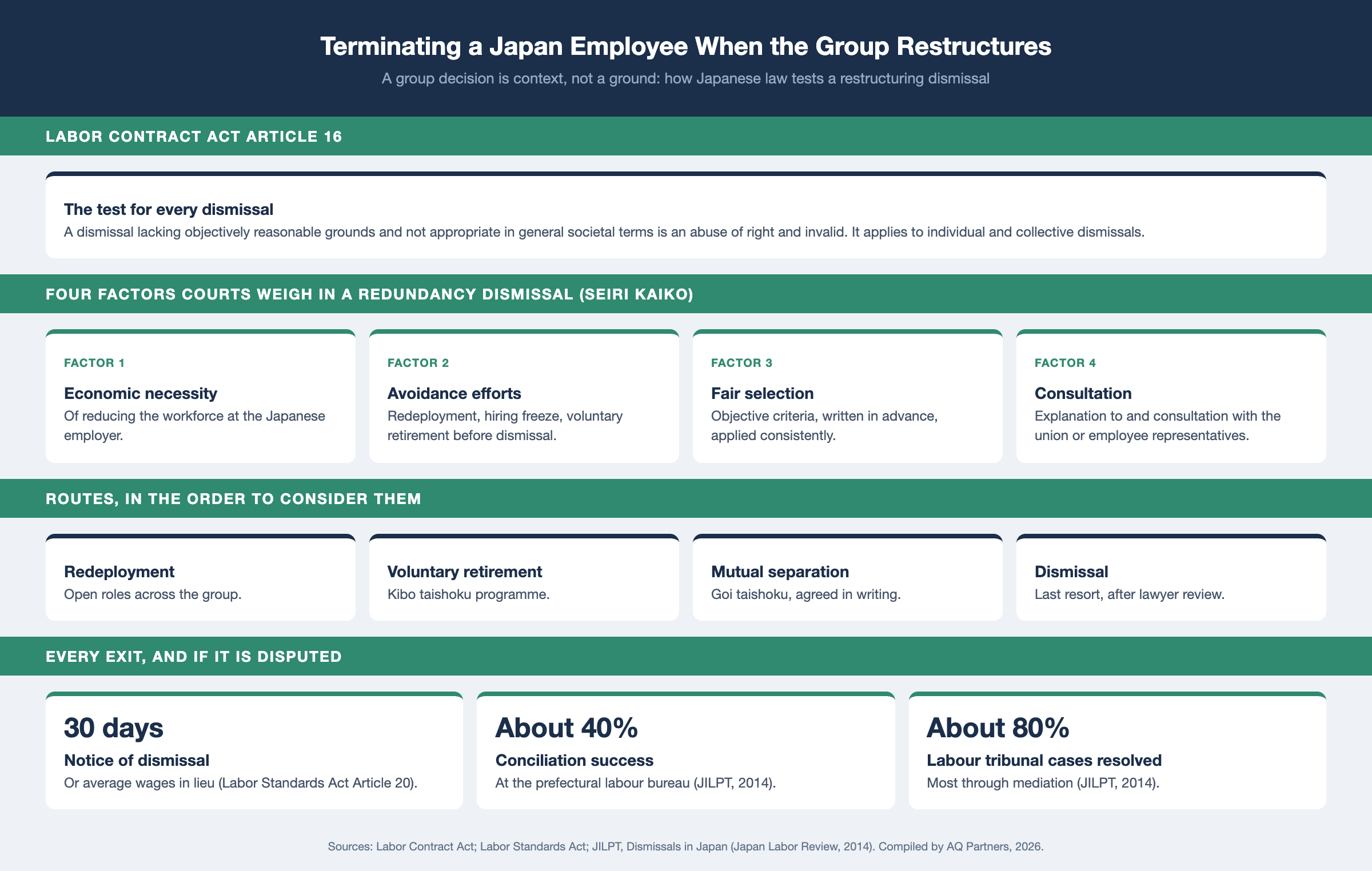
Japan's Civil Code still states that either party can end an indefinite employment contract with two weeks' notice, but that freedom has been heavily qualified. Article 16 of the Labor Contract Act provides that "a dismissal shall, if it lacks objectively reasonable grounds and is not considered to be appropriate in general societal terms, be treated as an abuse of right and be invalid." According to JILPT's Dismissals in Japan, published in Japan Labor Review in 2014, the rule codifies case law built up since the 1950s and endorsed by the Supreme Court between 1975 and 1977, and it applies to every kind of dismissal, individual or collective.
The practical consequence for a multinational is that the global restructuring memo, the board resolution at the parent, and the regional headcount target are context, not grounds. A Japanese court asks whether the Japanese employer, the KK or GK that holds the employment contract, had a reason that meets the Article 16 standard for this employee. The same JILPT paper notes that the OECD's 2013 Employment Outlook placed Japan in the less strictly regulated third of OECD countries for individual dismissal, which corrects the view that dismissal is impossible. The constraint is evidential: the employer must be able to show its reasoning.
How Japanese Courts Test a Redundancy Dismissal
Japanese courts weigh four factors in a redundancy dismissal (整理解雇, seiri kaiko): necessity, avoidance efforts, selection, and consultation.
The Labor Contract Act contains no specific procedure for collective dismissals, so the courts have filled the gap. Since the late 1970s, according to the JILPT paper, courts have weighed four factors in deciding whether an economic dismissal is abusive: the economic necessity of reducing the workforce; the efforts made to avoid dismissal in achieving the reduction; whether the employees to be dismissed were selected fairly on objective criteria; and the extent and manner of consultation with the union or employee representatives. A detailed explanation of each factor, with the case law, is in the guide to employee termination and dismissal rules in Japan.
For a group restructuring, two of the four factors need particular attention. Economic necessity is assessed for the Japanese employer, so a subsidiary that is profitable while the group cuts costs elsewhere has a harder case than one whose Japan business is closing. Avoidance efforts are where a multinational is often weakest on paper, because the group has options a standalone Japanese company does not: open roles in other group companies, a hiring freeze, reduced overtime, or voluntary retirement. If those options existed and were not offered, a court can treat the dismissal as avoidable. An employment lawyer in Japan should review the plan before any individual is notified.
What Headquarters Should Do in Japan Before Choosing Dismissal
Before any dismissal in Japan, the group should document the local business reason, offer alternatives, and consult employees on the record.
A global reduction in force can run from a central decision to individual notifications on a fixed communication date. In Japan the same steps need local evidence behind them, and the order often changes, because consultation and alternatives come before any selection is final. The table below maps a typical group playbook to what the Japanese subsidiary needs at each step.
| Group playbook step | What changes for the Japan subsidiary | Evidence to keep |
|---|---|---|
| Central restructuring decision | State the business reason for the Japanese employer specifically, not only for the group | Japan financials, the role changes, and the local rationale |
| Headcount target by country | Treat the number as a target to be tested against alternatives, not a fixed outcome | Record of how the Japan number was derived |
| Role mapping and selection | Use objective criteria written down in advance and applied consistently | Selection criteria and how each was scored |
| Redeployment search | Look across the group, including roles outside Japan where the employee could realistically move | Roles considered and offers made |
| Voluntary programme | Offer voluntary retirement (希望退職, kibo taishoku) before any dismissal where possible | Programme terms and take-up |
| Employee communication | Explain and consult with the union or employee representatives before final decisions | Meeting dates, materials, and questions answered |
| Individual notification | Discuss mutual separation first; dismissal only as a last resort with lawyer review | Written separation agreement or dismissal notice |
| Exit administration | Notice or pay in lieu, certificate of reasons on request, insurance loss filings | Notices, certificates, and filing receipts |
Where the subsidiary has rules of employment, the grounds for dismissal they list also matter. JILPT notes that courts start by asking whether the reason falls within the grounds set out in the rules of employment. The clause-by-clause approach is covered in localizing group employment policies for Japan.
Mutual Separation: The Agreed Route Out of a Japan Restructuring
Mutual separation (合意退職, goi taishoku) ends a Japan employment by agreement, on negotiated terms, recorded in a written agreement.
A mutual separation is not a dismissal. The employee agrees to end employment, so the Article 16 test does not apply in the same way, provided the agreement is genuinely voluntary. Japanese law does not require severance pay. The JILPT paper notes, however, that firms commonly pay retirement benefits even on discharge, and that when they solicit voluntary retirement to reduce the workforce they usually offer a considerable severance payment on top. Retirement allowance plans and their tax treatment are explained in severance pay and retirement allowances in Japan.
Three points decide whether a mutual separation holds up. The employee must be free to decline without being pressured, because a resignation obtained through repeated or coercive meetings may be challenged. The agreement should set out the separation date, the payments, the treatment of unused paid leave, and a waiver and confidentiality clause, drafted in Japanese with an English version for headquarters. And the classification of the separation reason can affect the employee's unemployment benefits under employment insurance, so it should be agreed with the employee and recorded accurately. The terms themselves are a matter for the employer and its employment lawyer.
Notice, Certificates, and the Filings After Any Separation in Japan
Every dismissal in Japan needs 30 days' notice or pay in lieu, and every separation, agreed or not, triggers insurance and payroll filings.
Under Article 20 of the Labor Standards Act, an employer that dismisses a worker must give at least 30 days' advance notice or pay average wages for at least 30 days instead (解雇予告手当, kaiko yokoku teate), with narrow exceptions. Notice does not make an invalid dismissal valid; it is a separate requirement. Under Article 22 of the same Act, a departing employee can request a certificate stating the reason for leaving, and the employer must issue it.
After the last working day, the separation is administered like any other exit: the final payroll, including any separation payment and unused leave if agreed; the loss of social insurance and employment insurance coverage; the separation certificate (離職票, rishokuhyo) the employee uses to claim unemployment benefits; and the residential tax and withholding adjustments. Preparing and submitting the social and labour insurance documents for the employer for a fee is reserved for a licensed sharoushi, so these filings run through the subsidiary's sharoushi.
If a Japan Separation Is Disputed: Conciliation, Labour Tribunal, and Court
A disputed Japan dismissal can move from labour bureau conciliation to the labour tribunal and, only if needed, to a civil court.
The JILPT paper describes four layers available to an employee who disputes a dismissal: information and consultation at the prefectural labour bureau, conciliation by a panel of lawyers and academics, the labour tribunal (労働審判, rodo shinpan) in the district court, and full civil litigation. Conciliation is free and quick, and the paper reports a success rate of about 40%. In the labour tribunal, about 80% of disputes are resolved, roughly 70% through mediation and 10% through decisions, and only about 10% move on to formal litigation. A civil case takes about a year on average.
The stakes of the last layer are the reason headquarters should invest in the process up front. If a court finds a dismissal abusive, it confirms that employment continues and orders the employer to pay the wages the employee would have earned from the dismissal date to the judgment. That is costly for a group that has eliminated the role, which is why a Japan restructuring is safer when it is designed around consultation and agreement rather than unilateral dismissal.
Frequently Asked Questions
Can a Japan subsidiary dismiss an employee because the parent has announced a global reduction in force?
Not on that basis alone. Article 16 of the Labor Contract Act requires objectively reasonable grounds and social appropriateness for the dismissal by the Japanese employer. For a redundancy, courts weigh the economic necessity of the Japan reduction, efforts to avoid dismissal, fair selection, and consultation. The group announcement is context, not a ground.
Is severance pay mandatory in Japan?
No statute requires severance pay. According to the same JILPT paper, employers commonly pay retirement benefits under their own rules, and when they solicit voluntary retirement to reduce the workforce they usually offer an additional payment, which is negotiated as part of a mutual separation agreement. Statutory notice of 30 days, or average wages in lieu, applies to any dismissal.
Who should be involved in a Japan restructuring?
Group HR and legal set the plan, an employment lawyer in Japan reviews it before employees are approached, and the subsidiary's sharoushi handles the social and labour insurance filings after each separation.
Working with AQ Partners. Our Tokyo team provides rules of employment, employment contracts and offer letters, monthly payroll coordination with a licensed sharoushi and employee life-cycle filings for foreign companies operating in Japan, so the employment documents and payroll behind any decision are in order. Book a consultation to discuss your situation.

Yuga Koda is a founding Director at AQ Partners, supporting foreign companies, funds, and families operating in Japan. His experience operating companies in both Japan and international markets gives him a practical understanding of back office operations from both sides.